

aba clinical data collection is the disciplined process of recording observable behavior or learning outcomes in a clinical service setting. The phrase sounds technical, but the core questions are practical: What is the target? What counts as one response? When does observation start and stop? Which measure does the written program require? This guide uses original examples to show how an RBT can collect useful data without turning a record into an unsupported diagnosis or treatment decision.
Table of Contents
- aba clinical data collection: from definition to record
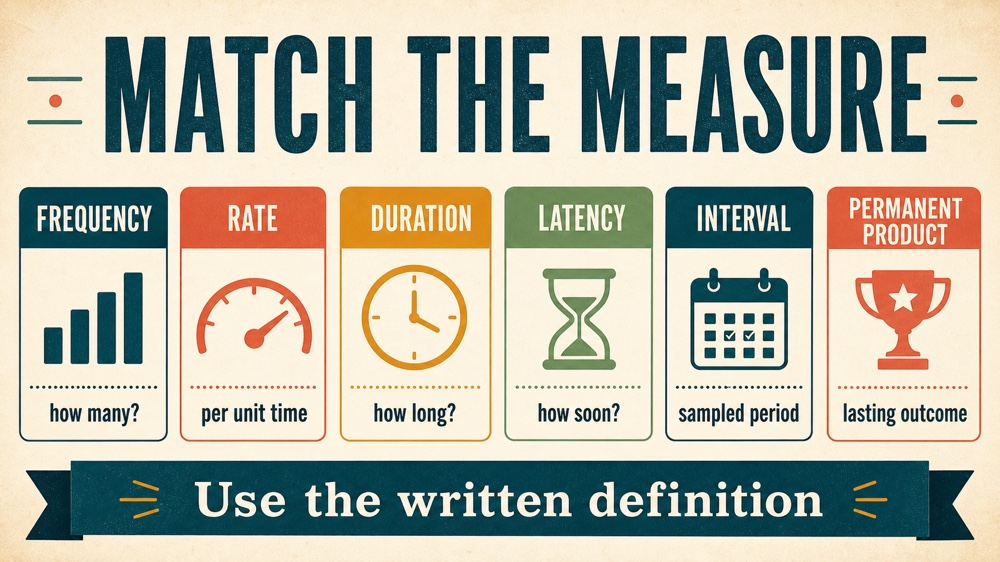
- Common measures in clinical data collection
- How to write a clinically useful example
- A practical session workflow
- Data quality and interobserver agreement
- Common errors to prevent
- RBT role in clinical data collection
- Frequently Asked Questions
- References
Quick answer: Start with the operational definition and authorized data sheet. Match the measure to the question: frequency or rate for counts, duration for persistence, latency for response initiation, interval procedures for defined samples, and permanent product for a lasting outcome. Record prompts, errors, opportunities, and unusual conditions when the program requires them.
Study boundary: This is independent exam-preparation content, not an official BACB handbook, certification decision, task answer key, or application determination. The examples in this article are newly written for study. They are not official, recalled, leaked, or BACB-endorsed exam questions. Requirements and policies can change, so use the current BACB handbook and your supervisor or requirements coordinator for decisions about an individual application or client program.
aba clinical data collection: from definition to record
Clinical data are only as useful as the behavior definition and measurement rule behind them. “Noncompliance” may be too broad to score consistently, while “after the instruction, the learner pushes the worksheet more than 10 centimeters away and turns away for at least 3 seconds” gives an observer a clearer target. The final operational definition must come from the responsible clinical team; an RBT should not rewrite it for convenience.
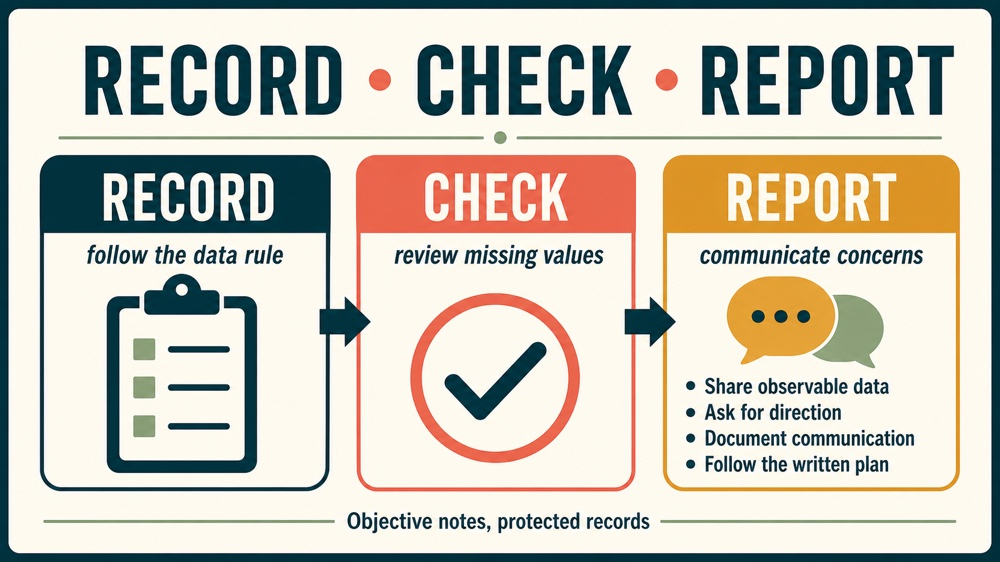
Before a session, confirm the target, unit, observation window, materials, prompt codes, and how missing or unsafe observations are handled. During the session, record as close to the event as the approved system allows. After the session, check for impossible values, missing fields, and a mismatch between the data sheet and the written procedure.
Common measures in clinical data collection
| Question | Possible measure | Example of the unit |
|---|---|---|
| How many? | Frequency | Defined responses per session. |
| How many per minute? | Rate | Responses divided by observation time. |
| How long? | Duration | Seconds from onset to offset. |
| How soon after the cue? | Latency | Seconds from instruction to response onset. |
| Did it occur under the interval rule? | Interval recording | Marked or unmarked defined intervals. |
| What outcome remains? | Permanent product | Correctly completed or assembled products. |
How to write a clinically useful example
A good scenario states the definition, the opportunity, the measure, and the boundary. It does not assume that a single observation explains why behavior occurred. It also distinguishes a direct observation from a later interpretation.
For example: The program defines an independent request as handing over a break card within 10 seconds of the stated opportunity without a prompt. During five opportunities, the learner makes three independent requests and two prompted requests. Record the categories the plan specifies; do not report five independent requests simply because all five led to a break.
A practical session workflow
- Prepare: Open the authorized form, timer, materials, and prompt code legend.
- Define: Read the target behavior, examples, nonexamples, onset, and offset.
- Observe: Deliver the programmed opportunity or follow the naturalistic procedure as trained.
- Record: Enter the response, prompt, timing, opportunity, or interval mark using the written rule.
- Check: Review totals, denominators, missing fields, and unusual conditions.
- Communicate: Report safety events, ambiguous definitions, data-system errors, or barriers through the approved route.
Data quality and interobserver agreement
Consistency can be checked through training, procedural-fidelity checks, and, when the plan calls for it, interobserver agreement (IOA). IOA is not a magic number and it does not prove that a definition is clinically correct. It shows how similarly observers scored the same events under a stated calculation. Follow the team’s training and calculation method; do not invent an IOA formula in the middle of a session.
For example: Two trained observers independently count 12 defined responses during the same observation. If the plan uses a specific total-count agreement formula, use that formula and document the observation conditions. If one observer used a different onset rule, discuss the procedural mismatch before comparing the percentages.
Common errors to prevent
- Counting words instead of defined response units.
- Comparing raw counts from observation windows of different lengths without using the plan’s denominator.
- Marking a prompted response as independent.
- Filling a missing value from memory without following the correction policy.
- Writing an inferred motive or function as if it were directly observed.
- Sharing identifiable clinical information outside the approved system.
RBT role in clinical data collection
An RBT can implement the authorized data procedure, record observations, support graphing or data entry when trained, and communicate data-quality concerns. Selecting a new measure, interpreting a pattern as a function, diagnosing a condition, or changing the intervention requires appropriate supervisor or qualified-professional direction.
Clinical usefulness does not mean making the record sound more certain than the observation. Objective notes describe what happened, what was measured, what assistance was provided, and what communication occurred. They leave clinical conclusions to the responsible team.
Current exam frame: The current RBT Test Content Outline (3rd ed.) applies beginning January 1, 2026. It describes 43 tasks across six content domains. The current examination format is 75 scored questions plus 10 unscored pilot questions, four answer choices per item, and a 90-minute testing period. These facts explain the study frame; they do not turn an independent guide into an official BACB resource.
For study, take one scenario and underline the target, unit, observation window, and scoring rule before choosing the measure. That habit connects measurement questions to the current outline without presenting an independent article as BACB guidance.
Practice clinical measurement decisions
Use independent RBT-style scenarios to rehearse data-collection choices, then verify procedures in your current training and official sources.
Review the RBT resource →
Frequently Asked Questions
What is aba clinical data collection?
It is structured recording of observable behavior, learning, or outcomes in a clinical service context using a defined procedure.
Who chooses the measurement procedure?
The responsible clinical team selects and defines the procedure. An RBT implements the written method and asks for direction before changing it.
Does clinical data prove a diagnosis or function?
No. Data describe observations and patterns. Diagnosis, functional interpretation, and plan changes require qualified-professional direction.
What should I do when the definition is unclear?
Follow the approved safety and communication route, document the concern, and ask the supervisor before improvising a new scoring rule.
Are these official BACB questions?
No. The scenarios are newly written independent study examples and are not official, recalled, leaked, or BACB-endorsed exam questions.