

ABA data are structured records of observable events collected according to a defined measurement system.
Table of Contents
- What ABA data means
- Start with the target and definition
- Choose the stated measurement
- Record the opportunity and response
- Write objective notes
- Protect data quality
- Use data review appropriately
- RBT role boundaries
- ABA data checklist
- Frequently asked questions
- References
ABA CONCEPTS · RBT DATA GUIDE
ABA Data: What RBTs Should Record and Review
A practical guide to definitions, opportunities, measurement, objective notes, and supervision boundaries.
ABA data are structured records of observable events collected according to a defined measurement system. For an RBT, accurate data begin with knowing the target response, the opportunity or observation period, the start and stop rules, and what to do when an event is unclear. Data are not guesses about a learner’s personality, motivation, or intentions.
A data sheet is also not a replacement for a treatment plan or supervision. The RBT follows the current authorized procedure, records what occurred, reports relevant questions, and avoids changing definitions or measures independently. Good data make later review more useful because the record separates observation from interpretation.
What ABA data means
In applied behavior analysis, data help a team describe behavior and evaluate change over time. The appropriate measure depends on the target and the program. A team may track frequency, rate, duration, latency, interval recording, percentage of opportunities, independent versus prompted responses, or a permanent product.
There is no single “best” measure for every behavior. Frequency may be useful for countable responses, duration for how long an event lasts, latency for time before a response begins, and percentage for opportunities with a defined denominator. Use the measure specified in the current plan instead of choosing the easiest option.
Start with the target and definition
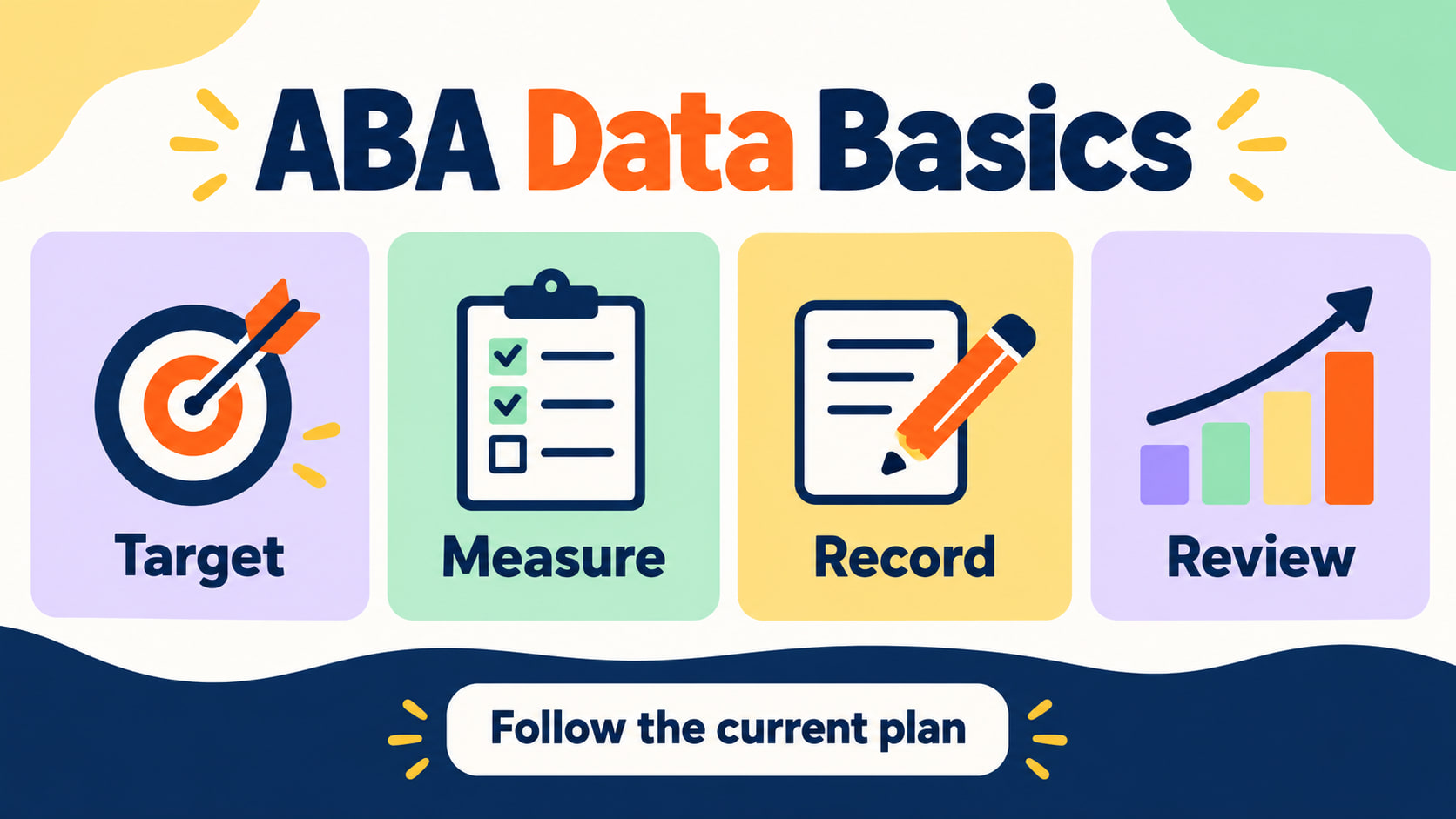
Before collecting data, locate the operational definition. It should describe what counts and what does not count in observable terms. “Noncompliance” or “was upset” may be too broad by themselves; the plan should identify the response, context, and measurement rule that make the observation consistent.
Check whether the target is a behavior to increase, decrease, maintain, or generalize. Then identify the opportunity, instruction, materials, response window, prompt level, consequence, and safety direction that apply. If a definition conflicts with what you were trained to use, do not silently choose one. Ask the supervisor which current instruction governs.
Choose the stated measurement
Frequency is the number of responses during a defined period. Rate incorporates time, which helps compare observations of different lengths. Duration measures how long a response lasts. Latency measures the time between an antecedent and the beginning of the response. Interval systems record whether a response occurred during specified intervals, using the rule stated by the plan.
Percentage of opportunities requires a clear numerator and denominator. If a learner responds independently on three of five defined opportunities, the record is not the same as three responses in an undefined session. Prompted and independent responses may also need separate categories. Follow the definitions and decision rules provided by the supervising professional.
Do not switch from one measure to another because the resulting number looks better. A change in measurement can look like a change in behavior. If the current system seems impractical or ambiguous, document the issue and ask for direction before altering it.
Record the opportunity and response
Good ABA data preserve the context needed to interpret a response. Record the opportunity, the target response, the prompt or assistance delivered, the programmed consequence, and the outcome required by the data system. Timing matters: a prompt delivered before the planned wait interval may change whether the response is independent.
Use the plan’s start and stop rules. If an opportunity was missed, a material was unavailable, or a device failed, record the event according to workplace policy. Do not invent a value, fill a gap from memory, or copy the previous trial simply to make a sheet appear complete.
When the response does not fit a category, preserve the observable facts and ask a specific question. “The learner touched the card after the partial verbal cue; I am unsure whether this meets the plan’s independent-response definition” is more useful than “the learner did it wrong.”
Write objective notes
Data and session notes serve related but different functions. A data field may contain a count or category, while a note can explain a relevant context, implementation issue, safety event, or communication. Notes should remain objective, timely, and limited to information needed for service and supervision.
Prefer observable language. Write “the learner pushed the materials away and the trial ended according to the procedure” rather than “the learner was defiant.” If you have a hypothesis, label it as a question or observation for supervision rather than presenting it as a fact.
Protect privacy in every system. Use approved devices and recipients, verify where notes are stored, and do not discuss identifiable client details in public, personal social media, or unauthorized messaging. Accurate documentation includes secure handling of the record.
Protect data quality
Data quality can be affected by unclear definitions, inconsistent timing, missing opportunities, distractions, device problems, or changes in implementer behavior. Prepare materials, review the current procedure, and ask questions before the session when possible. If a correction is needed, use the approved correction process instead of deleting or disguising the original record.
Consistency does not mean pretending that every session was identical. Record relevant changes such as a new setting, altered materials, an unusual schedule, or a safety event when the plan or policy requires it. Report errors promptly so the supervising team can decide whether data need context, correction, or a new review.
Use data review appropriately
An RBT can organize records, notice patterns, and communicate objective observations. Interpretation, treatment decisions, changes to mastery criteria, and changes to intervention belong to the authorized supervising team. Do not announce that an intervention “worked” or “failed” from one unusual trial.
When sharing a question, include the date or session, the defined target, what was observed, what was recorded, and what decision needs clarification. This gives the supervisor useful information without turning the RBT’s note into an independent clinical conclusion.
RBT role boundaries
An RBT may implement trained procedures, collect data accurately, report observations, protect privacy, and receive feedback. An RBT should not independently rewrite a definition, choose a new measurement, change a consequence, alter a prompt hierarchy, diagnose a learner, or make a plan change because a graph looks unusual.
If the plan is unclear or seems unsafe, follow the designated escalation route. If a caregiver asks what the data “prove,” explain only what you are authorized to explain and route interpretation questions to the supervisor. Respectful communication keeps data useful and protects the learner’s dignity.
ABA data checklist
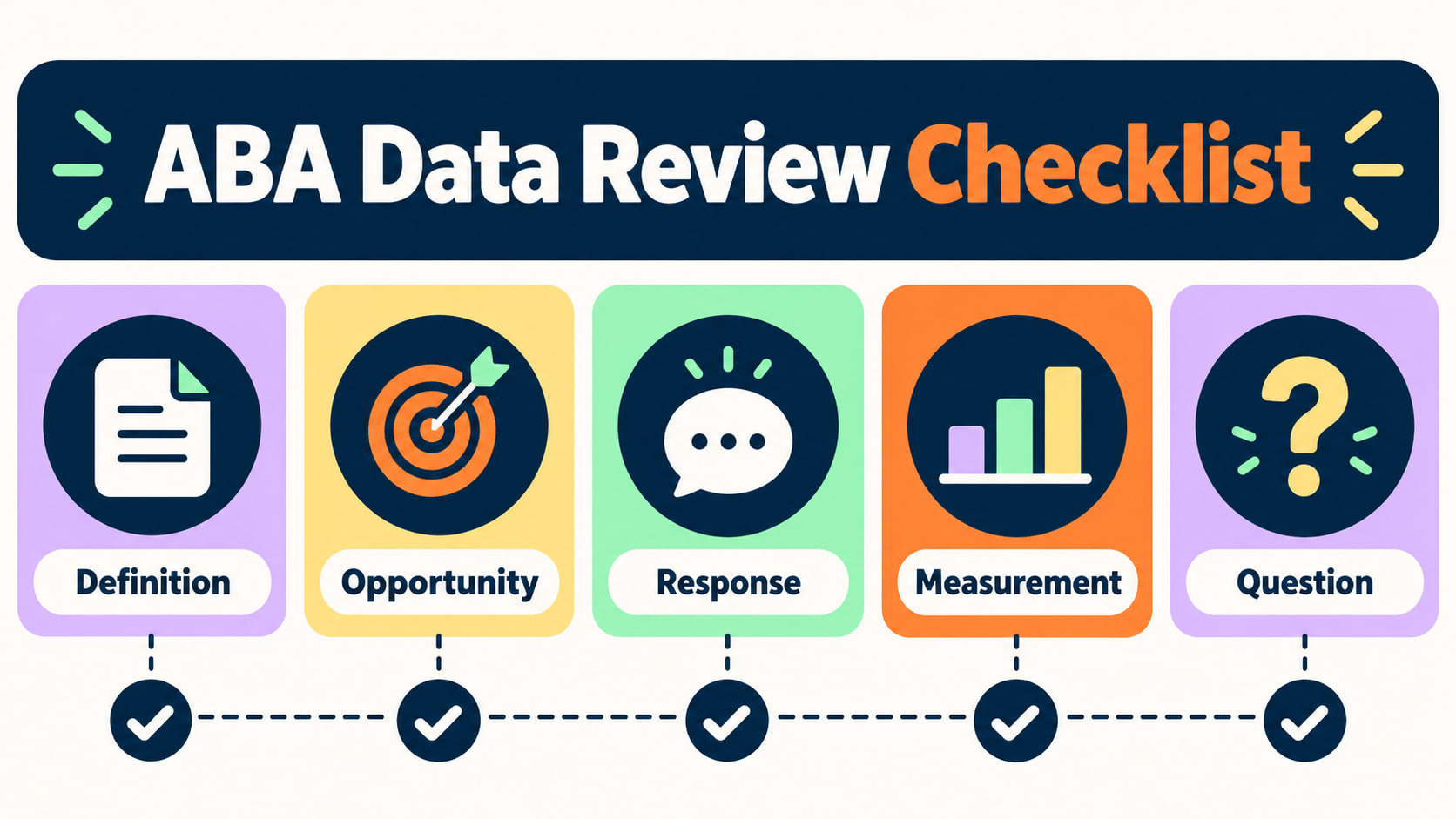
- Do I know the operational definition and nonexamples?
- Do I know the observation period, opportunity, and response window?
- Am I using the stated measurement system?
- Am I distinguishing independent and prompted responses when required?
- Am I recording missed opportunities and implementation issues honestly?
- Are my notes observable, timely, relevant, and private?
- Do I know which questions require supervisor direction?
Frequently asked questions
What should an RBT record?
Record the defined target response using the current measurement system, along with the opportunity, prompt level, consequence, or context that the plan requires.
Can an RBT change the data definition?
No. Bring an ambiguity or practical problem to the supervising professional and follow the approved correction or clarification process.
Is a session note the same as ABA data?
No. Data are structured measurements; a note provides relevant objective context. Both must follow the current plan, workplace policy, and privacy rules.
What if I miss an opportunity?
Do not invent a value. Record the event according to policy and report it if the issue affects interpretation or the data system.
Source note: Review the current BACB Handbook, RBT materials, learner plan, employer policy, and supervisor direction for your situation. This article is educational and does not provide individualized legal, clinical, employment, or credentialing advice.
Ready to practice the RBT concepts you just reviewed?
Try an independent, original RBT practice resource with exam-style questions, scoring, and answer explanations.
References
- Behavior Analyst Certification Board. RBT Test Content Outline, 3rd edition.
- Behavior Analyst Certification Board. RBT Handbook.
- Behavior Analyst Certification Board. RBT Ethics Code.