
ABA differential reinforcement means reinforcing one response or pattern while applying a planned rule to another response or pattern. For an RBT, the important questions are which rule the written program specifies, what data to record, and how to implement the procedure without independently changing the target or criterion.
Table of Contents
- ABA differential reinforcement: the short answer
- Map the four common arrangements
- DRA: reinforce an alternative response
- DRI: reinforce an incompatible response
- DRO: reinforce an absence interval
- DRL: reinforce a lower rate
- What an RBT records and does
- Implementation checklist
- Frequently asked questions
ABA reinforcement types, measurement, implementation, and RBT role boundaries
ABA Differential Reinforcement: Choose the Right Rule
Compare DRA, DRI, DRO, and DRL by the response being reinforced and the data rule in the plan.
ABA differential reinforcement means reinforcing one response or pattern while applying a planned rule to another response or pattern. The word “differential” points to the difference in the response or timing requirement. For an RBT, the key questions are which arrangement the written program specifies, what data to record, and how to implement the procedure without independently changing the target or criterion.
DRA, DRI, DRO, and DRL are useful study labels, but a label alone is not a treatment plan. The definition, interval, response requirement, reinforcer, prompt, safety procedure, and criterion come from the written program and supervisor direction. This article uses original educational examples and does not provide an individualized recommendation.
ABA differential reinforcement: the short answer
Ask what the plan is reinforcing:
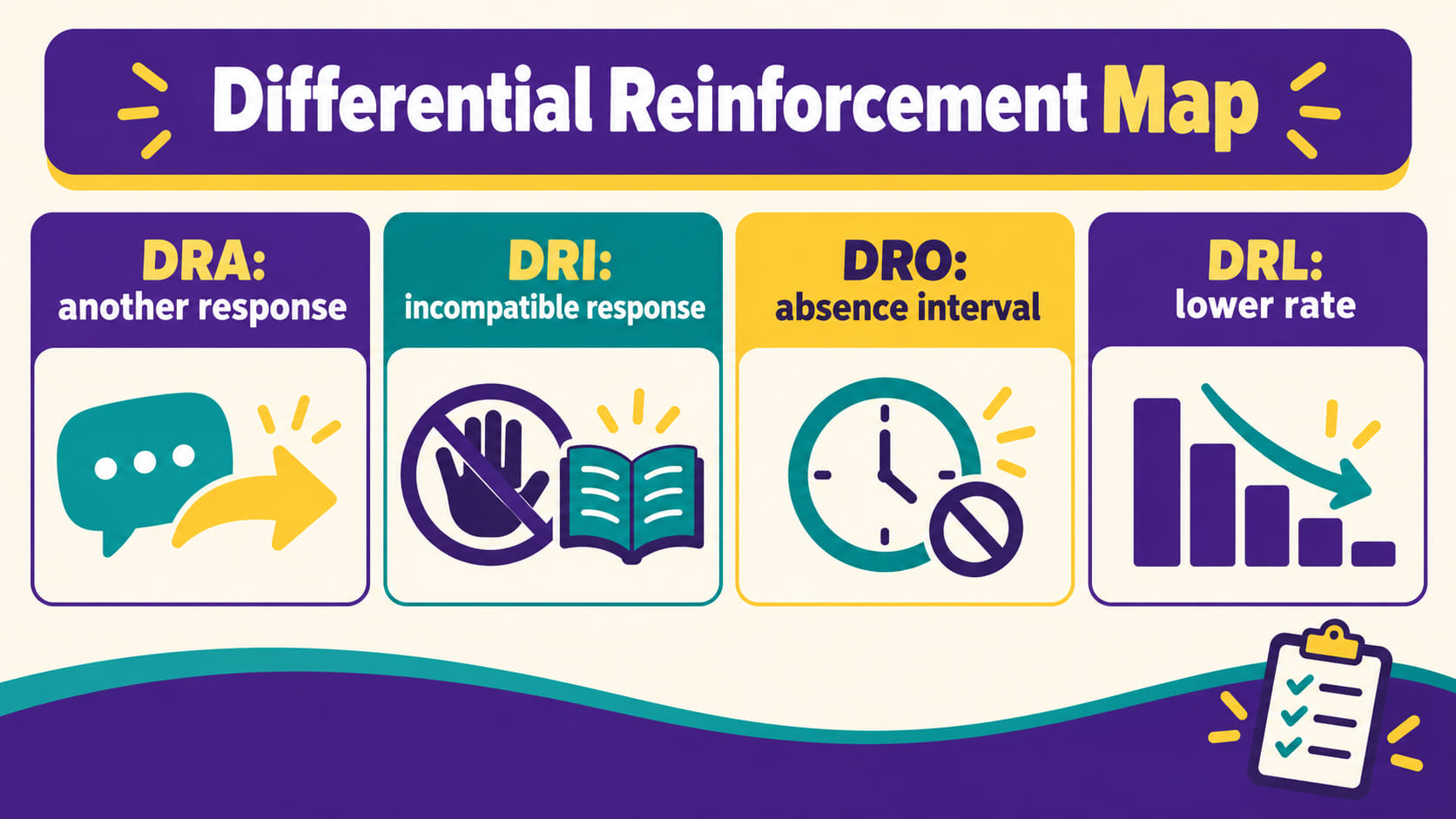
- DRA: a specific alternative response.
- DRI: a response that cannot occur at the same time as the target response.
- DRO: the absence of the defined target response for a specified interval or opportunity.
- DRL: a lower or limited rate of the target response, when the plan calls for reducing frequency rather than requiring zero.
The exact reinforcement contingency matters. “Give praise for good behavior” does not tell an RBT which response, what interval, what criterion, or what consequence the program requires. Implement the assigned contingency, collect the assigned data, and ask before changing it.
Map the four common arrangements
Use this comparison as a study map, not as permission to choose a procedure:
| Arrangement | What is reinforced? | What must be defined? |
|---|---|---|
| DRA | An alternative response | The alternative response, opportunity, prompt, and criterion |
| DRI | An incompatible response | Why the response cannot co-occur and how it will be measured |
| DRO | No target response during a defined interval | Target definition, interval, reset rule, and safety limits |
| DRL | A lower or limited target-response rate | Acceptable rate, observation period, and reinforcement rule |
DRA: reinforce an alternative response
In DRA, the program reinforces a defined response that serves as an alternative to the target response. For example, a plan may reinforce an appropriate request for help instead of a defined problem response. The RBT follows the plan for prompting, the opportunity, the response definition, and the reinforcer.
The alternative must be observable and practical. “Be calm” is not a useful recording rule unless the program defines what counts. “Use the help card within the opportunity” gives the RBT a response and an opportunity to measure. Do not invent the alternative response or promise that it meets the same need without supervisor direction.
DRI: reinforce an incompatible response
In DRI, the reinforced response cannot occur at the same time as the defined target response. The incompatibility must be real and clear in the program. A plan might reinforce hands placed on a designated activity when the target response is defined hand contact with another person, but the exact definitions and safety procedures control.
An RBT should not assume that a response is incompatible simply because it looks different. Ask how the plan defines co-occurrence, what prompt is allowed, and what data are required. Safety responses always take priority according to the current plan and organization procedure.
DRO: reinforce an absence interval
DRO reinforces the absence of a defined target response for a specified interval or opportunity. The interval could be fixed, variable, whole-session, or another arrangement in the plan. The RBT must know when the interval starts, what resets it, how the result is recorded, and what to do if the target occurs.
DRO does not mean “reinforce anything” or “ignore safety.” The target response must have a measurable definition, the interval must be feasible, and the plan must include the response to an occurrence. An RBT should not lengthen the interval because the learner is doing well or shorten it because collection is difficult without direction.
DRL: reinforce a lower rate
DRL is used when the goal is a lower or limited rate of a response, not necessarily zero responses. The plan defines the observation period, acceptable rate, and reinforcement rule. The response itself remains measurable, so the RBT must record it accurately rather than treating any occurrence as failure.
DRL can be misunderstood as permission to tolerate unsafe behavior. It is not. The written plan, risk assessment, supervisor direction, and urgent safety process control what happens. If the target response changes in severity or risk, report it rather than assuming the DRL criterion still fits.
What an RBT records and does
An RBT implements the assigned arrangement as trained. Record the opportunity, target or alternative response, prompt level, interval, count, duration, rate, or other measure the plan requires. Use objective language and include barriers such as a missing material, timer failure, interruption, or safety procedure according to policy.

Do not choose DRA, DRI, DRO, or DRL independently because an acronym seems to match the situation. Do not change the interval, response definition, reinforcer, prompt, or criterion to improve a graph. Bring the observation and data to supervision and request a program review.
Reinforcement must also follow the written plan. Do not provide a reinforcer for a response that does not meet the defined criterion, and do not withhold required communication, care, or safety support. If the contingency is unclear, pause and ask.
Implementation checklist
- The written plan identifies the differential-reinforcement arrangement.
- The target, alternative or incompatible response, interval, and criterion are observable.
- The RBT knows the prompt, reinforcer, data field, and safety steps.
- Opportunities and responses are recorded from direct observation.
- Missing data, interruptions, and deviations are documented honestly.
- The RBT does not change the arrangement, interval, criterion, or treatment independently.
- Unclear, unsafe, or out-of-scope requests are brought to supervision.
- Examples and records protect client privacy.
Frequently asked questions
What is ABA differential reinforcement?
It is a planned arrangement that reinforces one response or pattern while applying a defined rule to another response or pattern. The written program specifies the contingency.
What is the difference between DRA and DRI?
DRA reinforces an alternative response. DRI reinforces a response that cannot occur at the same time as the target response. The exact definitions and program rules control.
Does DRO mean the target response can never occur?
Not necessarily. DRO reinforces the absence of the defined target during a specified interval or opportunity. The plan defines the interval, reset, safety, and recording rules.
Can an RBT choose which differential-reinforcement procedure to use?
An RBT should implement the assigned procedure and ask the supervisor when the plan is unclear. Choosing or changing a treatment arrangement is not an independent RBT decision.
Role reminder: This article is educational content, not an individualized treatment plan, clinical recommendation, or substitute for the written program and supervisor direction.
Official starting points: the RBT Test Content Outline, the RBT Handbook, and the RBT Ethics Code (2.0).
Ready to practice the RBT concepts you just reviewed?
Try an independent, original RBT practice resource with exam-style questions, scoring, and answer explanations.
References
- Behavior Analyst Certification Board. RBT Test Content Outline, 3rd edition.
- Behavior Analyst Certification Board. RBT Handbook.
- Behavior Analyst Certification Board. RBT Ethics Code.