

ABA hierarchy can be a useful way to discuss levels of support, prompts, and movement toward more independent responding, but it is not a universal license to change a plan.
Table of Contents
- What ABA hierarchy can mean
- Think in levels of support
- Start with the approved plan
- Connect prompts to data
- Discuss fading carefully
- Document what happened
- Use a responsible workflow
- Frequently asked questions
- References
RBT KNOWLEDGE · SUPPORT LEVELS
ABA Hierarchy: Think in Levels of Support
Use hierarchy language to discuss prompts and support without changing an approved plan on your own.
ABA hierarchy can be a useful way to talk about levels of support, prompting, and movement toward more independent responding. The phrase is not a universal template, however. Different curricula and plans may define prompts, fading, mastery, and data rules differently.
Use the current approved plan, supervisor direction, employer procedures, and official sources for decisions in a real service setting. This article is educational. It does not authorize an RBT to alter a prompt plan, choose a treatment procedure, or make an independent clinical decision.
What ABA hierarchy can mean
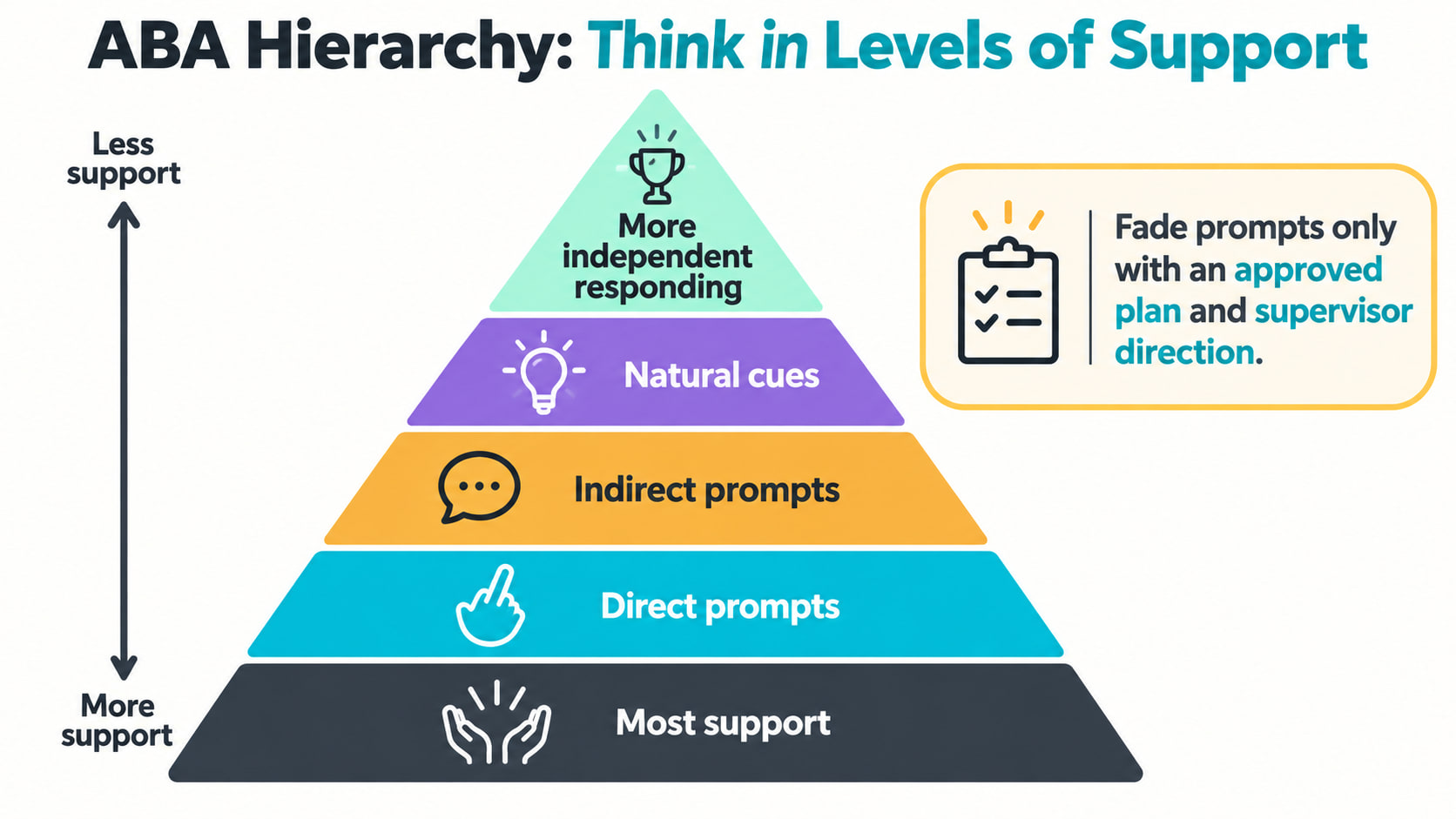
In learning conversations, hierarchy language often describes a progression from more support to less support. It may help a team discuss the cue, prompt, learner response, and next teaching question. A simple visual can make a complex idea easier to discuss, but the visual is only a teaching lens.
Do not assume that the highest or lowest level is always appropriate. The learner’s plan, skill definition, context, safety, communication needs, data, and supervisor direction matter. A prompt that appears “less intrusive” in a diagram may not be the correct prompt for a particular skill or moment.
Think in levels of support
A practical discussion can move from most supportive assistance toward more independent responding. The labels might include direct prompts, indirect prompts, natural cues, or other terms used by the approved program. Always use the definitions in the current plan and training materials.
For each level, ask what the learner sees or hears, what the technician does, what response is expected, and what consequence follows under the plan. This keeps the conversation observable. Avoid broad statements such as “the learner is independent” when the relevant behavior, cue, or prompt has not been defined.
Hierarchy language should also make room for a pause. If the learner is distressed, the materials are unavailable, the response is unsafe, or the plan is unclear, contact the responsible supervisor and follow applicable procedures. Progress toward less support is not a reason to ignore context.
Start with the approved plan
Before using a prompt or discussing fading, find the current goal, operational definition, prompting procedure, data rule, reinforcement arrangement, and correction procedure. Check the plan version or effective date. If two documents conflict, stop and ask which one is current.
Clarify who can change the procedure and how changes are communicated. An RBT can implement assigned procedures and report observations, while plan design and clinical decisions may belong to the responsible qualified professional. A diagram does not change those roles.
Ask the supervisor to define the prompt levels in plain language and provide examples relevant to the target skill. Repeat the direction in your own words and confirm that your understanding matches the plan before implementation.
Connect prompts to data
Data should distinguish the events that the plan asks you to distinguish. Depending on the system, this may include the cue, prompt used, learner response, latency, duration, accuracy, independence, or other defined measure. Do not invent a new data category because a hierarchy graphic suggests one.
Use objective language. Record what occurred, which approved prompt was used, how the learner responded, and what consequence or feedback was delivered under the plan. Avoid assuming why a response occurred unless that explanation is part of the approved documentation task.
If a prompt level is unclear, record the question and contact the supervisor. Do not silently reclassify data to make a trend look better. Follow the organization’s correction procedure if a record contains an error.
Discuss fading carefully
Prompt fading can be discussed as a way to support a learner’s responding with less assistance when the approved plan calls for it. The timing, sequence, criterion, and decision rule should come from the plan or supervisor direction. Do not remove a prompt simply because a learner succeeded once.
Ask what counts as mastery, how many opportunities or sessions are considered, what to do after an error, and when to return to a more supportive level. These questions make fading observable and prevent a visual hierarchy from being treated as a rigid staircase.
More independent responding is not the only relevant outcome. Generalization, maintenance, communication, dignity, safety, and functional participation may also matter. Use the goals and supervisor direction for the setting rather than selecting an outcome from a generic diagram.
Document what happened
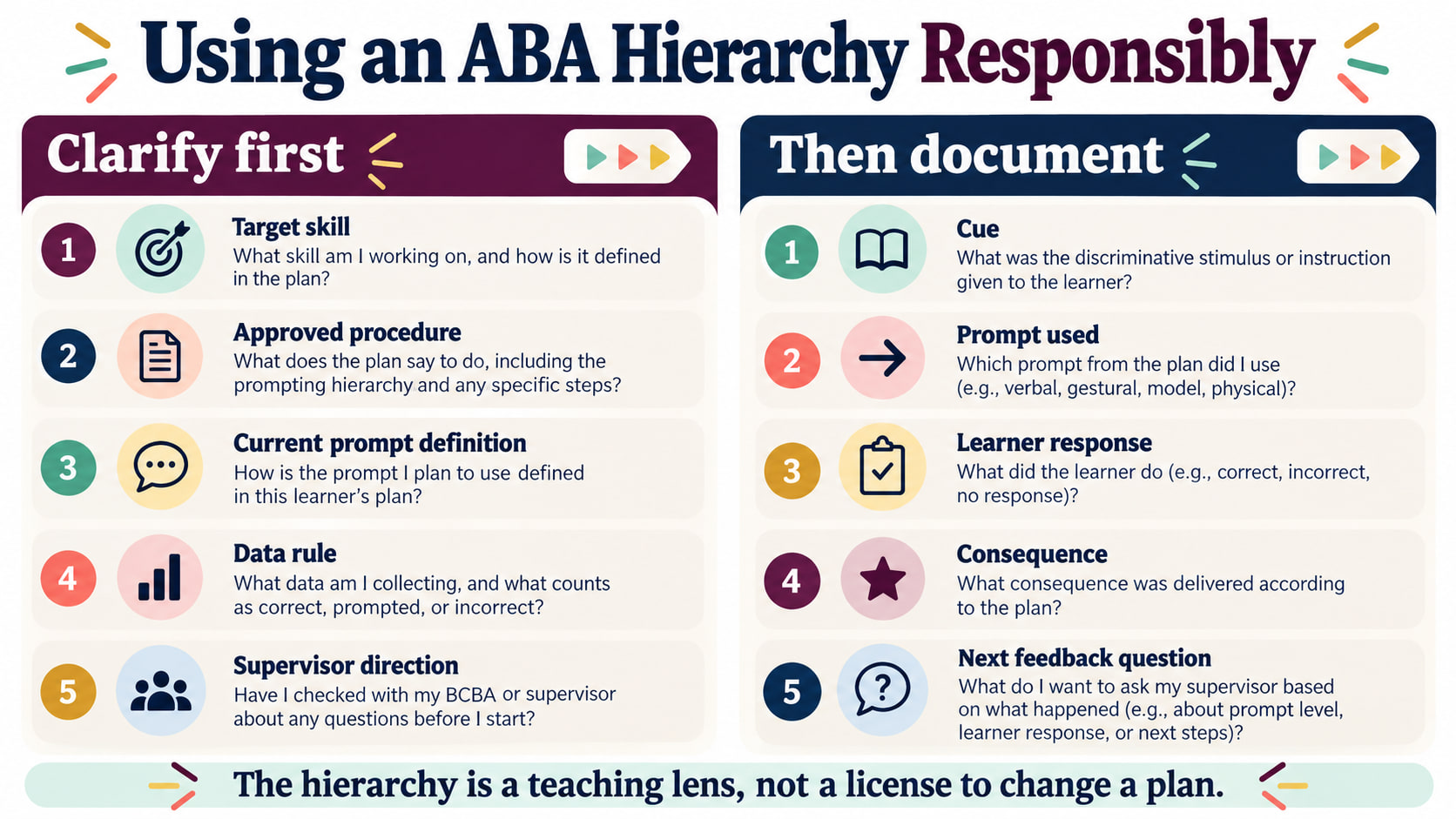
- Clarify the target: Write the skill and operational definition from the current plan.
- Confirm the cue: Note the instruction or condition presented.
- Record the prompt: Use the plan’s definition for the prompt level.
- Record the response: Describe what the learner did using observable language.
- Ask the next question: Note what you will review with the supervisor.
Protect privacy by using approved identifiers, systems, and storage. Do not place client information in a personal notes app, public discussion, or unapproved cloud file. Ask the organization how to correct, share, retain, and destroy records.
Use a responsible workflow
A simple workflow is: review the current plan, clarify the prompt definition, observe or implement as directed, record the defined data, communicate uncertainty, and revisit feedback. The workflow supports plan fidelity without pretending that every learner or skill follows one universal hierarchy.
Keep a question list for supervision. Useful questions include: Which prompt is approved? What is the fading criterion? Which data measure should I use? What should I do after an error? When should I pause? Who should receive the concern? What record proves that we reviewed it?
Different organizations may use different terminology, forms, and supervision arrangements. Adapt this educational outline to the approved workflow. If a diagram conflicts with current official guidance, the plan, or supervisor direction, stop and resolve the conflict instead of forcing the situation into the diagram.
Use hierarchy language to improve communication, not to create a private treatment plan. The most useful checklist records the source, the question, the observation, the feedback, the next action, and the date. That record helps the team revisit decisions accurately.
Before using a hierarchy graphic in training, verify its definitions and limitations. A concise visual can help a learner remember a conversation, but it should not be presented as an official form, a complete intervention protocol, or a substitute for supervision.
When the target skill, setting, learner communication, or plan changes, revisit the definitions. A prompt label that made sense in one context may not describe the same action in another. Ask for clarification before carrying a label across cases.
Frequently asked questions
Is there one universal ABA hierarchy?
No. Hierarchy language and prompt definitions can differ across curricula and plans. Use the current approved definitions.
Can an RBT use a hierarchy to change prompts?
Not independently. Follow the approved plan and supervisor direction, and ask before changing a prompt or fading procedure.
What should be recorded?
Record the defined cue, prompt, learner response, data, feedback, question, and next action using objective language and approved systems.
Does less support always mean better performance?
No. Context, communication, safety, generalization, maintenance, dignity, and the plan’s goals all matter.
Source note: Review the current BACB Handbook, RBT materials, employer requirements, applicable local rules, privacy policies, and supervisor direction for your situation. This article is educational and does not provide individualized legal, clinical, employment, or credentialing advice.
Ready to practice the RBT concepts you just reviewed?
Try an independent, original RBT practice resource with exam-style questions, scoring, and answer explanations.
References
- Behavior Analyst Certification Board. RBT Test Content Outline, 3rd edition.
- Behavior Analyst Certification Board. RBT Handbook.
- Behavior Analyst Certification Board. RBT Ethics Code.