
ABA positive reinforcement means a consequence follows a behavior and makes that behavior more likely in the future; the plan and data define how it is used.
Table of Contents
- ABA positive reinforcement: what it means
- The reinforcement sequence
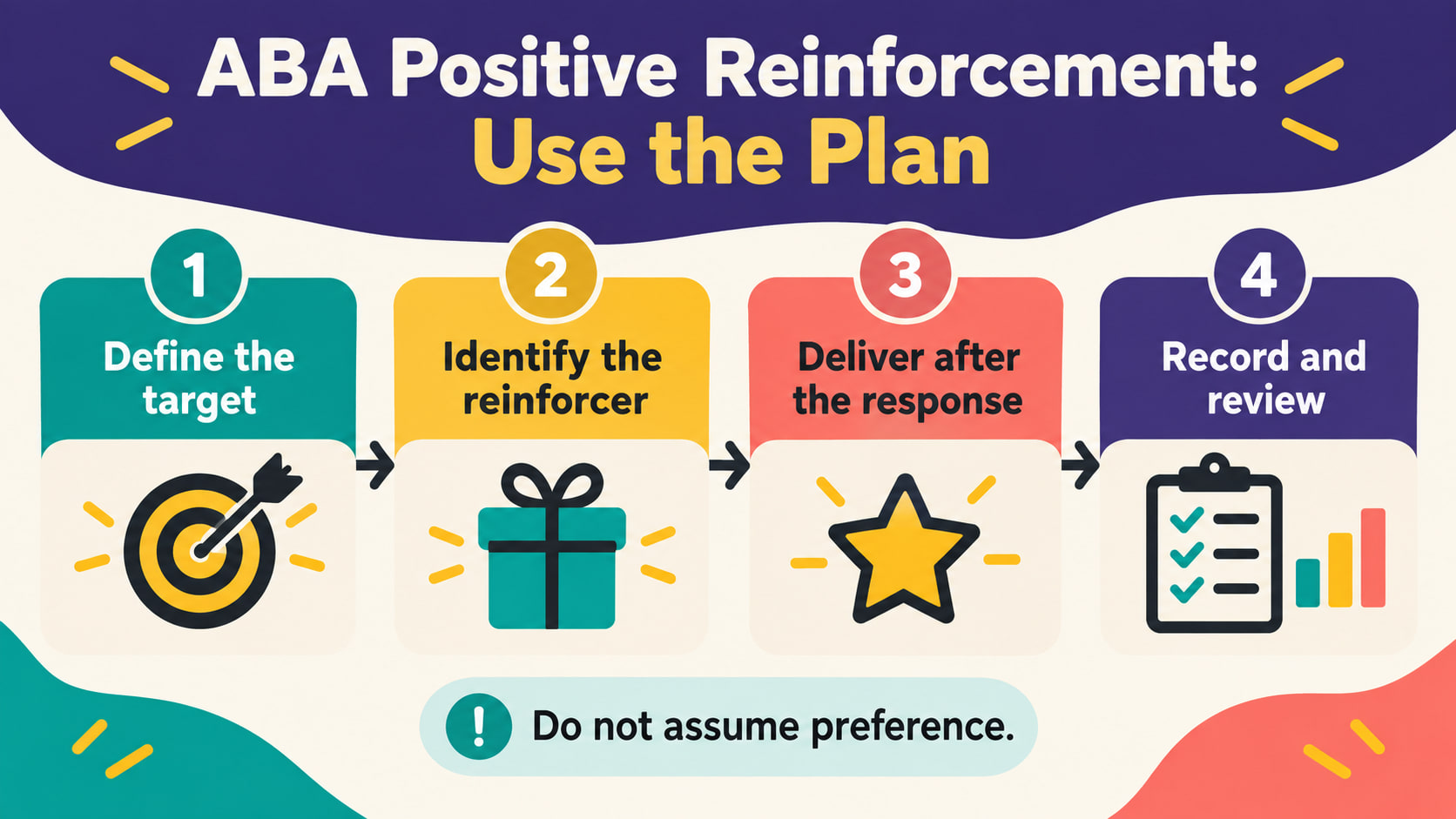
- Define the target behavior
- Identify a possible reinforcer
- Deliver the consequence after the response
- Record and review data
- Keep the RBT role and dignity clear
- Practice examples
- Frequently asked questions
- References
ABA KNOWLEDGE · RBT IMPLEMENTATION
ABA Positive Reinforcement: An RBT Guide
Define the target, deliver the planned consequence, and use data to check what changes.
ABA positive reinforcement means that a consequence follows a behavior and makes that behavior more likely in the future. “Positive” means something is added; “reinforcement” is demonstrated by a future increase in the behavior. It is not defined only by whether an item looks pleasant, whether an adult intended it as a reward, or whether the first response happened quickly.
In practice, the approved plan defines the target, opportunity, consequence, timing, data, and safety boundaries. An RBT implements that plan, observes what happens, records accurately, and brings questions to supervision. This guide does not authorize an RBT to select goals, guarantee outcomes, or change reinforcement procedures independently.
ABA positive reinforcement: what it means
Suppose a learner uses an approved communication response and then receives the planned access or social consequence. If that response becomes more likely in similar opportunities, the consequence may be functioning as reinforcement for that learner and context. If the response does not increase, the item may not be a reinforcer, the timing may differ, the response definition may be unclear, or other variables may matter.
Do not equate reinforcement with bribery. A bribe usually describes an improvised offer intended to obtain immediate compliance, while a reinforcement procedure is planned, observable, and reviewed through data. The distinction is not a license to force participation; dignity, choice, communication, safety, and consent-related procedures still matter.
Do not assume that a preferred item works for everyone or every skill. Preference can change with context, access, fatigue, schedule, culture, and the learner’s current interests. Use the approved preference and reinforcement process.
The reinforcement sequence
Positive reinforcement is easier to implement consistently when the sequence is visible:
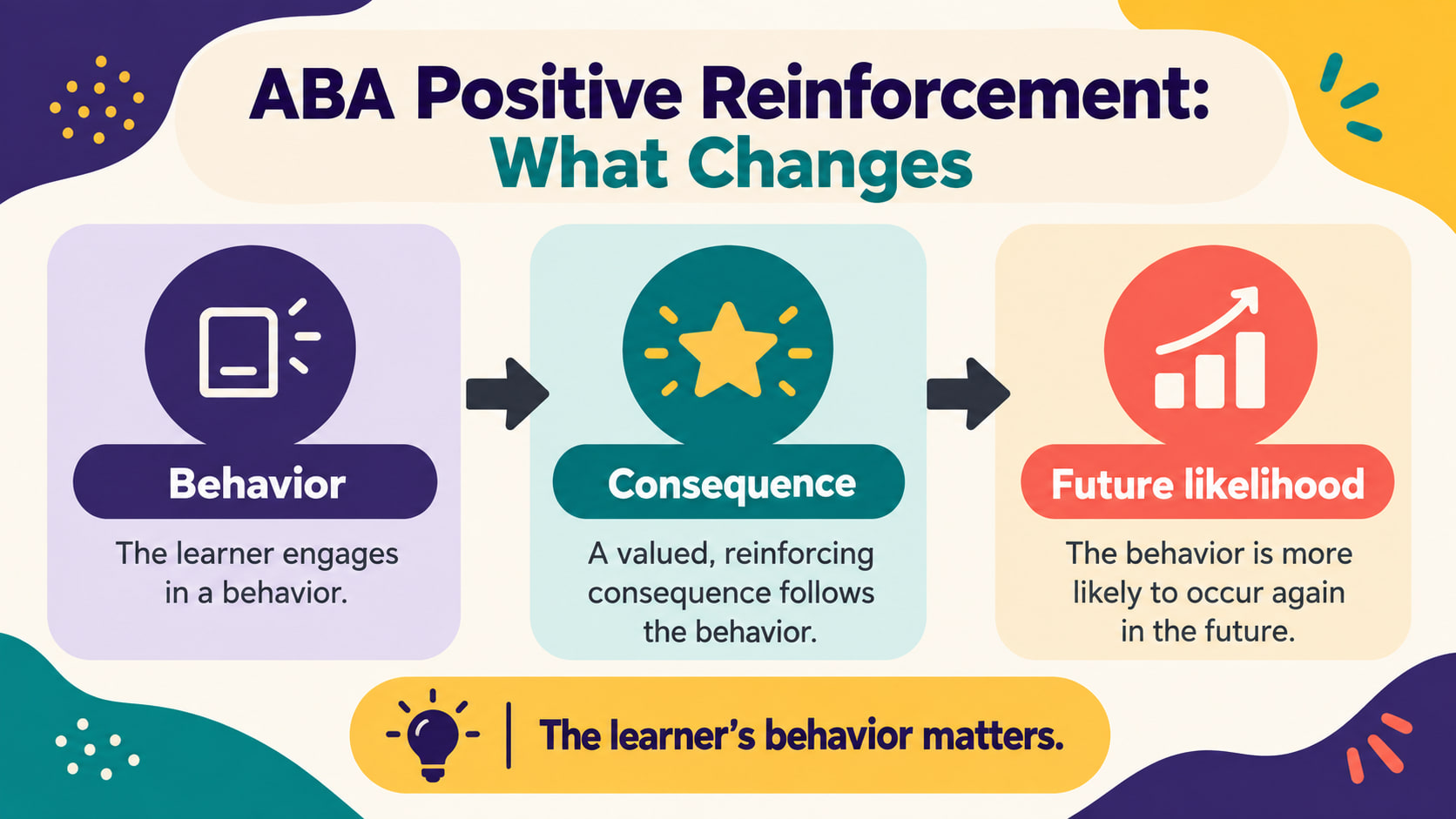
- Behavior: The learner performs the defined response in the relevant opportunity.
- Consequence: The planned reinforcer is delivered after the response, according to the current procedure.
- Future likelihood: Data show whether the response becomes more likely across opportunities or contexts.
Keep the order clear. Delivering the consequence before the target response may change its function, and delivering it after an unrelated response may reinforce the wrong behavior. If timing is difficult, record the facts and ask the supervisor how to practice.
Define the target behavior
A target should be observable and measurable. “Be cooperative” is too broad to tell a technician what response earns the consequence. “Places the requested item in the bin within 10 seconds of the instruction” is closer to a usable definition when the plan supports it.
Know what counts as an opportunity, a correct response, an approximation, an error, and a prompted response. Some plans reinforce a shaping step or a communication alternative; others require an independent response. Do not change the criterion because a different response feels close enough.
Consider quality as well as occurrence. A response should not be reinforced in a way that creates a safety problem, removes meaningful communication, or conflicts with the approved goal. Ask the supervisor when the target and the consequence do not appear aligned.
Identify a possible reinforcer
A reinforcer is defined by its effect on future behavior, not by its label. The plan may identify social interaction, a preferred activity, access to an item, a break, or another consequence. The technician follows the approved procedure and respects any restrictions, cultural considerations, health needs, and safety rules.
Never use food, personal contact, a client’s essential care, or access to a necessary item as an improvised reward. Do not remove communication or basic dignity to make a procedure more powerful. If the planned reinforcer is unavailable, contact the supervisor rather than substituting one without direction.
Observe the learner’s response without assuming preference. A person may reach for an item once and not want it later. Record the relevant behavior and context so the team can review whether the consequence is functioning as intended.
Deliver the consequence after the response
Timing affects what the learner experiences as connected. Follow the plan’s instructions for immediacy, duration, schedule, prompting, and fading. Keep language concise when extra attention could change the procedure. If a delay is unavoidable, record it and ask whether the trial should be interpreted differently.
Reinforcement does not mean giving unlimited access forever. The plan may specify a schedule, duration, token exchange, natural consequence, or gradual change. Do not thin, remove, or increase the schedule on your own. Changes should be based on authorized review and data.
Record and review data
Record the defined response, opportunity, prompt level if required, consequence delivered, and other fields in the approved system. Use objective language. “Independent request followed by 30 seconds of the planned activity” is more useful than “the reward worked.”
Look for change across enough opportunities to support review. One successful response does not prove reinforcement, mastery, or generalization. One missed response does not prove that the plan failed. Share patterns with the supervisor, including changes in setting, materials, timing, or learner preference.
When the response does not increase, do not blame the learner or improvise a stronger consequence. Check implementation fidelity, the definition, timing, data quality, and contextual variables with the supervisor. The authorized team decides whether the plan needs modification.
Keep the RBT role and dignity clear
RBTs implement approved reinforcement procedures, protect privacy and dignity, collect data, and communicate observations. They do not diagnose, select goals, promise behavior change, use essential care as leverage, or change the procedure because a quick result is desired.
Watch for signs that the plan is not fitting the learner or context. A learner may communicate refusal, discomfort, fatigue, or a need for a different support. Follow the approved response and safety procedure, record objective facts, and bring the concern to supervision. Reinforcement should support meaningful participation, not erase the learner’s voice.
Practice examples
- Requesting: The learner uses the planned request and receives the approved brief activity. The technician records the response and timing.
- Task completion: The learner completes the defined step and receives the scheduled consequence. The technician does not add an extra reward or change the criterion.
- Communication alternative: The learner uses the break response instead of the defined behavior of concern. The technician follows the approved break procedure and reports the pattern.
- Changing preference: The learner does not approach a previously preferred item. The technician records the observation and asks before substituting a new consequence.
Frequently asked questions
Is positive reinforcement the same as a reward?
Not exactly. Reinforcement is defined by an increase in future behavior. An item can be intended as a reward without functioning as reinforcement.
Can an RBT choose any preferred item?
No. Follow the approved plan, safety rules, preferences, restrictions, and supervision process. Do not improvise a consequence that could compromise dignity or care.
Does one response prove reinforcement worked?
No. Review data across opportunities and contexts. One response is evidence to record, not proof of a future pattern.
What if the planned reinforcer is unavailable?
Follow the contingency and contact the supervisor. Do not substitute, remove, or enlarge the consequence without direction.
Source note: Review the current BACB RBT Handbook, task list, ethics code, employer policy, and supervisor instructions. This article is educational and does not provide individualized legal, clinical, employment, or credentialing advice.
Ready to practice the RBT concepts you just reviewed?
Try an independent, original RBT practice resource with exam-style questions, scoring, and answer explanations.
References
- Behavior Analyst Certification Board. RBT Test Content Outline, 3rd edition.
- Behavior Analyst Certification Board. RBT Handbook.
- Behavior Analyst Certification Board. RBT Ethics Code.