
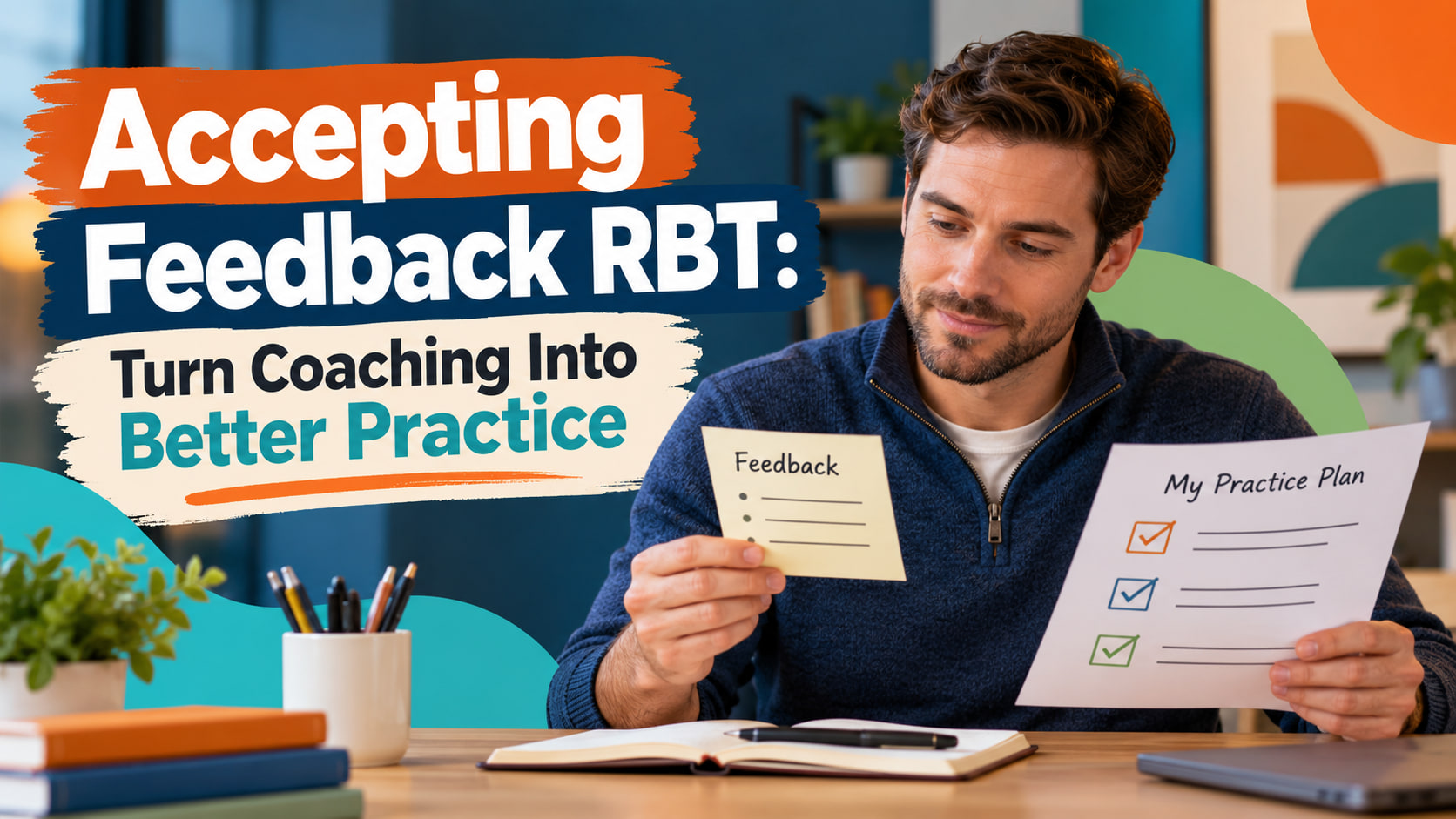
The phrase accepting feedback RBT points to a professional skill, not passive agreement or a judgment about your worth. Listen for the observable action, ask a focused question, practice the correction, and review the next result. Feedback works best when it stays connected to the current plan, competence, supervision, documentation, privacy, and learner support.
Table of Contents
- Accepting feedback RBT: the short answer
- Listen for the observable action
- Ask a useful clarifying question
- Practice the correction
- Keep feedback and scope connected
- Document learning and review the result
- Frequently asked questions
Accepting feedback as an RBT, supervision, observable coaching, practice, documentation, and professional growth
Accepting Feedback RBT: Turn Coaching Into Better Practice
Use supervision feedback as a concrete practice loop while keeping the plan, scope, privacy, and safety boundaries clear.
The phrase accepting feedback RBT points to a professional skill, not passive agreement or a judgment about your worth. Listen for the observable action, ask a focused question, practice the correction, and review the next result. Feedback works best when it stays connected to the current plan, competence, supervision, documentation, privacy, and learner support.
Feedback also has limits. Accepting coaching does not mean following an unsafe instruction, ignoring an ethical concern, disclosing private information, or silently changing a treatment procedure. If feedback conflicts with the written plan or creates a safety concern, pause and use the appropriate escalation route.
Accepting feedback RBT: the short answer
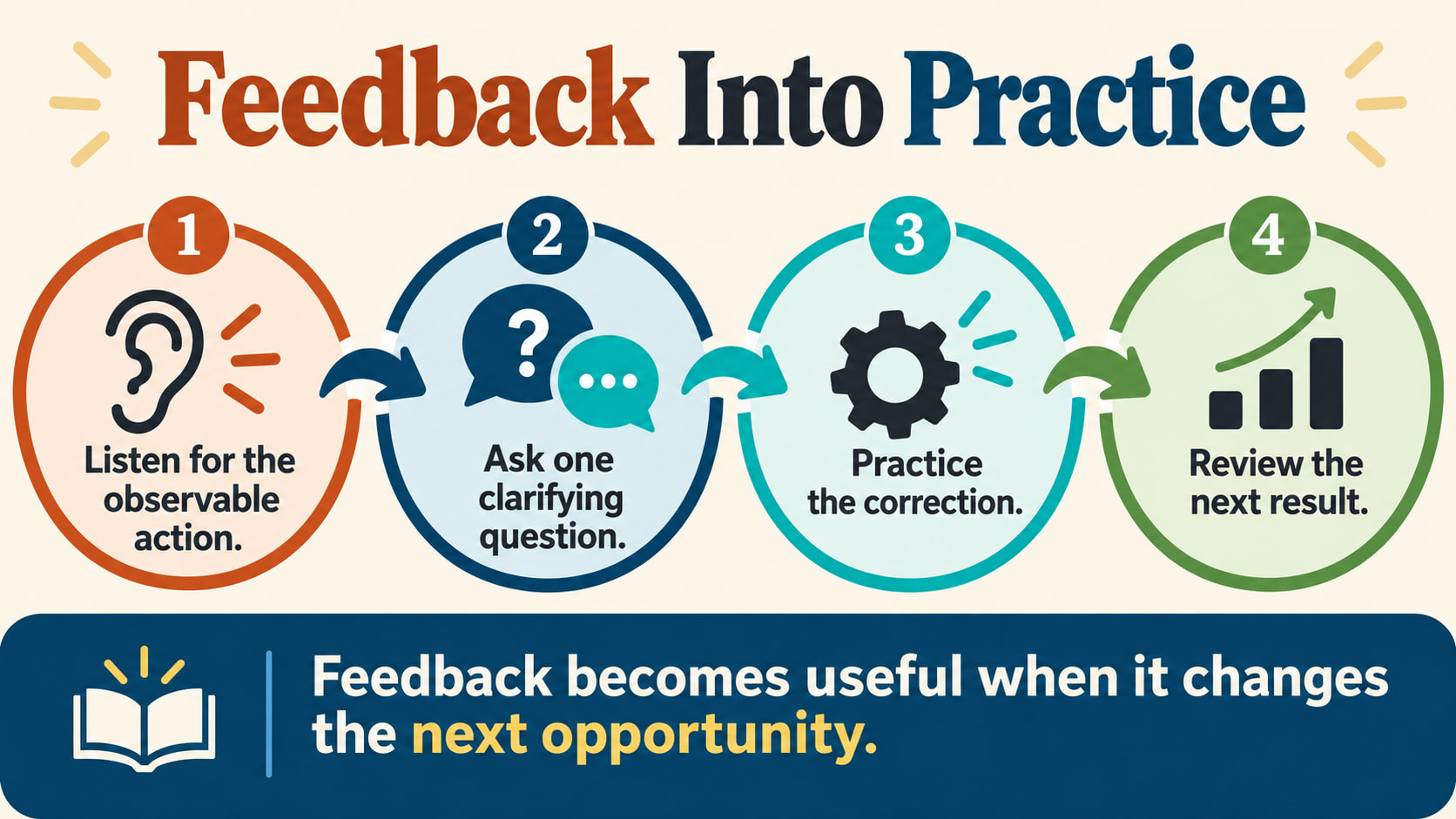
Use a four-step loop:
- Listen: identify the action or decision the feedback describes.
- Clarify: ask what to repeat, change, or observe next time.
- Practice: apply the correction in an assigned opportunity with support.
- Review: look at the next result and confirm whether more coaching is needed.
Listen for the observable action
Strong feedback describes what happened, not a fixed personality label. “The prompt was delivered after the response window” gives you a practice target. “You are careless” does not tell you what to do next and can shift the conversation away from the learner and the plan.
As you listen, separate the action from the explanation. Note the instruction, timing, prompt, reinforcement, data entry, transition, or communication step that the supervisor is discussing. If the feedback includes an interpretation you do not understand, ask for the observable example and the relevant procedure.
Stay present even when the feedback is uncomfortable. You can take a breath, write a short note, and ask to return to one point at a time. The goal is not to win an argument or say the perfect sentence; it is to understand the next professional action.
Ask a useful clarifying question
A focused question turns general coaching into a measurable practice target. Try:
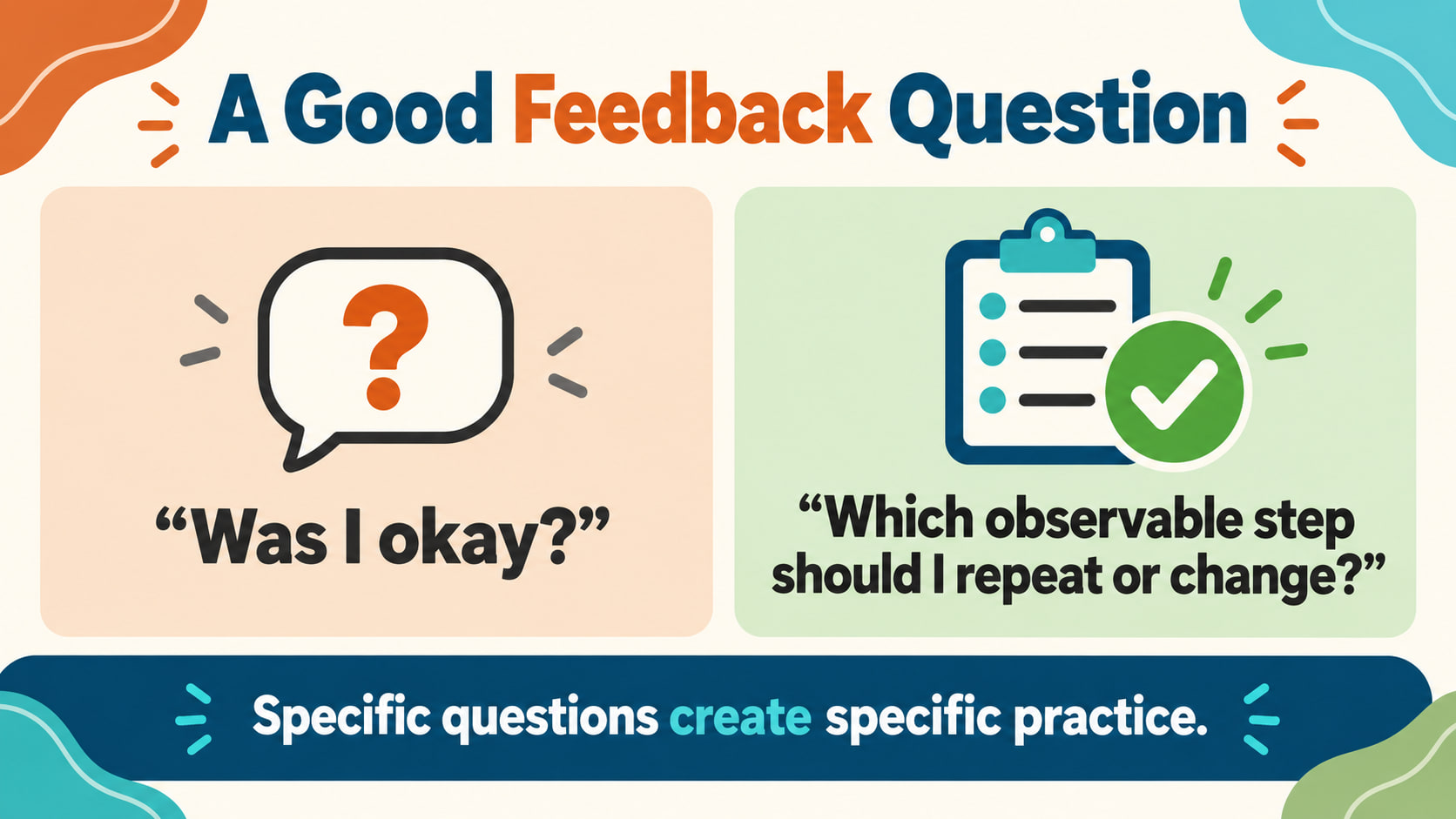
- “Which observable step should I repeat or change?”
- “What should I record when this happens again?”
- “Can you model the timing once so I can practice it?”
- “Does this correction apply to the current written procedure, or does the plan need review?”
- “How will we know whether the change helped?”
Clarification is not defiance. It is especially important when several instructions are delivered at once, a term is ambiguous, or the feedback could be interpreted as permission to change a plan. If you remain uncertain, repeat back your understanding and ask the supervisor to confirm it.
Practice the correction
Choose the next assigned opportunity and practice one correction at a time. If the issue was timing, focus on timing. If it was data, use the correct definition and record it promptly. If it was a handoff, practice the short factual structure. Narrow practice makes it easier to see whether the feedback changed performance.
Ask for modeling, rehearsal, or observation when the skill is new. A supervisor can show the procedure, watch a practice attempt, and identify the next adjustment. Do not use feedback as a reason to experiment with a new intervention or make an unapproved change with a learner.
After the practice, note what happened and what support was needed. “I used the revised prompt timing on four assigned opportunities and asked for review after the second entry” is more useful than “I tried to do better.”
Keep feedback and scope connected
Feedback should help an RBT implement assigned services more accurately, communicate better, collect useful data, and recognize when to ask for help. It does not automatically authorize diagnosis, assessment beyond the assigned task, treatment design, a new target, plan modification, or supervision of another person.
If feedback seems to ask for an action outside your training or role, state the concern calmly: “I want to make sure I am staying within the assigned procedure. Can we review the written plan and who should approve this change?” Follow the safety and reporting process if the concern is urgent.
Feedback should also be delivered in a way that supports learning. A supervisor can protect dignity by discussing the work privately, using factual examples, and making the next step clear. If feedback is vague, humiliating, discriminatory, retaliatory, or connected to unsafe conduct, do not treat “accepting feedback” as a reason to stay silent. Use the organization’s appropriate support or reporting route.
Document learning and review the result
Use the organization’s supervision or training record for feedback that needs follow-up. Include the skill reviewed, the direction given, the practice completed, and the next review point. Do not include unnecessary client-identifying information or move supervision details to a public or personal account.
Review can happen through observation, a record check, a role-play, or another approved method. If the correction did not work, report that fact without hiding it. The next step might be more practice, clearer instructions, a material change, or a supervisor review of the plan.
Receiving feedback well also includes giving feedback upward. If an instruction is unclear, a material is missing, or a safety condition has changed, describe the operational problem and ask for help. Accurate information lets the supervisor coach the right issue.
Over time, this creates a useful record of growth: the original observation, the correction, the practice opportunity, and the review. That record is stronger than a vague claim that someone is “experienced” because it shows how the skill was taught, applied, and checked consistently.
Frequently asked questions
What does accepting feedback mean for an RBT?
It means listening for an observable action, clarifying the direction, practicing it with appropriate support, and reviewing the next result. It does not mean agreeing to unsafe or unauthorized work.
How can an RBT avoid becoming defensive?
Pause, write down the specific action, ask one clarifying question, and focus on the next practice opportunity. You can acknowledge the feedback without turning it into a judgment about your identity.
What if the feedback conflicts with the plan?
Ask the supervisor to review the written procedure and confirm who can authorize a change. Do not silently alter the plan. Use the safety or escalation route when the concern is urgent.
Should feedback be documented?
Follow the organization’s supervision and training process. Document feedback when it affects a competency check, practice plan, correction, safety concern, or follow-up review.
Role reminder: This is educational supervision and professional-development information, not individualized clinical, employment, legal, or credentialing advice. Ask the responsible supervisor about a specific feedback or safety situation.
Official starting points: BACB supervision and training resources, the RBT page, RBT Handbook, and RBT Test Content Outline.
Ready to practice the RBT concepts you just reviewed?
Try an independent, original RBT practice resource with exam-style questions, scoring, and answer explanations.
References
- Behavior Analyst Certification Board. RBT Test Content Outline, 3rd edition.
- Behavior Analyst Certification Board. RBT Handbook.
- Behavior Analyst Certification Board. RBT Ethics Code.