
Accepting gifts from clients RBT questions should not be answered with an automatic yes or no based on size, holiday, or good intentions. For an RBT, the practical next step is to pause, identify the gift and context, check the current BACB Ethics Code and employer policy, and ask the supervisor or responsible workplace contact before accepting, returning, sharing, or promising anything.
Table of Contents
- Accepting gifts from clients RBT: the short answer
- What to check before accepting
- What to say in the moment
- When to involve the supervisor
- How to document the direction
- Red flags that need extra care
- Mistakes to avoid
- Frequently asked questions
RBT gifts, client boundaries, policy checks, supervision, and respectful responses
Accepting Gifts From Clients RBT: What to Check Before You Say Yes
A practical response for unexpected gifts, holiday gestures, thank-you offers, and boundary questions.
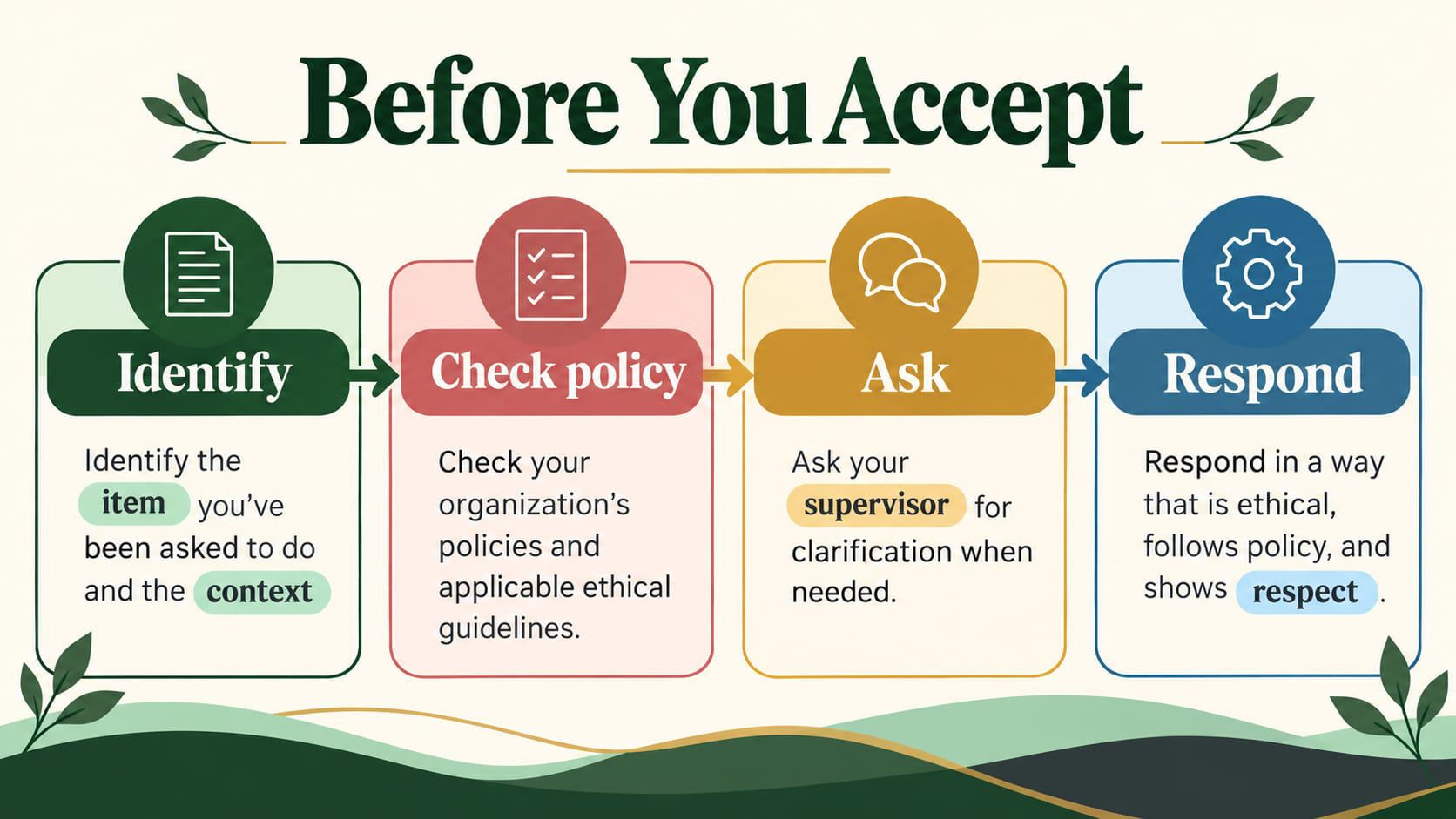
Accepting gifts from clients RBT questions should not be answered with an automatic yes or no based on size, holiday, or good intentions. For an RBT, the practical next step is to pause, identify the gift and context, check the current BACB Ethics Code and employer policy, and ask the supervisor or responsible workplace contact before accepting, returning, sharing, or promising anything.
A caregiver may offer a card, food, gift card, money, or a small present to express appreciation. That intention can be genuine. The RBT still has a professional responsibility to consider boundaries, fairness, privacy, conflicts of interest, and whether the offer could affect the service relationship.
Accepting gifts from clients RBT: the short answer
Use a pause-and-check response:
- Pause. Thank the person for the thought without promising that you can accept the gift.
- Identify. Name what is being offered, who offered it, and whether anything was requested in return.
- Check. Review the current ethics guidance and the employer or agency policy.
- Ask. Bring the specific facts to the supervisor or approved workplace contact.
- Respond. Follow the direction consistently and use the approved way to decline, return, redirect, or handle the item.
Do not create a private rule such as “I accept small gifts,” “holiday gifts are different,” or “I can take it home and ask later.” The setting and details may change the analysis, but the current policy and supervision process should decide the next step.

What to check before accepting
What is the benefit? A wrapped item, cash, gift card, discount, free service, invitation, meal, ride, or personal favor can each create a different kind of relationship. Describe the benefit precisely instead of calling everything “just a gift.”
Who is offering it? A client, caregiver, sibling, coworker, supervisor, vendor, or friend connected to the service may create different power and boundary considerations. A person’s connection to the client can matter even if they are not the person receiving services.
What is the context? Consider whether the offer occurs during a session, after a difficult conversation, around a complaint, before a schedule change, or through a private message. Ask whether it is one-time, repeated, public, secret, or linked to a request.
What could it change? Think about access, scheduling, data, communication, expectations, privacy, and perceived favoritism. A gift can create pressure even when nobody says that anything is owed.
Which rule applies? Check the current BACB Ethics Code, the employer or agency policy, and the supervisor’s direction. A remembered practice from another workplace is not enough.
What to say in the moment
A useful first sentence is: “Thank you for thinking of me. I need to check our professional policy and ask my supervisor before I can answer.” This acknowledges the person without accepting the item or making a promise.
If you need to decline, keep the explanation brief: “I appreciate the gesture, but I cannot accept this under our professional policy. Your kindness is meaningful, and I need to keep the relationship focused on services.” Adjust the wording to the setting, communication needs, and supervisor direction.
Avoid saying, “I would love to keep it but my supervisor is making me say no.” That wording can make the supervisor the villain, invite negotiation, or suggest that another answer is available. Present the boundary as part of the professional role and ask for help if the person is upset.
When to involve the supervisor
Ask before accepting whenever the policy is unclear or the offer involves money, a valuable item, a repeated benefit, a personal service, an invitation, or a request for secrecy. Also ask when the gift appears connected to a complaint, schedule, treatment preference, access, or a request for special communication.
Give enough context for a real decision: “The caregiver offered a gift card after today’s session. They said it was a thank-you, and they did not ask for a service change. What does our policy require, and how should I respond?” If you already accepted the item before understanding the policy, say so promptly and follow the supervisor’s instructions.
When the supervisor is unavailable, use the organization’s escalation route. Until you receive direction, do not use, deposit, post, exchange, or privately arrange the gift if doing so could make the situation harder to review.
How to document the direction
Use the approved supervision, incident, or workplace record. Record only the facts needed to show what happened and what direction was given: the offer, timing, relevant context, person notified, instruction received, and action taken.
Keep the language neutral. “Caregiver offered a gift card after the session; supervisor directed RBT to decline and use the approved script” is more useful than guessing that the caregiver was trying to buy special treatment. Do not place a family’s private message in an informal chat or share the gift online.
Red flags that need extra care
- Money or high-value items: may create a direct financial relationship or expectation.
- Repeated offers: may turn a one-time gesture into an ongoing benefit or personal tie.
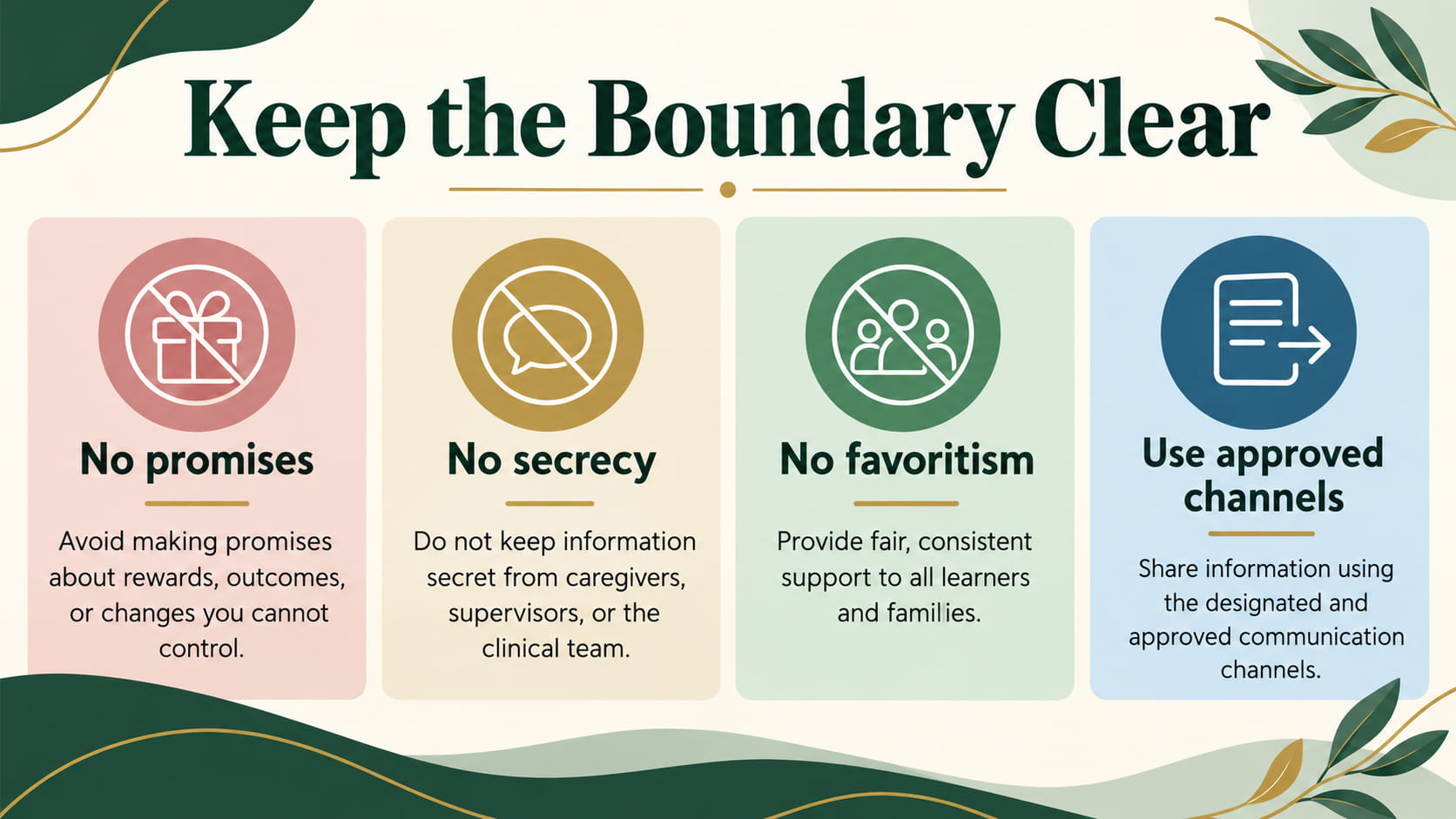
- Secrecy: “Do not tell your supervisor” is a reason to pause and seek direction.
- Special access: the offer is connected to extra time, preferred scheduling, private contact, or a service change.
- Personal invitations: social events or online contact may move the relationship beyond the approved role.
- Pressure after a decline: ask the supervisor for support rather than negotiating privately.
Mistakes to avoid
- Using a universal dollar rule: current policy and context matter more than a made-up threshold.
- Accepting first and asking later: early guidance prevents avoidable boundary repair.
- Shaming the giver: appreciation can be genuine even when the professional role cannot accept the gift.
- Creating a hidden workaround: taking the gift home, asking a friend to hold it, or exchanging it later does not solve the question.
- Allowing favoritism: a gift must never change service quality, access, privacy, or documentation.
Frequently asked questions
Can an RBT accept a small gift from a client?
Do not decide from size alone. Check the current BACB Ethics Code and employer policy, then ask the supervisor about the actual gift and context.
What if the gift is a holiday present?
A holiday does not automatically create an exception. Thank the person, pause, and follow the current policy and supervisor direction.
What should I do if I accepted it by accident?
Tell the supervisor or approved workplace contact promptly, describe the facts accurately, and follow the direction about returning, sharing, recording, or otherwise handling the item.
How do I decline without hurting the relationship?
Thank the person for the thought, explain that professional policy limits what you can accept, and keep the focus on supporting the client. Ask your supervisor for wording that fits the family and setting.
Role reminder: This is educational information, not credentialing, employment, legal, tax, or clinical advice. Verify the current BACB Ethics Code and your employer or agency policy, and ask a supervisor about a specific gift.
Official starting points: the BACB RBT Ethics Code, ethics codes page, RBT Handbook, and supervision and training resources.
Ready to practice the RBT concepts you just reviewed?
Try an independent, original RBT practice resource with exam-style questions, scoring, and answer explanations.
References
- Behavior Analyst Certification Board. RBT Test Content Outline, 3rd edition.
- Behavior Analyst Certification Board. RBT Handbook.
- Behavior Analyst Certification Board. RBT Ethics Code.