
This active listening vs seeking input RBT guide separates hearing a message from asking for the next authorized direction.
Table of Contents
- What is active listening vs seeking input RBT?
- What active listening can look like for an RBT
- What seeking input can look like for an RBT
- Use listening before asking
- Keep questions within role and safety boundaries
- Practice the four-step communication sequence
- Quick comparison
- Frequently Asked Questions
- Sources and further reading
RBT communication and supervision guide
Active Listening vs Seeking Input RBT: Hear It, Then Ask
Learn how to hear the observable point, reflect it accurately, ask one useful question, and route decisions safely.
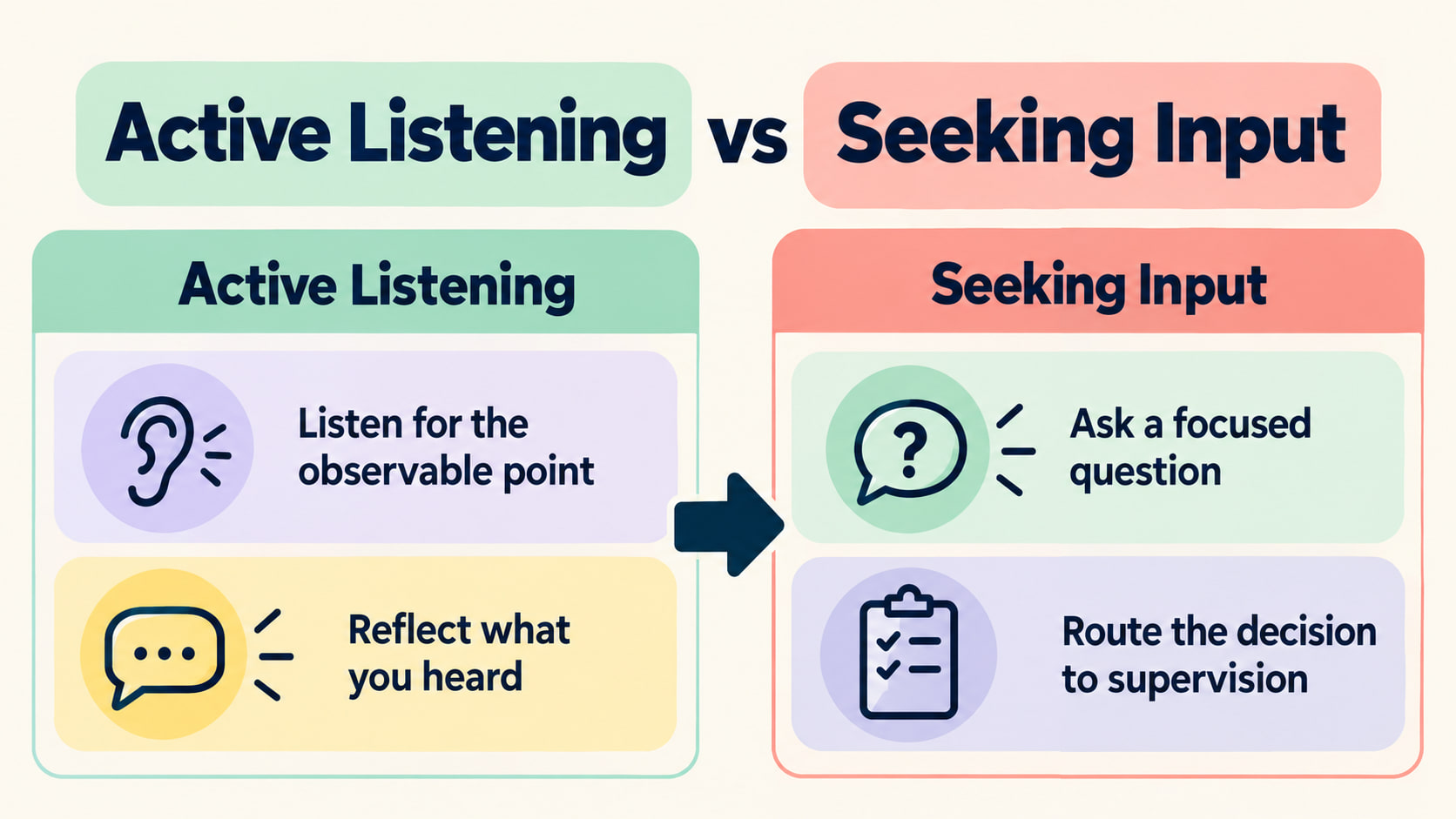
The phrase active listening vs seeking input RBT names two related communication skills. Active listening is how an RBT shows that a message, correction, or concern was heard and understood. Seeking input is how the RBT asks for clarification, feedback, or direction when the next step is uncertain. One skill does not replace the other: listening gives the question a reliable foundation, while a focused question prevents guessing.
This comparison is especially useful during supervision, a session handoff, a caregiver conversation, or a discussion about a written procedure. The aim is not to make an RBT sound agreeable at all times. A professional response can acknowledge the observable point, check the source, raise a safety or ethics concern, and still ask the right person what should happen next.
What is active listening vs seeking input RBT?
Active listening focuses on understanding the message. It can include allowing the speaker to finish, attending to the specific behavior or event being discussed, reflecting the point in neutral language, and checking whether the summary is accurate. It is a communication process, not proof that the listener agrees with every conclusion.
Seeking input focuses on obtaining information or direction. It can include asking what part of the written procedure controls, requesting an example, checking who owns a decision, or asking the supervisor to review a pattern in the data. It is not the same as asking another person to make a decision that belongs to the RBT, and it is not permission to improvise a plan change.
| Skill | Primary question | Observable example |
|---|---|---|
| Active listening | What did I hear and understand? | “You are pointing out that I delivered the prompt before the defined wait interval.” |
| Seeking input | What do I need to clarify or do next? | “Can we review one example and confirm the timing rule I should use?” |
| Role-safe follow-through | Who owns the decision? | “Should the responsible supervisor document any change to the written procedure?” |
The three parts work together. If an RBT asks a question before understanding the concern, the question may solve the wrong problem. If the RBT listens but never asks when the instruction is unclear, the team may mistake silence for understanding.
What active listening can look like for an RBT
Active listening is easier to observe when it is translated into small behaviors rather than a personality trait. During a coaching conversation, the RBT can pause the task long enough to hear the complete point, identify the concrete event, and summarize it without adding an explanation about someone’s motive.
For example, a supervisor says, “Your note uses a conclusion instead of describing what happened.” An active listening response might be: “You are saying that ‘the learner was anxious’ is not enough as written. I should describe the observable actions and context instead. Is that the part you want me to revise?” The response reflects the point and leaves room for correction if the summary is incomplete.
Useful listening behaviors include:
- Stay with the specific message: hear the example being discussed before bringing in an unrelated past disagreement.
- Separate observation from interpretation: identify the action, timing, prompt, data, or document rather than guessing a motive.
- Reflect briefly: summarize the correction in your own words and invite confirmation.
- Notice the unanswered part: determine whether you understand the concern but still need direction about the next step.
Listening can include emotion without being controlled by it. An RBT may feel embarrassed, worried, or frustrated and still say, “I want to make sure I understood the observable issue.” The goal is not to perform perfect calm. The goal is to keep the communication accurate enough that the next action can be reviewed.
What seeking input can look like for an RBT
Seeking input should be specific enough for another person to answer. “What should I do?” may be too broad when the real question is about timing, documentation, safety, or decision ownership. A better question names the source checked and the point that remains unclear.
Consider three common situations:
- Unclear procedure: “The current program says to wait five seconds, but I am unsure when the timer starts. Can we review one example?”
- Conflicting guidance: “I heard a different prompt sequence today than the one in the written procedure. Which direction controls until the update is documented?”
- Possible safety or ethics concern: “This request appears outside my training and the current plan. Who should I contact, and what should I do while it is being reviewed?”
Each question seeks input without handing over personal responsibility for basic follow-through. The RBT still checks the current procedure, records relevant observations, uses an approved channel, and follows the authorized direction. Seeking input is a way to reduce unsafe guessing, not a substitute for reading the plan or communicating a concern.
Use listening before asking
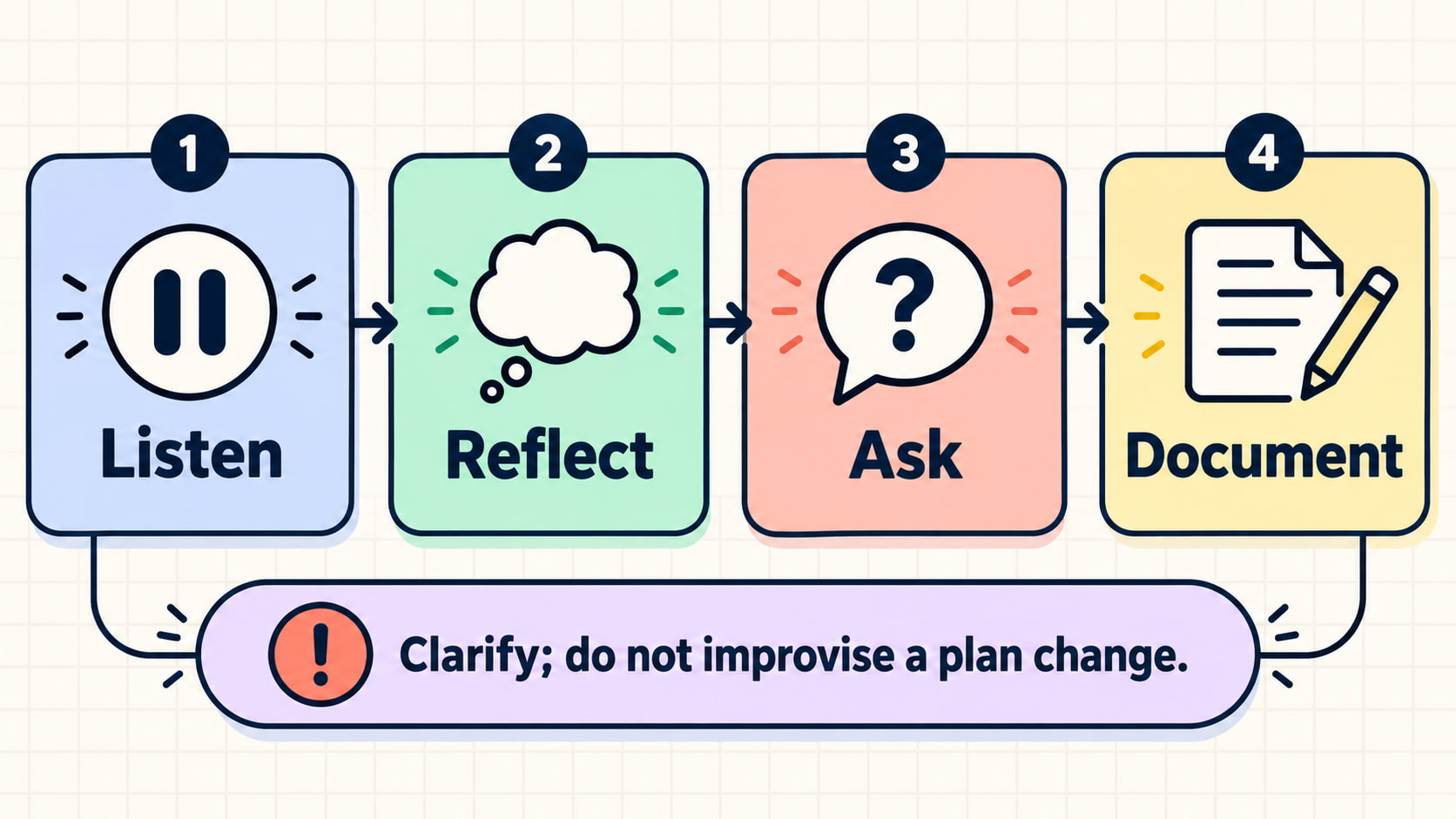
A simple sequence keeps the two skills connected:
- Listen: allow the speaker to state the concern or correction.
- Reflect: summarize the observable point without adding a motive.
- Ask: ask one focused question about the procedure, evidence, timing, or next practice opportunity.
- Document or follow through: use the approved record or communication process and complete the next authorized action.
Suppose a supervisor says that a data entry does not match the measurement definition. The sequence could sound like this: “I hear that the entry counted an interval as a response even though the definition requires the response to occur for the specified duration. I will review the definition. Should I correct this record through the approved process, and can we check one more example together?”
This response does not hide an error or promise that the data pattern means something clinically. It identifies the correction, asks about the proper record process, and requests a bounded learning opportunity.
Keep questions within role and safety boundaries
Active listening does not require an RBT to accept an unsafe, abusive, discriminatory, retaliatory, unethical, or out-of-scope instruction. Seeking input does not authorize an RBT to diagnose, redesign treatment, conduct an independent assessment, supervise another provider, or change a behavior plan without the required direction.
When a request conflicts with the current written procedure, keep the conflict visible. A role-safe response might be: “I want to follow the correct direction. This request seems different from the current procedure, and I do not want to improvise. Can the responsible supervisor confirm the instruction and document any approved change?”
Privacy is part of the same boundary. Use the organization’s approved system and share only the information needed for the professional purpose. Do not use a personal social-media account, public forum, or casual group chat to seek advice about an identifiable client. When the concern is urgent, follow the applicable safety or reporting process rather than waiting for an ordinary coaching conversation.
Practice the four-step communication sequence
Use a short role-play with a general scenario rather than private client details. One person gives a correction, and the RBT practices the following response:
“Let me make sure I heard you. You are saying [observable point]. I will check [procedure or record]. My question is [focused question]. Until that is clarified, should I continue [current authorized step]?”
After the role-play, review four qualities:
- Was the reflection accurate, or did it insert an assumption about intent?
- Was the question narrow enough to answer?
- Did the wording make decision ownership clear?
- Did the proposed follow-through stay inside the written role and safety process?
If the feedback feels personal, take a brief pause and name the return point: “I want to respond thoughtfully. I will summarize what I heard and ask my question in a moment.” Returning to the issue matters. A pause supports listening when it leads back to a concrete review; it should not become a way to avoid every correction.
Quick comparison
| Moment | Active listening | Seeking input |
|---|---|---|
| A correction is offered | Reflect the observable point | Ask what to practice or review next |
| The wording is unclear | Identify what you understood | Ask for an example or definition |
| The plan appears different | State the source you checked | Ask who owns the decision and documentation |
| A safety concern appears | Listen for the relevant facts | Use the required escalation route |
Frequently Asked Questions
Is active listening the same as agreeing with a supervisor?
No. Active listening means trying to understand and accurately reflect the message. An RBT can ask for evidence, clarify a procedure, or raise a safety, ethics, privacy, or scope concern through the correct process.
Is seeking input a sign that an RBT is not competent?
No. A focused question can protect accuracy and safety, especially when the procedure is unclear or two directions appear to conflict. Competent communication includes knowing when to ask the appropriate person.
What should an RBT do if a question is not answered?
Use the approved follow-up or escalation channel, document the relevant concern as required, and continue only the current authorized step unless an urgent safety process says otherwise. Do not invent a new procedure while waiting.
Can an RBT ask a caregiver for input?
An RBT can listen respectfully to relevant observations and route questions through the organization’s process. Caregiver input does not by itself authorize an RBT to change a plan or make a clinical decision.
Sources and further reading
- BACB RBT Test Content Outline, 3rd edition
- BACB Supervision and Training resources
- BACB RBT Handbook
- BACB Ethics Codes and RBT Ethics Code resources
Explore RBT communication training, supervision learning, and role-safe practice resources for your next coaching conversation.
Ready to practice the RBT concepts you just reviewed?
Try an independent, original RBT practice resource with exam-style questions, scoring, and answer explanations.
References
- Behavior Analyst Certification Board. RBT Test Content Outline, 3rd edition.
- Behavior Analyst Certification Board. RBT Handbook.
- Behavior Analyst Certification Board. RBT Ethics Code.