

People search for applied behavior analysis data sheets when they need a printable form, a digital template, or a clearer way to connect a measurement system to an RBT session. The form matters, but the first decision is not “Which template looks best?” It is “What observable question does the written procedure require me to answer?”
Table of Contents
- What applied behavior analysis data sheets should contain
- Choose applied behavior analysis data sheets by measurement
- Design the fields before using a sheet
- Collect data without backfilling
- Connect data sheets to the current TCO
- Original data-sheet decisions
- Audit data quality before reporting
- Paper, digital, and privacy choices
- Avoid common data-sheet mistakes
- Frequently Asked Questions
- References
A data sheet is a recording tool. It does not create a treatment plan, authorize a new procedure, or prove the function of behavior by itself. The current RBT Test Content Outline, 3rd edition, places data collection and graphing in Domain A, with 43 tasks across six domains overall. The current written-exam context includes 75 scored questions and 10 unscored pilot questions.
RBT Training is an independent educational resource and is not affiliated with or endorsed by the Behavior Analyst Certification Board (BACB) or any template provider reviewed here. The examples in this guide are newly written for study and are not official, recalled, leaked, or BACB-endorsed questions. A template cannot guarantee clinical results, exam certification, or a passing result.
What applied behavior analysis data sheets should contain
Useful applied behavior analysis data sheets make the measurement rule visible enough that another trained person can understand what was recorded. The exact layout depends on the client-specific program, but a well-designed form usually identifies:
| Field | Why it matters | Example |
|---|---|---|
| Target and operational definition | Defines what counts and what does not count. | “Leaves the chair with both feet outside the marked area.” |
| Date, time, setting, and observer | Provides the context needed to compare sessions. | School, 9:00–9:30, assigned RBT. |
| Measurement unit | Prevents a count from being mistaken for duration, rate, or latency. | Count per session, seconds, percentage, or interval mark. |
| Procedure or trial rule | Shows how the observation or teaching opportunity was run. | Prompt level, interval length, or opportunity number. |
| Summary and deviation note | Allows accurate reporting without hiding missing or unusual data. | Session total plus “two trials missed during transition.” |
A visually clean sheet can still be clinically weak if the definition is vague, the unit is missing, or the observer has to guess where to record a deviation. Conversely, a simple paper form can be appropriate when it matches the procedure and is used consistently.
For example: “track cooperation” is not a measurement instruction. The RBT needs an observable definition, the opportunity or interval rule, and the response code. The sheet should make it difficult to write an impression such as “seemed better” in place of the required data.
Choose applied behavior analysis data sheets by measurement
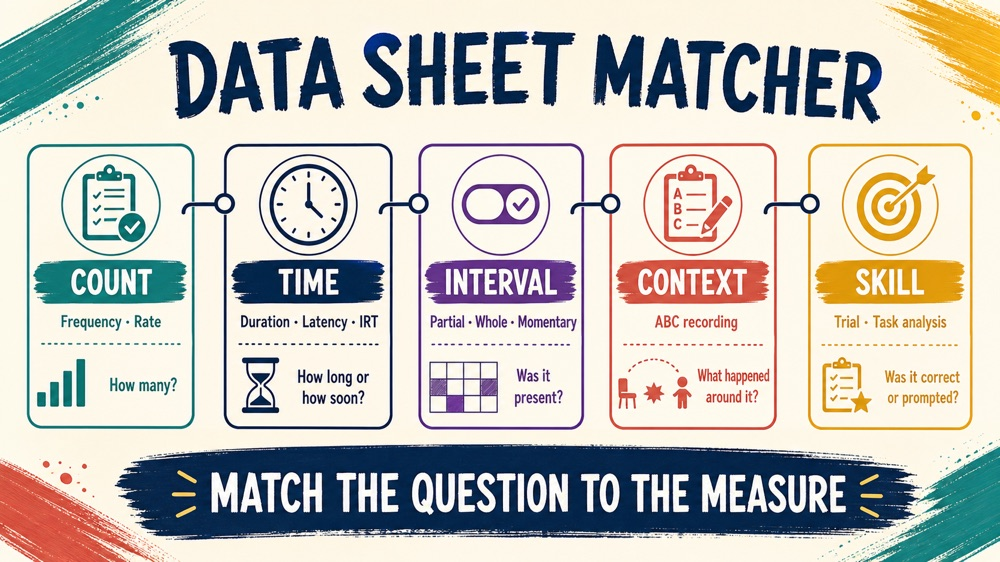
Choose the sheet after identifying the dimension of behavior or skill the plan asks you to measure. The following table is a study crosswalk, not permission to replace a client’s assigned procedure:
| Question | Measurement family | Typical sheet fields | Common trap |
|---|---|---|---|
| How many times did it happen? | Frequency or event recording | Tally, session length, total count. | Calling a count a rate without a time denominator. |
| How often per unit of time? | Rate | Count, observation time, calculated rate. | Comparing sessions of different lengths using raw counts only. |
| How long did it continue? | Duration | Start time, stop time, episode duration, total or mean. | Using latency because the record contains seconds. |
| How long until it began? | Latency | Instruction or cue time, response onset, elapsed seconds. | Ending the interval at response offset instead of onset. |
| How much time separates responses? | Interresponse time | Response timestamps and time between occurrences. | Confusing spacing with total duration. |
| Did it occur within an interval? | Partial, whole, or momentary sampling | Interval length, interval marks, scoring rule. | Using the wrong mark rule or treating a sample as a true count. |
| What happened before and after? | ABC recording | Antecedent, observable behavior, consequence, time. | Writing an inferred function in the behavior column. |
| Was a skill correct or prompted? | Trial-by-trial or task analysis | Opportunity, response, prompt level, correction, step score. | Changing prompt or scoring rules without authorization. |
Do not select a data sheet because it includes every possible column. Extra columns can slow collection and create inconsistent entries. The best form captures the variables the procedure requires while leaving enough room to record accurately during a live session.
Design the fields before using a sheet
Before using any of the applied behavior analysis data sheets found online, compare the template with the written program. Check these design questions:
- Definition: Can the observer identify the response without guessing at intention?
- Unit: Does the sheet state count, seconds, percentage, interval, opportunity, or another required unit?
- Denominator: If the program uses rate or percentage, is the time or opportunity total captured?
- Timing: Are start, stop, interval, or opportunity boundaries clear?
- Prompt and error codes: Are the codes defined somewhere the RBT can check?
- Deviation: Is there a place to record an interruption, missing material, safety event, or procedure change?
- Summary: Can the RBT total or transmit the data without changing the original entries?
Templates are not universal programs. A frequency form designed for a discrete behavior may be inappropriate for an ongoing behavior with unclear boundaries. An ABC form can organize observations, but it does not authorize the RBT to conduct a functional analysis or independently diagnose function. A task-analysis form can record steps, but it does not decide the teaching sequence or mastery criterion.
If the online template conflicts with the written plan, follow the plan and ask the supervisor how to adapt the form. Do not silently change the measurement system because the downloaded sheet is more convenient.
Collect data without backfilling
Accurate sheets are built during the observation or immediately according to the approved procedure. Backfilling from memory after the session is risky because the observer may remember the overall impression but not the exact count, timing, prompt, or context.
| Situation | Role-safe action |
|---|---|
| You miss one event while helping with a safety transition. | Record the deviation as required and report it; do not invent the value. |
| A pen or device fails during a short interval. | Use the approved backup method and preserve the time boundary; ask how to handle missing data. |
| The definition seems unclear in the moment. | Use the current written definition, note uncertainty, and ask through supervision rather than rewriting it. |
| A caregiver asks what the pattern “means.” | Share only the approved communication and direct clinical interpretation to the supervising professional. |
| A digital sheet calculates a surprising rate. | Check count, denominator, session duration, and data entry; report the discrepancy before changing anything. |
Real-time collection does not mean rushing past the measurement definition. Prepare materials, place the sheet where it can be used without unsafe distraction, and practice the codes before the session. If the method cannot be run accurately in the setting, that is information for the supervisor, not a reason to substitute a different method.
Connect data sheets to the current TCO
The most direct alignment for this topic is Domain A, Data Collection and Graphing. Current tasks A.1–A.8 cover measurement, data entry and graphs, observable descriptions, calculations and summaries, trends, and the risks of unreliable collection or poor procedural fidelity.
| Current task pattern | What to practice with a data sheet |
|---|---|
| A.1–A.3 measurement procedures | Match frequency, duration, latency, IRT, interval, or permanent product to the stated question. |
| A.4 data entry and graphs | Enter the original value accurately and identify what the graph is displaying. |
| A.5 observable descriptions | Write behavior and environment in measurable terms rather than labels or inferred motives. |
| A.6 calculations and summaries | Use the correct denominator, total, mean, percentage, rate, or comparison rule. |
| A.7 trends | Describe a visible direction or pattern without overclaiming causation. |
| A.8 reliability and fidelity risks | Recognize backfilling, inconsistent definitions, missed events, and procedure deviations. |
Keep the full outline in view as well. The current TCO includes 43 tasks across six domains: A. Data Collection and Graphing, B. Behavior Assessment, C. Behavior Acquisition, D. Behavior Reduction, E. Documentation and Reporting, and F. Ethics. A data sheet article can focus on Domain A while still teaching how recording connects to assessment, acquisition, reduction, documentation, and ethical practice.
Original data-sheet decisions
These examples are newly written for independent study. They are not official, recalled, leaked, or BACB-endorsed questions.
- Frequency or rate: A learner raises a hand 12 times during a 30-minute lesson, and the supervisor asks for responses per minute. What must the sheet preserve? The count and the 30-minute observation time so the rate can be calculated.
- Duration: Three episodes last 20, 45, and 35 seconds. What would a duration sheet need before a mean can be reported? The duration of each defined episode and the rule for handling incomplete or interrupted episodes.
- Latency: The instruction is delivered at 10:02:00 and the response begins at 10:02:12. What is the relevant interval? Twelve seconds from the instruction to response onset, assuming those are the program’s defined events.
- Interval recording: The behavior occurs briefly once during a 1-minute interval. If the rule is partial interval, how should it be scored? Mark occurrence for that interval; do not convert the mark into a count of episodes.
- ABC: The note says, “The learner wanted attention.” What should be corrected? Record observable antecedent, behavior, and consequence events; do not replace the behavior description with an inferred function.
- Trial-by-trial: A learner responds correctly after a model prompt. What should be distinguished? Correctness and prompt level, using the program’s codes; prompted performance is not the same as independent performance.
- Missing data: The RBT loses access to the digital form for five minutes. What is the best answer? Use the approved backup and report the gap; never fill the interval from memory as if it were observed.
- Graph interpretation: A line rises after one session with a different observer and shorter duration. What should you check first? Measurement conditions, denominator, procedure fidelity, and data integrity before claiming a behavior change.
For each decision, name the nearest wrong choice and the missing fact that would make it correct. This practice turns a blank template into a measurement-reasoning exercise.
Audit data quality before reporting
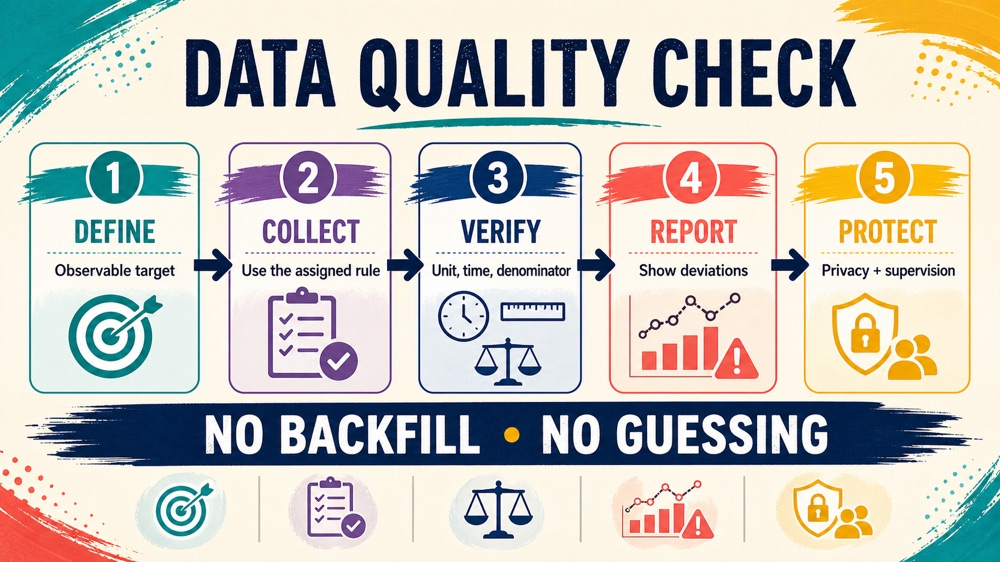
Before transferring information from a sheet into a note, graph, or supervisor message, use a short quality check:
- Definition check: Does every entry use the same observable definition?
- Unit check: Are counts, seconds, percentages, intervals, and prompts kept distinct?
- Completeness check: Are date, time, setting, observer, session length, and denominator present?
- Fidelity check: Was the assigned procedure followed, and are deviations visible?
- Arithmetic check: Do totals, rates, means, and percentages use the correct formula?
- Pattern check: Does the apparent trend remain after considering missing data or changed conditions?
- Communication check: Does the report describe observations without making an unauthorized clinical conclusion?
A data sheet can support a supervisor’s analysis, but the RBT should not independently decide that an intervention “worked,” diagnose a function, or change a goal based on one unusual row. Report the data and relevant context accurately. Ask when the next clinical decision is outside the assigned procedure.
Paper, digital, and privacy choices
Paper, spreadsheet, and digital applications each have tradeoffs. A digital form may calculate rate or graph data quickly, while paper may be easier during active play or in a low-connectivity setting. The choice should be made within the organization’s approved system and the client-specific plan.
| Choice | Check |
|---|---|
| Paper | Legibility, secure storage, correct version, and a plan for approved data entry. |
| Spreadsheet | Formula accuracy, access control, version history, and no accidental client exposure. |
| App | Offline behavior, synchronization, user permissions, defined codes, and what happens when the device fails. |
Never paste identifiable client information into a public template, online quiz, or unapproved AI tool. Use de-identified examples for study. A neat sheet is not worth a privacy breach. If the approved system is unavailable, follow the organization’s backup and incident-reporting procedure.
Avoid common data-sheet mistakes
- Starting with a template: start with the measurement question and written procedure.
- Tracking everything: collect the variables the plan requires; extra columns can reduce fidelity.
- Confusing count and rate: preserve the time denominator.
- Confusing latency and duration: identify where the interval starts and ends.
- Using ABC as a diagnosis: record events; do not write inferred function as fact.
- Backfilling: record missing data or deviations rather than reconstructing from memory.
- Changing the program: a form does not authorize a new prompt, consequence, assessment condition, or mastery rule.
- Ignoring privacy: keep paper, screenshots, exports, and digital access within approved controls.
Bottom line: the best applied behavior analysis data sheets make the target, measurement, timing, prompt or interval rules, and deviation path visible. Match the form to the written procedure, collect observable data in the moment, protect data integrity and privacy, and report patterns without claiming more than the record supports.
Ready to practice data-collection decisions?
Use original RBT practice questions to match measurement systems, data-sheet fields, and role-safe reporting decisions.
Try Free RBT Practice Questions →
Frequently Asked Questions
What are applied behavior analysis data sheets?
They are forms used to record defined behavior or skill data under an assigned procedure. They may capture frequency, rate, duration, latency, interval, ABC, trial-by-trial, task-analysis, or other specified measures.
How do I choose applied behavior analysis data sheets?
Start with the observable question and written measurement procedure, then choose a form with the required unit, timing, denominator, prompt or interval fields, and deviation space.
Can an RBT create a new data sheet for a client?
An RBT can use an approved form and report when it does not fit, but should not independently change a client-specific measurement system or clinical procedure. Ask the supervisor for direction.
Can ABC data prove the function of behavior?
ABC data records observable events around behavior and may support a broader assessment. It does not by itself authorize an RBT to diagnose function or select treatment.
Should I use paper or digital data sheets?
Use the organization’s approved option and the written procedure. Check legibility, access control, offline or backup handling, formulas, privacy, and data-transfer rules for the selected system.
References
- Behavior Analyst Certification Board. RBT Test Content Outline, 3rd edition.
- Behavior Analyst Certification Board. RBT Test Content Outline, 3rd-edition PDF.
- Behavior Analyst Certification Board. RBT Handbook.
- Independent ABA data-collection methods guide. Reviewed for competitor research; not an endorsement.
- Independent behavior data-sheet resource. Reviewed for competitor research; not an endorsement.
- Independent RBT data-collection guide. Reviewed for competitor research; not an endorsement.
- Independent task-analysis data-sheet examples. Reviewed for competitor research; not an endorsement.