

Avoid multiple relationships RBT decisions should start with identifying overlapping roles, checking the facts, pausing before acting, and seeking supervision through the appropriate route.
Table of Contents
- What avoid multiple relationships RBT means
- Identify the roles before deciding
- Recognize common warning signs
- Pause and seek supervision
- Choose a proportionate response
- Document facts and follow-up
- Short practice scenarios
- Frequently asked questions
- References
RBT ETHICS · PROFESSIONAL BOUNDARIES
Avoid Multiple Relationships RBT: Boundary Guide
How to recognize overlapping roles, pause before acting, and use supervision to protect professional boundaries.
Avoid multiple relationships RBT decisions should start with identifying overlapping roles, checking the facts, pausing before acting, and seeking supervision through the appropriate route. An RBT may encounter a person in more than one setting: a client’s family member might be a neighbor, a coworker might ask for personal help, or a community connection might create pressure around a service relationship.
An overlap is not automatically a final ethics conclusion. The concern is whether the additional role could create a conflict, pressure, loss of objectivity, privacy risk, unfair advantage, or confusion about the RBT’s professional responsibilities. Use current official materials, organizational policy, and supervision for the situation instead of relying on a quick label.
What avoid multiple relationships RBT means
In plain language, a multiple relationship exists when a professional relationship overlaps with another relationship or role. The second role may be social, financial, familial, educational, religious, online, or connected to another service. The overlap can be direct or develop over time.
The important question is not only whether two people know each other. Ask what responsibilities, information, influence, or expectations come with each role. A professional boundary becomes harder to protect when one person can affect another person’s access, privacy, money, work, housing, social standing, or care.
RBTs should not make a final determination from a single keyword. Gather objective facts, protect confidential information, and take the concern to the supervisor or designated organization contact. A timely consultation is usually more useful than waiting until a small overlap becomes a larger conflict.
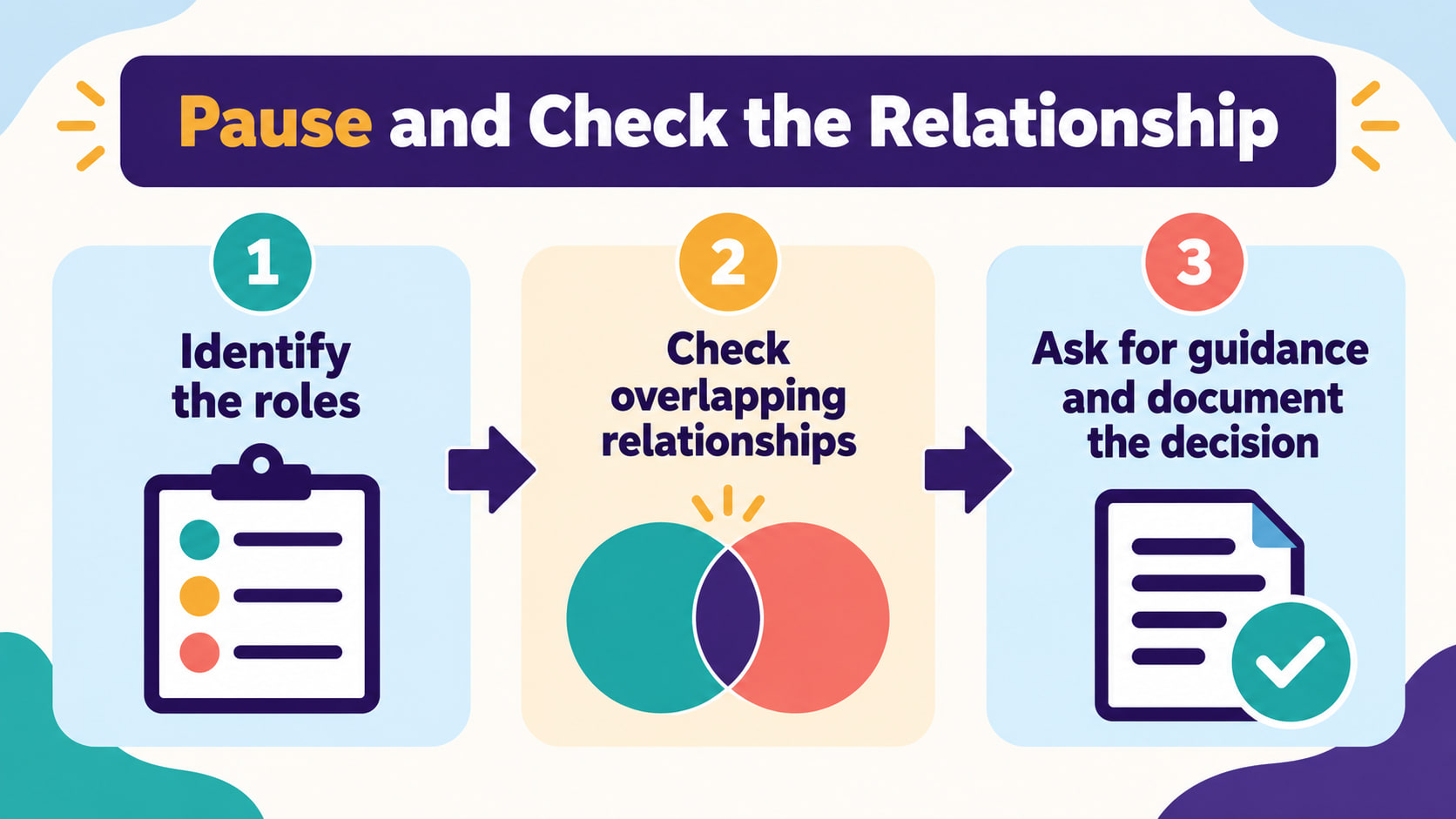
Identify the roles before deciding
Start with a role map. Write down the professional role, the other role, the people involved, and where the overlap occurs. For example, the RBT may be providing services in one setting while also being asked to join a private social group. The goal is to describe the situation without adding assumptions about motives.
- Professional role: What service, support, communication, or documentation responsibility exists?
- Additional role: Is the connection personal, financial, social, educational, family-based, or online?
- Power or access: Could either role affect information, opportunities, money, services, or decisions?
- Privacy: Could information from one relationship be revealed or expected in the other?
- Duration: Is the overlap temporary, recurring, or likely to continue after services end?
Keep the description factual. “A client’s parent invited me to provide paid tutoring outside the service setting” is more useful than “the family is trying to manipulate me.” Facts allow a supervisor to evaluate options without turning an uncertain situation into an accusation.
Recognize common warning signs
Warning signs often appear as requests that seem small but add a second source of influence or obligation. A personal favor may make it harder to say no. A financial exchange may create a competing interest. Social pressure may make the RBT fear upsetting someone. Conflicting roles may blur whether a conversation is about services or a private relationship.
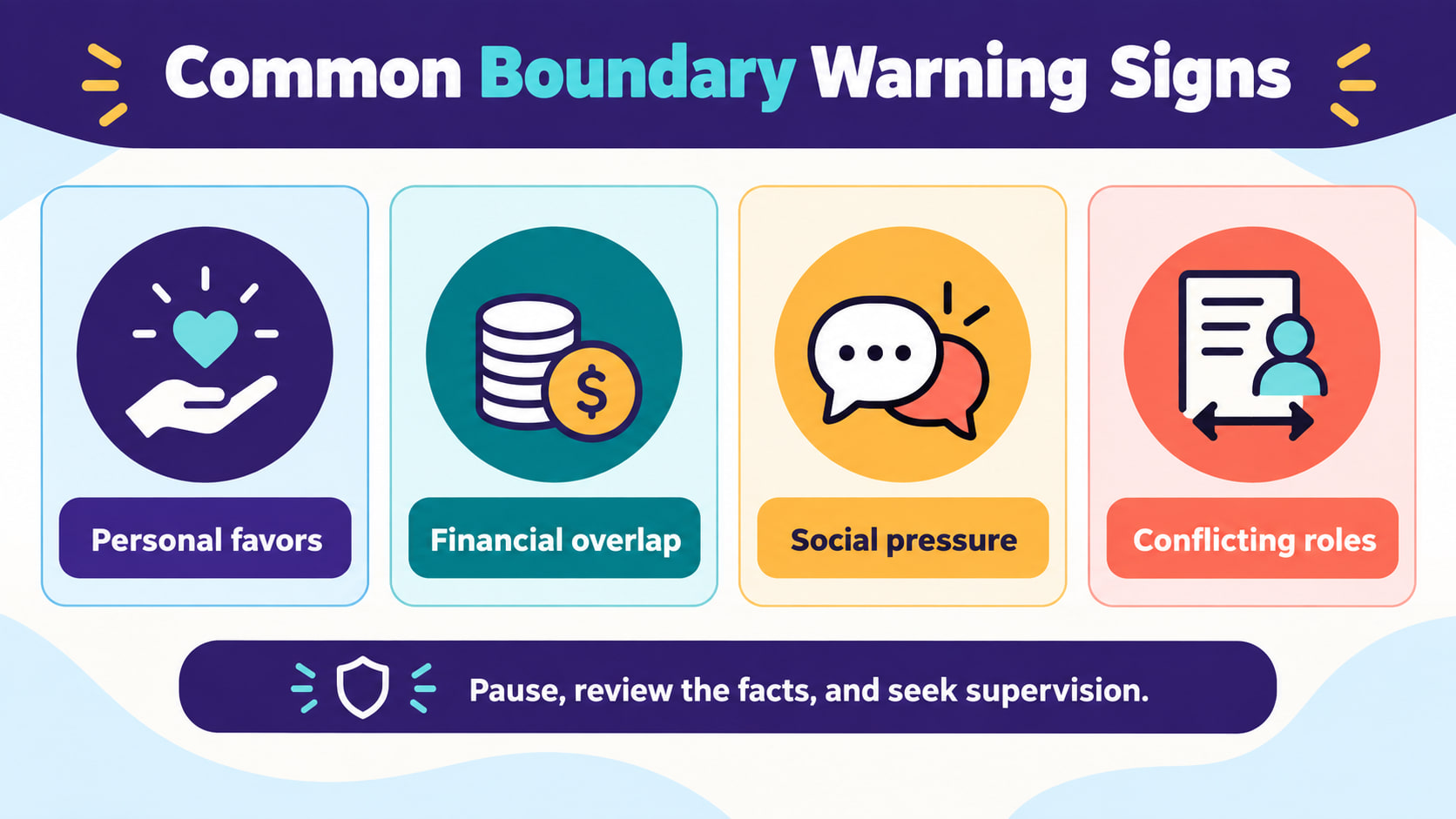
Other signals include requests to keep an arrangement secret, invitations that involve confidential service information, gifts that feel unusually valuable, direct messages through personal accounts, or pressure to bypass a supervisor or organization policy. One sign does not decide the outcome, but it is a reason to slow down and consult.
Pause and seek supervision
When the overlap is unclear, do not accept, promise, disclose, or change a service arrangement while trying to decide alone. A pause can be brief and respectful: explain that you need to check the appropriate process before responding. Do not use the pause to punish the other person or to discuss private details with uninvolved people.
Bring the supervisor a concise description: who is involved, what was requested, where the other role exists, what action is pending, and what privacy or power concerns may arise. Ask what should be communicated, documented, declined, referred, or escalated. If the supervisor is part of the concern, use the organization’s alternate consultation or reporting route.
Choose a proportionate response
The response should fit the facts and current requirements. Possible steps may include declining a personal request, moving communication to an approved channel, separating service and social settings, disclosing the concern to the appropriate supervisor, creating a boundary plan, or requesting a change in assignment. Do not promise a particular outcome before the responsible person reviews the situation.
Use plain language when setting a boundary. “I need to keep our contact within the approved service communication process, so I cannot accept that personal arrangement” is clearer than an argument about someone’s character. If the situation creates immediate safety, exploitation, harassment, or confidentiality concerns, follow the applicable urgent escalation process.
Document facts and follow-up
Document the date, setting, objective request, people notified, guidance received, and action taken according to policy. Avoid unnecessary private details. Do not copy client information into personal notes or send screenshots through an unauthorized channel. A record should help the authorized team understand what happened and what remains to be done.
Set a follow-up point. Check whether the boundary was understood, whether communication moved to the approved channel, and whether the assignment or plan needs review. A relationship can change after the first consultation, so a decision that was reasonable today may need another review if the roles, setting, or risks change.
Short practice scenarios
A paid favor: A family member asks the RBT to provide unrelated paid tutoring. The RBT should not accept on the spot. Identify the additional financial role, consult the supervisor, and follow the organization’s process.
A private invitation: A client’s caregiver invites the RBT to a personal event and asks the RBT not to mention it. The secrecy request is a warning sign. The RBT should protect privacy, pause, and seek guidance.
An online connection: A person connected to services sends a social-media request. The RBT should check policy and supervision guidance before accepting, responding with private information, or moving service communication to a personal account.
These examples illustrate a decision process, not a universal answer. The relevant facts, current official materials, organizational policy, and supervisor direction control the response.
Frequently asked questions
Is every second relationship automatically prohibited?
No. The significance depends on the roles, power, privacy, risk, setting, and current requirements. Treat a possible overlap as a reason to review the facts and consult.
What should an RBT do first?
Pause before accepting a request or sharing information, identify the roles, protect confidentiality, and bring the objective facts to the supervisor or authorized contact.
Can I solve the concern by simply saying no?
Sometimes declining is part of the response, but the situation may also require documentation, a communication change, assignment review, or escalation. Follow the approved process.
What if the supervisor is involved in the overlap?
Use the organization’s alternate consultation, compliance, or reporting route. Do not assume that discussing the concern with an uninvolved coworker is an authorized substitute.
Source note: Review current BACB materials, current organizational policy, approved systems, and supervisor or administrator direction for your situation. This article is educational and does not provide individualized legal, clinical, employment, or credentialing advice.
Ready to practice the RBT concepts you just reviewed?
Try an independent, original RBT practice resource with exam-style questions, scoring, and answer explanations.
References
- Behavior Analyst Certification Board. RBT Test Content Outline, 3rd edition.
- Behavior Analyst Certification Board. RBT Handbook.
- Behavior Analyst Certification Board. RBT Ethics Code.