
A BACB checklist can organize an RBT preparation review, but it should point you back to current official materials and supervision.
Table of Contents
- What a BACB checklist can do
- Start with the current source
- Review RBT role limits
- Turn the checklist into study targets
- Write focused questions
- Use the checklist as a review tool
- Common checklist mistakes
- Frequently asked questions
- References
RBT PREPARATION · RESPONSIBLE REVIEW
BACB Checklist: A Practical RBT Preparation Review
Organize current sources, role limits, study targets, and focused questions without treating a checklist as official authority.
A BACB checklist can organize an RBT preparation review, but it should point you back to current official materials rather than replace them. A useful checklist helps you see what to locate, what to practice, what to clarify, and what still needs evidence. It is a navigation tool, not a credentialing decision.
Checklists vary. Some are personal study notes, some are employer orientation tools, and some are third-party resources. Before using one, identify who created it, when it was updated, which source it reflects, and whether it is intended for the RBT role. Do not assume that a document using BACB language is published or endorsed by the BACB.
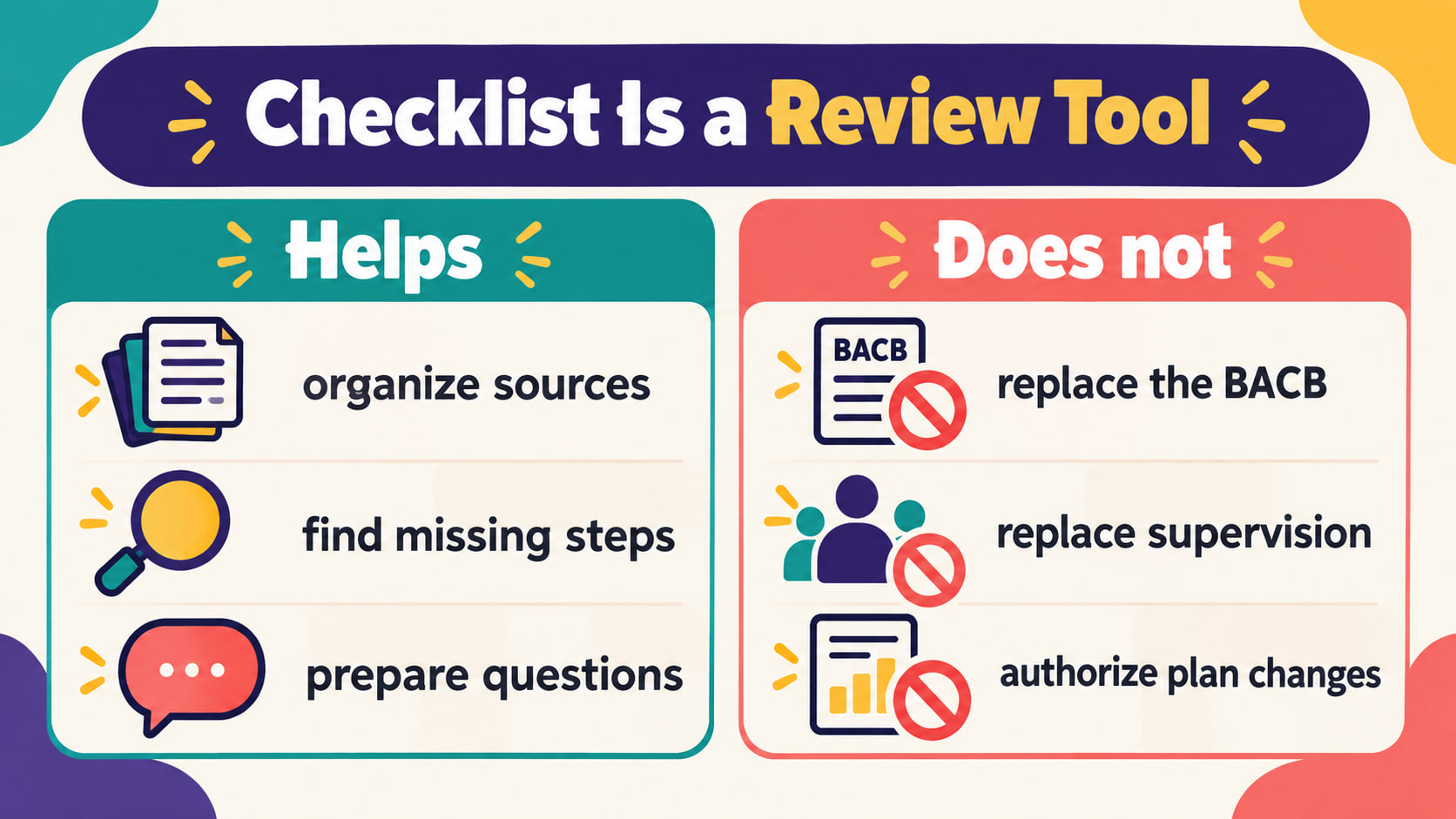
The current official content outline, handbook, organizational policy, assigned procedures, and supervision control decisions in your setting. A checklist can help you prepare a better question, but it cannot authorize a plan change, replace competence assessment, or guarantee an examination result.
What a BACB checklist can do
A checklist can break a broad preparation task into visible actions. It can remind you to find the current source, define unfamiliar terms, compare an example with the assigned procedure, practice objective descriptions, and write down a question for supervision. It can also show which items have not yet been reviewed.
Use completion marks carefully. A checked box may mean “I located the source,” “I can explain the term,” “I practiced the skill,” or “I asked for clarification.” These are different levels of readiness. Label the kind of evidence instead of treating every check as proof of competence.
Start with the current source
First record the title, edition, date, and link for the source you are using. Check that the material is current. Older outlines, screenshots, copied summaries, and search snippets may omit updates or use language that no longer matches the current document.
For each checklist item, ask: “Which primary source supports this?” If the item cannot be connected to a current official source, policy, assigned procedure, or clearly labeled educational explanation, mark it for review rather than treating it as settled.
Review RBT role limits
Preparation should include what an RBT does and what an RBT should route to a supervisor or another authorized professional. Review implementation, data collection, communication, documentation, privacy, safety, and supervision expectations together with the limits of competence.
A checklist item such as “understand assessment” needs careful interpretation. Studying a concept is not the same as independently conducting an assessment. Similarly, recognizing a treatment-plan component is not permission to design or change one. Add a boundary note beside any item that could be misunderstood.
Turn the checklist into study targets
Convert broad items into observable study actions. Instead of “know data,” write “explain the difference between frequency and duration, identify which measure the assigned procedure requires, and ask what to do when a value is missing.” Instead of “know ethics,” write “identify the privacy, role, and escalation question in an original scenario.”
Mix recognition with application. You may recognize a definition in a multiple-choice question but still need practice describing an event objectively or locating the correct procedure. Use examples that are original and clearly labeled as educational; never present recalled or leaked examination questions as study material.
Write focused questions
A checklist is most valuable when it produces a specific question. Include the source checked, the observable situation, the exact uncertainty, and the decision or explanation you need. For example: “The procedure states X, but the current form asks for Y. Which approved instruction should I follow, and where should the discrepancy be documented?”
Do not include unnecessary client-identifying information in personal study notes. Use the approved communication route for real service questions. If the issue involves safety, privacy, missing data, a conflict in instructions, or a task beyond demonstrated competence, follow the designated escalation process.
Use the checklist as a review tool
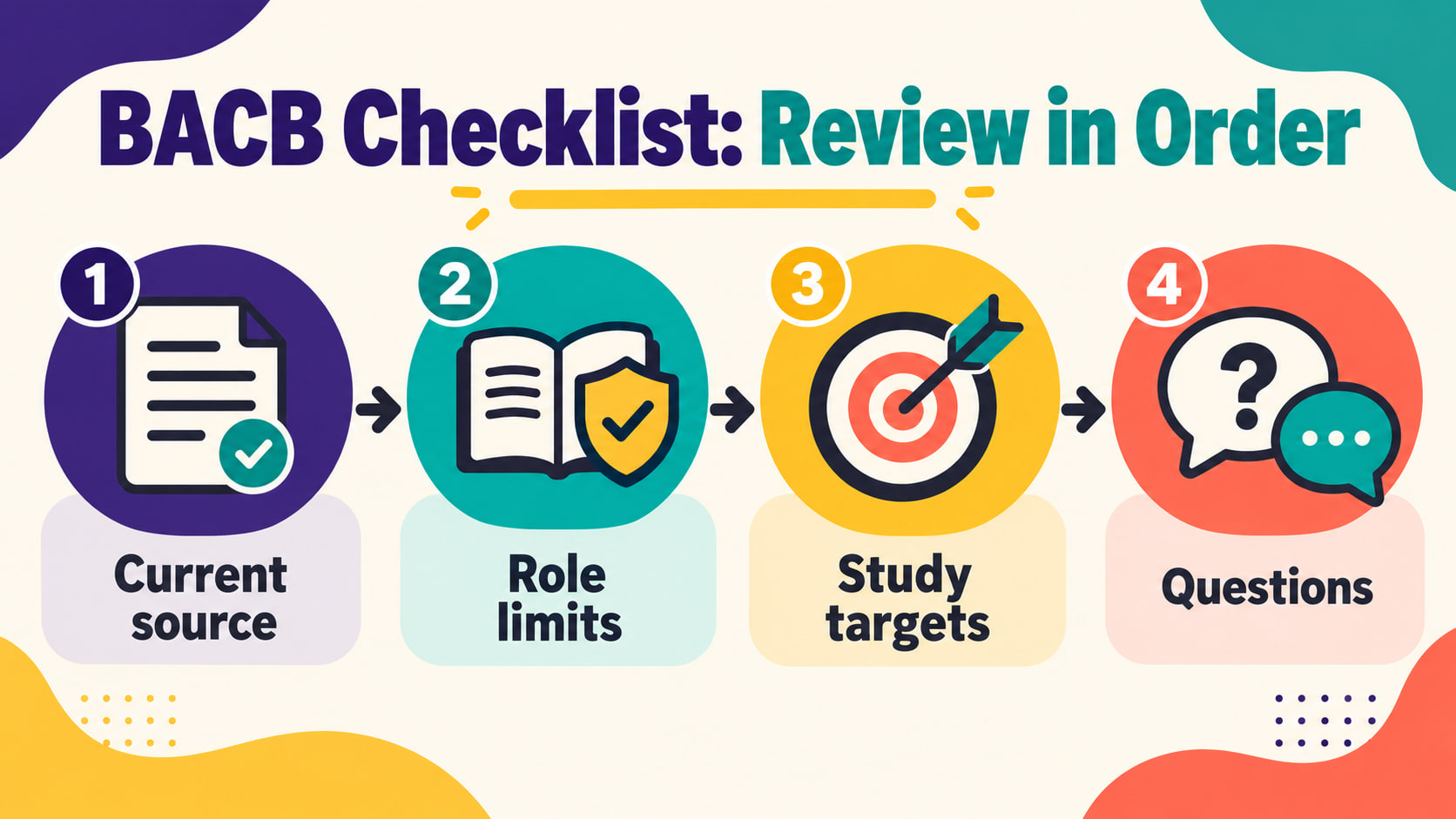
Review the checklist in order: current source, role limits, study targets, and questions. Then return to items marked uncertain. Note the source and date of an update, remove obsolete links, and separate personal reminders from official requirements.
Ask a supervisor or approved trainer to review the interpretation when a checklist item affects implementation. A checklist can organize the conversation, but the responsible person determines how a current procedure applies in the service context. Keep the checklist from becoming an unofficial replacement for supervision.
Common checklist mistakes
- Confusing a third-party list with an official source: branding is treated as endorsement.
- Checking boxes without evidence: reading is mistaken for demonstrated competence.
- Using an old edition: outdated language drives current study or practice.
- Ignoring role boundaries: a concept review becomes permission for independent action.
- Copying exam claims: unofficial questions are presented as real or recalled content.
- Skipping the question step: uncertainty is hidden instead of routed to supervision.
A strong checklist is short enough to use, specific enough to verify, and humble enough to show what it cannot answer. Its job is to improve attention and preparation, not to create false certainty.
It can help to keep three columns beside each item: source, evidence, and next step. “Source” records where the information came from. “Evidence” records whether you located, explained, practiced, or observed the skill. “Next step” records the question, review date, or supervision action still needed. This prevents an attractive checklist from becoming a collection of vague promises.
Use the same discipline when sharing a checklist with another learner. Explain whether it is a personal study aid, an employer tool, or a summary of an official document. Include the date you last checked it and invite readers to verify current requirements. That small context protects learners from treating a convenient list as the final authority.
When a learner cannot complete an item, record the reason rather than hiding it. A missing source, unclear definition, incomplete practice opportunity, or unresolved supervision question each calls for a different next step.
Frequently asked questions
Is every BACB checklist official?
No. Check the publisher, source, date, and purpose. Use current official materials for controlling requirements.
Can a checklist prove I am competent?
No. A check mark can document review or practice, but competence requires the applicable training, observation, feedback, and supervision process.
Can I use a checklist to change a procedure?
No. Use it to identify a question and follow the current written instruction and supervision process.
What should I do when the checklist conflicts with the handbook?
Pause, identify the exact conflict, and ask the responsible person which current source controls. Do not choose the easier version independently.
Source note: Review current BACB materials, organizational policy, assigned procedures, the written service plan, and supervisor direction for your setting. This article is educational and does not provide individualized legal, clinical, employment, or credentialing advice.
Ready to practice the RBT concepts you just reviewed?
Try an independent, original RBT practice resource with exam-style questions, scoring, and answer explanations.
References
- Behavior Analyst Certification Board. RBT Test Content Outline, 3rd edition.
- Behavior Analyst Certification Board. RBT Handbook.
- Behavior Analyst Certification Board. RBT Ethics Code.