
A BACB VCS list can help you check training information, but it is only one part of responsible RBT preparation and eligibility review.
Table of Contents
- What a BACB VCS list is for
- Find the official source
- Confirm the course information
- Check dates and status
- Understand what the list does not prove
- Save useful evidence
- Common VCS list mistakes
- Frequently asked questions
- References
RBT TRAINING · SOURCE CHECKING
BACB VCS List: How to Check Training Information
Use course-sequence information carefully, verify current sources, and keep training details separate from the full RBT eligibility pathway.
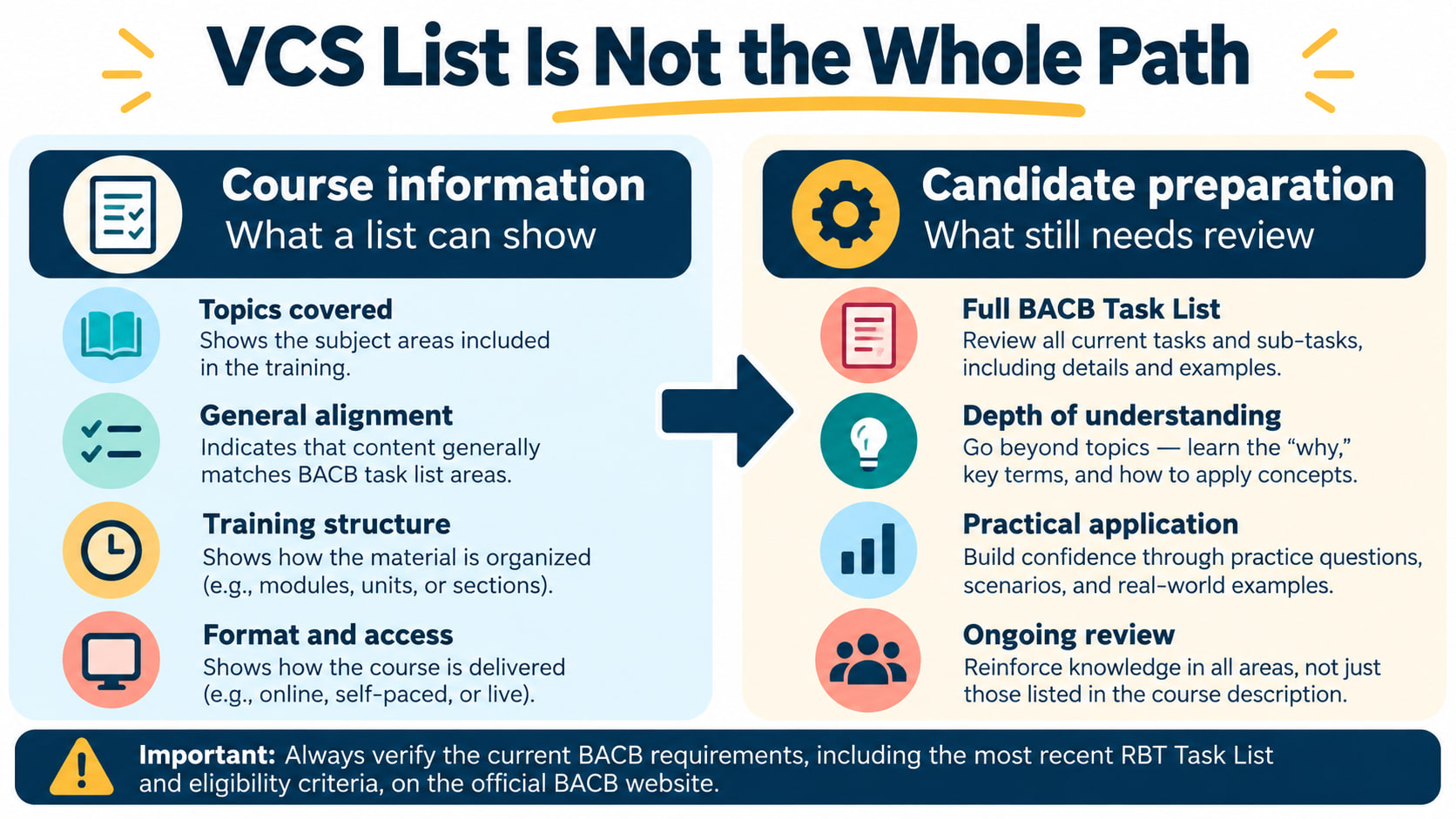
A BACB VCS list can help a reader check verified course sequence information, but it is only one part of responsible RBT preparation and eligibility review. The list may help identify course details or compare training information. It does not, by itself, guarantee that a person meets every current requirement or that a course will produce a particular result.
VCS commonly refers to a verified course sequence. Because course information, official terminology, and requirements can change, use the current BACB source rather than relying on a copied directory, old screenshot, search snippet, or provider claim. Check the date, the source, the specific course, and the purpose of the information.
Keep three questions separate: What does the course list show? What does the current official requirement say? What still needs to be completed or verified for the individual candidate? Separating these questions prevents a convenient list from becoming a misleading promise.
What a BACB VCS list is for
A VCS list is a source-checking tool for course-sequence information. Depending on the official page and its fields, it may help a reader locate a sequence, understand the institution or provider associated with it, and review the information that the source makes available.
Use the list to begin verification, not to end it. Read the surrounding official explanation, identify the date and status language, and follow the linked instructions. If a provider’s marketing page says more than the official source supports, treat the official source as the starting point for clarification.
Find the official source
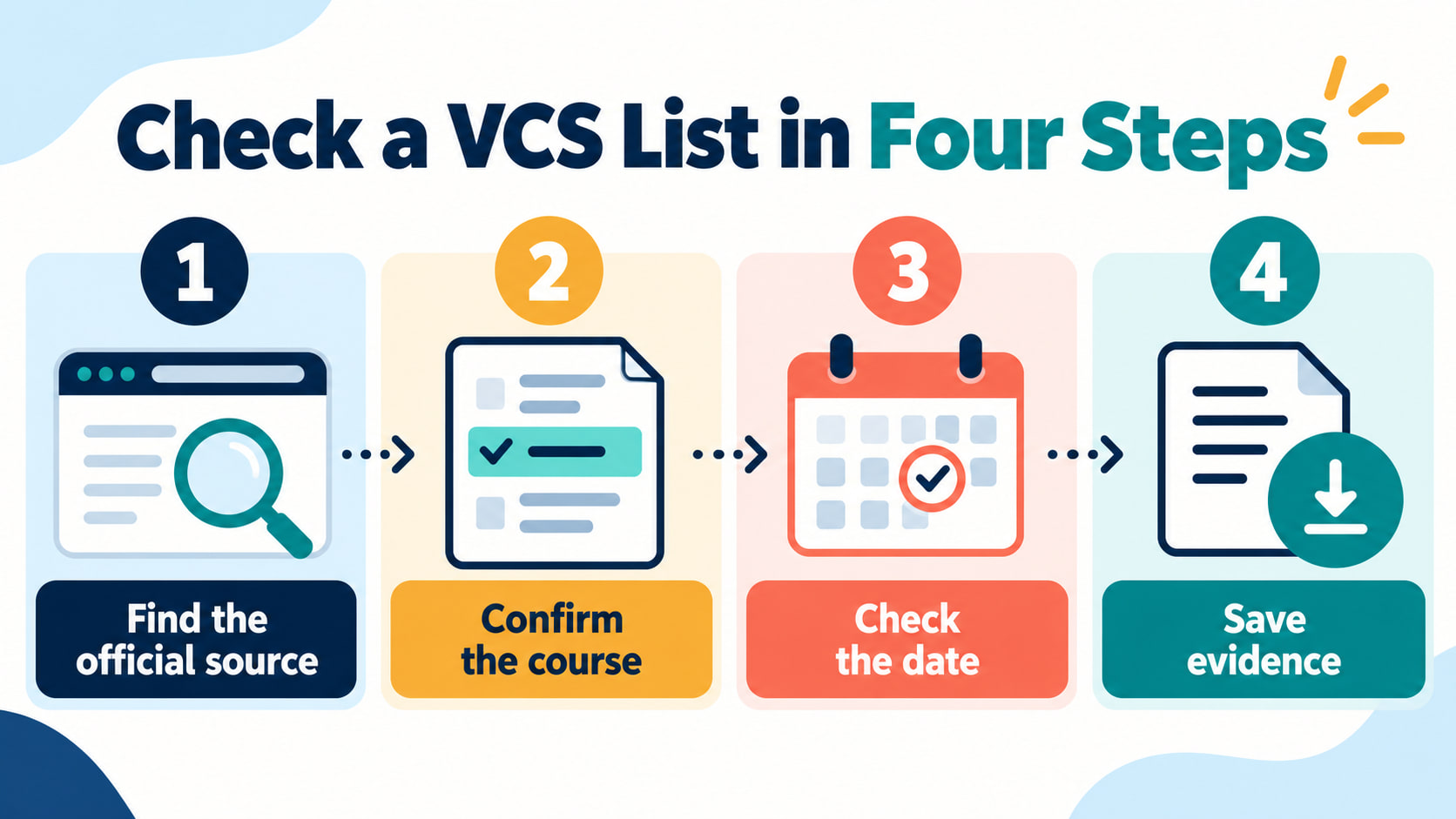
Start from the BACB website or the current official resource linked by the relevant handbook or instructions. Check the web address, page title, update date, and explanation of what the list represents. A page that merely mentions “BACB,” “VCS,” or “verified” is not automatically an official directory.
Save the page title and access date for your own review. If the page links to a downloadable document, check that the document belongs to the official source and is not a third-party rewrite. When a link is broken or the wording is unclear, contact the designated source rather than guessing.
Confirm the course information
Match the exact course or sequence name, institution, provider, location or delivery format when listed, and any identifier supplied by the source. Similar names can refer to different courses. Do not assume that one course, one instructor, or one training package is interchangeable with another because the descriptions use similar words.
Check what the course information actually covers. A course listing may identify training structure, topics, modules, or delivery details. It may not answer whether the individual completed the course, met a competency requirement, submitted an application, passed an examination, or has current supervised experience.
Check dates and status
Record when you checked the information and whether the source describes it as current, active, approved, verified, or another specific status. Do not turn a past status into a permanent statement. A candidate’s records and a provider’s listing may change independently, so verify again when applying or making an important decision.
If the current official page conflicts with an old course advertisement, pause and ask the provider or BACB through the appropriate channel. Do not edit a screenshot or rely on a cached description as proof of current status.
Understand what the list does not prove
A course list does not automatically prove that a person is eligible for certification, has completed every required step, has passed an examination, or holds a current credential. It does not replace the current handbook, application instructions, competency process, supervision requirements, employer onboarding, or any other applicable requirement.
Training information also does not authorize an RBT to work outside the assigned role. A course may explain concepts such as measurement, prompting, reinforcement, ethics, or documentation. The RBT still follows the current written procedure, service plan, policy, and supervision for implementation.
Save useful evidence
Keep a simple verification note with the official URL, page title, access date, course or sequence name, and the question the information answered. Store it in an approved location and avoid including unnecessary personal or client information. Evidence should make later review easier, not create a new privacy risk.
When asking for help, share the exact source and the specific uncertainty: “The official page lists this sequence, but the provider describes an additional requirement. Which current instruction applies to my application?” A focused question is more useful than forwarding a long collection of screenshots without context.
Common VCS list mistakes
- Using a third-party directory as final authority: a copied list is treated as current.
- Confusing course presence with personal completion: a listed sequence is assumed to prove an individual’s record.
- Ignoring dates: old status language is used for a current decision.
- Assuming endorsement: provider marketing is read as official approval.
- Skipping the full pathway: course information is treated as every eligibility step.
- Saving private screenshots carelessly: evidence is stored or shared in an unapproved location.
A responsible VCS review ends with a clear next action: verify the source, contact the provider or official channel, complete a required step, or ask supervision for role-specific direction.
It is also helpful to separate “course fit” from “candidate fit.” Course fit asks whether the training information matches the subject and format you are looking for. Candidate fit asks whether your own education, documentation, timing, application, and other requirements are complete. A list can inform the first question without answering the second.
When comparing providers, use the same evidence standard for each one. Record the official listing, the provider’s written completion terms, the total cost and format when relevant, and the questions that remain unanswered. Avoid choosing based only on a badge, a search ranking, or a promise that is not supported by the official source.
Frequently asked questions
Does a BACB VCS list guarantee certification?
No. It provides course-sequence information and does not establish that every current eligibility, application, competency, examination, or supervision requirement is complete.
Can I rely on a provider’s VCS screenshot?
Use it as a lead, then verify the exact information on the current official source. Record the access date and ask when the wording is unclear.
Does a VCS list prove I completed a course?
No. A listing and an individual completion record are different questions. Keep the provider’s approved completion documentation and follow current instructions.
What if the official list and provider page disagree?
Pause and ask the appropriate official or provider contact which current source controls. Do not choose the version that seems easiest.
Source note: Review the current BACB VCS resources, RBT Handbook, official content outline, provider documentation, and applicable application instructions. This article is educational and does not provide individualized legal, clinical, employment, or credentialing advice.
Ready to practice the RBT concepts you just reviewed?
Try an independent, original RBT practice resource with exam-style questions, scoring, and answer explanations.
References
- Behavior Analyst Certification Board. RBT Test Content Outline, 3rd edition.
- Behavior Analyst Certification Board. RBT Handbook.
- Behavior Analyst Certification Board. RBT Ethics Code.