
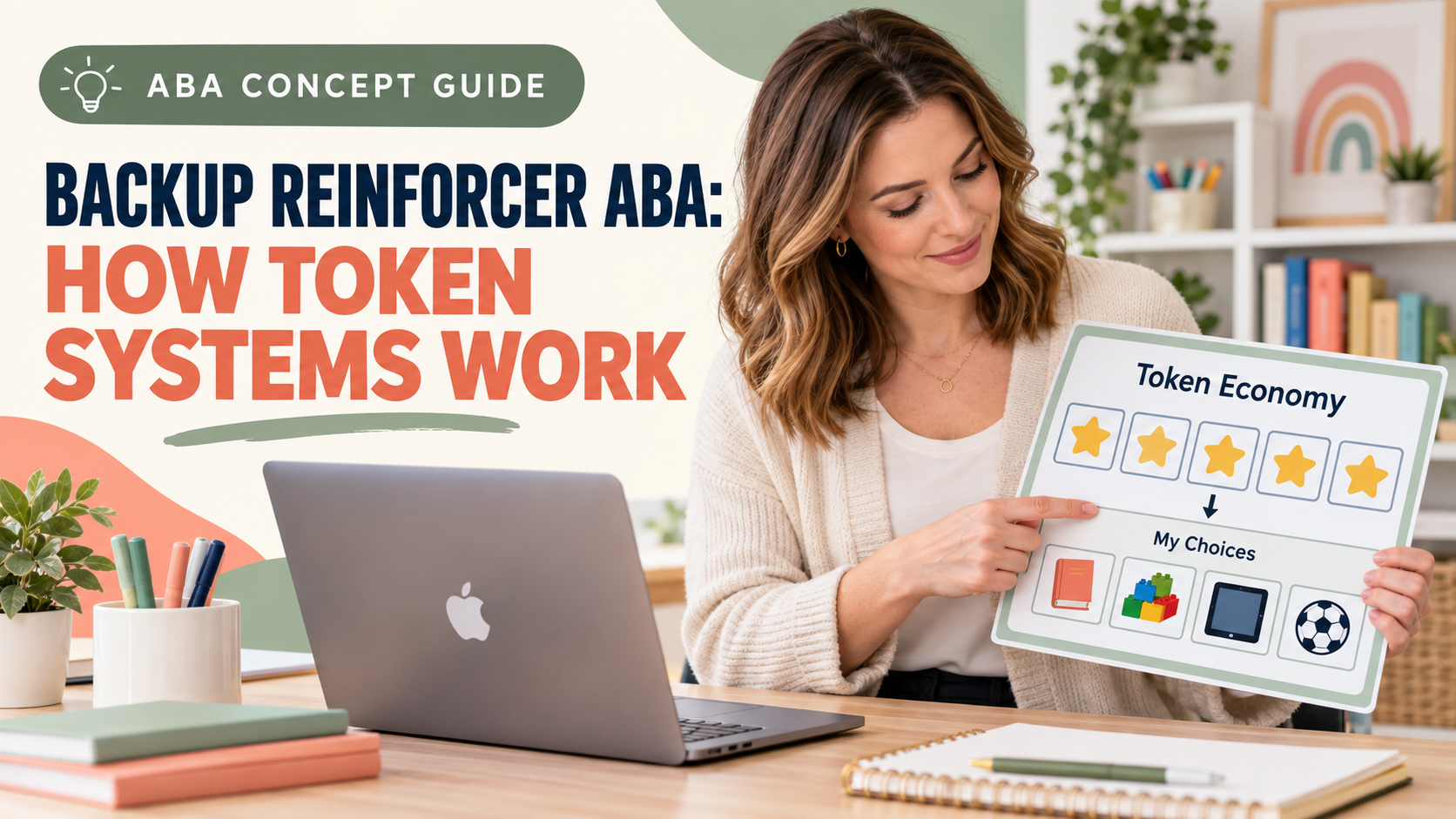
Backup reinforcer ABA refers to the preferred item, activity, or privilege exchanged for tokens in a token system; the token bridges the delay, while the backup is what the learner chooses to work toward.
Table of Contents
- Backup reinforcer ABA: the simple definition
- Backup reinforcer versus token
- The parts of a token system
- How preference and choice guide the menu
- How an RBT implements the procedure
- What to measure and review
- Pairing, fading, and generalization
- Ethical and practical safeguards
- Common backup-reinforcer mistakes
- Frequently asked questions
- References
ABA CONCEPT GUIDE · REINFORCEMENT SYSTEMS
Backup Reinforcer ABA: How Token Systems Actually Work
Learn what the backup is, why the token is only the bridge, and how an RBT can implement the authorized system with choice and data.
Backup reinforcer ABA refers to the preferred item, activity, or privilege exchanged for tokens in a token system. The token bridges the delay between a target behavior and the later exchange; the backup is what the learner ultimately chooses to work toward. Keeping those two parts separate makes token-board discussions much clearer.
The BACB RBT Test Content Outline (3rd ed.) includes establishing and using conditioned reinforcers and implementing token economies. This guide explains the concept and implementation logic for RBT learning. It does not design an individualized program, choose an exchange rate for a learner, or authorize response-cost procedures. Those decisions belong to the responsible supervisor and the current plan.
Backup reinforcer ABA: the simple definition
A backup reinforcer is a consequence that has value for the learner and can be exchanged for earned tokens. Examples may include a preferred activity, a short game, time with a favorite material, a social interaction, a privilege, or another authorized option. The right option depends on the learner, context, access, culture, communication, and current preferences.
Consider a simple sequence:
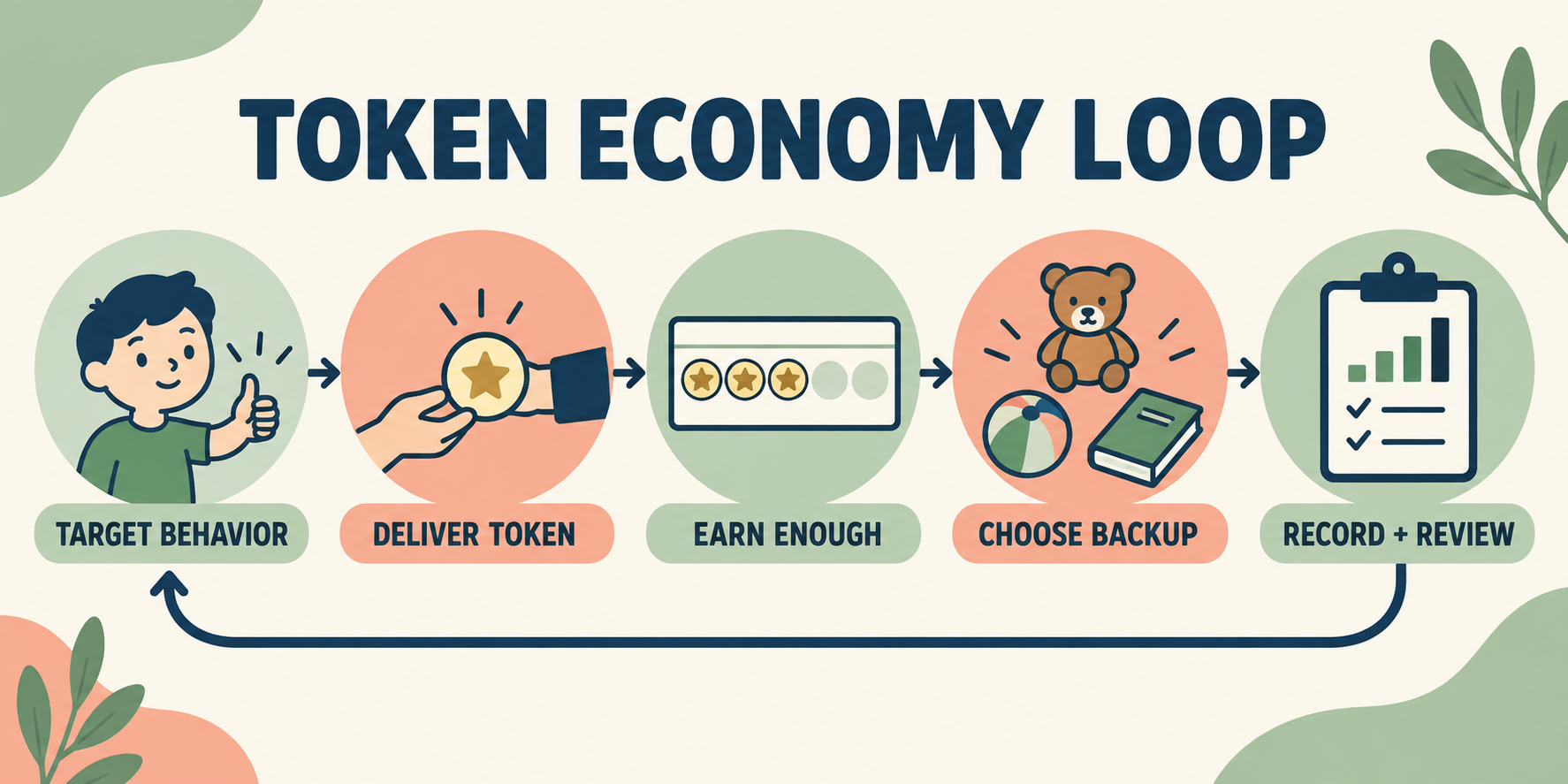
- The plan defines a target behavior in observable terms.
- The learner engages in that behavior.
- The RBT delivers a token according to the current contingency.
- The learner earns enough tokens to exchange them.
- The learner selects an available backup reinforcer and receives it as described by the plan.
The backup is not automatically reinforcing just because an adult calls it a reward. It earns that description from its effect on behavior and from the learner’s demonstrated preference. If the learner repeatedly chooses the option but the target behavior does not improve, the supervisor may need to review the definition, timing, effort, teaching procedure, or the whole system.
Backup reinforcer versus token
The token is the immediate, portable signal delivered after the target response. It may be a point, checkmark, chip, sticker, card, or digital mark. By itself, it may have little value. Through pairing and exchange, it can become a conditioned reinforcer that tells the learner, “You are closer to an available option.”
The backup reinforcer is the item or activity for which the token can be traded. A star on a chart is the token; five stars exchanged for ten minutes of a preferred activity makes that activity the backup reinforcer. Confusing the two can lead to a system in which tokens are handed out but there is no reliable, meaningful way to use them.
A token system is also different from a bribe. A planned system identifies the behavior and consequence before the situation, delivers the token according to the stated contingency, and uses an exchange rule. Offering a new reward in the middle of a problem behavior to make the moment stop can create a different contingency. If the plan is not working, contact the supervisor instead of improvising.
The parts of a token system
Before implementation, the responsible clinician should define the system clearly. At minimum, ask whether the written procedure identifies:
- Target behavior: what the learner can do to earn a token, described so different adults can recognize it.
- Token form: what the token looks like, where it is kept, and how it is delivered.
- Delivery rule: when and how quickly the token follows the target response.
- Exchange menu: which backup reinforcers are available and how the learner chooses.
- Exchange requirement: how many tokens are needed and when exchange occurs.
- Data plan: which behavior, token deliveries, exchanges, and relevant variables are recorded.
- Fading or generalization plan: how the learner will use skills beyond the board or one adult.
The RBT should not fill missing clinical decisions with personal preference. If the target is vague, the menu is empty, the exchange rule is impossible, or staff are delivering tokens inconsistently, document the problem and seek supervisor direction.
How preference and choice guide the menu
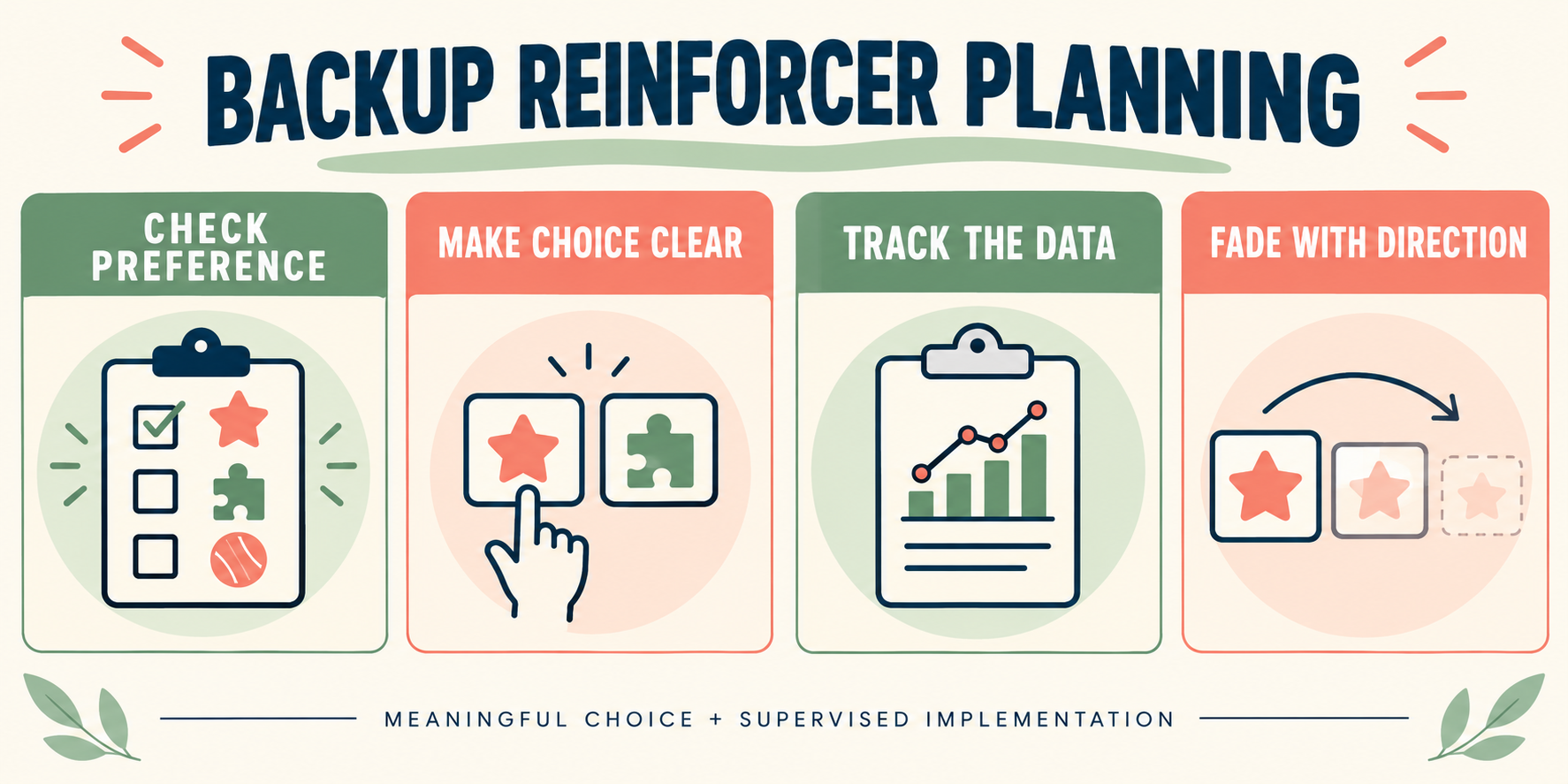
A good menu starts with information about what the learner currently approaches, requests, selects, or enjoys. Preferences can change with time, access, context, effort, and fatigue. An item that worked yesterday may be less useful today, while an activity that an adult overlooks may be highly valuable to the learner.
Choice can be built into the authorized procedure. Offer the available options in the way the plan specifies, allow the learner to communicate a selection, and honor the selection when possible. If the learner rejects every option, reaches for something unavailable, or shows signs that the exchange is not meaningful, record the response and ask the supervisor how to proceed. Do not turn the menu into a demand that the learner must accept.
Use multiple kinds of backups when the plan allows it. A small activity, a social option, and a longer preferred activity may provide flexibility. The point is not to create a large prize store; it is to maintain meaningful choice while keeping the system understandable and feasible in the setting.
How an RBT implements the procedure
Implementation begins before the target behavior occurs. Have the token ready, confirm the exchange menu, and check that the learner can see or understand the system. When the defined behavior occurs, deliver the token promptly and pair it with a brief, specific statement if the plan includes that language. Avoid a long explanation that delays the next learning opportunity.
At exchange time, follow the current steps exactly. Count tokens with the learner if that is part of the procedure, present the available choices, and deliver the selected backup for the stated duration or amount. Return to instruction or the next routine without making the exchange feel like a public performance.
If the learner asks to exchange early, loses a token, earns tokens too quickly, or cannot access the backup because the schedule changed, do not invent a new rule. Note what happened, maintain safety and dignity, and contact the supervisor for direction.
What to measure and review
Data should answer whether the system is doing its job. Depending on the plan, the team may track the frequency, duration, latency, or percentage of the target behavior; the number of tokens delivered; successful exchanges; choice patterns; or the amount of prompting required. Record the measure that was assigned rather than collecting a large pile of unrelated numbers.
Also note variables that may change the result: the backup was unavailable, the learner had already had extensive access to it, the activity was interrupted, the exchange delay increased, a new staff member implemented the system, or the target was harder than usual. These observations help the supervisor distinguish a preference issue from a teaching, measurement, or implementation issue.
A token system is not successful merely because the board is full. Look at the learner’s behavior, communication, choice, participation, and progress across the relevant setting. If the learner earns tokens but never exchanges them, the system may need review. If behavior changes only when the board is visible, generalization may need attention.
Pairing, fading, and generalization
Tokens become useful through a history of reliable pairing with meaningful consequences. Early in a system, the learner may need frequent exchanges and clear demonstrations. As the learner understands the relationship, the supervisor may plan changes in exchange timing, prompts, or the visibility of the board. Do not thin the schedule simply because the adults are tired of carrying tokens.
Generalization means the learner uses the skill with different people, materials, activities, or settings when the plan calls for it. A token system may begin at a table and later be practiced during a transition or community routine. The RBT should follow the written progression and report whether the behavior transfers. The long-term goal is meaningful participation and independence, not dependence on an adult-controlled prize menu.
Ethical and practical safeguards
Respect and safety come before a full token board. Do not withhold food, water, medication, communication, necessary breaks, comfort, or basic care as a backup reinforcer. Do not use public charts that expose a learner’s performance without authorization. Avoid language that shames a learner for not choosing an option or not earning a token.
Food can raise health, allergy, cultural, and family-consent concerns. If food is included in an authorized plan, follow the responsible professional’s instructions and all setting requirements. An RBT should never introduce a food-based backup because it seems convenient.
Response cost, token loss, or restrictive access can have additional ethical and clinical implications. These are not automatic parts of a token economy. If they appear in a plan, implement only after training and competency, and ask the supervisor about any safety, dignity, or implementation concern.
Common backup-reinforcer mistakes
- Choosing what adults like: an adult’s favorite prize is not evidence of the learner’s preference.
- Delivering tokens late: a delayed token can weaken the connection between the response and consequence.
- Changing the exchange rate casually: the learner needs a predictable rule unless the authorized plan changes.
- Using one backup forever: satiation, availability, and changing interests can reduce effectiveness.
- Calling any sticker chart a token economy: the system still needs a defined contingency and an exchangeable backup.
- Ignoring learner communication: refusal, choice, requests, and engagement are information to report, not obstacles to overpower.
Frequently asked questions
Is the token the backup reinforcer?
No. The token is the conditioned signal or bridge delivered after the target behavior. The backup reinforcer is the preferred item, activity, or privilege exchanged for the token or token total.
Can a break be a backup reinforcer?
A break or preferred activity may be an authorized backup option when it is appropriate for the learner and setting. The supervisor and team should determine how it is defined, scheduled, and protected from becoming a denial of necessary rest or access.
What should an RBT do when no backup seems effective?
Continue the current safe procedure, collect the assigned data, record the relevant context, and contact the supervisor. Do not add a new reward, increase the token requirement, or introduce response cost without direction.
How many backup choices should a token board have?
There is no universal number that works for every learner or plan. Too few options can make the system fragile; too many can make it confusing. Use the authorized menu, offer meaningful choice, and ask the supervisor to revise it when data show a problem.
The most useful way to remember the concept is this: the target behavior earns the token, and the token opens access to a meaningful backup reinforcer. When the menu is based on real preference, the exchange is clear, data are reviewed, and the RBT stays within supervision, the system becomes a teaching tool rather than a decorative chart.
Ready to practice the RBT concepts you just reviewed?
Try an independent, original RBT practice resource with exam-style questions, scoring, and answer explanations.
References
- Behavior Analyst Certification Board. RBT Test Content Outline, 3rd edition.
- Behavior Analyst Certification Board. RBT Handbook.
- Behavior Analyst Certification Board. RBT Ethics Code.