
A BCBA RBT checklist can organize a supervision conversation, but it should support—not replace—current official requirements and professional judgment.
Table of Contents
- What a BCBA RBT checklist is for
- Before support: prepare the conversation
- During support: observe and ask
- Clarify data and documentation
- Protect privacy and role boundaries
- After support: record next actions
- Adapt the checklist to the setting
- Frequently asked questions
- References
RBT PRACTICE · SUPERVISION CHECKLIST
BCBA RBT Checklist: Clarify Supervision and Documentation
Organize plans, responsibilities, data, privacy, feedback, and next actions in supervision conversations.
BCBA RBT checklist is a useful search phrase for people who want to organize supervision, but a checklist is not automatically an official BACB form. It should support communication about the current plan, assigned responsibilities, observations, feedback, documentation, and next steps.
Use current official BACB materials, employer policies, applicable privacy rules, and supervisor direction for decisions about credentialing and practice. The checklist below is an educational planning tool. It does not authorize independent clinical decisions or replace a supervisor’s individualized guidance.
What a BCBA RBT checklist is for
A checklist helps a learner or team remember questions before, during, and after a support conversation. It can reduce the chance that a practical detail—such as the current version of a plan, the data rule, or the next follow-up—remains unclear.
The checklist does not decide what an RBT should implement. The applicable plan, supervisor direction, employer procedures, official requirements, and the actual service context remain important. Treat each checkbox as a prompt to clarify, not as permission to act outside the assigned role.
Before support: prepare the conversation
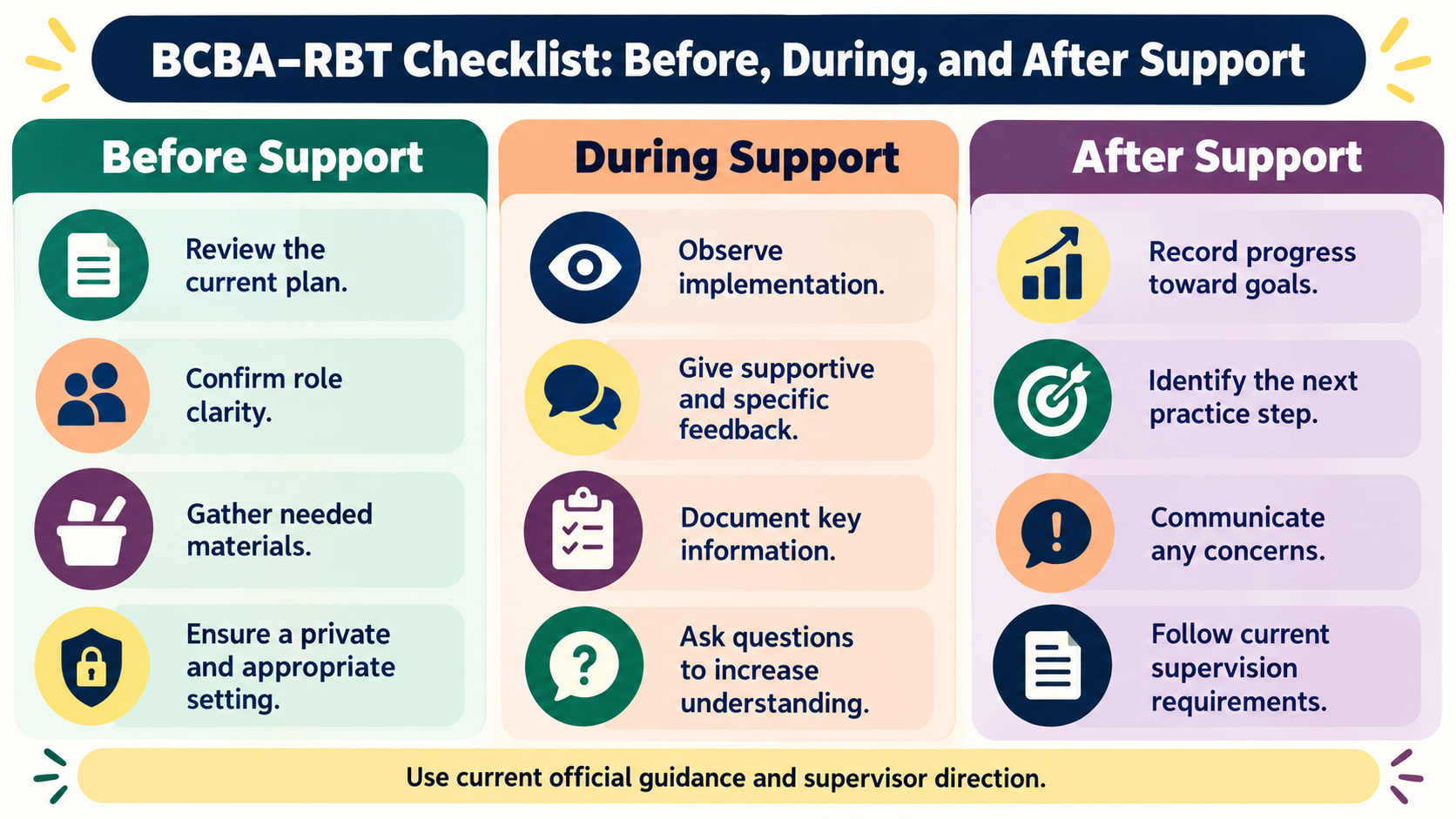
Start by identifying the date, setting, people involved, learner or case identifier used by the organization, and purpose of the meeting. Use the organization’s privacy-safe naming system; do not place unnecessary identifying information in a personal checklist.
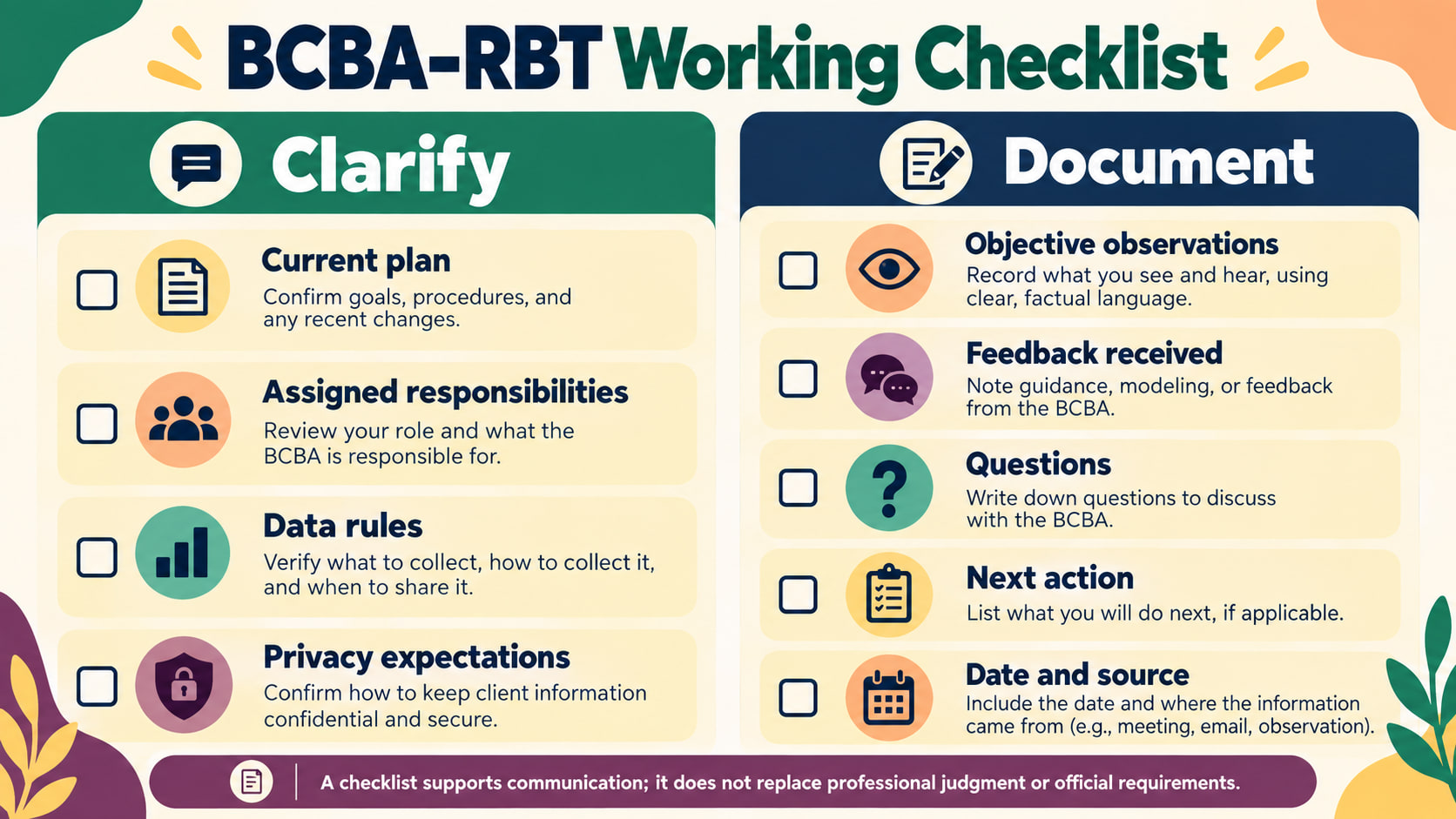
Review the current plan and note its version or effective date. Ask whether goals, procedures, data definitions, materials, reinforcement arrangements, prompting, or safety instructions have changed. If you find two versions, pause and ask which one is current.
Clarify responsibilities before implementation. What should the RBT do? What should the supervisor or other responsible professional do? What should be reported immediately? What should be documented for the next meeting? Written role clarity can prevent a learner from improvising when the plan is unclear.
Gather only the materials you are authorized to use. Check that data sheets, approved visuals, communication tools, and other materials match the current plan. Confirm how paper or digital records are stored and who can access them.
During support: observe and ask
During observation or modeling, focus on observable actions and the context in which they occur. Note what was demonstrated, what you practiced, what feedback was given, and what remains uncertain. Avoid turning a quick conversation into a broad conclusion about a person’s behavior or ability.
Ask specific questions: What is the operational definition? Which measurement is required? When should the response be prompted? What consequence is in the approved procedure? When should the RBT pause and contact the supervisor? Specific questions make feedback easier to apply and document.
Request supportive, concrete feedback. If a direction is unclear, repeat it in your own words and ask whether your understanding is correct. A checklist can record the question and answer; it should not be used to create an unapproved procedure.
Clarify data and documentation
Data rules should be observable and consistent. Confirm what to record, when to record it, which measure to use, how to handle a missed opportunity, and where to report a technology or materials problem. Ask what the supervisor wants to review and how quickly concerns should be communicated.
Use objective language. Record what you saw or heard, the relevant context, the action taken under the plan, and the communication that followed. Avoid speculation, labels, diagnoses, or conclusions that are not part of your assigned documentation task.
Check the organization’s correction policy before changing a record. Do not erase or silently rewrite data to make it look cleaner. Ask the responsible person how to correct an error while preserving the original record and date.
Protect privacy and role boundaries
Confirm where information may be viewed, discussed, stored, and transmitted. Use approved systems and follow employer privacy procedures. A personal notes app, open email, or public discussion board may not be appropriate for client information.
Role boundaries matter when a situation changes. An RBT should not independently diagnose, design treatment, change a learner’s plan, select an unapproved intervention, or make a decision outside demonstrated competence. Use the checklist to identify when to contact the supervisor, not to replace that contact.
If safety, consent, privacy, or ethical concerns arise, follow the applicable emergency and reporting procedures. Record the fact that the concern was communicated, the date, and the direction received, using the organization’s approved system.
After support: record next actions
End the conversation by summarizing the next action, owner, deadline, and evidence of completion. This could be a practice task, a data review, a question for the next meeting, a plan clarification, or a request for additional observation.
Record feedback in a way that is useful and respectful. Note the skill or procedure, the observable feedback, and what you will practice. Avoid using the checklist as a performance score unless the organization has adopted a specific validated tool and explained how it is used.
Revisit open items at the next appropriate contact. If the plan, setting, employer, or supervisor changes, update the checklist rather than carrying forward an assumption. A dated record helps distinguish current direction from older notes.
Adapt the checklist to the setting
- Identify the source: Record the current plan, policy, or official material that informs the question.
- Clarify the role: Write who observes, directs, documents, reviews, and communicates.
- Protect information: Use approved identifiers, systems, and privacy practices.
- Document objectively: Separate observations, feedback, questions, and decisions.
- Close the loop: Record the next action, owner, date, and proof of completion.
Different employers may use different forms, terminology, reporting windows, and supervision arrangements. Adapt this educational outline to the organization’s approved workflow. If a checkbox conflicts with current official guidance or supervisor direction, stop and resolve the conflict rather than forcing the checklist to fit.
Keep the checklist short enough to use. A long form that distracts from the learner, the approved plan, or real-time safety is not automatically better. Prioritize current instructions, objective observations, privacy, feedback, and the next action.
Ask how the completed record is stored, who can review it, and how long it is retained. If you are unsure whether a note belongs in the record, ask the responsible supervisor or organization rather than keeping sensitive information in an unapproved personal file.
Use the tool for communication, not for independent treatment planning. Its value comes from making questions visible and follow-up reliable. The supervisor, employer, official authority, and applicable policies still determine the answer for the situation.
Before using any template in a new setting, confirm its purpose, owner, version, and privacy status. A checklist copied from another organization may omit a local requirement or use a definition that does not match the current plan.
Frequently asked questions
Is a BCBA RBT checklist an official BACB form?
Not automatically. Treat a general checklist as an educational communication tool unless the responsible organization identifies a specific official form.
What should an RBT checklist cover?
It can prompt questions about the current plan, roles, data rules, privacy, feedback, documentation, next actions, and follow-up.
Can a checklist authorize an RBT to change a plan?
No. A checklist supports communication; it does not authorize independent clinical decisions or replace supervisor direction.
Should client information be placed in a personal checklist?
Use approved systems and privacy-safe identifiers. Ask the organization how sensitive information should be documented and stored.
Source note: Review the current BACB Handbook, RBT materials, employer requirements, applicable local rules, privacy policies, and supervisor direction for your situation. This article is educational and does not provide individualized legal, clinical, employment, or credentialing advice.
Ready to practice the RBT concepts you just reviewed?
Try an independent, original RBT practice resource with exam-style questions, scoring, and answer explanations.
References
- Behavior Analyst Certification Board. RBT Test Content Outline, 3rd edition.
- Behavior Analyst Certification Board. RBT Handbook.
- Behavior Analyst Certification Board. RBT Ethics Code.