
A behavior acquisition plan turns a broad learning goal into observable teaching steps, measurement rules, and decision points. For an RBT, the key task is usually to understand and implement the current written program accurately—not to invent a new clinical plan. This guide maps the sections an RBT should locate before a session and shows when unclear wording requires supervisor direction.
Table of Contents
- Behavior acquisition plan: the quick meaning
- Behavior acquisition plan: the components an RBT should locate
- How to read target, baseline, and measurement sections
- Behavior acquisition plan: prompts, reinforcement, and teaching steps
- Mastery, generalization, and maintenance rules
- What an RBT implements versus what requires supervisor direction
- Frequently asked questions
- Official sources and scope
RBT skill acquisition, written programs, and supervision
Behavior Acquisition Plan: What an RBT Should Read Before a Session
A practical map of the target, baseline, teaching steps, data rules, and role boundaries inside a written acquisition program.
A behavior acquisition plan turns a broad learning goal into observable teaching steps, measurement rules, and decision points. Instead of simply saying “teach communication” or “improve independence,” a useful written plan explains what skill is being taught, how the current performance will be measured, what the practitioner will do, and what counts as progress.
For an RBT, the most important distinction is role. The RBT should be able to find and follow the current written procedure, prepare the required materials, deliver the assigned teaching steps, record accurate data, and communicate observations. The RBT should not quietly rewrite the target, change the mastery criterion, or invent a new prompting procedure because a plan feels incomplete. When a detail is missing or contradictory, the safe professional move is to ask the supervisor.
Behavior acquisition plan: the quick meaning
Behavior acquisition means teaching a new skill or increasing a skill that is not yet occurring reliably. The skill might involve communication, social interaction, self-care, learning readiness, safety, or another meaningful area. A behavior acquisition plan is the written map for teaching that skill under defined conditions.
“Behavior” in this context does not mean that the learner is a problem. It refers to an observable response or skill that can be taught, practiced, measured, and used in daily life. A plan should connect the skill to a meaningful outcome rather than treating a number alone as the goal.
For example, a generic plan might teach a learner to request help with a card, device response, sign, or spoken phrase. The plan would need to identify the response form, the situation in which help is available, the prompt sequence, the reinforcer or natural outcome, the data rule, and the criterion for moving forward. The exact response and procedure must come from the learner’s current program, not from this article.
Behavior acquisition plan: the components an RBT should locate
Before a session, an RBT should know where the following information appears in the written program or electronic record:
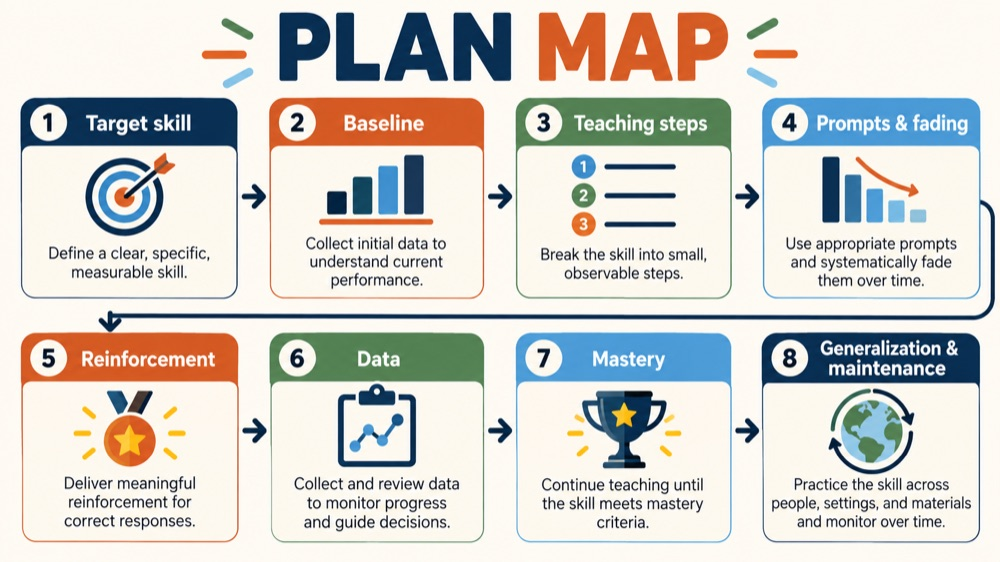
- Target skill. Look for a clear description of what the learner will do. A target should be specific enough that two trained people can recognize the response in the relevant setting.
- Starting point or baseline. Find the initial performance information. Baseline may describe frequency, accuracy, independence, latency, duration, or another measurement that matches the skill.
- Materials and conditions. Check what items, cues, people, locations, and motivating circumstances are part of the teaching arrangement. Small changes in materials can change what is actually being measured.
- Teaching procedure. Identify the sequence of instruction, the expected learner response, the consequence, and any error-correction or break procedure that is explicitly written.
- Prompts and fading. Find the approved prompt type, order, timing, and fading plan. Do not replace one prompt strategy with another because it seems faster.
- Reinforcement. Check what consequence follows the target response and how the plan says to deliver it. Use the current program and supervisor direction rather than assuming a favorite item is always appropriate.
- Data method. Confirm what to record, when to start and stop, what counts as a correct or independent response, and which data system is authorized.
- Mastery and next steps. Locate the criterion for maintaining, generalizing, thinning, or changing instruction. A target is not automatically mastered because one session looked successful.
How to read target, baseline, and measurement sections
A strong target description answers the question, “What would an observer see or hear?” Compare an interpretation such as “the learner is more independent” with a measurable description such as “the learner completes the listed steps after the instruction, without a prompt, within the stated interval.” The second description gives the RBT a scoring rule, but the exact wording still has to match the written program.
Baseline tells the team where teaching begins. It may show that a learner can complete some parts of a chain but not others, responds accurately only with a prompt, or uses a skill in one setting but not another. The RBT should not treat baseline as a permanent label. It is a starting measurement used to organize teaching and evaluate change.
Next, check the measurement definition. Frequency asks how often a response occurs. Duration asks how long it lasts. Latency asks how long it takes to begin after a cue. Percentage or trial-by-trial accuracy may be appropriate for discrete responses. Interval systems record whether a response occurred during or across specified intervals. The correct measure depends on the plan and the skill; an RBT should not substitute a more convenient measure without direction.
Look for start and stop rules, examples, nonexamples, and any condition that excludes a response from scoring. If “independent” means no prompt was delivered within a defined interval, the RBT needs to know that interval. If a response is correct only when a particular cue is present, the cue belongs in the data context. When those details are absent, ask before making up a rule.
Behavior acquisition plan: prompts, reinforcement, and teaching steps
Teaching steps describe what happens from the instruction or opportunity through the learner’s response and the consequence. The plan may specify a prompt hierarchy, a time delay, modeling, a visual cue, task analysis, shaping, or another procedure. The RBT’s responsibility is to implement the procedure as written and record what happened, including prompts when the data system requires them.
Prompting should support the target response without becoming an untracked replacement for the response itself. A learner who completes a step after a full physical prompt is not scored the same way as a learner who completes it independently. Prompt level, prompt timing, and fading rules therefore matter. If the learner needs a prompt not described in the plan, pause at the appropriate point and seek the supervisor’s instruction.
Reinforcement is also more precise than “give praise.” A plan may identify a natural outcome, social feedback, access to a chosen activity, or another approved consequence. It may specify when reinforcement is delivered and how it changes as independence increases. Follow the written program, respect the learner’s communication and preferences, and report patterns that make the plan difficult to implement.
Error correction and breaks deserve the same care. Do not improvise a correction sequence, remove a break, or extend a demand simply because a target was missed. Those decisions can affect learner dignity, safety, data quality, and treatment integrity.
Mastery, generalization, and maintenance rules
Mastery is the plan’s rule for deciding when the learner has met the target under the defined conditions. It may involve a percentage across sessions, a number of consecutive opportunities, independence across people, or another criterion. The exact criterion is individualized. Meeting a criterion on one day may not be enough if the plan requires stability across sessions or settings.
Generalization asks whether the skill occurs with different people, materials, places, instructions, or examples. A learner who requests help from one familiar RBT may need additional teaching before using the response with a caregiver or in a community setting. Maintenance asks whether the skill continues after intensive teaching is reduced. Both concepts should appear as written decisions, not as assumptions.
The RBT can help by implementing the stated variations, recording the relevant conditions, and telling the supervisor when performance changes across contexts. The RBT should not independently move a target to a new setting, thin reinforcement, or declare generalization complete unless the current program authorizes that step.
What an RBT implements versus what requires supervisor direction
The RBT role is easiest to protect when implementation and clinical design are kept separate:
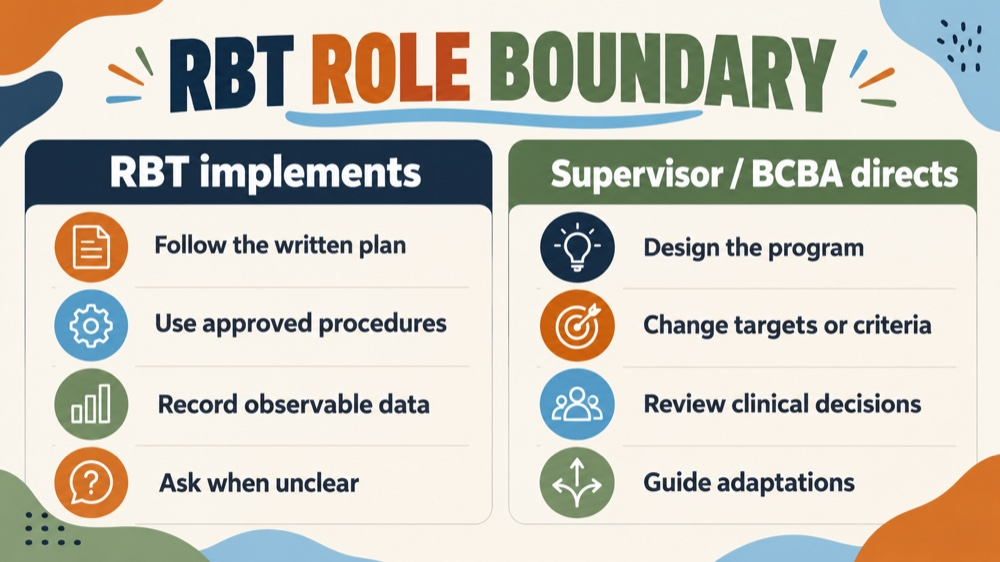
| RBT implementation and communication | Supervisor or BCBA direction |
|---|---|
| Read the current plan and prepare the listed materials. | Design the target, procedure, measurement system, or clinical rationale. |
| Use approved prompts, reinforcement, and data procedures. | Change prompt hierarchy, mastery criteria, or reinforcement schedule. |
| Record observable responses and relevant conditions. | Interpret trends and decide whether the program needs modification. |
| Report barriers, safety concerns, missing information, and learner responses. | Clarify adaptations, evaluate treatment integrity, and direct next steps. |
If a plan says “teach requesting” but does not identify the response form, opportunity, prompt, data rule, or safety procedure, that is not an invitation to fill in the blanks independently. Write down the specific question, follow the applicable safety procedure, and ask the supervisor for clarification before implementing an invented version.
Frequently asked questions
What is a behavior acquisition plan?
It is a written teaching plan that defines a skill, describes the starting performance, specifies instructional procedures and consequences, explains how data will be collected, and identifies mastery or generalization decisions. Names and formats vary across providers.
Is a behavior acquisition plan the same as a treatment plan?
Not necessarily. A behavior acquisition plan is usually one program or component focused on teaching a skill. A broader treatment plan may include assessment, multiple acquisition and reduction programs, caregiver training, coordination, safety planning, and other clinical decisions.
Does an RBT write the behavior acquisition plan?
Generally, an RBT implements assigned procedures and communicates data and observations under supervision. The qualified supervisor or clinician responsible for the service directs clinical program design and changes. Follow the current organizational structure and written responsibilities.
What should an RBT do if the plan is unclear?
Identify the exact ambiguity, check whether an approved safety or session procedure applies, avoid guessing, and seek supervisor direction. Document the relevant observable information using the authorized system.
Can the same plan be used with every learner?
No. Targets, communication forms, prompts, reinforcers, materials, measurement, mastery criteria, and safety procedures should be individualized. A generic example can explain concepts, but it cannot replace the current learner-specific program.
Official sources and scope
This guide was checked against the BACB RBT Test Content Outline, BACB’s Task Lists page, and BACB’s ethics materials. General plan-component terminology was cross-checked against educational skill-acquisition references from Passage Health and Finni Health. The examples are original educational illustrations, not client-specific instructions or official BACB templates.
Ready to practice the RBT concepts you just reviewed?
Try an independent, original RBT practice resource with exam-style questions, scoring, and answer explanations.
References
- Behavior Analyst Certification Board. RBT Test Content Outline, 3rd edition.
- Behavior Analyst Certification Board. RBT Handbook.
- Behavior Analyst Certification Board. RBT Ethics Code.