
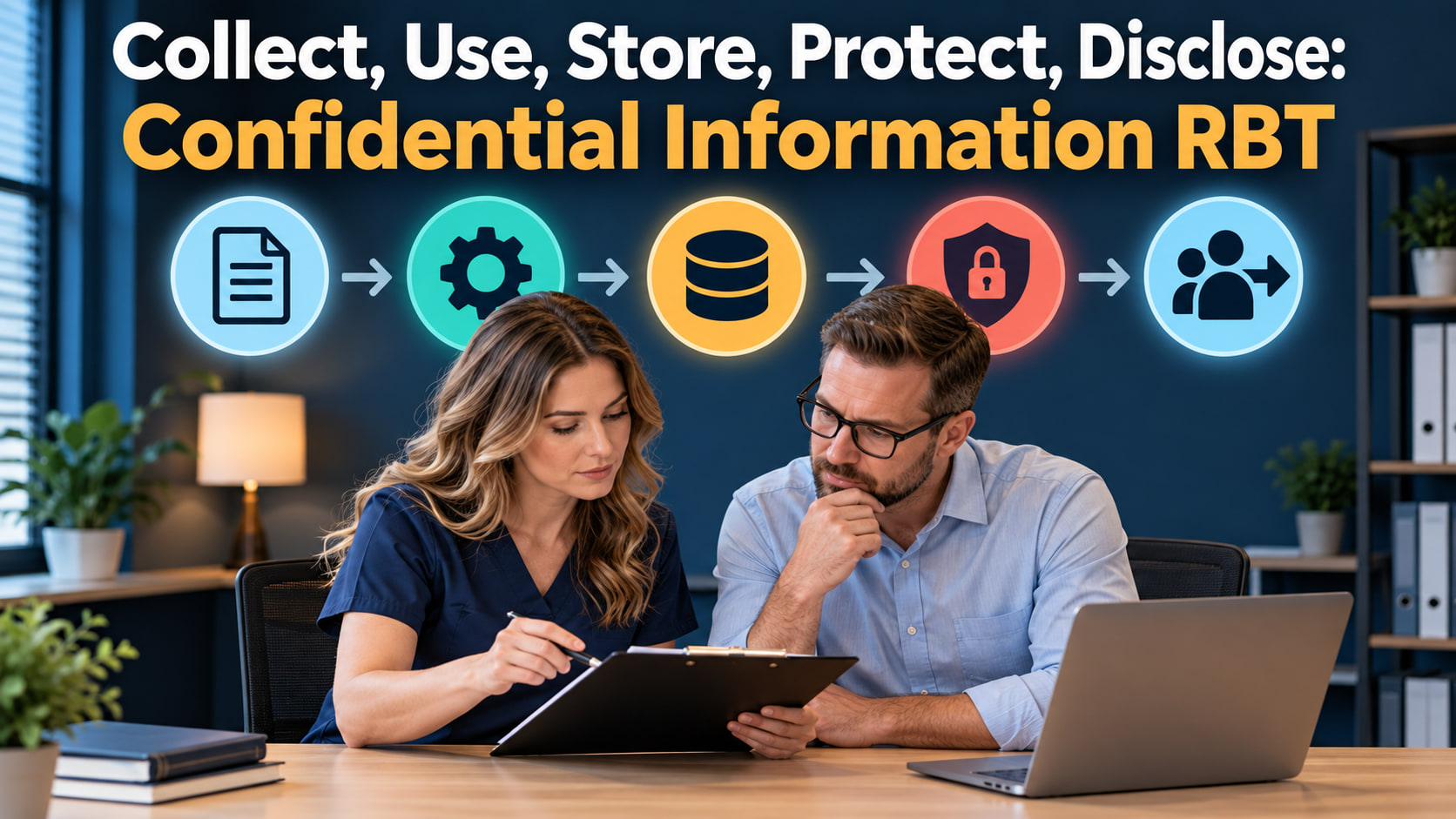
Collect use store protect disclose confidential information RBT work is easier to manage when every record passes through a clear five-decision workflow.
Table of Contents
- Collect use store protect disclose confidential information RBT workflow
- Collect use store protect disclose confidential information RBT: collect only what the task requires
- Use information for an approved purpose
- Store it in the approved system
- Protect information from casual exposure
- Collect use store protect disclose confidential information RBT: disclose only after checking
- What to do after a mistake
- Keep the RBT role clear
- Frequently asked questions
- References
RBT DOCUMENTATION GUIDE · CONFIDENTIAL INFORMATION
Collect, Use, Store, Protect, Disclose: Confidential Information RBT
A five-decision workflow for safer records, communication, storage, and escalation.
Collect use store protect disclose confidential information RBT work is easier to manage when every record or message passes through a clear five-decision workflow. The goal is not to make communication impossible. The goal is to make sure information is gathered for a reason, used appropriately, kept in the right place, protected from unnecessary access, and shared only through an approved path.
RBT work can involve data sheets, session notes, schedules, photographs, device records, family communication, and supervision documentation. The exact privacy requirements depend on applicable requirements, the employer, the service setting, the client’s authorization, and the responsible supervisor. Use this guide as a practical checklist, not as independent legal or clinical direction.
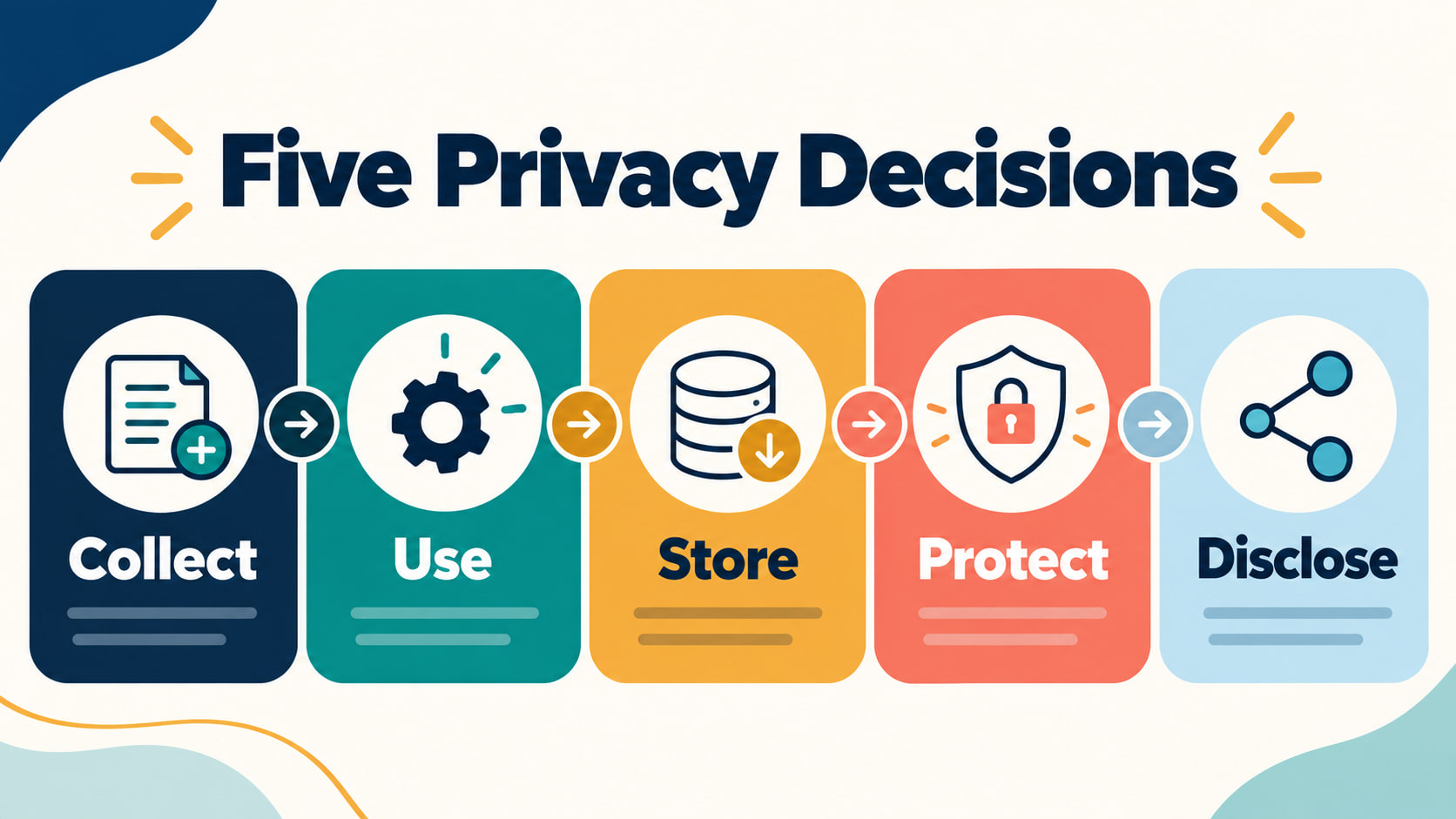
Collect use store protect disclose confidential information RBT workflow
- Collect: identify the information needed for the assigned service or required record.
- Use: connect access to an approved service, documentation, communication, or quality purpose.
- Store: place the information in the approved system, location, or record.
- Protect: limit casual access and follow device, password, retention, and disposal procedures.
- Disclose: verify authorization, recipient, channel, and minimum necessary detail before sharing.
Collect use store protect disclose confidential information RBT: collect only what the task requires
Start with the assigned task and the approved record. If the task is to document a defined response, collect the relevant observation, measurement, date, and required context. Do not add unrelated family information, personal opinions, or details that do not support the service or record.
Use the organization’s definitions and templates. If a form field is confusing, ask the supervisor or designated contact instead of inventing a new category. Accuracy matters as much as privacy: a speculative note can expose sensitive information without helping the team understand what happened.
Use information for an approved purpose
Access should have a reason. An RBT may need a current program, data sheet, communication log, or safety procedure to implement assigned services. That does not mean browsing unrelated files, looking up another client, or saving copies for personal reference.
Keep work and personal channels separate. Do not place identifiable information in a personal notes app, private email, social-media draft, or unapproved cloud folder. When a learning question can be answered with a de-identified example, remove unnecessary identifiers and follow the organization’s communication rules.
Store it in the approved system
Use the approved electronic record, platform, paper location, or upload workflow. Lock a screen when stepping away. Keep paper records out of public view and do not leave them on a shared printer, in a vehicle, or in an unattended treatment area.
Convenience is not a privacy system. If a secure upload exists, use it instead of taking a screenshot and texting it. Follow the organization’s retention and disposal procedures rather than keeping a private archive “just in case.”
Protect information from casual exposure
Protection includes more than passwords. Check who can see a screen, who is included in a meeting, what appears in a notification, and whether a paper record is visible to visitors. Use only the access and device practices approved by the organization.
Be careful with photographs, video, recordings, school information, and public-facing examples. Do not reuse them because they seem anonymous, educational, or positive. Follow the authorization and media rules that apply to the setting.
A practical habit is to pause at transitions. Before leaving a session, close or secure the record. Before entering a public space, check whether a conversation can be heard. Before sending a message, remove unrelated details and verify the recipient. These short pauses reduce accidental exposure without preventing necessary teamwork.
Collect use store protect disclose confidential information RBT: disclose only after checking
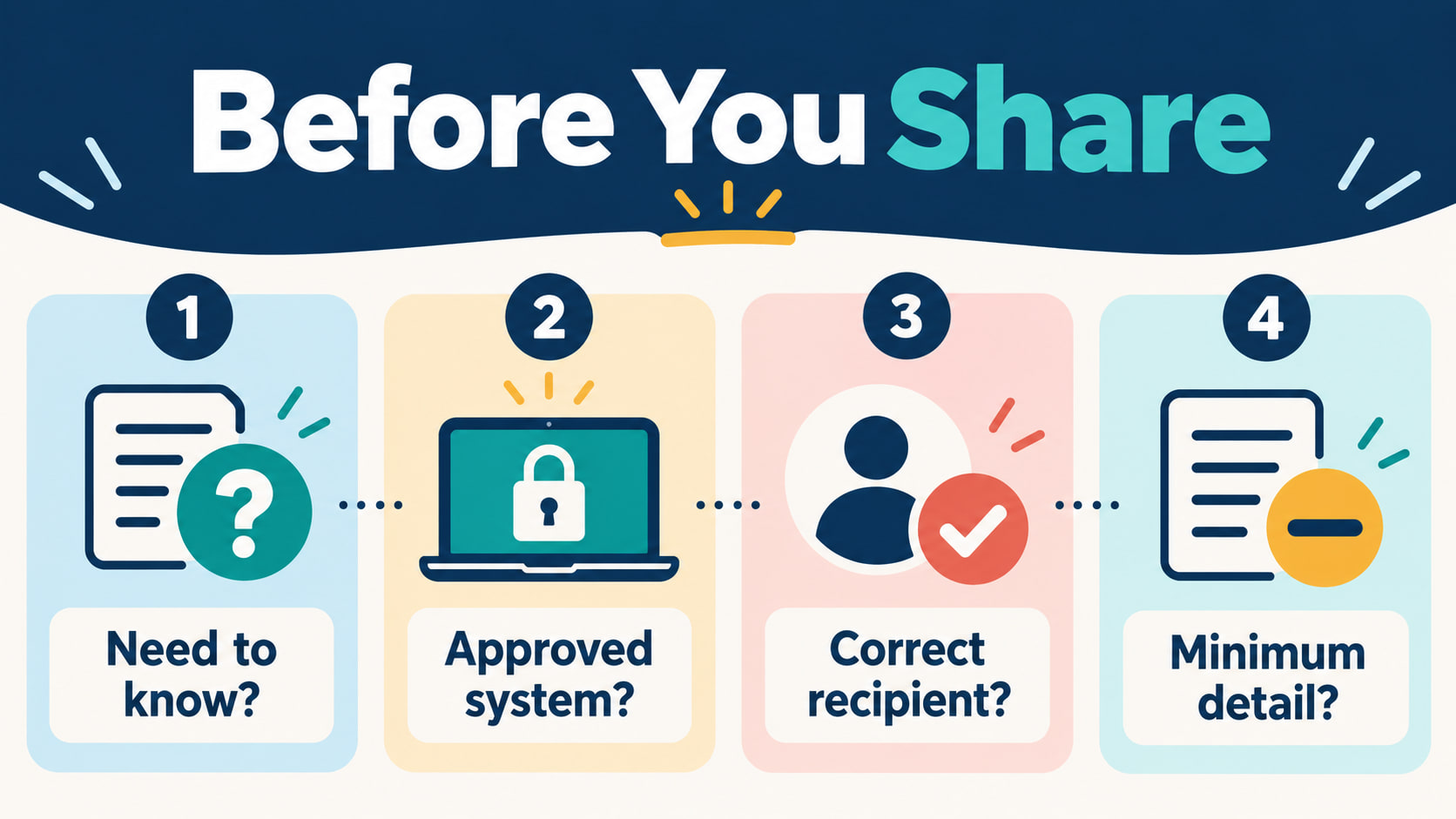
Before sharing, ask four questions: Does the recipient need to know? Is this the approved system? Is this the correct recipient? What is the minimum detail needed? Verify an address, number, platform account, or meeting participant according to policy.
Minimum necessary does not mean incomplete. It means the message contains the information needed for the authorized task without unrelated details. A supervisor reviewing a data question may need the date, program step, response pattern, and de-identified context; they may not need an entire family history.
When a family member, school employee, outside professional, or third party requests information, do not improvise. Use the designated supervisor or organizational process to determine what may be shared, how, and by whom.
If authorization or identity is unclear, pause and ask. Do not assume that a familiar voice, saved contact, or urgent tone proves the request is approved. Verification is part of responsible communication.
What to do after a mistake
If information goes to the wrong recipient, a record cannot be found, or an unapproved device is used, stop further sharing and report the concern through the designated route. State what happened, when, what information was involved, who received it if known, and what immediate action was taken.
Do not quietly rewrite a record to hide the mistake or delete evidence against policy. Corrections, late entries, and incident reports should follow the approved process so the organization can decide what follow-up is needed.
Reporting promptly is not the same as assigning blame. The purpose is to contain the exposure, preserve accurate facts, and allow the responsible team to determine whether notification, correction, training, or another response is required. Keep the report factual and avoid speculating about intent.
Keep the RBT role clear
An RBT implements assigned services after demonstrating competence and under ongoing supervision. The RBT can report objective facts, use approved systems, ask what information is needed, and escalate uncertainty. The RBT should not independently decide a legal disclosure, reinterpret consent, change a treatment plan, or create a new privacy rule.
Urgent danger, medical needs, safeguarding concerns, or emergencies may require emergency and organizational procedures in addition to supervision. Address immediate risk first, then document and seek the appropriate follow-up.
Frequently asked questions
Is removing a name enough to make information private?
Not always. Schedule, location, age, school, behavior, and family details may identify someone in combination. Use approved de-identification guidance and share only what the task requires.
Can I text a data sheet if the supervisor needs it quickly?
Use the approved communication system. Speed does not automatically make a personal text channel acceptable. Ask the supervisor or designated privacy contact when the correct route is unclear.
What if I accidentally open the wrong record?
Stop viewing it, do not copy or discuss the content, and report the access according to the organization’s procedure. Provide factual details so the responsible team can determine next steps.
What is the safest next step when I am unsure?
Pause before sharing, preserve the relevant facts, and ask the responsible supervisor or designated privacy route. A timely question is safer than an improvised disclosure or private workaround.
Source note: Review current BACB materials, organizational policy, applicable requirements, and supervisor direction for your setting. This article is educational and does not provide individualized legal, clinical, employment, or credentialing advice.
Ready to practice the RBT concepts you just reviewed?
Try an independent, original RBT practice resource with exam-style questions, scoring, and answer explanations.
References
- Behavior Analyst Certification Board. RBT Test Content Outline, 3rd edition.
- Behavior Analyst Certification Board. RBT Handbook.
- Behavior Analyst Certification Board. RBT Ethics Code.