

Continuous vs discontinuous measurement ABA questions are easier when you start with the behavior dimension, not the label. Are you trying to count every response, measure how long it lasts, time how quickly it begins, or sample whether it occurs during selected intervals? The answer determines the measurement system.
Table of Contents
- The core difference: complete record versus sampled record
- Continuous measurement methods
- Discontinuous measurement methods
- Continuous vs discontinuous measurement ABA comparison
- How continuous vs discontinuous measurement ABA choices affect a real RBT session
- Original exam-style examples
- Common interpretation errors
- Map continuous and discontinuous measurement to six RBT domains
- Frequently Asked Questions
- References
Continuous measurement attempts to record every relevant occurrence or dimension during the observation period. Discontinuous measurement records behavior during intervals or at selected moments, so it provides a sample or estimate rather than a complete event-by-event record. Discontinuous does not mean “bad”; it means the team accepts a known sampling tradeoff to make observation feasible under the written plan.
The current RBT Test Content Outline, 3rd edition, places continuous measurement examples in A.1, discontinuous measurement examples in A.2, and observable behavior description in A.5. The outline contains 43 tasks across six domains. For exam context, the current written exam presents 75 scored questions and 10 unscored pilot questions; those figures are exam structure, not measurement procedures.
This is independent educational content. RBT Training is not the BACB, is not a certification program, and is not affiliated with or endorsed by the BACB. All scenarios are newly written and are not official, recalled, leaked, or BACB-endorsed questions. No article, course, or practice set can guarantee certification or a passing result.
The core difference: complete record versus sampled record
| Question | Continuous measurement | Discontinuous measurement |
|---|---|---|
| What is observed? | The relevant behavior dimension throughout the planned observation period. | Behavior during selected intervals or at selected moments. |
| What does the result represent? | A count, time value, latency, rate, or IRT based on the recorded events. | A percentage or count of sampled intervals or moments. |
| Main advantage | More complete information when the observer can reliably capture the target. | More feasible when continuous observation or recording is difficult. |
| Main caution | Recording can compete with teaching, safety, or other session responsibilities if the plan is not practical. | Sampling can miss events or systematically over- or underestimate occurrence. |
| Exam clue | Every instance, total time, time to start, or time between responses. | Any part of an interval, the whole interval, or the interval-end moment. |
The phrase “continuous measurement” does not mean that the behavior itself must be continuous. A brief discrete response can be measured continuously by counting every occurrence. Conversely, a long behavior can be measured discontinuously by sampling intervals. The classification describes the recording system, not the physical shape of the behavior.
Before choosing an answer, identify the operational definition, the observation window, the unit, and the decision the data will support. If a question asks “how many,” do not answer with a percentage of intervals. If it asks “how long,” do not substitute a frequency count just because the behavior is easy to count.
Continuous measurement methods
Continuous procedures attempt to capture each relevant event or the full value of a defined dimension. They are useful when the exact count, duration, onset delay, or spacing between responses matters.
| Method | What it measures | Example clue | Common reporting unit |
|---|---|---|---|
| Frequency | The number of occurrences during an observation. | Count each instance of hand raising during a 20-minute lesson. | Count, often with a fixed observation length. |
| Rate | Occurrences relative to a standard amount of time. | Compare 12 responses in 30 minutes with another session of a different length. | Responses per minute or another defined time unit. |
| Duration | How long the behavior lasts. | Start the timer when a defined episode begins and stop it when it ends. | Seconds, minutes, total duration, or mean duration. |
| Latency | Time from a specified event to the start of the response. | Time from “begin writing” to the first written response. | Seconds or minutes to initiate. |
| Interresponse time (IRT) | Time between the end of one response and the beginning of the next. | Time between consecutive instances of a defined vocal response. | Seconds between responses. |
Frequency and rate are not interchangeable. A higher count may simply reflect a longer observation. Duration is not latency: duration measures how long the response continues, while latency measures how long the person waits before starting. IRT is not latency because it begins with the end of one response and ends with the start of the next.
Discontinuous measurement methods
Discontinuous procedures divide the observation into defined intervals or moments and record a sample. They can reduce the burden of capturing every instance, but the data must be interpreted according to the exact sampling rule.
| Method | When is the interval marked? | Likely interpretation issue |
|---|---|---|
| Partial-interval recording | Mark “yes” if the behavior occurs at any time during the interval. | Can overestimate how much of the session the behavior occurred because a brief event marks the entire interval. |
| Whole-interval recording | Mark “yes” only if the behavior occurs throughout the entire interval. | Can underestimate occurrence or duration because a brief pause makes the interval a “no.” |
| Momentary time sampling (MTS) | Check whether the behavior is occurring at the specific moment the interval ends. | It is a snapshot; behavior that occurs before or after the check may not be recorded. |
Suppose a 10-minute session is divided into ten one-minute intervals. If the target occurs for 5 seconds in intervals 1, 3, and 7, partial interval recording would mark 3 of 10 intervals, or 30%. Whole interval recording would mark none unless the behavior occurred for the entire minute in an interval. MTS would depend only on whether the behavior was occurring at the end of each minute. Those percentages are not interchangeable with “the behavior occurred for 30% of the session.”
The direction of bias is a study clue, not a guarantee about every data set. Partial interval tends to inflate the percentage of intervals with any occurrence; whole interval tends to deflate it when the behavior is not sustained; MTS may miss behavior between checks. The team should select and interpret the system specified by the plan.
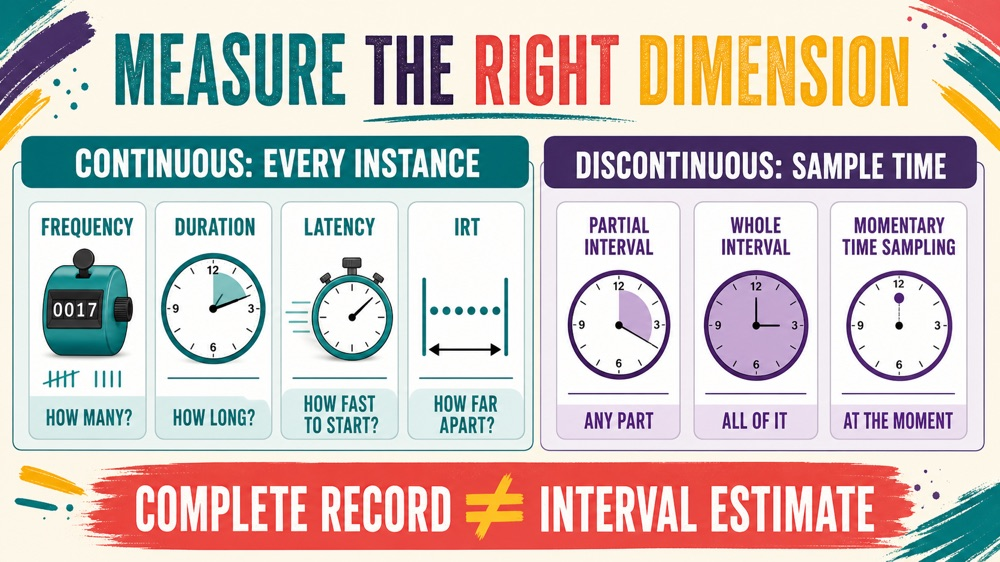
Continuous vs discontinuous measurement ABA comparison
Use this table as a decision map. It does not authorize an RBT to replace the measurement system because another one seems faster. The written definition, treatment goal, safety needs, feasibility, and supervisor direction all matter.
| When the question asks… | Start with… | Do not confuse it with… |
|---|---|---|
| How many times did it occur? | Frequency or rate, depending on whether time must be standardized. | Percentage of partial intervals. |
| How long did it last? | Duration. | Latency to begin or frequency of episodes. |
| How long until it starts? | Latency. | Duration after the response begins. |
| How far apart were responses? | IRT. | Latency from an instruction to the first response. |
| Did it occur at any point in each interval? | Partial interval recording. | Whole interval or MTS. |
| Did it continue for the entire interval? | Whole interval recording. | Partial interval, which needs only one occurrence. |
| Was it happening at the check? | Momentary time sampling. | A full interval observation. |
A strong answer also considers the behavior’s dimensions. A discrete response that happens many times may be suited to frequency or rate. A response with a meaningful start and stop may be suited to duration. A delay after an instruction may be latency. A behavior that is difficult to observe continuously in a group may use a sampling procedure if the plan specifies it and the known limits are acceptable.
How continuous vs discontinuous measurement ABA choices affect a real RBT session
- Read the operational definition: identify exactly what counts as an onset, offset, response, or interval event.
- Find the dimension: ask whether the plan needs count, rate, duration, latency, IRT, occurrence in an interval, or occurrence at a moment.
- Check the observation window: confirm the session length, interval length, timer rule, and start/stop events.
- Use the assigned system: do not switch from whole interval to partial interval because the percentage feels low.
- Record exceptions: note interruptions, unavailable materials, unsafe events, or missed intervals according to the documentation rule.
- Contact the supervisor: report unclear definitions, repeated missed observations, or a system that cannot be implemented as written.
Feasibility matters, but feasibility is not a license for silent substitution. If a teaching session requires the RBT to deliver prompts and record every brief response at the same time, the correct professional action may be to use an approved recording aid or request direction—not to collect a different measure and present it as equivalent.
Data quality also depends on procedural fidelity. An observer who uses the wrong interval length, starts the timer late, or marks a partial interval only when the behavior lasts “long enough” is no longer implementing the defined system. The resulting number may look precise while answering a different question.
Original exam-style examples
For example: if the stem says “mark yes when the behavior happens at any time during the interval,” the key clue is partial-interval recording, not a full-session duration measure.
Example 1—frequency versus rate: an RBT counts 18 instances of a vocal response during a 30-minute session. The count is frequency. If the team needs comparison across sessions of different lengths, the count can be converted to a rate using the defined time unit. The clue is whether time is standardized.
Example 2—duration versus latency: after the instruction “open your book,” the learner begins 12 seconds later and keeps the book open for 4 minutes. Twelve seconds is latency; four minutes is duration. The same session can contain both measures because they answer different questions.
Example 3—partial versus whole interval: during a 60-second interval, the target occurs for 3 seconds and then stops. Partial interval is marked yes; whole interval is marked no. A response that says both are yes has ignored the words “any time” versus “throughout.”
Example 4—MTS: the plan divides a lesson into two-minute intervals and asks the RBT to check at the end of each interval. If the target occurred during the first minute but stopped before the check, that interval is recorded no under MTS. The clue is the specific observation moment.
Example 5—role boundary: the written plan requires whole-interval recording, but the RBT believes partial interval would show more change. The RBT should implement the assigned plan, document the concern, and contact the supervisor. The RBT should not change the system and relabel the data.
These examples are newly written for study. They are not official, recalled, leaked, or BACB-endorsed questions. The test skill is identifying the measurement rule from observable facts.
Common interpretation errors
- Calling discontinuous measurement inaccurate: it is a sampling system with known limitations; the issue is whether the estimate is appropriate for the purpose and implemented correctly.
- Calling a percentage of intervals a percentage of time: 30% of intervals marked does not automatically mean the behavior occupied 30% of the session.
- Confusing any occurrence with the whole interval: partial interval needs one occurrence; whole interval needs sustained occurrence for the full interval.
- Checking MTS continuously: MTS is defined by the planned momentary check, not by recording every event between checks.
- Using frequency for unequal session lengths: compare rate when the plan calls for a time-standardized result.
- Using duration for a response with no clear offset: confirm the operational definition before starting a timer.
- Changing the method silently: a different measure answers a different question and needs supervisor direction.
- Inferring intent: record observable behavior and the defined unit rather than writing that the learner was lazy, angry, or unmotivated.
When two options look plausible, highlight the words that define the unit: number, time, delay, between, any part, entire, or exact moment. Most RBT measurement questions are resolved by that language.
Map continuous and discontinuous measurement to six RBT domains
| Domain | Connection to measurement | Review question |
|---|---|---|
| A. Data Collection and Graphing | Choose, implement, summarize, and graph the assigned measurement system. | What unit and recording rule does the plan define? |
| B. Behavior Assessment | Use measurement data as one part of assessment without confusing it with function. | What is observed, and what would be an unsupported inference? |
| C. Behavior Acquisition | Measure skill responses and teaching progress with a system that matches the target. | Does the measure show acquisition, fluency, latency, or maintenance? |
| D. Behavior Reduction | Track reduction targets and safety-relevant behavior using the written definition. | Would interval sampling hide an event that the plan requires every-instance recording? |
| E. Documentation and Reporting | Record interruptions, missed intervals, trends, and barriers objectively. | Can another team member tell how the number was produced? |
| F. Ethics | Protect dignity, privacy, competence, and accurate reporting. | Am I reporting the assigned measure rather than manufacturing a favorable result? |
Domain A is the center of this article, but measurement quality affects every domain. A neat graph built from the wrong unit can still mislead the team. Accurate RBT work means following the definition, preserving the sampling rule, and escalating when the system cannot be implemented with fidelity.
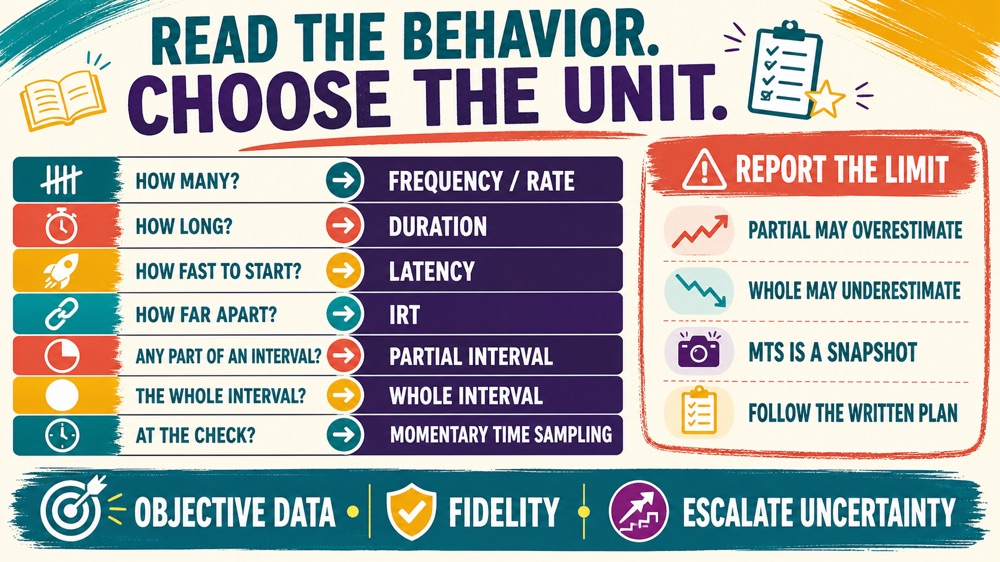
Bottom line: continuous vs discontinuous measurement ABA is a question about what the recording system captures. Match “how many,” “how long,” “how fast,” and “how far apart” to frequency/rate, duration, latency, and IRT. Match “any part,” “all of it,” and “at the moment” to partial interval, whole interval, and MTS. Then follow the written plan and report the limits honestly.
Turn measurement mistakes into targeted practice.
Use original RBT practice questions to identify the behavior dimension, sampling rule, and data-quality decision behind each answer.
Try Free RBT Practice Questions →
Frequently Asked Questions
What is continuous measurement in ABA?
Continuous measurement attempts to record every relevant occurrence or dimension during the planned observation period. Common examples include frequency, rate, duration, latency, and interresponse time.
What is discontinuous measurement in ABA?
Discontinuous measurement samples behavior during intervals or at selected moments. Common examples include partial-interval recording, whole-interval recording, and momentary time sampling.
Does discontinuous measurement mean the data are wrong?
No. Discontinuous systems can be useful when continuous observation is not feasible, but they produce an estimate with known sampling limitations. The team must use the system specified by the plan and interpret the result correctly.
Which method overestimates behavior?
Partial-interval recording can overestimate the percentage of intervals with any occurrence because one brief response marks the whole interval. Whole-interval recording can underestimate occurrence when behavior is not sustained, and MTS can miss behavior between checks.
What is the difference between duration and latency?
Duration measures how long a response continues. Latency measures the time from a defined event, such as an instruction, until the response begins.
Can an RBT change continuous to discontinuous measurement?
Not independently. The RBT should implement the written system, document feasibility or safety barriers, and contact the supervisor for direction about a plan change.
References
- Behavior Analyst Certification Board. RBT Test Content Outline, 3rd edition.
- Behavior Analyst Certification Board. RBT Test Content Outline, 3rd edition PDF.
- Continuous versus discontinuous measurement concept page. Reviewed for competitor research.
- Theralytics continuous versus discontinuous measurement guide. Reviewed for competitor research.
- Master ABA data collection methods guide. Reviewed for competitor research.
- Office Puzzle data-collection decision guide. Reviewed for competitor research.
- Behavior Prep RBT study guide. Reviewed for terminology comparison; not a BACB endorsement.
- Vanderbilt IRIS Center: functional behavior assessment module. Reviewed for observable measurement context.