

This cultural humility RBT guide turns a broad value into observable habits for respectful communication and role-safe support.
Table of Contents
- What is cultural humility RBT?
- Reflect on assumptions before acting
- Ask respectful, useful questions
- Listen to the answer and adjust support
- Protect dignity, privacy, and role boundaries
- Practice a cultural humility response
- Quick comparison
- Frequently Asked Questions
- Sources and further reading
RBT ethics, culture, and respectful support guide
Cultural Humility RBT: Learn, Ask, Adjust
Turn reflection, respectful questions, listening, and adjustment into observable role-safe habits.
The phrase cultural humility RBT describes an ongoing way to approach support, communication, and supervision. It is not a claim that an RBT knows everything about another person’s culture, family, language, disability experience, religion, identity, or community. It is a practice of noticing assumptions, asking respectfully when information is relevant, listening to the answer, and adjusting communication or support through the approved process.
Cultural humility also has a role boundary. An RBT can observe, communicate, implement an authorized procedure, and seek direction. The RBT should not guess a person’s preferences, disclose private information, change a plan independently, or treat one conversation as proof that every cultural question has been solved.
What is cultural humility RBT?
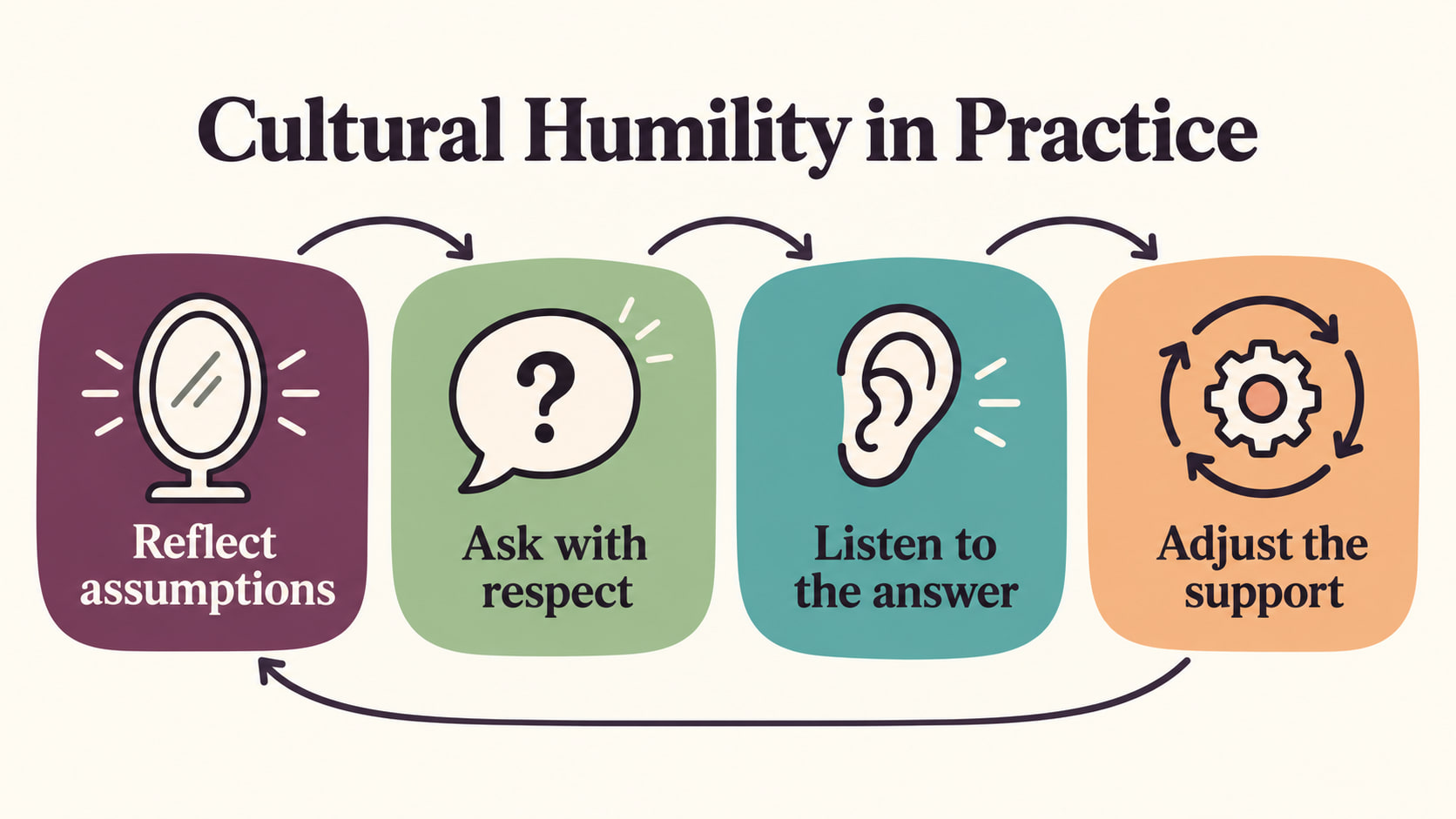
For an RBT, cultural humility can be translated into four observable habits:
- Reflect: notice the assumption you may be bringing to an interaction.
- Ask: use a relevant, respectful question instead of filling the gap with a guess.
- Listen: allow the person or authorized team member to explain what matters to them.
- Adjust: make a role-appropriate communication or implementation adjustment, or route a plan-level request to the responsible professional.
The word “humility” does not mean self-criticism or uncertainty about every action. It means remaining open to correction and recognizing that the RBT’s first interpretation may not be complete. The word “cultural” is also broader than nationality. It can include family routines, language preferences, disability identity, communication style, community expectations, religion, gender identity, socioeconomic context, and other parts of a person’s lived experience.
| Moment | Assumption-based response | Humility-based response |
|---|---|---|
| A routine is unfamiliar | Decide what it means without checking | Ask what context is relevant and listen |
| A preference is unclear | Choose based on a stereotype | Offer the authorized choices or ask the right person |
| A request conflicts with the plan | Change the procedure immediately | Route the request to supervision |
| A communication error occurs | Defend the original assumption | Acknowledge, repair, and use the approved process |
Reflect on assumptions before acting
An assumption can enter a session through a quick interpretation: “This family probably prefers…,” “That behavior must mean…,” or “Everyone from this background values….” The concern is not that an RBT has a first thought. The concern is treating the thought as verified information and allowing it to control support without checking.
A short reflection can ask:
- What did I directly observe, and what did I infer?
- What information am I missing?
- Am I treating a group label as if it describes one individual?
- Is this question relevant to the person’s support, or am I asking out of curiosity?
- Who is authorized to clarify the procedure or make the decision?
For example, if a learner does not participate in a familiar greeting routine, the RBT should not conclude that the learner is rude, unmotivated, or rejecting the team. The observable fact may simply be that the learner did not respond to that greeting at that time. The next step might be to check the communication plan, offer an authorized alternative, or ask the supervisor what information is relevant.
Reflection should lead to better action, not to a long internal story about whether the RBT is a good person. Write objective notes, correct the assumption when needed, and focus on what the team can observe and support.
Ask respectful, useful questions
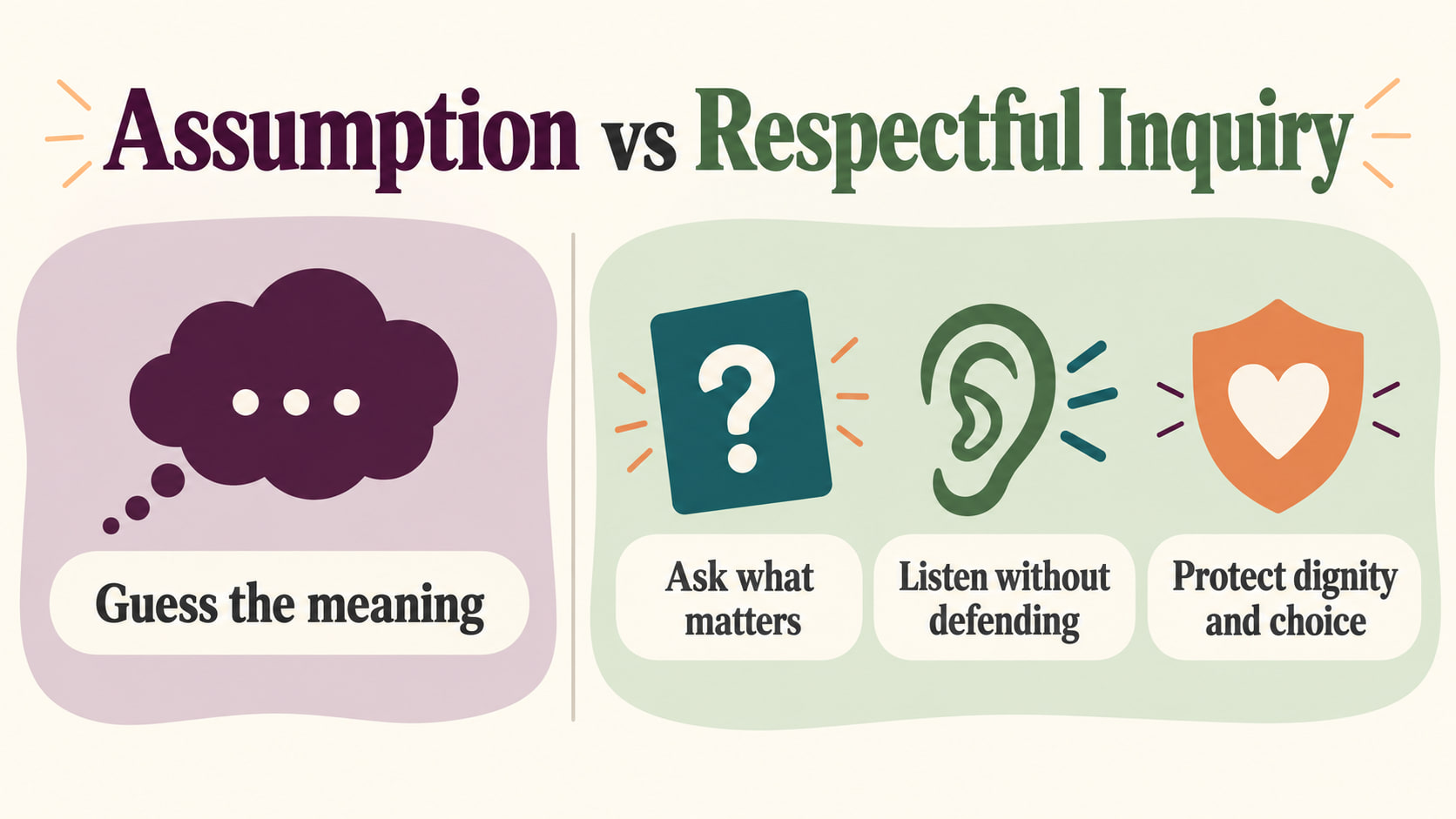
A respectful question is relevant, specific, and optional when the person is not required to answer. It avoids making the person responsible for educating everyone, and it does not presume that a single answer represents an entire community.
Examples of useful questions include:
- “Is there a communication preference the team should record and follow?”
- “What part of this routine is important to preserve at home?”
- “Would you like the supervisor to review this request with the team?”
- “Which approved choice should I offer in this situation?”
- “Is there a better way to explain this instruction so it is clear and respectful?”
Do not ask for private details that are not necessary for the professional purpose. Do not use a question to pressure a person into disclosing identity, family history, religion, immigration information, health information, or other sensitive details. If the answer is not needed to implement the current plan, it may not belong in the session conversation or record.
If the RBT is unsure how to ask, the supervisor can help identify the right channel and wording. Seeking input is part of role-safe practice when a concern involves a plan, a safety procedure, a communication accommodation, or a possible ethical issue.
Listen to the answer and adjust support
Asking a question is only useful if the RBT listens to the answer. Listening means allowing the person to finish, checking understanding, and resisting the urge to defend the original assumption immediately. A brief reflection can prevent a misunderstanding: “I hear that the written visual should use the family’s preferred term. I will check whether that wording is already in the current materials and ask the supervisor about updating it if it is not.”
Adjustment depends on the type of information:
- Communication adjustment: use the approved name, pronoun, language support, visual, or interaction style documented by the team.
- Choice adjustment: present the authorized options in a way that preserves meaningful choice and dignity.
- Documentation adjustment: record the relevant preference through the approved system without adding unnecessary private details.
- Plan-level adjustment: bring the request to the responsible supervisor rather than changing the program independently.
Adjustment is not the same as promising that every request can be implemented immediately. The team may need to check safety, competence, resources, consent, policy, or the written plan. A respectful response can acknowledge the request while being honest about who must decide.
Protect dignity, privacy, and role boundaries
Cultural humility is inseparable from dignity. Avoid public correction, jokes about identity, broad labels, or comments that make a person represent an entire group. Use the person’s stated preferences when they are relevant and approved, and repair a mistake directly without demanding that the other person comfort the RBT.
Privacy matters in notes and team communication. Share the minimum necessary information through the approved channel. Do not post a question about an identifiable client in a social-media group, a personal messaging thread, or a public forum. When a concern involves discrimination, harassment, retaliation, abuse, or immediate safety, use the organization’s required reporting or escalation process.
An RBT should also distinguish cultural responsiveness from independent clinical decision-making. A request to change a reinforcement item, prompt, communication procedure, assessment condition, or treatment target may be important, but it still needs to be evaluated and authorized through the current process. The RBT can bring the context and observation; the responsible professional owns the plan-level decision.
Practice a cultural humility response
Use this four-part practice sentence:
“I want to check my assumption. What I observed was [observable event]. Is there relevant context I should understand? I will follow [current authorized step] and ask [responsible person] before changing anything.”
Practice it with a neutral scenario, such as an unfamiliar greeting, a caregiver request for a different communication format, or a disagreement about a routine. Then review the response:
- Did the speaker distinguish observation from interpretation?
- Was the question necessary and respectful?
- Did the listener avoid treating one person as a spokesperson for a group?
- Did the next action protect privacy, dignity, safety, and decision ownership?
Supervision is a good place to review patterns in the RBT’s own assumptions. The goal is not to produce a perfect script for every culture. The goal is to build a repeatable habit of noticing, asking, listening, and routing decisions responsibly.
Quick comparison
| Question | Useful check | Boundary |
|---|---|---|
| What do I know? | Separate observable facts from inference | Do not present a guess as a fact |
| What should I ask? | Ask only what is relevant to support | Do not pressure disclosure |
| What did I hear? | Reflect the answer and check understanding | Do not debate someone’s lived experience |
| What changes? | Adjust approved communication or route the request | Do not change a plan independently |
Frequently Asked Questions
Is cultural humility the same as knowing every culture?
No. It is an ongoing practice of reflection, respectful inquiry, listening, and adjustment. It does not turn a person’s identity into a checklist or prove that the RBT understands every relevant context.
Can an RBT ask a family about cultural preferences?
An RBT can listen to relevant information and use the approved channel, but questions should be necessary, respectful, and optional when appropriate. The RBT should not pressure disclosure or make a plan-level decision independently.
What should an RBT do after making a cultural assumption?
Acknowledge the mistake, correct the immediate communication when possible, document through the approved process if required, and ask the supervisor how to repair or adjust the support. Avoid asking the other person to manage the RBT’s feelings.
Does cultural humility mean ignoring the written plan?
No. Relevant context can be brought to supervision and may support a plan review. Until an authorized change is made, the RBT follows the current procedure and uses the required safety and escalation steps.
Sources and further reading
- BACB RBT Test Content Outline, 3rd edition
- BACB Supervision and Training resources
- BACB RBT Handbook
- BACB Ethics Codes and RBT Ethics Code resources
Explore RBT ethics, communication, supervision learning, and role-safe practice resources for your next team discussion.
Ready to practice the RBT concepts you just reviewed?
Try an independent, original RBT practice resource with exam-style questions, scoring, and answer explanations.
References
- Behavior Analyst Certification Board. RBT Test Content Outline, 3rd edition.
- Behavior Analyst Certification Board. RBT Handbook.
- Behavior Analyst Certification Board. RBT Ethics Code.