

If you searched for data collection apps behavior analysis, you are probably looking for a clear definition plus a decision rule you can use while studying or working under supervision. This independent guide connects the search term to the current RBT Test Content Outline (3rd ed.) and to observable RBT actions.
Table of Contents
- data collection apps behavior analysis: the short answer
- What data collection apps behavior analysis means in the RBT study map
- data collection apps behavior analysis: an original scenario
- How to use data collection apps behavior analysis in study and supervised practice
- data collection apps behavior analysis: important distinctions
- Common mistakes with data collection apps behavior analysis
- A practical review checklist
- Frequently Asked Questions
- References
This topic belongs primarily to measurement and assessment reasoning in the RBT study map. The goal is not to repeat a vocabulary label. It is to show what the term means, what it does not mean, how it appears in a short scenario, and when the correct professional response is to follow the written plan or contact the supervisor.
The examples in this article are newly written for study. They are not official, recalled, leaked, or BACB-endorsed exam questions. Requirements and policies can change, so use the current BACB handbook and your supervisor or requirements coordinator for decisions about an individual application or client program.
Quick answer: A data collection app is useful only when it supports the written measurement plan, accurate timing, secure handling, and readable review. The app itself does not make a data system valid.
data collection apps behavior analysis: the short answer
A data collection app is useful only when it supports the written measurement plan, accurate timing, secure handling, and readable review. The app itself does not make a data system valid.
Read the phrase in context. A search keyword can be broad, abbreviated, or written like a practice-question stem. The reliable method is to identify the behavior, procedure, document, or exam step being requested, then compare it with the current official source and the role boundary. That keeps data collection apps behavior analysis useful without turning a search result into unsupported advice.
For a fast review, start with more RBT study notes. Then return to the official sources in the reference section when the question involves a requirement, credential status, ethics rule, or testing policy.
What data collection apps behavior analysis means in the RBT study map
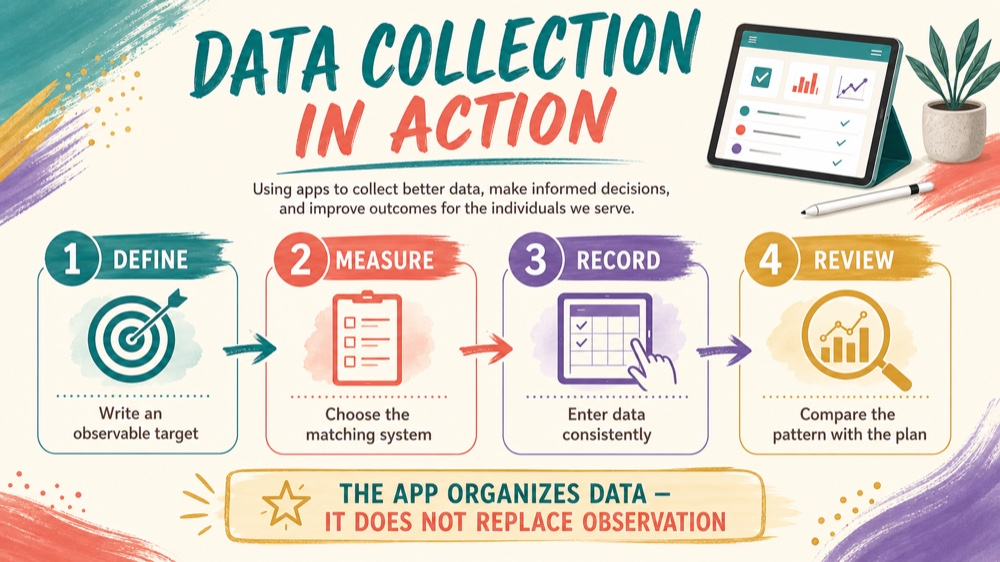
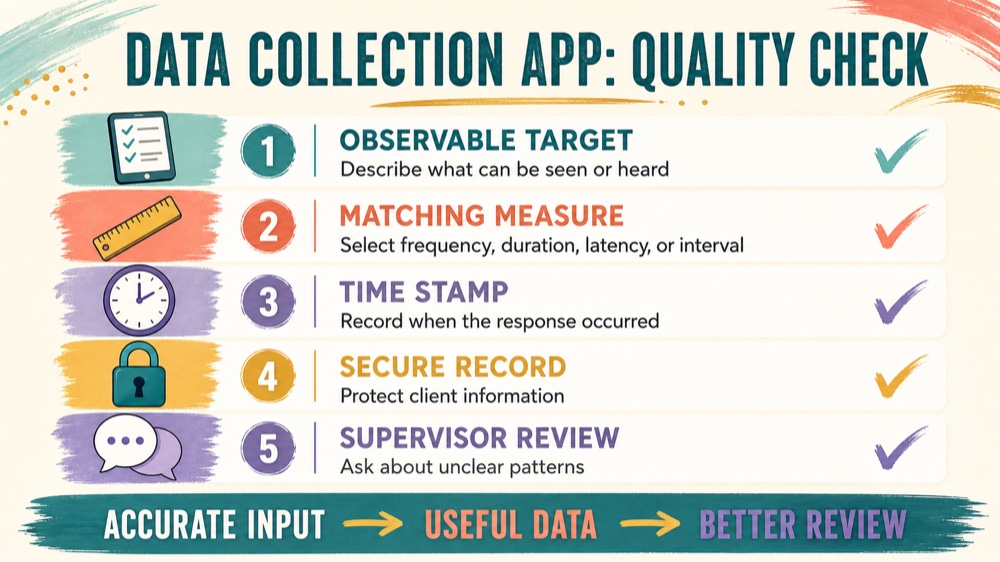
Evaluate the app as part of a workflow: operational definition, response entry, timer behavior, offline handling, edit history, export, user access, and supervisor review. A colorful interface cannot fix a vague behavior definition or an inconsistent recording rule.
An RBT is a paraprofessional who provides behavior-analytic services under the direction and close supervision of the responsible supervisor or requirements coordinator. A strong answer therefore separates what an RBT can implement as written from what requires assessment, clinical interpretation, plan changes, or supervisor direction.
What to identify before choosing an answer
- What is directly observable, and what is an interpretation?
- Which definition, time window, prompt rule, document version, or supervision instruction controls?
- What action is within the RBT role, and what action should be referred to the supervisor or official organization?
- What evidence would show that the procedure was implemented consistently?
data collection apps behavior analysis: an original scenario
Before adopting an app for duration data, confirm that it records start and stop times, preserves the session date and observer, prevents accidental overwrites, and exports a report the supervising team can audit. If the app only offers a generic tally, it may not fit the planned dimension.
The useful question is not “what would I personally do?” It is “what does the defined procedure require, what did I observe, and who has authority to resolve the uncertainty?” That sequence protects data quality and keeps a practice explanation separate from an individual clinical decision.
| Question | What a careful reader checks | Why it matters |
|---|---|---|
| Fit | Can the app implement the exact written rule? | Do not force a plan into a convenient button |
| Integrity | Can entries be reviewed and corrected transparently? | Keep an audit trail |
| Privacy | Are access and storage approved? | Minimize identifiable information |
When two options appear plausible, look for the one that matches the exact cue in the stem. A distractor may use a familiar word but change the time window, scoring rule, credential version, or scope of practice. Explain the distinction in your own words before moving on.
How to use data collection apps behavior analysis in study and supervised practice
Use only an organization-approved system, verify permissions, and test it against paper or the current platform before relying on it. Record downtime or sync errors, protect identifiers, and ask the supervisor how corrections should be documented.
- Before the session or study block: locate the current definition, plan, outline, or handbook instruction.
- During the task: record observable events using the stated procedure and avoid adding an unapproved interpretation.
- After the task: check the record for completeness, note deviations, and ask the supervisor about unresolved questions.
- For exam review: write why the correct option fits and why each distractor fails; do not memorize an answer letter.
For a structured 90-minute study block, spend the first part retrieving the rule without notes, the middle part applying it to original scenarios, and the final part correcting one recurring error. A short explanation that names the cue, action, and boundary is more durable than rereading a long list.
data collection apps behavior analysis: important distinctions
| Layer | Correct question | Safe RBT interpretation |
|---|---|---|
| Fit | Can the app implement the exact written rule? | Do not force a plan into a convenient button |
| Integrity | Can entries be reviewed and corrected transparently? | Keep an audit trail |
| Privacy | Are access and storage approved? | Minimize identifiable information |
Evaluate the app as part of a workflow: operational definition, response entry, timer behavior, offline handling, edit history, export, user access, and supervisor review. A colorful interface cannot fix a vague behavior definition or an inconsistent recording rule. The same word can appear in a study question, a client record, and a credentialing document with different consequences. Keep the source and the role visible while reviewing.
Common mistakes with data collection apps behavior analysis
- Choosing an app before defining the measure. Correct the error by returning to the operational definition, current official source, or supervision instruction.
- Editing data without a correction record. Correct the error by returning to the operational definition, current official source, or supervision instruction.
- Assuming cloud storage is automatically approved. Correct the error by returning to the operational definition, current official source, or supervision instruction.
- Failing to reconcile a sync error. Correct the error by returning to the operational definition, current official source, or supervision instruction.
A high-quality answer is precise without pretending to know facts that were not provided. If an item omits the written plan, answer choices, jurisdiction, or current document version, state the assumption and identify the source that would resolve it. That is stronger reasoning than inventing a single universal rule.
A practical review checklist
- Can I define the keyword in observable or document-specific language?
- Can I give a new scenario without relying on recalled exam content?
- Can I name the closest competing concept and explain the difference?
- Can I identify the data, privacy, ethics, or supervision boundary?
- Can I locate the current BACB source when the fact may have changed?
Use the checklist with data collection apps behavior analysis, then record the exact mistake you made and the rule that fixes it. If the same mistake repeats, bring the example to the supervisor, trainer, or study partner instead of adding more unstructured notes.
Turn this concept into a decision rule.
Review original RBT scenarios, compare the explanation with the current official outline, and use the result to plan your next study block.
Try the RBT practice materials →
Frequently Asked Questions
What is the fastest way to understand data collection apps behavior analysis?
Start with the exact definition or official document, then apply it to one original scenario. Finish by naming the nearest competing concept and the supervision boundary.
Is this article an official BACB answer key?
No. It is independent study content. It does not reproduce, recall, leak, or claim endorsement for BACB examination questions.
Why does the current RBT edition matter?
The RBT Test Content Outline changed to a 3rd edition effective in 2026, and handbook requirements can be updated. Check the current BACB source whenever the question involves a date, fee, eligibility rule, or exam format.
What should an RBT do when the plan is unclear?
Pause at the point of uncertainty, check the written plan and operational definition, keep the client safe, document objectively, and contact the supervisor or requirements coordinator. Do not invent a new procedure.
Can I use a practice explanation as proof of competency?
No. A practice explanation can organize study, while competency must be demonstrated and documented through the applicable current process and authorized assessor.
Where can I verify a changing RBT fact?
Use the current BACB RBT Test Content Outline, RBT Handbook, ethics resources, and official account or testing-provider instructions linked below.