

The phrase data irregularity vs training need rbt describes a practical question: is the concern about the record, the procedure, or the technician’s current competence? The distinction is not a diagnosis or an independent clinical decision; it helps an RBT report the right facts and request timely supervisor direction.
Table of Contents
- Data irregularity vs training need rbt: why this distinction matters
- The practical two-path framework
- Data irregularity vs training need rbt: when data needs review
- Data irregularity vs training need rbt: when you need training
- When both concerns may be present
- How to communicate the concern
- How to follow up after direction
- Common escalation mistakes
- Frequently asked questions
- References
RBT TASK GUIDE · DATA AND SUPERVISION
Data Irregularity vs Training Need RBT: How to Tell What to Escalate
Use objective facts to decide whether to request a data review, targeted training, or both—without changing the plan independently.
The phrase data irregularity vs training need rbt describes a practical question: is the concern about the record, the procedure, or the technician’s current competence? The distinction is not a diagnosis or an independent clinical decision; it helps an RBT report the right facts and request timely supervisor direction.
The BACB RBT Test Content Outline places both training needs and data irregularities under the expectation that an RBT seeks and prioritizes clinical direction from a supervisor in a timely manner. This guide turns that expectation into a communication framework. It does not replace the client’s plan, supervision, competency assessment, or employer policy.
Data irregularity vs training need rbt: why this distinction matters
An unexpected data point can create several different questions. Did the client’s behavior or skill actually change? Was the session different? Was the operational definition applied correctly? Did the RBT use the assigned measurement system? Was the procedure understood but difficult to implement? The answer cannot be inferred from one number alone.
Separating the questions helps the supervisor respond efficiently:
- A possible data irregularity starts with the record or the pattern in the data and asks for review.
- A possible training need starts with the RBT’s ability to explain or implement an assigned task and asks for instruction, modeling, rehearsal, feedback, or observation.
- An overlap means the recording concern may be related to implementation, so the supervisor may review the data and provide training together.
These are not official BACB diagnostic labels. They are useful prompts for what to document and what kind of help to request.
The practical two-path framework
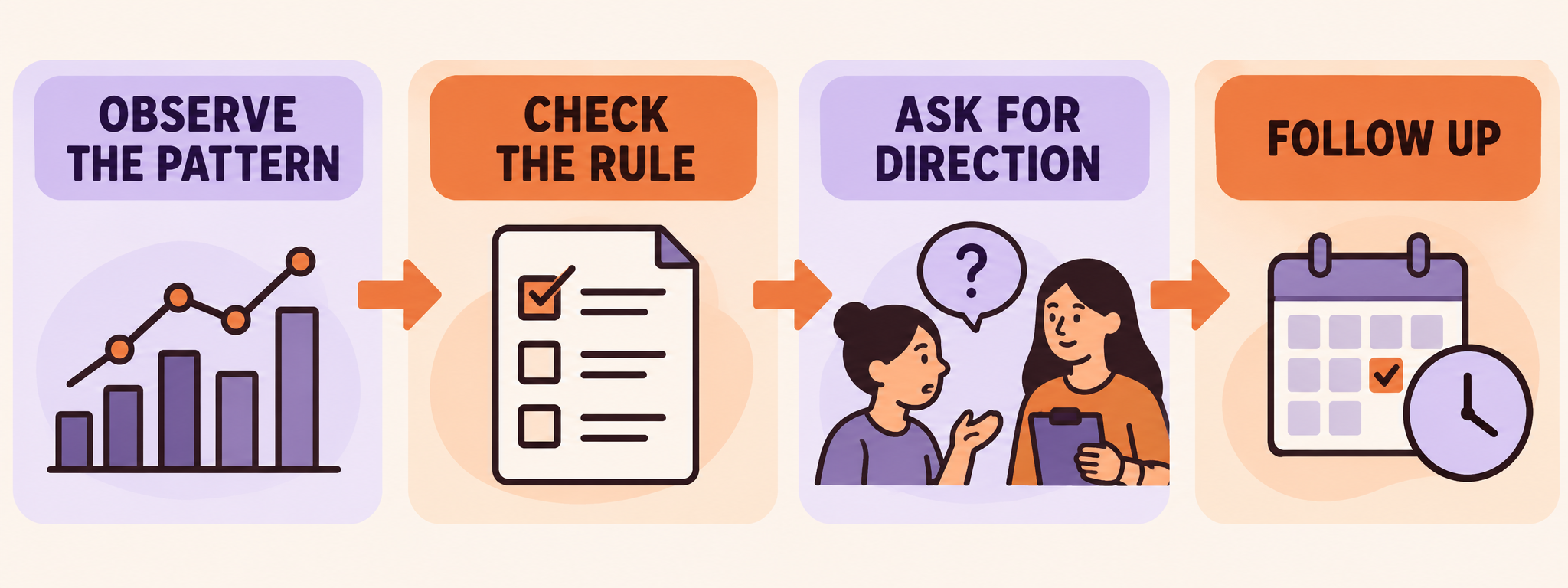
Use a four-step check before sending a message:
- Describe the observation: State what changed, what you recorded, or which step you could not implement.
- Check the assigned procedure: Review the operational definition, measurement rule, current plan, and session context without changing them.
- Name the uncertainty: Say whether you need data review, implementation clarification, training, or help following the chain of command.
- Ask for direction: Give the supervisor one clear question and follow the response.
Do not spend so long trying to classify the problem that you delay a time-sensitive report. If safety, privacy, or client care is affected, use the urgent process and chain of command immediately.
Data irregularity vs training need rbt: when data needs review
Start with data review when the main concern is an unexpected value, sudden trend, missing record, or mismatch between sources. An irregularity can be real, but it can also reflect a change in setting, schedule, materials, observer, measurement, or recording process.
Before contacting the supervisor, check the assigned steps:
- Confirm the client, date, session length, target, and measurement dimension.
- Re-read the operational definition and the start, stop, or scoring rules.
- Check whether the setting, materials, staff, schedule, or task presentation changed.
- Separate your direct observation from information reported by a caregiver or teacher.
- Preserve the unexpected value and correct documentation only through the approved process.
A useful message might be: “The duration recorded today was 17 minutes, compared with 6 to 8 minutes in the previous three sessions. The session was in a different room, and I used the same assigned start and stop rules. Can you review the data and tell me whether I should complete an implementation check or document any additional variables?”
Notice what the message does not say. It does not claim the client regressed, the plan failed, or the number is invalid. It preserves the observation and asks for review.
Data irregularity vs training need rbt: when you need training
Start with a training request when you cannot confidently explain or implement a procedure that you are assigned to use. Examples include uncertainty about the measurement rule, a new prompting sequence, a revised data-entry process, or a procedure you have only read about but have not rehearsed.
A training need is not the same as a personal weakness. It is a request to build competence before implementation. Ask for the form of support that would help:
- Instruction: a clear explanation of the steps and decision points.
- Modeling: the supervisor demonstrates the procedure.
- Rehearsal: you practice the procedure in a controlled setting.
- Feedback: the supervisor identifies what to keep and what to correct.
- Observation: the supervisor watches implementation in the service setting when appropriate.
Example: “I can identify the target, but I am unsure when the latency timer starts and stops. Could you model one example and observe my rehearsal before I collect the next set of latency data?” This asks for a specific competency check instead of improvising a new rule.
When both concerns may be present
Data and training concerns often overlap. Suppose an RBT’s data look unusually low and the RBT also discovers that the recording rule was misunderstood. The next step is not to erase the data or independently recalculate the trend. Report both facts: what was recorded, what rule was used, and what part of the procedure needs clarification.
Use language such as: “I noticed that today’s percentage-correct values are lower than the recent pattern. While reviewing the sheet, I realized I may have scored prompted responses differently from the written rule. I preserved the original record. Can you review the scoring and provide training before the next session?”
The supervisor may decide that the data need a correction note, additional review, retraining, a new observation, or no change at all. The RBT’s responsibility is accurate reporting and following direction—not selecting the final clinical response.
How to communicate the concern
Use the approved communication channel and protect client information. A concise message can follow this structure:
- Context: identify the session safely and state the target or procedure.
- Observation: give the measurable fact, date, count, duration, or exact implementation step.
- Procedure check: state what you reviewed and whether you followed the current instruction.
- Impact or uncertainty: explain what you cannot determine or implement confidently.
- Request: ask for data review, training, clarification, or the next person in the chain of command.

How to follow up after direction
Write down the direction in the approved supervision or session record. If the supervisor provides training, record the training activity according to policy and use the corrected procedure only after you understand it. If the supervisor asks for additional data, follow the assigned method and report any new barrier.
Compare implementation with the written direction, not with memory. If the question remains unresolved, escalate through the chain of command rather than sending the same uncertainty to multiple people without context. If the issue affects immediate safety or confidentiality, use the urgent procedure even if routine supervision is pending.
Common escalation mistakes
- Calling every unusual value invalid: An unusual point is a reason for review, not a final conclusion.
- Calling every uncertainty incompetence: A training request is a normal way to build competence.
- Changing the measurement rule while checking it: Preserve the assigned procedure and ask for direction.
- Reporting a conclusion instead of facts: Replace “the intervention failed” with the measurable observation and context.
- Waiting for a routine meeting when safety is urgent: Follow the emergency and chain-of-command process.
- Sharing more client information than needed: Use approved channels and the minimum necessary detail.
Frequently asked questions
Is data irregularity vs training need rbt an official BACB category?
No. It is a practical way to organize a supervisor question. The BACB outline names training needs and data irregularities as examples of situations in which an RBT should seek timely clinical direction.
What should I do first when a data point looks unusual?
Preserve the record, check the assigned definition and measurement steps, note relevant context, and report the concern to the supervisor. Do not erase the value or change the procedure independently.
How do I know whether I need training?
If you cannot explain or implement an assigned procedure confidently and competently, ask for instruction, modeling, rehearsal, feedback, or observation. The supervisor can decide the appropriate support.
Can one concern be both a data issue and a training issue?
Yes. A recording concern may reveal a need for training, and a skill gap may affect data quality. Report both parts so the supervisor can review the record and provide direction.
Bottom line: In data irregularity vs training need rbt situations, preserve facts and ask for the right kind of help. Review the record when the data look unusual, request training when implementation is unclear, and remember that both concerns can overlap. The RBT’s job is timely, accurate escalation—not independent clinical redesign.
Ready to practice the RBT concepts you just reviewed?
Try an independent, original RBT practice resource with exam-style questions, scoring, and answer explanations.
References
- Behavior Analyst Certification Board. RBT Test Content Outline, 3rd edition.
- Behavior Analyst Certification Board. RBT Handbook.
- Behavior Analyst Certification Board. RBT Ethics Code.