
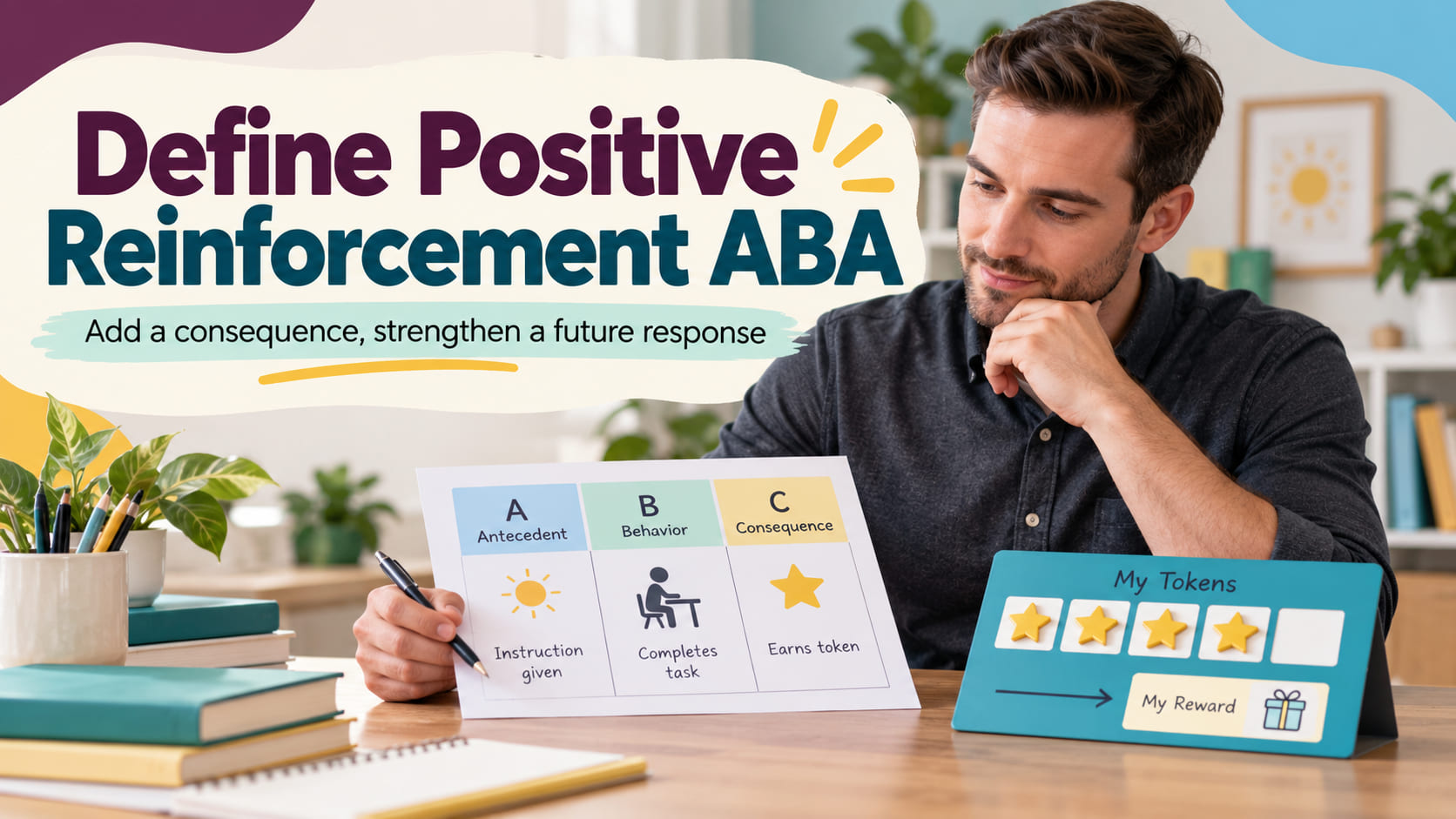
To define positive reinforcement ABA clearly, remember two parts: something is added after a response, and that response becomes more likely in a relevant future situation. “Positive” means adding, not good or pleasant, and reinforcement is confirmed by a change in future behavior rather than by the adult’s intention or the learner’s apparent enjoyment alone.
Table of Contents
- Define positive reinforcement ABA: the short answer
- The two parts of the definition
- Examples without guessing
- What positive reinforcement is not
- How to check the contingency
- The RBT’s role in implementation
- Common definition mistakes
- Frequently asked questions
ABA reinforcement, contingencies, behavior measurement, and RBT implementation
Define Positive Reinforcement ABA: What It Means and How to Check It
“Positive” means adding; reinforcement is confirmed when the future response changes in the expected direction.
To define positive reinforcement ABA clearly, remember two parts: something is added after a response, and that response becomes more likely in a relevant future situation. “Positive” means adding, not good or pleasant, and reinforcement is confirmed by a change in future behavior rather than by the adult’s intention or the learner’s apparent enjoyment alone.
This definition is useful because casual language can blur the contingency. A teacher may say, “I rewarded the learner,” but the important questions are what response occurred, what was added, when it was added, and whether the response increased later. The label should follow the observed relationship, not replace measurement.
Define positive reinforcement ABA: the short answer
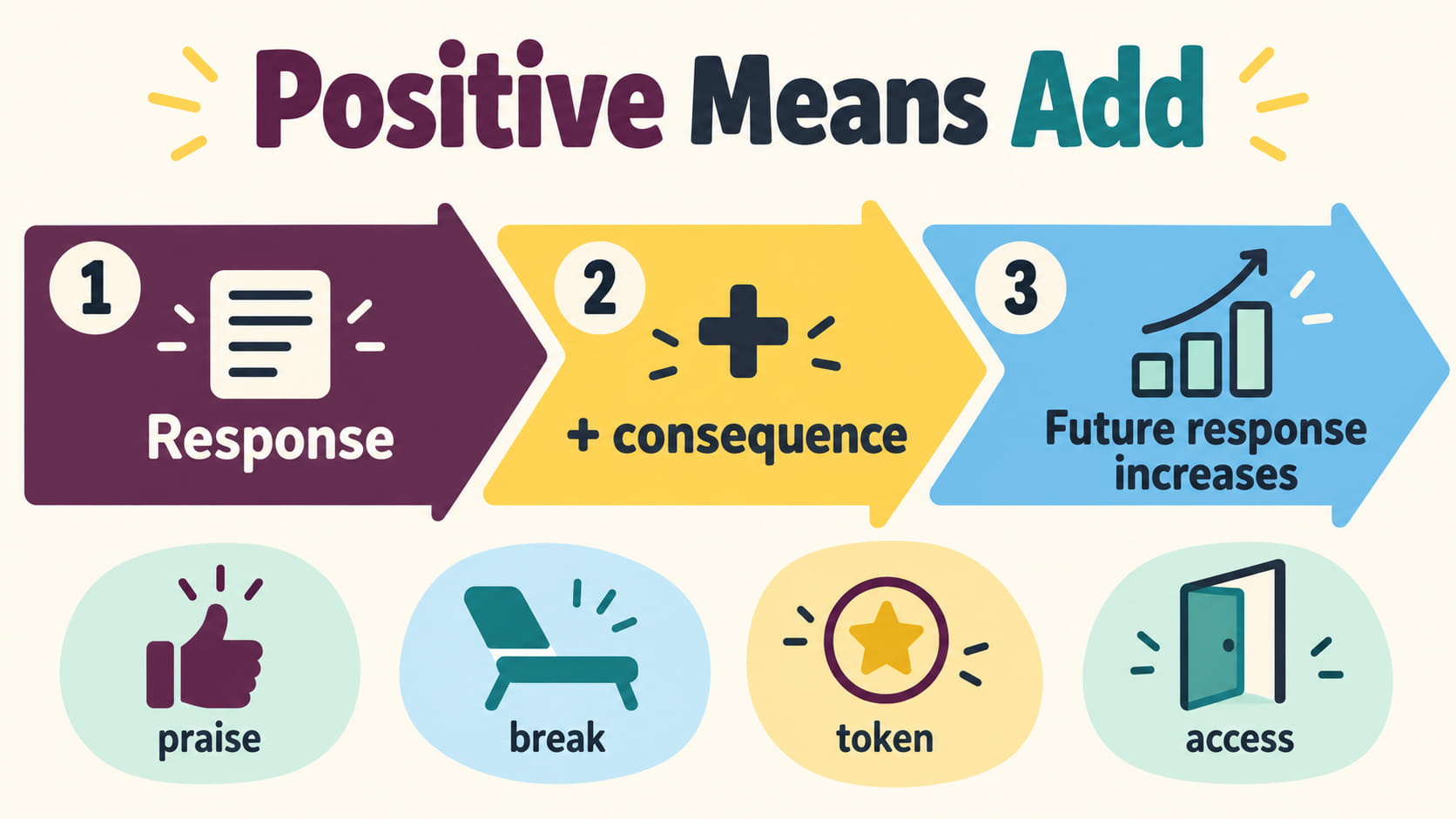
Positive reinforcement can be written as a simple sequence:
Response → something is added → the response becomes more likely in the future.
For example, a learner completes an assigned step, and the plan provides access to a preferred activity. If completing that step becomes more frequent under comparable conditions, the added consequence may be functioning as positive reinforcement for that response. The conclusion comes from the pattern of future behavior, not merely from the fact that the activity was offered.
“Positive” does not mean morally positive or universally pleasant. It describes the addition of a stimulus or event. “Reinforcement” does not mean a bribe, a compliment, or a guaranteed reward. It describes the effect on future behavior.
The two parts of the definition
Part one: an addition. After the response, something enters the situation or becomes available. It might be praise, access to an activity, a token, a break, information, social interaction, or another consequence specified by the program. The category is not determined by what an outsider thinks is pleasant.
Part two: a future increase. The response occurs more often, more quickly, with greater persistence, or under the relevant conditions in the future. The program’s measurement definition decides which dimension matters. One successful trial does not prove reinforcement, and an adult’s plan does not guarantee that the consequence will function as a reinforcer.
The word “contingent” is also important in many teaching arrangements. The added event follows a defined response according to a plan. If access is delivered randomly, before the response, or after a different behavior, it may not be the same contingency the team intended.
Examples without guessing
Praise: After the learner independently requests help, the adult says “Nice asking.” If independent requests increase across comparable opportunities, the praise may be reinforcing. If they do not, the team should not assume that praise worked simply because it sounded positive.
Tokens: After each defined response, the learner receives a token that can later be exchanged according to the plan. The token itself is added, but the team still evaluates whether the target response changes. The exchange rules and data should be assigned, not improvised.
Access to an activity: After completing a step, the learner receives a planned opportunity to use a preferred activity. The activity is added after the response, and the team checks whether the target response becomes more likely.
Information or feedback: After a correct response, the learner receives clear feedback or information that supports continued responding. Again, the label depends on the effect and the relevant data, not on the adult’s assumption.
What positive reinforcement is not
- Not the same as “nice.” A consequence can be added without being enjoyable, and something enjoyable can fail to strengthen the response.
- Not the same as punishment. Reinforcement is defined by an increase in future behavior; punishment is defined by a decrease. The labels depend on observed effects.
- Not automatically a bribe. A planned, transparent consequence in an assigned teaching procedure is different from making a last-minute promise to obtain compliance, though the exact arrangement should still be reviewed.
- Not a guarantee. What reinforces one learner, response, or context may not reinforce another.
- Not a license to change treatment. An RBT should implement assigned procedures and ask the supervisor before inventing or changing contingencies.
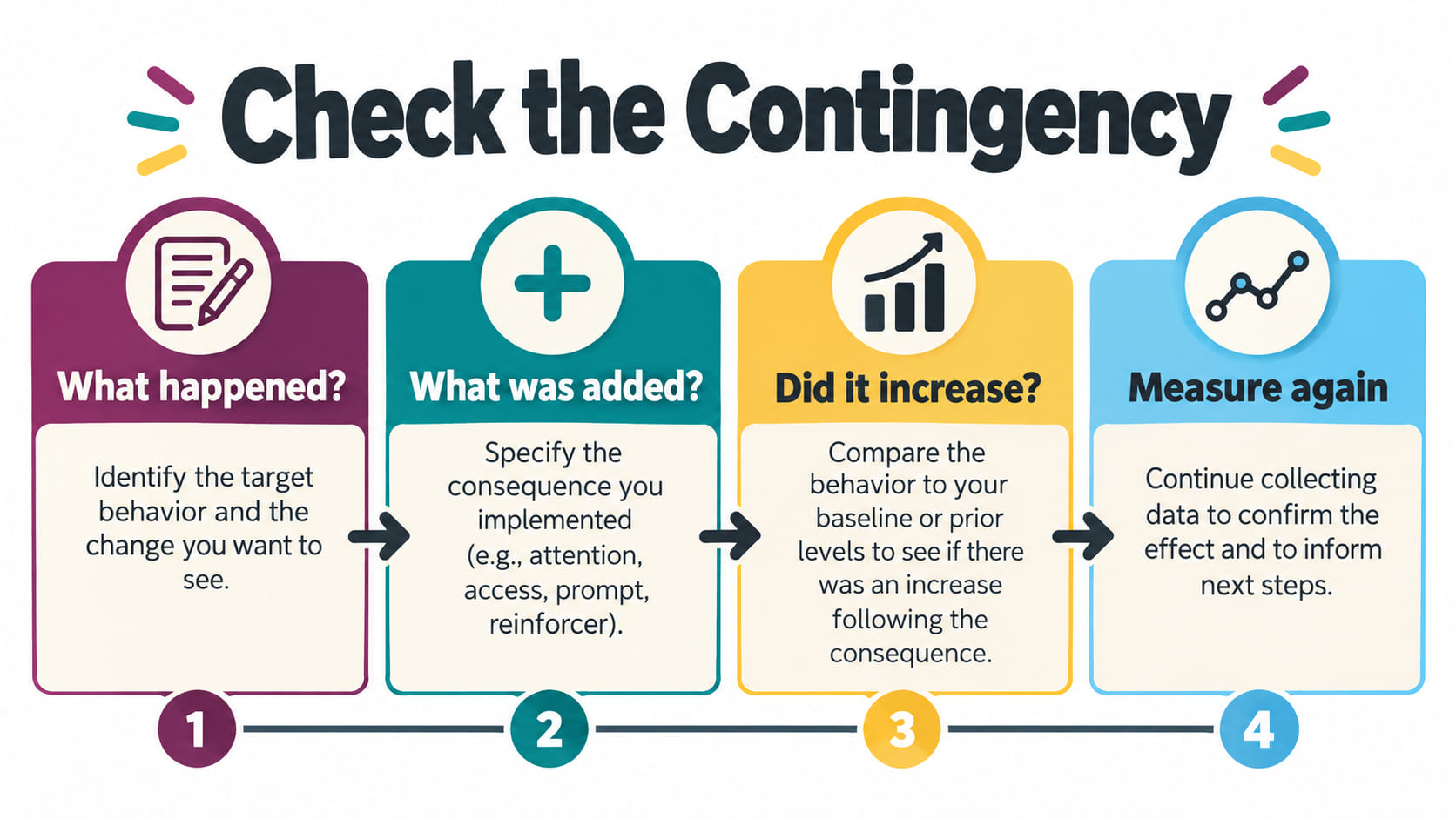
How to check the contingency
Use a structured review rather than a guess:
- Define the response. What exactly did the learner do, and what counted as an opportunity?
- Identify the addition. What entered the situation, when, and for how long?
- Check the relation. Was the addition delivered according to the assigned contingency or after an unrelated event?
- Measure future behavior. Did the target response increase under comparable conditions?
- Report the pattern. Share the data and relevant context with the supervisor before changing the plan.
Context can change the effect. A preferred activity may reinforce a response in one setting but not after a long day, with different materials, or when the learner has had unlimited access to it. That does not mean the learner is “unmotivated.” It means the team needs accurate observations and supervision.
The RBT’s role in implementation
An RBT may deliver an assigned consequence, follow the schedule or criterion in the plan, record the defined data, and communicate observations. Accuracy matters: if the consequence was delivered early, late, or after a different response, record what happened and ask for direction.
The RBT should not independently select a new reinforcer, rewrite a contingency, change a schedule, remove a consequence, or promise a learner that a particular item will always be available. If the assigned consequence is unavailable or appears ineffective, report the facts rather than silently substituting a new procedure.
Respect and dignity remain part of implementation. Reinforcement should not involve humiliation, threats, unnecessary deprivation, or a hidden exchange. The plan, supervision, and applicable ethics requirements should guide how consequences are offered and how the learner’s choices are respected.
Common definition mistakes
- Calling every reward reinforcement: the future response must be evaluated.
- Thinking “positive” means good: in this term, positive refers to adding a consequence.
- Ignoring timing: a consequence delivered far from the response may not represent the planned contingency.
- Measuring only adult satisfaction: a calm session or happy expression is not the same as a defined future increase.
- Changing the plan in the moment: RBTs should ask a supervisor before altering reinforcement procedures.
- Overgeneralizing a preference: a preferred item is not automatically a reinforcer for every response, context, or day.
Frequently asked questions
What does positive mean in positive reinforcement?
It means something is added after the response. It does not mean the consequence is morally good or always pleasant.
How do you know something is a reinforcer?
You look for an increase in the defined future response under relevant conditions. An adult’s intention or a learner’s apparent enjoyment alone is not enough.
Is praise always positive reinforcement?
No. Praise is added, but it is positive reinforcement only when the relevant response becomes more likely under the applicable conditions.
Can an RBT choose any positive reinforcer?
Follow the assigned plan and supervision. An RBT should not independently create or change reinforcement procedures; report observations and ask for direction.
Role reminder: This is educational information, not individualized clinical, credentialing, or treatment advice. RBTs should follow the assigned plan and ask a supervisor before changing reinforcement, measurement, or consequence procedures.
Official starting points: the BACB RBT Test Content Outline, RBT Handbook, supervision and training resources, and RBT Ethics Code.
Ready to practice the RBT concepts you just reviewed?
Try an independent, original RBT practice resource with exam-style questions, scoring, and answer explanations.
References
- Behavior Analyst Certification Board. RBT Test Content Outline, 3rd edition.
- Behavior Analyst Certification Board. RBT Handbook.
- Behavior Analyst Certification Board. RBT Ethics Code.