

Define preference assessment ABA as a structured way to learn what a person chooses or approaches under specific conditions without assuming that one item is always reinforcing.
Table of Contents
- Define preference assessment ABA: what it means
- Define preference assessment in ABA: what it can and cannot show
- Common preference assessment formats
- Prepare a respectful assessment
- Record choices and context
- Review and update preferences
- RBT role boundaries
- Frequently asked questions about preference assessment
- References
ABA KNOWLEDGE · CHOICE AND DATA
Define Preference Assessment in ABA: A Practical Guide
Learn what a person chooses under defined conditions without assuming one item always works.
Define preference assessment ABA as a structured way to learn what a person chooses or approaches under specific conditions without assuming that one item is always reinforcing. A preference assessment may offer objects, activities, social options, or other accessible choices and record selection according to a planned format.
This guide explains common formats for RBT learners and behavior technicians. It does not authorize an RBT to decide that an item is a reinforcer, change an assessment procedure, remove communication access, or interpret a choice as a diagnosis. Follow the current plan, respect assent and refusal, and bring questions to the supervisor.
Define preference assessment ABA: what it means
A preference assessment is a planned observation of choices under defined conditions. The team may present one item at a time, two items at once, or a larger array and record approach, selection, duration, or another specified response. The purpose is to gather information that can guide discussion about possible reinforcers or activities.
Preference is not a fixed personality trait. The same person may choose different things when tired, hungry, finished with an activity, learning a new skill, using a different communication system, or choosing among different options. The assessment is a snapshot under particular conditions, not a permanent ranking of what a person likes.
Choice must be meaningful and accessible. A person may select by reaching, pointing, looking, speaking, signing, using a device, moving toward an item, or another response defined by the program. Do not require speech or a motor response that is not necessary for the choice.
Define preference assessment in ABA: what it can and cannot show
The result can show relative selection under the assessment conditions. It may help a team identify activities to offer, materials to rotate, or options to test during instruction. It cannot prove that an item will increase a target response in every situation. Reinforcement depends on what happens after a response and whether the consequence changes future behavior.
Selection also does not mean consent to every later use. Explain or present the choice in an accessible way, honor a clear refusal, and follow the current safety and communication procedures. A person can prefer an item in one context and decline it later without being inconsistent or difficult.
Do not use preference data to label a person’s character, intelligence, motivation, or diagnosis. Record what was selected, under what conditions, and how the program directs the team to use the information.
Common preference assessment formats
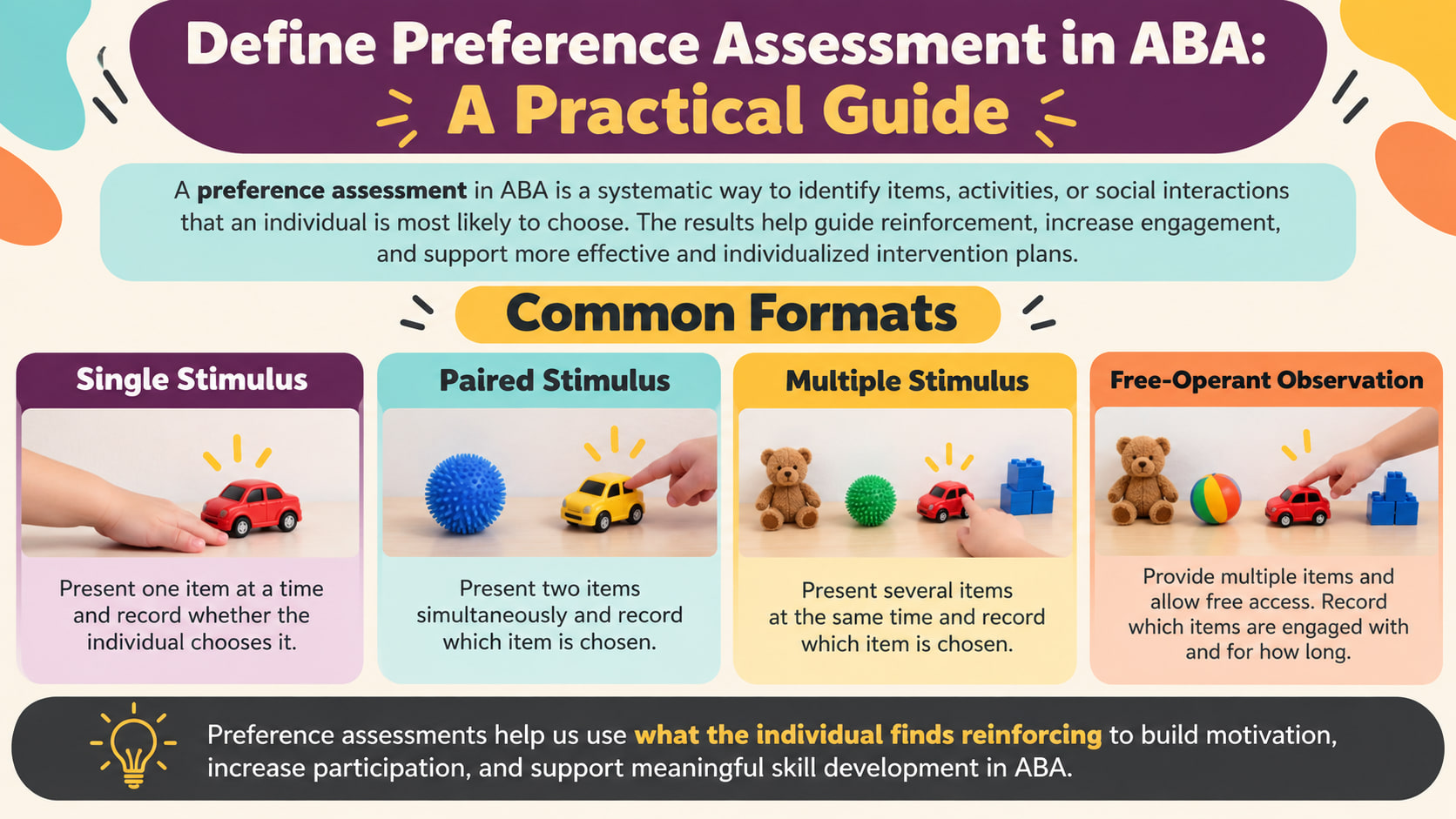
Different formats answer slightly different practical questions. Use the one named in the current program:
- Single-stimulus: Present one option at a time and record the defined response, such as approach, interaction, or acceptance. This can make a choice accessible when comparing several items at once is difficult.
- Paired-stimulus: Present two options together and record which one is selected. Across trials, the team can compare choices between pairs, following the planned order and replacement procedure.
- Multiple-stimulus: Present an array of several options and record the selection. The program may remove the chosen item or replace it for the next trial, so follow the exact format.
- Free-operant observation: Make available options accessible for a defined period and observe approach or engagement without requiring a forced choice between two items. The program should specify what is measured and how context is documented.
These formats are not interchangeable. A person may choose an item in a paired comparison but spend little time with it during free access, or may select a familiar item when it is placed in an array but approach a novel activity when the environment changes. The supervisor decides how to interpret the pattern.
Prepare a respectful assessment
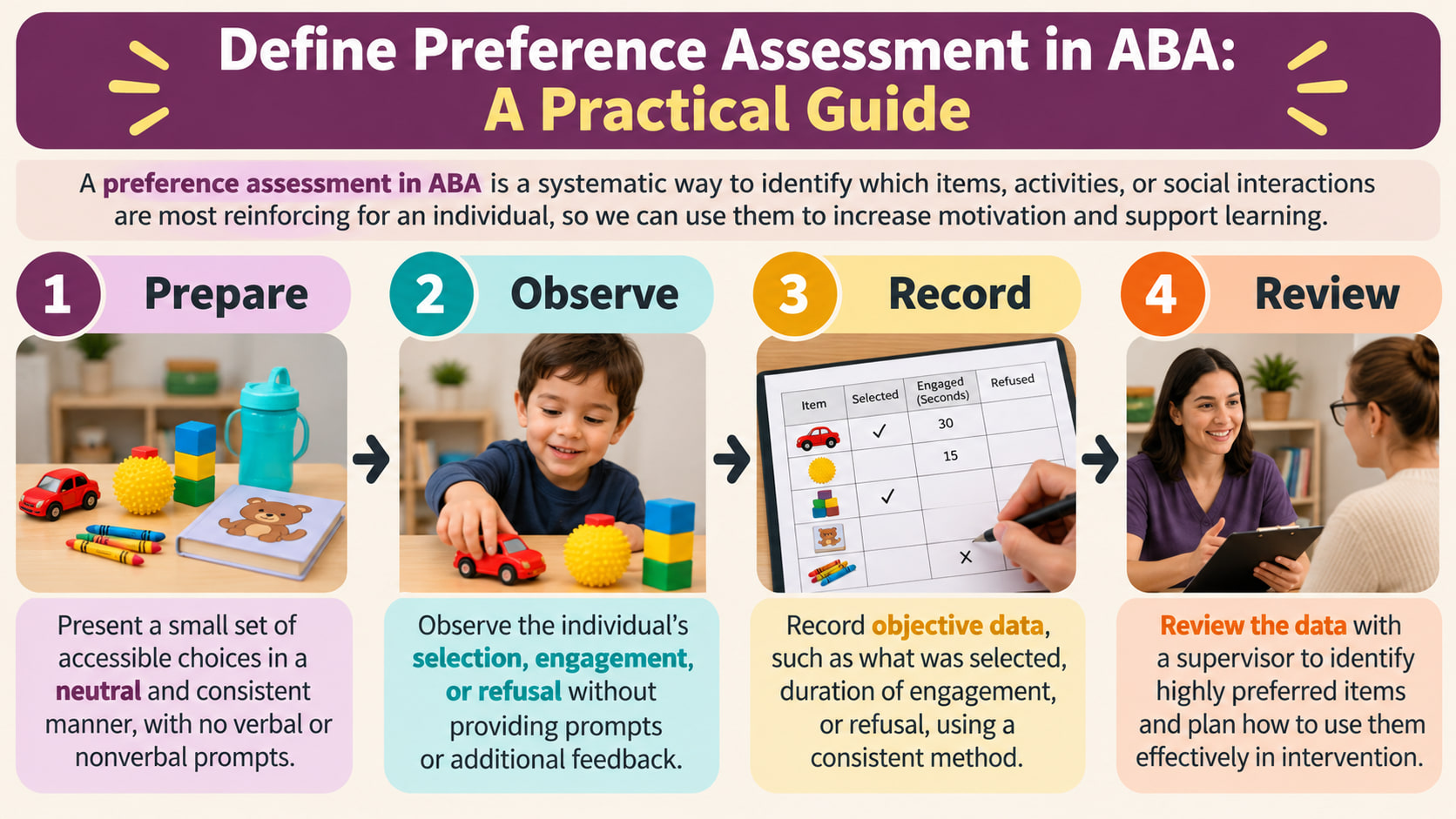
Before beginning, confirm the target response, items or activities, trial order, time limits, instructions, consequence after selection, and data fields. Check that materials are safe, functional, culturally appropriate, and available in an accessible form. Ask whether food, personal belongings, sensory materials, or other restricted items require additional guidance.
Use a neutral presentation. Do not steer the person toward an adult-preferred option through facial expressions, repeated hints, or unequal access. Present the choices as directed and allow the specified response time. If the person turns away, pushes an item away, communicates “no,” or shows distress, follow the plan rather than escalating the presentation.
Prepare the setting so the choice is observable without making the person perform for an audience. Protect privacy, limit unnecessary conversation, and avoid describing the person’s choices in front of others. If the assessment itself creates a barrier, record the observation and contact the supervisor.
Record choices and context
Record the response the program defines: selected option, approach, engagement, refusal, latency, duration, or another field. Include the trial number and the available alternatives when required. “Liked the ball” is an interpretation; “reached for the ball within five seconds and interacted for two minutes” is closer to an observable record when those fields are part of the plan.
Context can change the result. Note relevant conditions such as prior access, schedule, environment, communication support, item condition, task demands, or a change in the person’s routine. Do not add private information beyond what the approved record requires.
If a choice is ambiguous, do not invent a result. Follow the program’s rule for no response or simultaneous selection, preserve the record, and ask how the supervisor wants the trial handled. Consistent uncertainty is more useful than a confident guess.
Review and update preferences
Review the data with the supervisor rather than treating a rank order as permanent. The team may rotate options, offer a choice again later, compare an activity with another consequence, or change the assessment when selections no longer predict engagement. Keep the person’s communication and refusal options available during review.
A selected item may not function as reinforcement if it is delivered too often, is not contingent on the target response, is unavailable in the relevant setting, or is less valuable than another outcome. The team should evaluate the full arrangement and use data, not simply repeat the same assessment until a preferred answer appears.
Report patterns that matter: the person consistently selects “none,” chooses the same option only when it is closest, engages briefly and then moves away, or uses a communication device to request something not on the array. These observations may indicate that the choices, access, response form, or procedure needs authorized review.
RBT role boundaries
An RBT prepares approved materials, presents the defined choice, records the specified response, protects privacy and dignity, and reports barriers. The supervisor or authorized team selects the format, interprets results, and determines how preferences inform teaching or reinforcement.
- Before: confirm items, access, response definition, trial procedure, timing, and safety.
- During: present neutrally, honor communication and refusal, and record observable data.
- After: secure the record, report unusual patterns, and do not independently label an item as a universal reinforcer.
Frequently asked questions about preference assessment
Does choosing an item prove it is a reinforcer?
No. Selection shows preference under the assessment conditions. The team must evaluate what happens after a target response and review the effect over time.
Can a preference assessment include activities?
Yes, when the current program defines safe and accessible activities as options. The assessment should specify what counts as selection or engagement.
What if the person refuses every option?
Follow the refusal and safety procedure, record the defined response, and contact the supervisor. Do not pressure the person or keep presenting options outside the plan.
Can an RBT create a new choice array?
Use the approved array and procedure. Suggest observations to the supervisor, who can decide whether the assessment should be updated.
Source note: Review the current BACB RBT Handbook, task list, ethics code, employer policy, and supervisor guidance. This article is educational and does not provide individualized legal, clinical, employment, or credentialing advice.
Ready to practice the RBT concepts you just reviewed?
Try an independent, original RBT practice resource with exam-style questions, scoring, and answer explanations.
References
- Behavior Analyst Certification Board. RBT Test Content Outline, 3rd edition.
- Behavior Analyst Certification Board. RBT Handbook.
- Behavior Analyst Certification Board. RBT Ethics Code.