
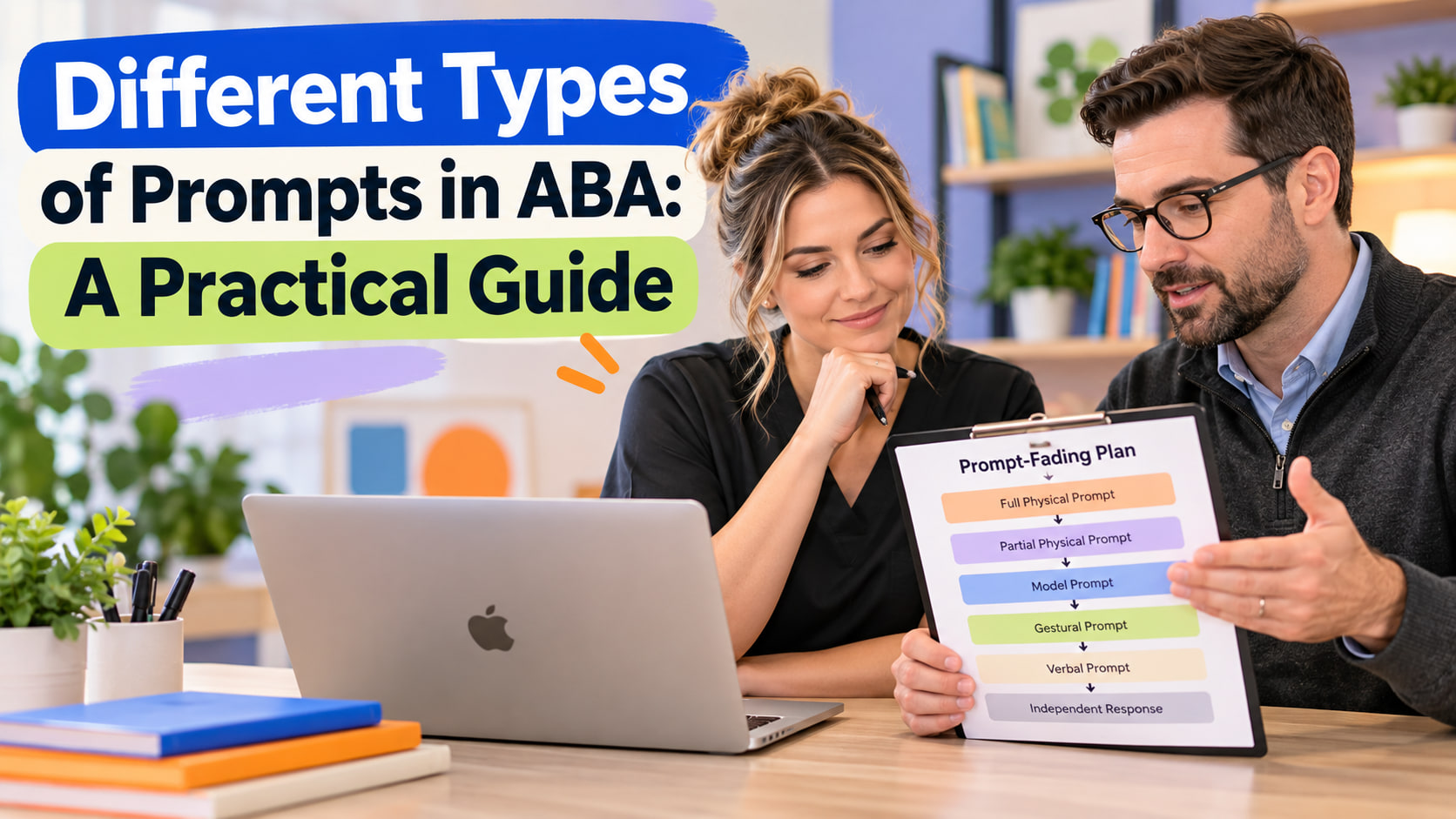
Different types of prompts in ABA help a learner contact the correct response when a skill is being taught, but each prompt should follow the approved program and be faded toward independence.
Table of Contents
- Different types of prompts in ABA: what a prompt does
- Different types of prompts in ABA
- Prompt intrusiveness and the teaching context
- Prompt fading
- Data and independence
- Respectful prompting
- RBT role boundaries
- Frequently asked questions about different types of prompts in ABA
- References
ABA KNOWLEDGE · SKILL TEACHING
Different Types of Prompts in ABA: A Practical Guide
Use planned supports, fade them thoughtfully, and measure independence.
Different types of prompts in ABA help a learner contact the correct response when a skill is being taught, but each prompt should follow the approved program and be faded toward independence. A prompt may be a spoken cue, gesture, model, visual, position of materials, or physical support. The best choice depends on the learner, target, setting, safety, communication, and current teaching plan.
This guide explains common prompt forms for RBT learners and families. Prompting is not a license to pressure, repeat demands indefinitely, or invent a hierarchy. Follow the current program, use the least intrusive procedure that the authorized team specifies, record what happened, and bring uncertainty to the supervisor.
Different types of prompts in ABA: what a prompt does
A prompt is an added antecedent support that increases the likelihood of a target response. For example, a learner who is learning to place a cup in a bin might receive a visual picture, a gesture toward the bin, a model of the action, or a brief physical guide when the program permits it. The prompt is not the skill itself. The teaching goal is usually for the learner to respond to the natural cue with less or no adult assistance.
Prompts should be connected to a clearly defined target. “Be independent” is too vague to measure; “places the cup in the labeled bin within five seconds of the cleanup cue” is more observable. Ask the supervisor what counts as a correct response, which prompts are allowed, how long to wait, and what consequence follows.
Prompting should also protect communication and dignity. A learner may need more processing time, an accessible response form, or a different way to show the skill. Do not treat a delayed response, movement difference, or communication device as refusal without checking the program and context.
Different types of prompts in ABA
Programs may use different names or combine prompt forms. The following descriptions are practical starting points, not a substitute for the definitions in a learner’s current plan:
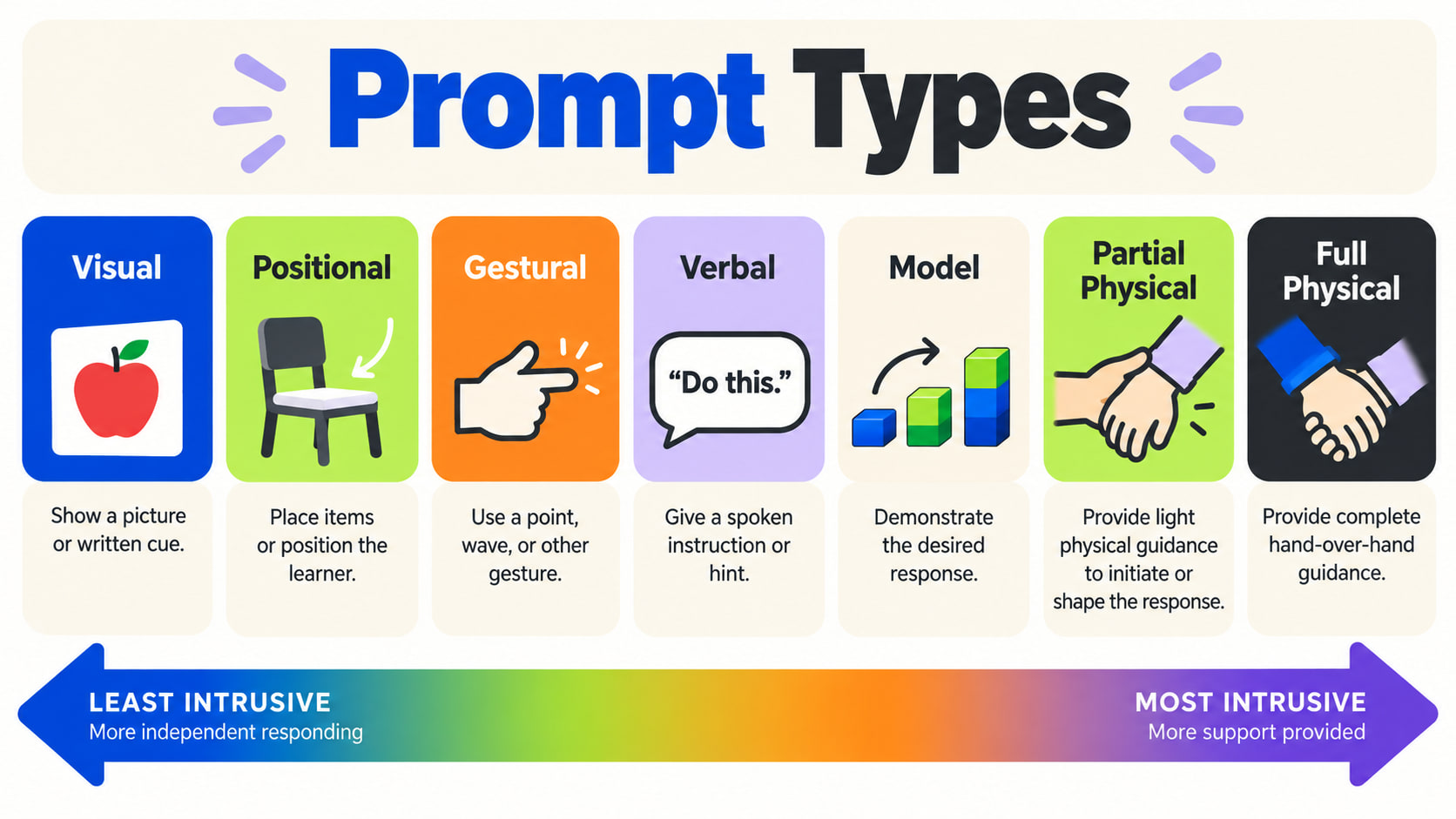
- Visual prompt: A picture, written cue, checklist, color signal, or other visual information shows what to do or where to respond. Visuals can make a routine more predictable and may remain available as an appropriate support.
- Positional prompt: The instructor places the correct item or response in a position that makes it more likely to be selected. Use only the arrangement specified by the program, because position can accidentally become the only cue.
- Gestural prompt: A point, movement, or other gesture directs attention toward the relevant object or action without physically guiding the learner.
- Verbal prompt: Spoken information tells the learner what to say or do, or provides part of the response. Record the exact level required when the program distinguishes a full verbal cue from a brief verbal cue.
- Model prompt: The instructor demonstrates the action or response for the learner to imitate. Modeling should be clear, accessible, and appropriate to the target.
- Partial-physical prompt: Physical contact provides limited guidance toward the response when the plan allows it and consent, safety, and dignity are addressed.
- Full-physical prompt: More complete physical guidance supports the movement through the response. This is highly intrusive and must never be improvised or used casually.
A prompt can be helpful without being permanent. The team may decide that a visual checklist is an appropriate long-term accommodation while fading a verbal reminder that the learner no longer needs. Independence means access to the skill with the supports that are intentionally available, not forcing every person to perform without tools.
Prompt intrusiveness and the teaching context
People often describe prompts as a continuum from less intrusive to more intrusive, but the order is not universal. A verbal prompt may be less intrusive for one learner and confusing or overwhelming for another. A visual prompt may be more accessible than speech. Physical prompting may be necessary for a safety skill in one carefully defined context and inappropriate in another.
Do not select a prompt because a chart says it is always “least to most” or “most to least.” Ask what the current teaching procedure requires. The authorized team may choose a procedure based on error prevention, response effort, motor access, communication, safety, or the learner’s history. The RBT’s job is to implement the selected procedure consistently and report what the data show.
Before prompting, check the natural cue, materials, environment, and learner readiness. A missing item, unclear instruction, excessive noise, or inaccessible device can look like a skill deficit. Fix the programmed environmental support or ask the supervisor rather than escalating prompts automatically.
Prompt fading
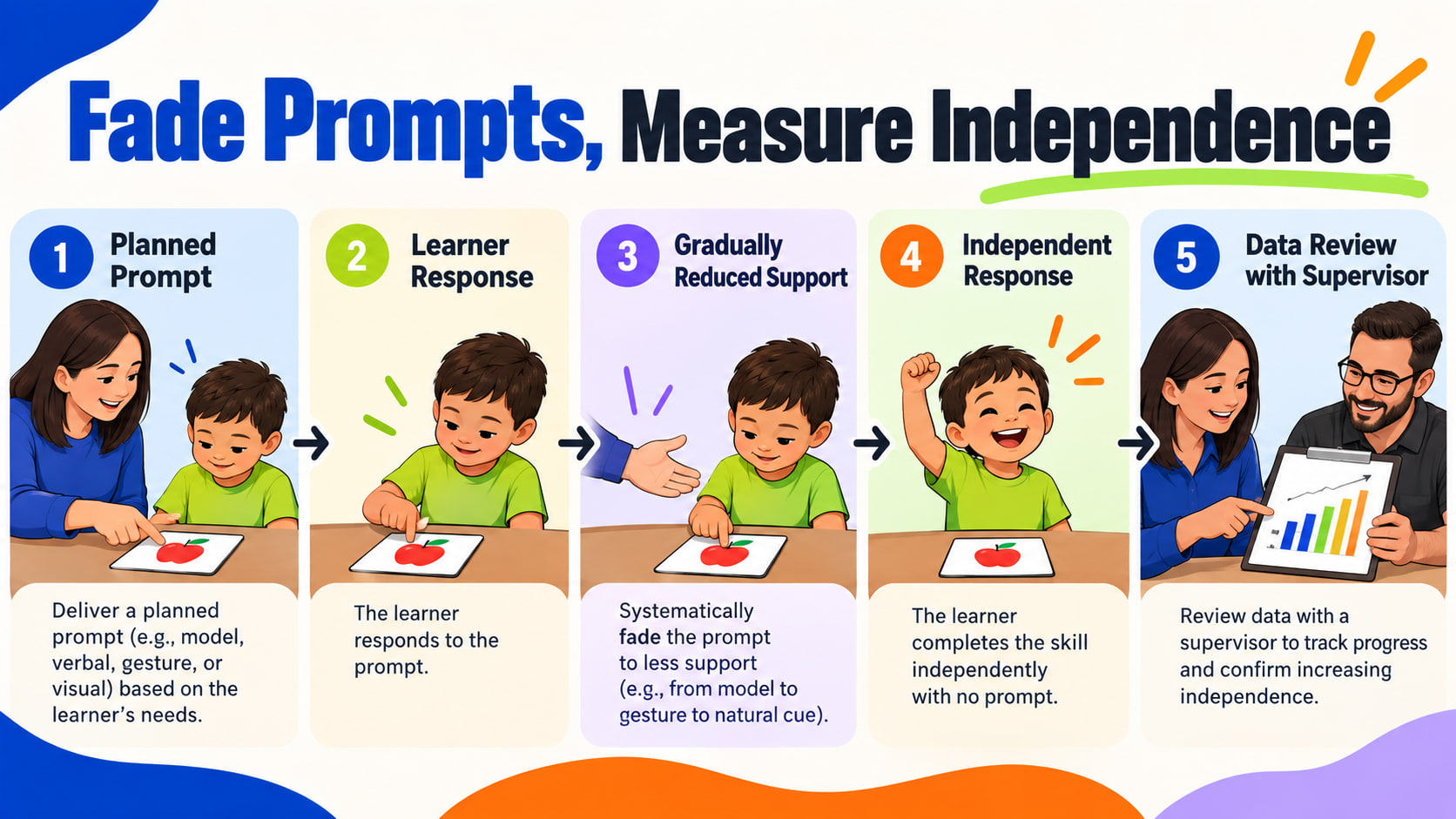
Prompt fading gradually reduces the added support so the natural cue can control the response. A program might reduce the length of a verbal cue, move a gesture farther away, delay a model, change the position of materials, or reduce physical guidance. The exact method and criterion should come from the plan.
Fading too quickly can produce errors, frustration, or loss of access to the skill. Fading too slowly can create prompt dependence, in which the learner waits for an adult cue even when the natural cue is present. Data help the team balance these risks. If a learner is succeeding only with a prompt, record that accurately and ask whether the fading criterion needs review.
Do not covertly fade by making a prompt so subtle that it is difficult to describe. A prompt should remain observable enough to implement and record. If the program uses a time delay, follow the specified wait time. Do not add repeated questions or hints during the delay unless the procedure says to do so.
Data and independence
Prompt data usually distinguish an independent response from a prompted response and may specify the prompt level. Follow the program’s operational definitions. “Completed task” is not enough if the important outcome is whether the learner responded independently, after a gesture, after a model, or after physical guidance.
Record what occurred, not what you think the learner intended. A useful note might say that the cleanup cue was presented, the learner touched the cup after a gestural prompt, and the cup was placed in the bin. Avoid labels such as lazy, unmotivated, or noncompliant. Context, timing, materials, and access to communication can all affect performance.
Share patterns during supervision. If a prompt works in one room but not another, if the response changes with a different material, or if the learner communicates discomfort, preserve those observations. The supervisor can decide whether the target, prompt, environment, reinforcement, or measurement system needs review.
Respectful prompting
Use calm, concise instructions and allow the programmed response time. Avoid turning a prompt into a test of obedience. If the learner signals pain, distress, confusion, or a need for a break, follow the safety and communication procedures and contact the supervisor as required.
Physical prompts require special care. Explain or prepare the interaction in the way the plan and learner’s communication support, use only authorized contact, and stop or seek guidance when safety or consent concerns arise. Never use force to obtain a practice response or continue physical contact because a learner did not perform quickly.
Respect culture, language, sensory needs, motor access, and the learner’s preferred communication. A prompt that is technically effective but humiliating, inaccessible, or unnecessary is not a high-quality teaching support. The aim is meaningful participation and growing access to the skill.
RBT role boundaries
An RBT implements the current prompting procedure, prepares materials, delivers the specified cue, records prompt level and response, protects privacy, and reports barriers. The supervisor or authorized team selects the prompt strategy, defines mastery and fading criteria, reviews data, and changes the plan.
- Before teaching: confirm the target, natural cue, prompt allowed, wait time, consequence, and safety procedure.
- During teaching: use the same defined prompt, give the programmed opportunity, and avoid adding improvised hints.
- After teaching: record the response and prompt level, note relevant context, and report concerns or patterns in supervision.
Frequently asked questions about different types of prompts in ABA
Which prompt is the least intrusive?
There is no universal answer. The least intrusive effective support depends on the learner, target, access needs, context, and authorized teaching procedure.
Are visual prompts better than verbal prompts?
Not automatically. A visual may be more accessible for one learner, while another may respond best to speech, modeling, or a different support. Use the plan and data.
Should every prompt be faded?
Added prompts are usually faded when the goal is independent responding, but a visual, communication device, or other support may be intentionally maintained as an appropriate accommodation.
Can an RBT create a new prompt hierarchy?
No. Implement the current procedure and ask the supervisor to review a barrier or propose a change through the authorized process.
Source note: Review the current BACB RBT Handbook, task list, ethics code, employer policy, and supervisor guidance. This article is educational and does not provide individualized legal, clinical, employment, or credentialing advice.
Ready to practice the RBT concepts you just reviewed?
Try an independent, original RBT practice resource with exam-style questions, scoring, and answer explanations.
References
- Behavior Analyst Certification Board. RBT Test Content Outline, 3rd edition.
- Behavior Analyst Certification Board. RBT Handbook.
- Behavior Analyst Certification Board. RBT Ethics Code.