
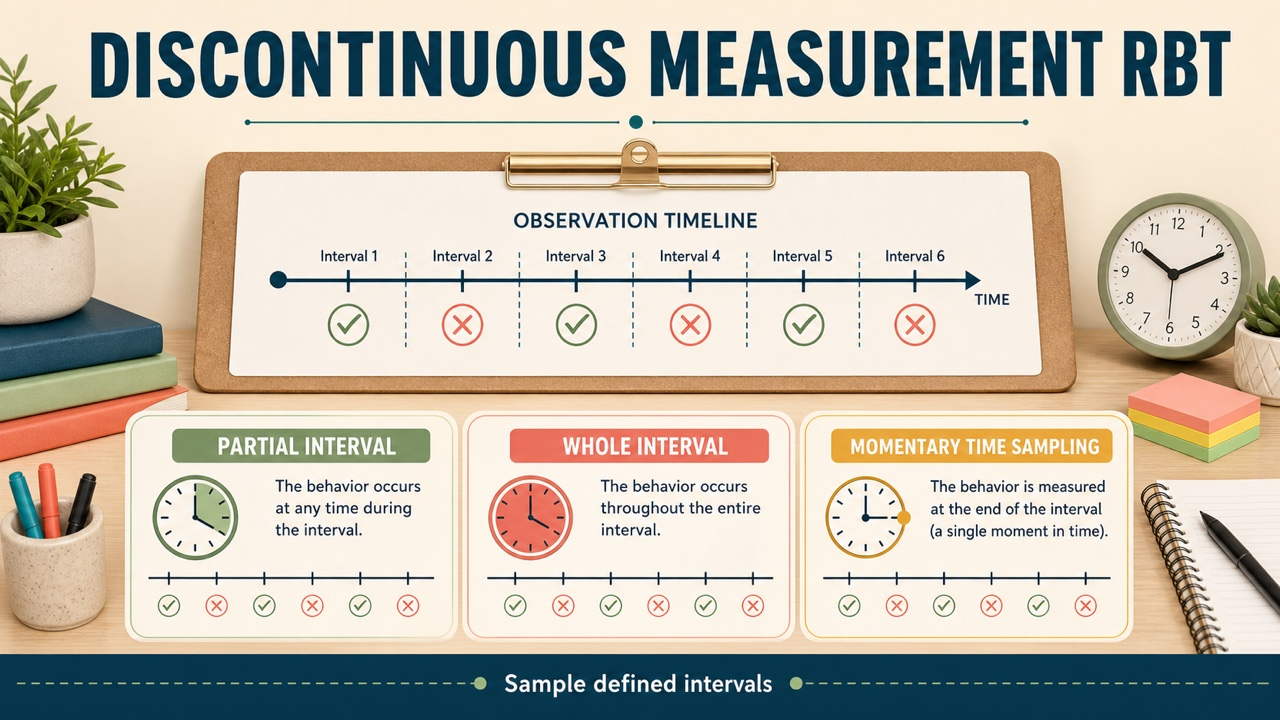
discontinuous measurement rbt questions are usually testing a recording rule, not asking you to guess which method feels easiest. Discontinuous measurement samples behavior across intervals instead of recording every response continuously. The three procedures most often compared are partial-interval recording, whole-interval recording, and momentary time sampling. Each has a different rule and a different way of representing behavior.
Table of Contents
- discontinuous measurement rbt: the basic definition
- Partial-interval recording
- Whole-interval recording
- Momentary time sampling
- Compare the three interval rules
- How an RBT implements discontinuous measurement
- Discontinuous versus continuous measurement
- Data fidelity, interpretation, and role boundaries
- Frequently Asked Questions
- References
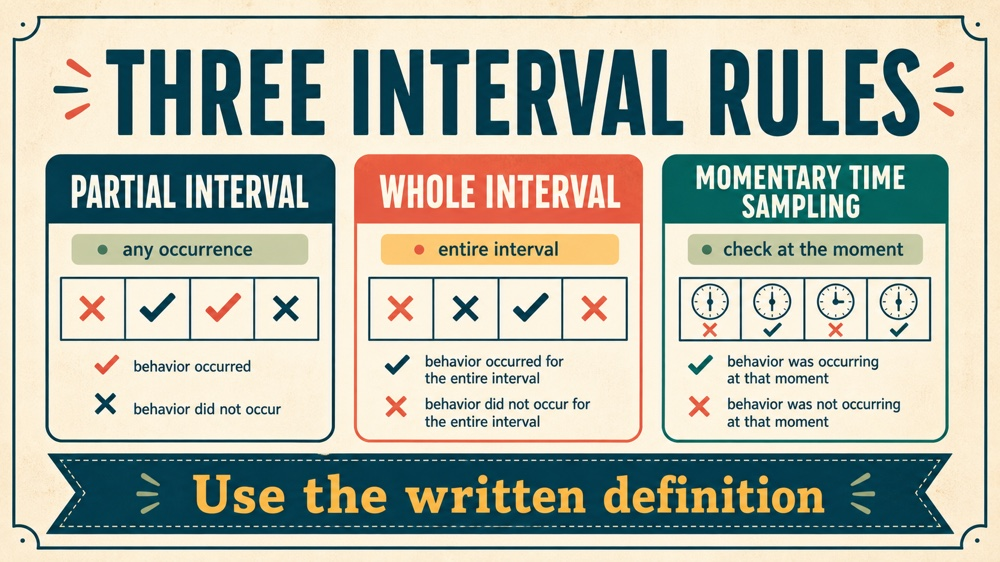
Quick answer: Partial-interval recording marks an interval when the behavior occurs at any time. Whole-interval recording marks it only when the behavior occurs for the entire interval. Momentary time sampling checks whether the behavior is occurring at a specified instant. Use the written procedure, interval length, and scoring rule exactly as assigned.
Study boundary: This is independent exam-preparation content, not an official BACB handbook, task answer key, or application determination. The examples in this article are newly written for study. They are not official, recalled, leaked, or BACB-endorsed exam questions. Requirements and policies can change, so use the current BACB handbook and your supervisor or requirements coordinator for decisions about an individual application or client program.
discontinuous measurement rbt: the basic definition
Discontinuous measurement divides an observation into intervals and samples behavior according to a rule. It can reduce the burden of timing every response, especially when the target is frequent, rapid, or difficult to observe continuously. The result is an estimate or sample of occurrence, not a direct record of every second or every instance.
The method should match the purpose. If the team needs an exact count or duration, a continuous procedure may be more appropriate. If the program specifies interval sampling, the RBT implements it consistently and communicates limitations or unusual conditions to the supervisor.
Partial-interval recording
Under partial-interval recording, mark the interval if the target behavior happens at any point during that interval. A behavior lasting one second and a behavior lasting 25 seconds can both receive a mark in the same 30-second interval. Partial interval is therefore not a duration measure.
Original scenario: A 5-minute observation uses ten 30-second intervals for hand flapping. The learner flaps for 2 seconds in interval 3 and for the full 30 seconds in interval 7. Both intervals are marked under the partial-interval rule. The percentage is based on marked intervals divided by the total defined intervals, not on 32 seconds.
Partial interval can be sensitive to brief behavior and may overestimate the amount of time behavior occurred. That is a property of the measurement method, not an invitation for the RBT to change the score.
Whole-interval recording
Under whole-interval recording, the target must occur for the entire interval for the observer to mark it. If the learner stops for even the amount of time defined as a break in the program, the interval may not qualify. The exact scoring rule and any pause criteria come from the data procedure.
Original scenario: A plan uses five 1-minute intervals to measure on-task engagement. The learner looks away for 3 seconds during interval 2, so interval 2 is not marked if the whole-interval definition requires engagement for the entire minute. The note should not describe the learner as “off task for one minute”; it should report the interval score and any additional data the plan requests.
Whole interval can underestimate behavior or engagement that is important but not continuous. It is often useful when the team wants to know whether a behavior persists across the complete interval, but it is not the same as duration.
Momentary time sampling
Momentary time sampling checks whether the behavior is occurring at a particular moment, commonly at the end of each interval. Behavior that begins and ends between checks may not be recorded. The observer must use the same check moment and avoid looking across the whole interval.
Original scenario: A timer signals at the end of each 2-minute interval. At the signal for interval 4, the learner is seated and writing, so the technician marks “on task” if that is the defined response. If the learner was off task for 90 seconds earlier but returned before the signal, that earlier period does not change the momentary mark.
Compare the three interval rules
| Procedure | When to mark | Typical measurement effect |
|---|---|---|
| Partial interval | Behavior occurs at any time in the interval. | Can overestimate brief or frequent behavior. |
| Whole interval | Behavior occurs for the entire interval. | Can underestimate behavior that pauses. |
| Momentary time sampling | Behavior occurs at the specified check moment. | Can miss behavior between checks. |
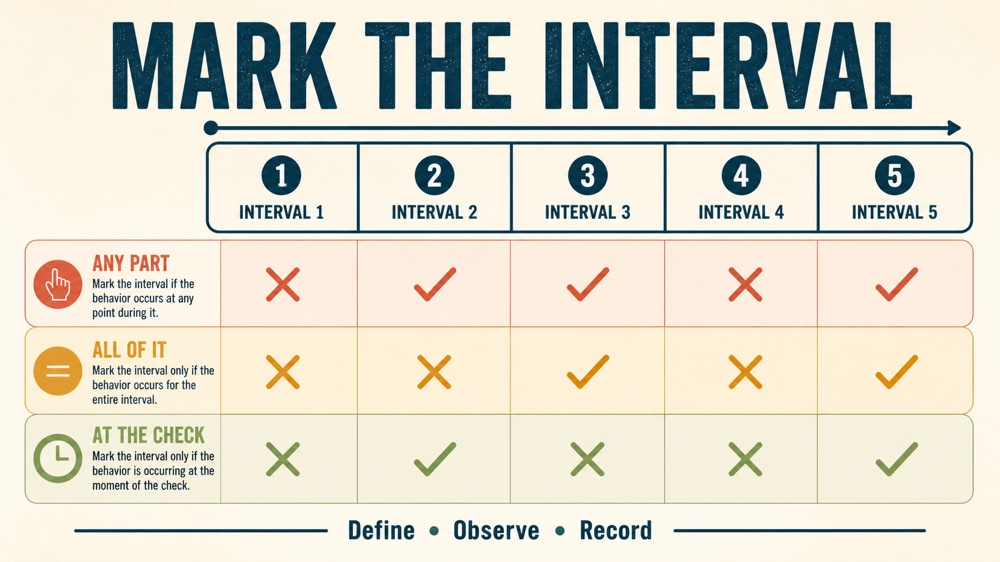
The phrase “percentage of intervals” does not identify the method by itself. Look for the condition attached to the mark: any occurrence, entire interval, or check moment. That single distinction often resolves a close answer choice.
How an RBT implements discontinuous measurement
- Confirm the target: Review the operational definition and examples/nonexamples.
- Confirm the interval: Note the length, number, start signal, end signal, and observation window.
- Confirm the rule: Ask whether the score is partial, whole, or momentary and what counts at the boundary.
- Use one timing system: Keep signals consistent and avoid changing the interval length mid-session.
- Record interruptions: Follow the plan when a safety event, transition, or missing signal affects an interval.
- Communicate limitations: Report unusual conditions instead of presenting a sample as a complete continuous record.
Discontinuous versus continuous measurement
Continuous frequency can answer how many responses occurred; duration can answer how long they lasted. Discontinuous sampling answers whether behavior met a rule in selected intervals. If a question asks for the exact number of episodes, interval percentage is not the answer. If it asks whether behavior persisted for every interval, whole interval may fit. If it asks what was happening at a signal, momentary time sampling may fit.
Original comparison: A learner hums for 5 seconds at the beginning of a 1-minute interval and is quiet at the end. Partial interval would mark occurrence, whole interval would not, and momentary time sampling would not if the check is at the end. The same observation produces three different scores because the methods ask three different questions.
Data fidelity, interpretation, and role boundaries
Do not use the method to label a learner or infer a function. A sample can show a pattern worth discussing, but clinical interpretation and treatment decisions require the appropriate supervisor or qualified professional. Protect privacy, use the approved record system, and correct errors according to documentation policy.
An RBT is a paraprofessional who provides behavior-analytic services under the direction and close supervision of the responsible supervisor or requirements coordinator. A strong answer therefore separates what an RBT can implement as written from what requires assessment, clinical interpretation, plan changes, or supervisor direction.
Current exam frame: The current RBT Test Content Outline (3rd ed.) applies beginning January 1, 2026. It describes 43 tasks across six content domains. The current examination format is 75 scored questions plus 10 unscored pilot questions, four answer choices per item, and a 90-minute testing period. These facts explain the study frame; they do not turn an independent guide into an official BACB resource.
For study, draw a timeline for one interval and place a dot at the check moment. Then ask whether a one-second occurrence, a full interval, or an end-of-interval response would earn a mark. Visualizing the rule prevents many wording errors.
Practice interval-measurement decisions
Use independent RBT-style examples to compare partial interval, whole interval, and momentary time sampling, then verify the definitions in current official materials.
Review the RBT resource →
Frequently Asked Questions
What is discontinuous measurement?
It samples behavior across defined intervals rather than recording every response continuously. The recording rule determines how each interval is scored.
What is partial-interval recording?
Mark the interval if the target occurs at any time during it. The amount of time within the interval does not change the basic mark.
What is whole-interval recording?
Mark the interval only when the target occurs for the entire interval under the written definition.
What is momentary time sampling?
Check whether the target is occurring at a specified moment, often the end of the interval. Behavior between checks may not be captured.
Are these official BACB questions?
No. The scenarios are newly written independent study examples and are not official, recalled, leaked, or BACB-endorsed exam questions.