
A free printable RBT study guide is useful when it turns the current outline into observable decisions instead of becoming a pile of disconnected definitions. Printables can help with active recall, source checking, and weekly planning, but the current BACB Handbook and RBT Test Content Outline control requirements and examination details. This page shows how to build a study sheet that stays accurate and within the RBT role.
Table of Contents
- Free printable RBT study guide: start with current sources
- Map the six RBT domains
- Make the data section concrete
- Add acquisition and reduction decision boxes
- Include documentation and ethics
- Use active recall instead of passive rereading
- Current exam context and study planning
- Mistakes to avoid in a free printable
- Free printable RBT study guide checklist
- Frequently Asked Questions
- References
Then reinforce the concepts with free RBT mock exams and review the explanations.
Continue your RBT study with RBT exam study materials and original practice resources.
Quick answer: Treat free printable rbt study guide as a current-source RBT study topic. Define the concept, connect it to an observable action, use original examples, and keep the supervision boundary visible.
Study boundary: This independent guide is educational content. It is not a BACB policy, certification decision, legal opinion, answer key, or guarantee of examination success. Examples are original and are not official, recalled, leaked, or BACB-endorsed questions.
Current exam context: The current BACB RBT Test Content Outline describes 43 tasks across six domains; the examination includes 75 scored questions and 10 unscored pilot questions in a 90-minute testing period. Verify the current handbook and outline before relying on a time-sensitive detail.
Free printable RBT study guide: start with current sources
Put the source title, version date, official URL, and check date at the top of the page. The current RBT Test Content Outline (3rd ed.) should anchor examination coverage, while the Handbook controls administrative pathway details. A printable without a version marker can look finished while silently relying on an old requirement.
Leave a margin for source checks. When a fee, document window, identity instruction, or exam detail changes, mark the item for review rather than overwriting it from memory. A good study guide makes uncertainty visible.
Map the six RBT domains
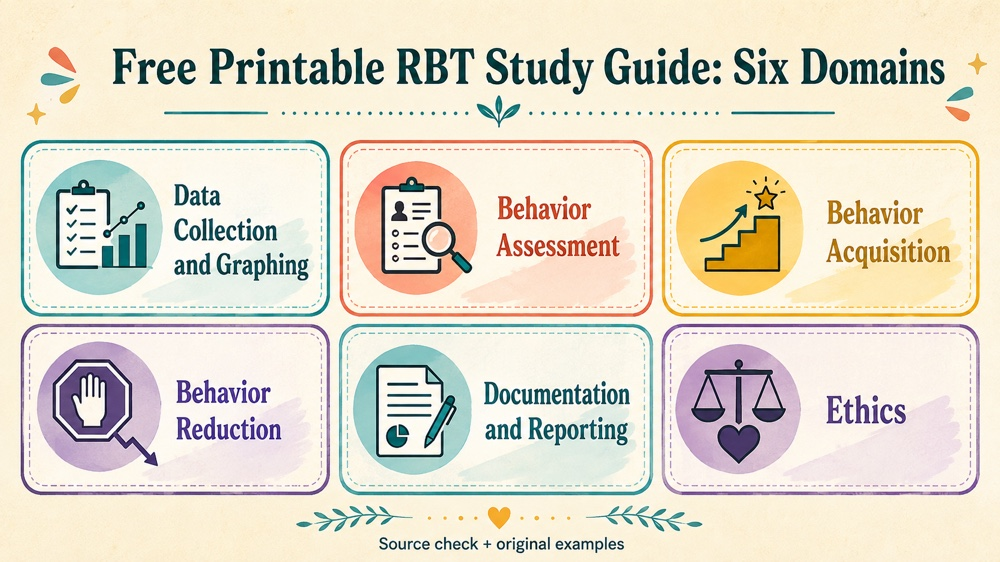
The current outline describes 43 tasks across six domains: Data Collection and Graphing, Behavior Assessment, Behavior Acquisition, Behavior Reduction, Documentation and Reporting, and Ethics. Build one box for each domain and write an action, a data rule, and a role boundary inside each box.
- Name the task or concept in plain language.
- Write an original condition that requires a decision.
- State what the RBT observes, records, or implements.
- Add what requires supervision or a written plan.
- Mark the source and date used to check the note.
Make the data section concrete
A useful page distinguishes frequency, rate, duration, latency, interval recording, permanent product, and percentage. Each term should have a start rule, a stop rule, and a small example. For instance, latency is the time between a specified cue and the start of the target response; the program controls the cue, response, and timing rules.
Do not replace a programmed measurement system because another one is easier. Include a reminder to use the operational definition, record what occurred, and report a barrier. The point of a printable is accurate implementation, not a prettier substitute for the plan.
Add acquisition and reduction decision boxes
For acquisition, include prompting, prompt fading, reinforcement, shaping, chaining, discrimination, generalization, and maintenance. For reduction, include antecedent strategies, differential reinforcement, extinction, safety, and reporting. Each box should answer: what is the RBT expected to implement, what is recorded, and what is not independently changed?
Use one original scenario per concept. Change the setting, person, material, prompt, or consequence on the next scenario. That prevents memorization of a single sentence and supports transfer to a new question.
Include documentation and ethics
A study guide is incomplete without objective notes, confidentiality, competence, supervision, reporting, and accurate data. Put a privacy check beside examples that include client information. Put a role-boundary check beside examples that ask for a diagnosis, a new function-based procedure, or a change to a written plan.
The RBT Ethics Code is a source for professional conduct, not decoration at the end of the page. Write the action: protect privacy, document facts, seek direction, disclose limits, and report concerns through the proper route.
Use active recall instead of passive rereading
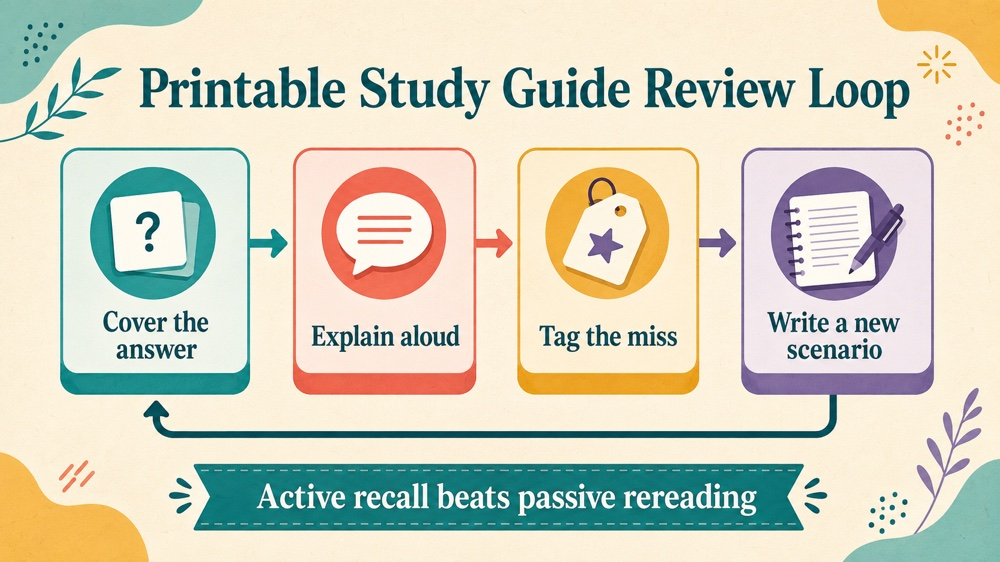
Print the guide, cover the answer column, and explain each concept aloud. For every miss, tag the reason: vocabulary, discrimination, measurement, calculation, reading the condition, or role boundary. Then write a new scenario. A page becomes more useful when it tells you what to do after a mistake.
Mix domains during review. A short block may move from latency to prompting to confidentiality to documentation. Real decisions do not announce which box they came from, so interleaving is more informative than reading one section repeatedly.
Current exam context and study planning
The current examination includes 75 scored questions and 10 unscored pilot questions in a 90-minute testing period. Use those figures only for planning and verify the current source before relying on them. They do not make a third-party printable official or predictive of protected questions.
Plan short sessions with one source check, one active-recall round, and one original scenario. Keep practice feedback separate from any administrative application record. Preparation is stronger when it produces a reproducible decision process.
Mistakes to avoid in a free printable
- Leaving out the outline version date or source URL.
- Listing definitions without an observable example.
- Calling an independent printable official, endorsed, or predictive.
- Treating a practice score as proof of eligibility or certification.
- Turning vocabulary into permission for an independent clinical change.
- Ignoring privacy, documentation, competence, or supervision.
- Copying recalled or protected questions instead of writing original scenarios.
Free printable RBT study guide checklist
- Does each domain include a condition, action, data rule, and boundary?
- Have I checked the current Handbook and TCO version dates?
- Can I explain the six domains without relying on a keyword alone?
- Do my examples use original scenarios and observable actions?
- Are privacy, documentation, ethics, and supervision included?
- Do I know what to review after each missed item?
- Will I update the page when an official source changes?
A free printable RBT study guide should be a living study tool. Keep it concise, source-linked, and original. When a rule changes, update the page rather than adding an unverified note on top of an old one.
Practice the concept
Review free printable rbt study guide with original RBT scenarios, current-source reminders, and clear role boundaries.
Review the RBT study resource →
Frequently Asked Questions
What should a printable RBT study guide contain?
Use the six current domains, source and version notes, original scenarios, observable actions, data rules, documentation, ethics, and role boundaries.
Is a free printable an official BACB document?
No. It is independent study content. The current BACB Handbook and RBT Test Content Outline are the controlling sources.
How should I study from a printable?
Use active recall, interleave domains, tag the reason for each miss, and write a new scenario instead of rereading the same answer.
Can a printable predict exam questions?
No. Do not treat independent material as official, recalled, leaked, or predictive of protected questions.
References
- Behavior Analyst Certification Board: Registered Behavior Technician Handbook, updated June 2026.
- Behavior Analyst Certification Board: RBT Test Content Outline (3rd ed.).
- Behavior Analyst Certification Board: RBT resources.
- Behavior Analyst Certification Board: ethics resources.
- Behavior Analyst Certification Board: RBT Ethics Code (2.0).