
Functional communication training ABA is a function-based teaching approach: an individual learns a socially appropriate communication response that can contact the same class of reinforcement that previously followed challenging behavior. The goal is not to make communication look one particular way. The response may be speech, sign, a picture, a gesture, a speech-generating device, or another form specified by the team and accessible to the learner.
Table of Contents
- Functional communication training ABA: the core idea
- Choose a functionally equivalent response
- Separate assessment from the RBT role
- Build the teaching sequence
- Prompt, reinforce, and measure
- Handle extinction and safety carefully
- Thin schedules and generalize
- Map functional communication training ABA to six TCO domains
- Original functional communication training ABA examples
- Audit FCT implementation data
- Fix common mistakes
- Frequently Asked Questions
- References
For RBT exam preparation, FCT is especially important because the current RBT Test Content Outline, 3rd edition, lists functional communication training as an example under D.3, differential reinforcement procedures. A strong answer must connect the response, its function, the programmed consequence, prompting, reinforcement, safety, and data—not merely say “teach the child to ask.”
FCT is not a shortcut for independently deciding a behavior’s function or changing a behavior plan. The RBT implements written procedures under supervision, records what happened, communicates concerns, and asks for direction when a response, consequence, safety risk, or schedule is unclear. The examples in this guide are newly written for study and are not clinical recommendations.
The current RBT blueprint includes 43 tasks across six domains, and the exam includes 75 scored questions and 10 unscored questions. This article is an independent study resource; it is not official, recalled, leaked, or BACB-endorsed content. No example, intervention, practice score, or article can guarantee a result.
Functional communication training ABA: the core idea
FCT is commonly described as a form of differential reinforcement of alternative behavior, or DRA. The alternative behavior is communication, and its consequence is selected because it produces the same functional class of outcome that maintained the challenging behavior. “Same outcome” does not mean the exact same item, sentence, or adult reaction in every case; it means the plan is designed around the relevant function.
| Part | Question to ask | Study caution |
|---|---|---|
| Problem behavior | What observable response is occurring, and what does the plan define? | Do not use a broad label such as “tantrum” as if it were an operational definition. |
| Function | What consequence or event has been identified as relevant? | An ABC record can suggest a pattern; it does not independently prove function. |
| Alternative communication | What response can the learner perform and what outcome can it request? | Choose an accessible response, not necessarily spoken language. |
| Reinforcement | What consequence follows the alternative response under the plan? | Do not improvise a different reinforcer because it seems convenient. |
For example: if a learner throws materials when a difficult task is presented and the assessment supports an escape-related pattern, the plan may teach a break request. The break request is not “better” because it sounds polite; it is useful because it can give the learner a safe, teachable way to communicate the same need when the plan says to honor it.
Choose a functionally equivalent response
Functional equivalence is a decision about the relation between the communication response and the relevant reinforcement—not about the surface form. A picture card, sign, vocal approximation, button on an AAC device, gesture, or written word may be appropriate depending on the learner, communication system, motor access, language profile, and written plan.
A practical response checklist includes:
- Accessible: the learner can physically and visually access it in the setting.
- Efficient: it does not require a much harder response than the challenging behavior.
- Recognizable: communication partners know what it means and how to respond.
- Specific: the response contacts a meaningful request such as break, help, attention, item, or information.
- Generalizable: the team can plan practice across people, places, materials, and times.
The RBT may model, prompt, and reinforce the specified response. The RBT should not select a new communication system, rewrite the response definition, or decide that a learner “can talk instead” without supervisor and team direction. Communication access and dignity are part of the quality of the plan.
Separate assessment from the RBT role
FCT is function-based, so intervention design depends on assessment. The current TCO Domain B includes participating in components of functional assessment, and Domain D includes identifying common functions and implementing differential reinforcement. These are related tasks, not permission for an RBT to perform independent clinical analysis.
| RBT may be directed to | RBT should escalate before |
|---|---|
| Record antecedents, behavior, and consequences using the operational definitions. | Changing the definition because the current one seems too broad. |
| Run a preference or skill-assessment component as trained and written. | Choosing a new assessment procedure or interpreting results beyond the direction. |
| Teach and reinforce the communication response as programmed. | Changing the communication form, reinforcer, prompt level, or schedule. |
| Report irregular data, safety events, and learner responses promptly. | Announcing a function or treatment conclusion from one observation. |
Descriptive information can be valuable without being definitive. If the same event appears before a behavior across several observations, report the pattern with neutral language and let the qualified supervisor determine what additional assessment or treatment decision is needed.
Build the teaching sequence
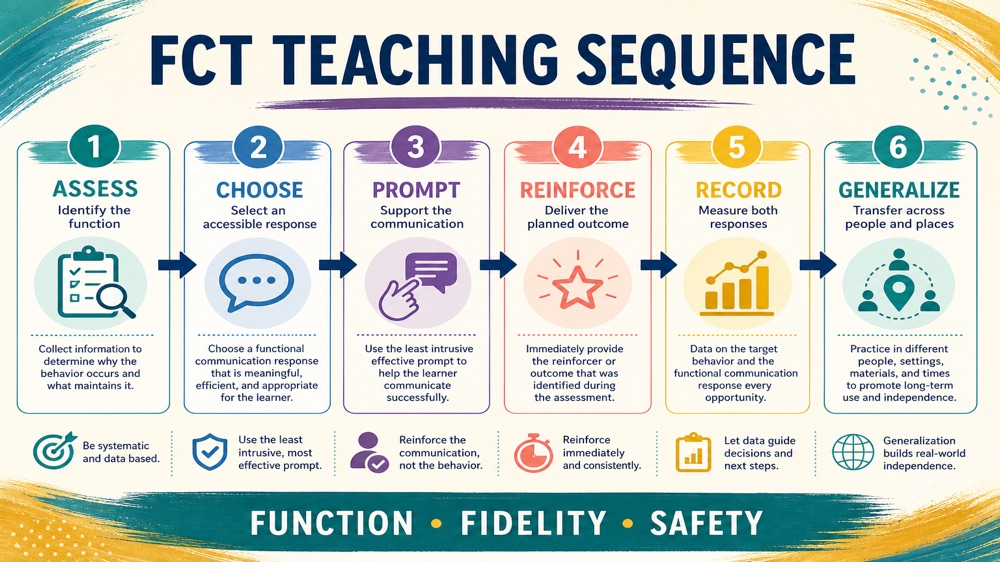
A well-written FCT program often contains a sequence that the RBT can follow:
- Define the target and communication response: specify what counts, how it is measured, and what the learner will do.
- Arrange teaching opportunities: create or capture safe moments when the relevant motivation and context are present.
- Prompt before escalation when possible: use the programmed prompt and least intrusive effective support.
- Reinforce the communication response: deliver the programmed consequence quickly and contingently when the plan says to do so.
- Record both responses: measure communication and challenging behavior according to the plan, not only the success story.
- Fade support and plan transfer: follow the specified prompt-fading, delay, schedule-thinning, and generalization steps.
The sequence is not a universal recipe. A plan for a high-risk behavior may require additional prevention, crisis, medical, communication, or caregiver procedures. If the learner begins to escalate, follow the safety plan and contact the supervisor rather than forcing a communication trial.
Prompt, reinforce, and measure
Prompting is a teaching support, not the final skill. The written plan may specify a verbal model, gesture, visual cue, physical prompt, time delay, least-to-most sequence, or another arrangement. Read the prompt definition carefully: a prompt can be delivered before the response opportunity, after an error, or during a planned teaching sequence. The correct choice depends on the program.
Reinforcement also requires precision. The communication response should contact the consequence that the plan identifies, and reinforcement should be delivered according to the programmed contingency. If a break request is followed by a long lecture, a different task, or an unpredictable delay, the learner may not experience the response as efficient communication.
Collect data that lets the team examine treatment integrity:
- frequency, rate, or percentage of independent communication responses;
- prompt level needed and whether prompts are fading;
- latency from the opportunity to the communication response;
- frequency, duration, or intensity measure for the target behavior when specified;
- reinforcer delivery, delay, or schedule information; and
- setting, partner, task, health, and other variables that could affect performance.
Do not replace the written measurement system with a convenient tally. Accurate data helps the supervisor decide whether the communication response is increasing, whether challenging behavior is changing, and whether the plan is being implemented as intended.
Handle extinction and safety carefully
Many FCT descriptions mention extinction: challenging behavior no longer produces the maintaining consequence while the alternative communication response does. That description is conceptually important, but implementation depends on a written plan, supervision, risk assessment, and context. Extinction can produce an extinction burst, response variation, emotional responding, or other changes, and it may be unsafe or impractical to withhold a consequence in some situations.
Do not read “extinction” as permission to ignore a person in distress, withhold essential support, or continue a procedure during danger. An RBT follows the behavior plan, crisis/emergency procedures, and supervisor direction. If the plan does not explain what to do when the alternative response is unavailable, delayed, or unsuccessful, pause and ask.
Research has also examined FCT variations without extinction and different reinforcer parameters. The exam-relevant point is not to memorize a universal exception. It is to recognize that consequence procedures must match the assessment, written plan, safety requirements, and supervisory direction.
Thin schedules and generalize
Early teaching may deliver reinforcement immediately and often so that the communication response becomes efficient. A learner cannot be expected to tolerate a long delay before understanding what the new response contacts. Later, the plan may thin the schedule, increase delay, require a larger response requirement, or arrange natural contingencies. The RBT implements these changes only when they are written, modeled, and supervised.
Generalization means more than using the response in the therapy room. Plan and measure transfer across:
- communication partners, such as technician, caregiver, teacher, and peer;
- settings, such as clinic, home, school, community, and telehealth context when applicable;
- materials and activities, such as tasks, toys, foods, or routines;
- response forms, when the plan allows more than one accessible mode; and
- time and motivation conditions, including when the original trainer is absent.
A response that occurs only after a full prompt from one technician is not yet the same as independent functional communication across the learner’s day. Record the conditions and communicate gaps rather than claiming generalization too early.
Map functional communication training ABA to six TCO domains
FCT is most visible in D.3, but an RBT exam question can connect it to every domain:
| Domain | FCT connection | Decision point |
|---|---|---|
| A. Data Collection and Graphing | Measure communication, target behavior, prompts, latency, and trends. | Choose the unit and record what the plan defines. |
| B. Behavior Assessment | Participate in descriptive or functional-assessment components. | Describe patterns without independently declaring function. |
| C. Behavior Acquisition | Teach the communication response using prompts, reinforcement, shaping, and generalization. | Follow the teaching sequence and fade support as written. |
| D. Behavior Reduction | Implement DRA/FCT and function-based reduction procedures. | Match the consequence and safety procedure to the plan. |
| E. Documentation and Reporting | Report data, variables, concerns, and session events objectively. | Escalate irregularities promptly and protect privacy. |
| F. Ethics | Respect communication access, competence, supervision, dignity, and confidentiality. | Do not improvise beyond training or disclose client information. |
This map is useful for study because the same FCT scenario can test different tasks. A question may ask for the measurement, the best prompt, the function-based consequence, the documentation, or the ethical boundary. Read the verb in the stem before choosing an answer.
Original functional communication training ABA examples
The following scenarios are original study examples. They are not official, recalled, leaked, or BACB-endorsed questions.
- Attention: A learner calls out repeatedly when a technician talks with another person. The written plan teaches a tap or “excuse me” response that contacts attention. Best reasoning: reinforce the specified communication response and collect both measures; do not invent a new attention schedule.
- Tangible: A learner grabs a tablet when access ends. The team teaches a card that requests the tablet or “more time,” with a stated schedule. Best reasoning: follow the programmed access rule; handing over the tablet after grabbing may strengthen the target behavior if it is not part of the plan.
- Escape: A learner drops to the floor after a difficult task begins. The plan teaches “break” using a picture and specifies when a short break is available. Best reasoning: prompt and reinforce the request as written while following the safety and demand procedures; do not remove every task immediately because the behavior occurred.
- Help: A learner tears paper when a zipper or puzzle is difficult. The plan teaches a “help” response and records independent versus prompted requests. Best reasoning: reinforce help according to the plan and communicate if the task is too difficult or the response is not accessible.
- Function uncertainty: A learner uses a break card before several different events. Best reasoning: record the antecedent and consequence and ask the supervisor whether the assessment or plan needs review; do not announce that the card proves escape function in every context.
- Schedule thinning: A learner requests a snack every two minutes after the plan begins to delay reinforcement. Best reasoning: implement the programmed delay or schedule only when it is written and trained; do not make the delay longer because the learner “should be ready.”
- Communication mode: A learner does not use speech but reliably activates a picture or device button. Best reasoning: use the accessible response in the plan; FCT is not a requirement to replace AAC with speech.
- Safety: The communication response is not available when a learner begins dangerous behavior. Best reasoning: follow crisis/emergency procedures and notify the supervisor; do not force a long prompted request during an unsafe event.
Audit FCT implementation data
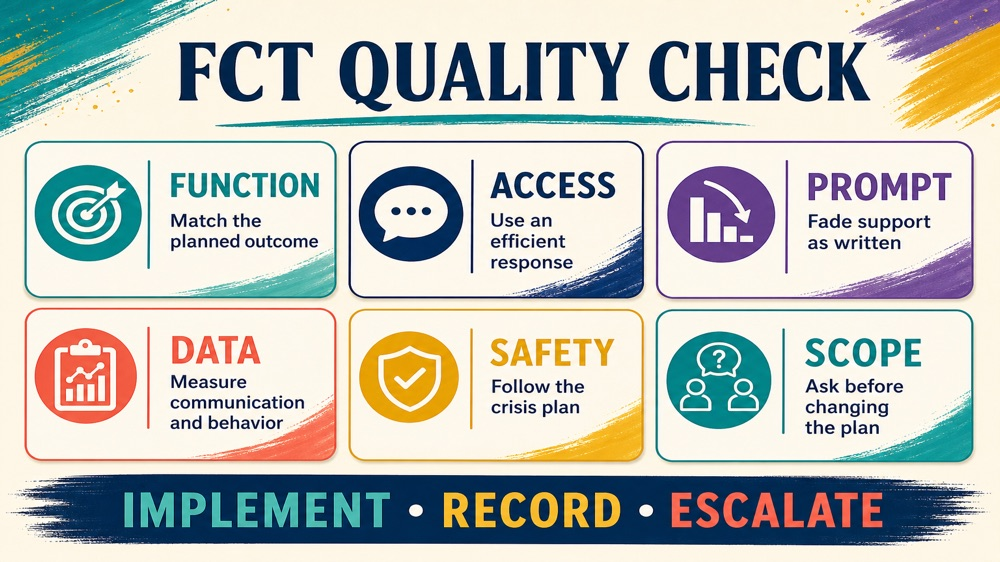
At the end of a session, ask a small set of fidelity questions:
| Audit question | Evidence | Escalate when |
|---|---|---|
| Was the opportunity defined? | Antecedent, activity, partner, and context were recorded. | The trigger or motivation is unclear. |
| Was the response accessible? | The learner could reach, see, select, sign, say, or activate it as written. | The device, materials, motor access, or partner response blocked communication. |
| Was the prompt correct? | Prompt level, timing, and fading matched the program. | Staff used an unapproved prompt or the learner remained prompt-dependent. |
| Was reinforcement programmed? | The specified consequence followed the communication response under the stated schedule. | Consequence delivery was delayed, inconsistent, or unsafe. |
| Were both outcomes measured? | Communication and target-behavior data were entered accurately. | Data are missing, contradictory, or affected by a procedural change. |
A good data review does not ask only “Did the challenging behavior go down?” It also asks whether communication increased, whether independence improved, whether prompts faded, whether generalization occurred, and whether the plan was implemented with fidelity. A short-term change without treatment-integrity information is difficult to interpret.
Fix common mistakes
- Teaching a generic request: “Ask nicely” may not be functionally equivalent or measurable. Use the defined response.
- Assuming speech is required: honor the learner’s accessible communication mode and the plan.
- Calling every problem behavior escape-maintained: use assessment evidence and supervisor direction.
- Withholding all reinforcement: do not add extinction or schedule thinning without a written, safe procedure.
- Reinforcing the wrong response: check whether the consequence follows communication, problem behavior, or both under the plan.
- Prompting forever: measure prompt dependence and follow the fading plan.
- Ignoring generalization: practice with different partners and settings when the plan says to do so.
- Changing the plan after one hard session: document the difficulty and seek clinical direction.
The best RBT answer is often the one that protects function-based fidelity and scope: implement what is written, record what is observed, communicate what changed, and ask before making a clinical decision.
Bottom line: functional communication training ABA is a function-based DRA approach that teaches an accessible alternative response and arranges reinforcement according to the identified function and written plan. Study the relation among assessment, communication, reinforcement, safety, data, and generalization—and keep the RBT role boundary visible in every scenario.
Practice function-based RBT scenarios
Use original questions to review differential reinforcement, communication, data, and supervisor boundaries.
Try Free RBT Practice Questions →
Frequently Asked Questions
What is functional communication training in ABA?
FCT is a function-based differential-reinforcement approach that teaches an alternative communication response which can contact the same class of reinforcement as a challenging behavior identified through assessment.
Is FCT the same as teaching a child to talk?
No. FCT can use speech, signs, gestures, pictures, AAC, a speech-generating device, or another accessible response specified by the team and written plan.
Does FCT always require extinction?
No universal implementation rule should be assumed. Some FCT descriptions include extinction, but consequence procedures must be written, supervised, and safe; an RBT should not add or change extinction independently.
What does an RBT do during FCT?
An RBT may collect data, prompt, teach, reinforce, and report outcomes as directed and trained. The RBT should not independently determine function, redesign the communication response, change the schedule, or alter the behavior plan.
Is functional communication training on the RBT exam?
FCT is listed as an example under differential reinforcement in the current RBT Test Content Outline, 3rd edition. Questions may also connect it to functions, prompting, reinforcement, generalization, documentation, and ethics.
Can this article provide an individualized FCT plan?
No. An individualized plan requires assessment, qualified clinical oversight, learner-specific communication and safety decisions, and ongoing data review. Use this article for concepts and study boundaries, not as a replacement for supervision.
References
- Behavior Analyst Certification Board. RBT Test Content Outline (3rd ed.).
- Behavior Analyst Certification Board. RBT Handbook.
- Tiger, J. H., Hanley, G. P., and Bruzek, J. Functional Communication Training: A Review and Practical Guide.
- Association for Science in Autism Treatment. Functional Communication Training (FCT).
- Chezan, L. C., Wolfe, K., and Drasgow, E. A Meta-Analysis of Functional Communication Training Effects.
- Fisher, W. W. and colleagues. Differential Reinforcement without Extinction.
- A Mega-Review of Functional Communication Training for Students with Disabilities. Reviewed for academic grounding; not an endorsement.