
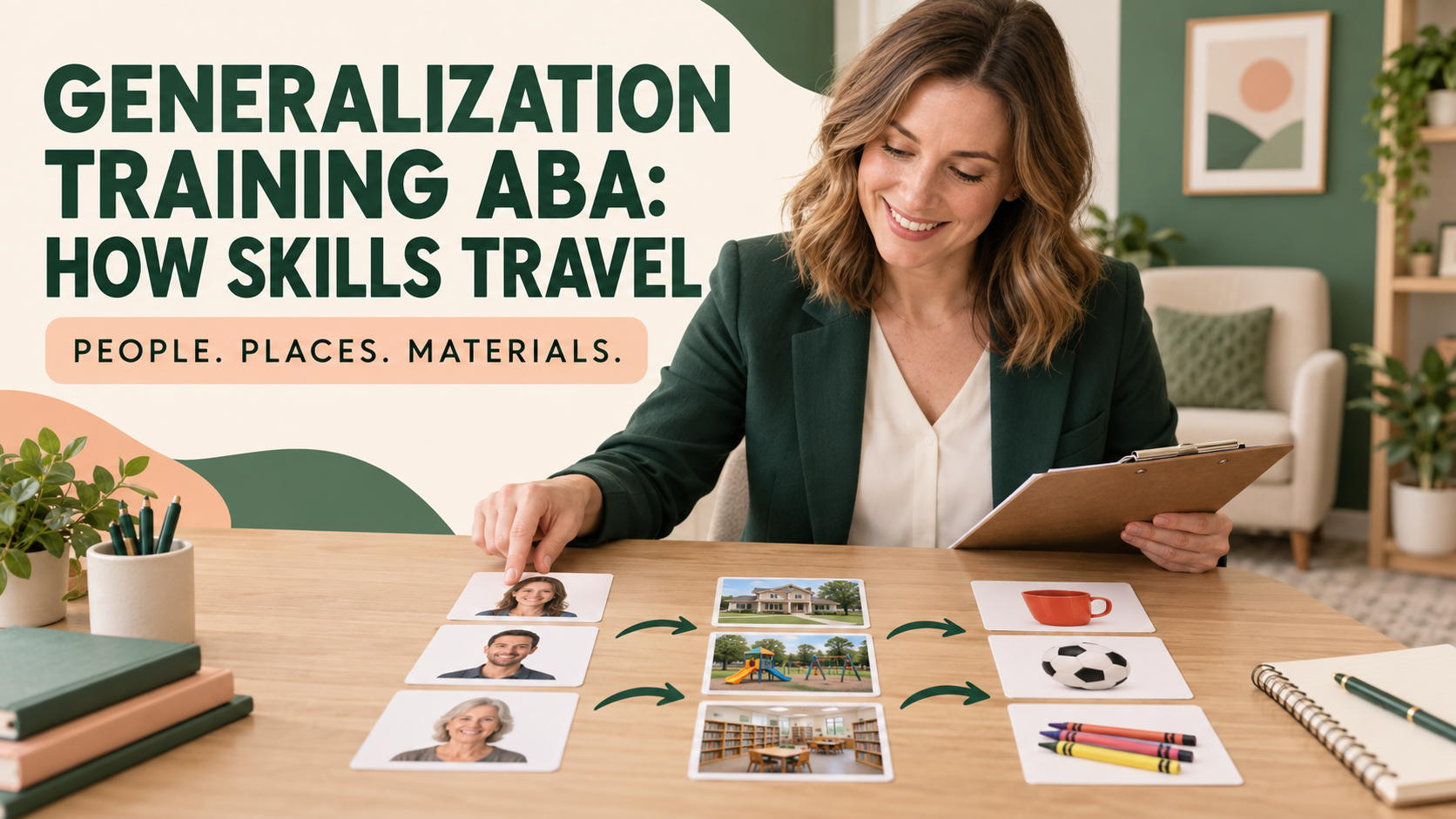
Generalization training ABA addresses a practical problem: a learner may perform a skill during therapy but not use it with a different person, in a new place, with another material, or at a later time.
Table of Contents
- Generalization training ABA: quick answer
- What generalization training ABA means in practice
- Stimulus, response, and setting generalization
- A worked requesting-help example
- What a generalization plan includes
- Strategies that support skill transfer
- How to measure generalization
- Generalization and maintenance are different
- Caregiver, teacher, and team coordination
- The RBT’s role and boundaries
- Frequently asked questions
Skill transfer across people, places, materials, time, communication modes, data, and RBT supervision
Generalization Training ABA: How to Help Skills Travel
Generalization training ABA addresses a practical problem: a learner may perform a skill during therapy but not use it with a different person, in a new place, with another material, or at a later time. The gap does not automatically mean the learner “forgot” the skill. It may mean the teaching conditions were too narrow or the natural cues and outcomes have not yet been programmed. This guide explains how to plan, probe, measure, and discuss generalization within an RBT’s supervised role.
Generalization training ABA: quick answer
Generalization means that a learned skill occurs under appropriate new conditions beyond the exact conditions used during teaching. A learner who requests help from one therapist may need to use the same functionally meaningful communication with a caregiver, teacher, peer, or unfamiliar staff member. A learner who washes hands at one sink may need to do so at home, school, and a public restroom.
Do not simply teach once and hope the skill travels. The team should decide what needs to vary, which cues should remain meaningful, what response forms are acceptable, how the natural outcome will support the skill, and how transfer will be measured. An RBT implements the authorized plan, conducts assigned probes, records the conditions, and reports when generalization is weak or creates a safety concern.
What generalization training ABA means in practice
Generalization is a change in behavior that extends beyond the precise stimulus, response, person, setting, or time arrangement directly used during instruction. The learner applies the skill when relevant features change and the response remains useful. Generalization can involve a broader set of stimuli, a broader set of response forms, or both.
The classic literature treated generalization as something that deserved active planning rather than passive hope. Stokes and Baer’s review categorized approaches such as training sufficient exemplars, training loosely, programming common stimuli, introducing natural maintaining contingencies, mediating generalization, and teaching the learner to generalize. These categories are a conceptual map, not a checklist that an RBT should independently apply.
Generalization should be defined in functional terms. If the goal is requesting a break, the important outcome may be that the learner can communicate the need safely through speech, sign, a card, or an AAC device across appropriate people and settings. Requiring one exact sentence in every setting may narrow the skill instead of making it more useful.
Stimulus, response, and setting generalization
Stimulus generalization
Stimulus generalization occurs when a learned response occurs with new stimuli that share relevant features with the training stimulus. A learner taught to label one cup may label several cups with different colors, sizes, and materials. The target concept remains stable while the examples change.
Response generalization
Response generalization occurs when the learner uses new but functionally equivalent responses. A learner taught to ask for help may later say “help please,” sign for help, point to a help icon, or use an AAC message, depending on the communication plan. The team should decide which forms are meaningful and acceptable instead of assuming that only one topography counts.
Setting, person, and time generalization
A skill may need to transfer from a clinic to a home, school, community, or telehealth setting; from one therapist to a caregiver, teacher, peer, or other support person; and from the teaching session to a later day or routine. These dimensions can change independently. A learner may generalize to a new room with the same therapist but not to a new person in the familiar room.
A worked requesting-help example
Consider an authorized program for requesting help with a difficult zipper. During initial teaching, the learner uses a help card with the therapist at a table. The target is not the card itself; the practical outcome is getting assistance safely instead of pulling, throwing the item, or leaving without communication.
- Define the trained response: the learner independently selects the help card, uses an approved AAC message, or produces another response listed in the program.
- Identify relevant variations: different clothing items, a backpack, a container, a different room, and a different communication partner.
- Plan the natural outcome: the available adult responds promptly and appropriately according to the plan, so requesting help contacts useful assistance.
- Probe new conditions: present an authorized opportunity with a new item or person without adding an unplanned prompt.
- Measure and report: record the condition, response form, independence, latency, prompt, and outcome.
If the learner uses the help card only at the table, the next step is not to label the learner unmotivated. The team should examine whether the card is available, whether the natural partner recognizes it, whether the task is difficult enough to evoke help, and whether the teaching history included varied examples. The supervisor decides how the program changes.
What a generalization plan includes
A useful plan identifies the skill, the people and settings that matter, the materials or cues that will vary, the acceptable response forms, and the criteria for transfer. It should also state how reinforcement or natural consequences will be arranged and who is responsible for each step.
Ask these questions:
- What exact skill should travel, and why does it matter in the learner’s daily life?
- Which features should remain stable so the learner can recognize the opportunity?
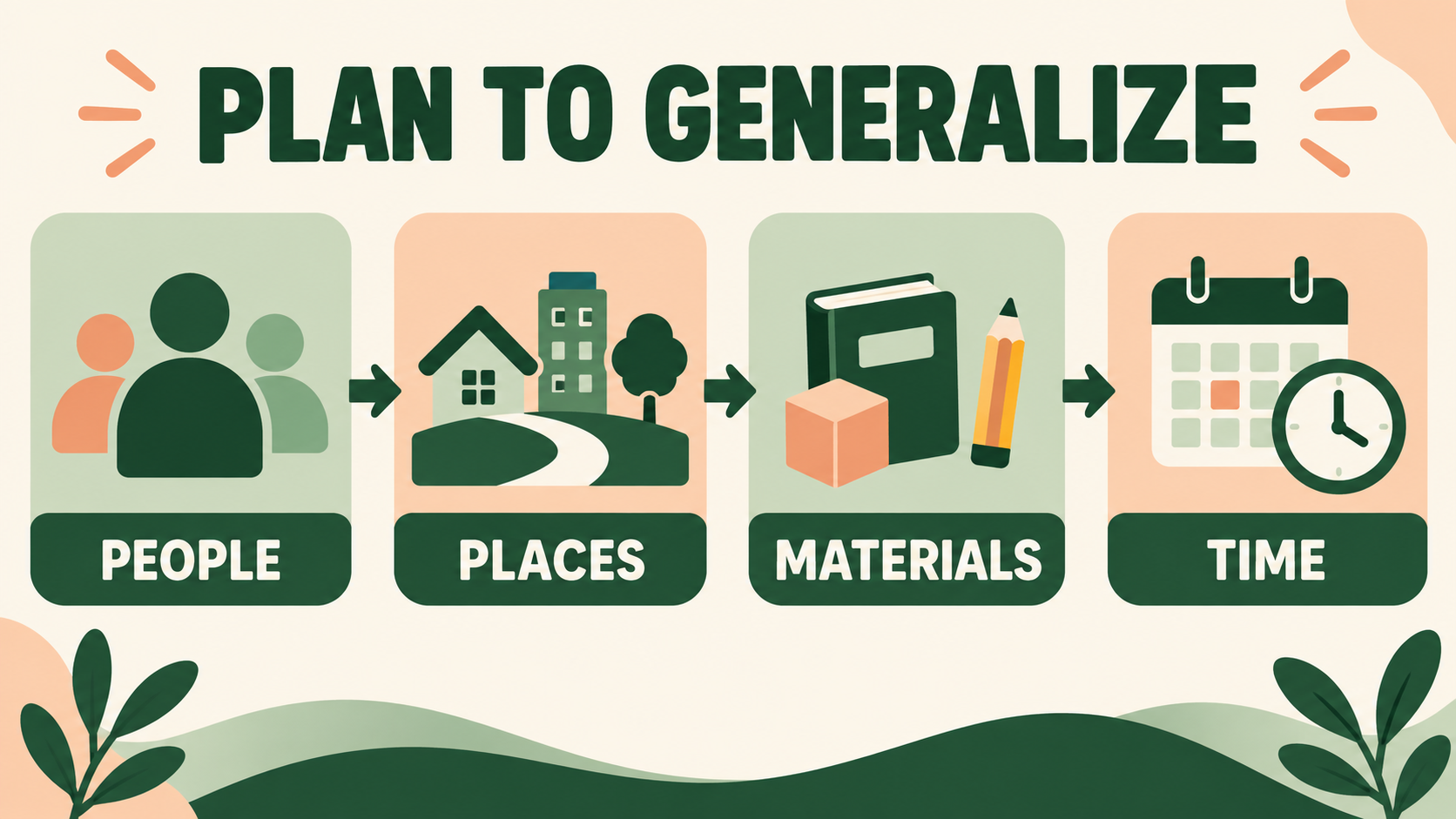
- Which people, places, materials, times, and communication modes should be sampled?
- What counts as an independent, prompted, functionally equivalent, or unsafe response?
- What natural or programmed outcome follows the response?
- When will the team run a generalization probe, and how will it record the result?
- What will trigger a review, additional teaching, or a change in safety support?
Do not write criteria that make generalization look better than it is. “The learner performed well” does not identify the conditions. A stronger record says, “The learner independently requested a break with the AAC icon during a transition with the caregiver in the kitchen; no independent request occurred during the playground probe with a teacher.”
Strategies that support skill transfer
The supervisor may select one or more strategies based on the learner, goal, setting, and data:
- Multiple exemplars: teach the same concept with varied people, materials, examples, and formats rather than one repeated item.
- Loose training: vary nonessential features while keeping the target response and relevant cue clear.
- Common stimuli: carry a helpful visual, phrase, device, or cue into the natural environment when appropriate.
- Natural contingencies: arrange practice where the response produces the real-life outcome that makes the skill useful.
- Caregiver or teacher practice: train the people who will be present in the target routine, with clear limits and feedback.
- Mediated generalization: teach a self-management, self-instruction, visual, or other portable support when authorized.
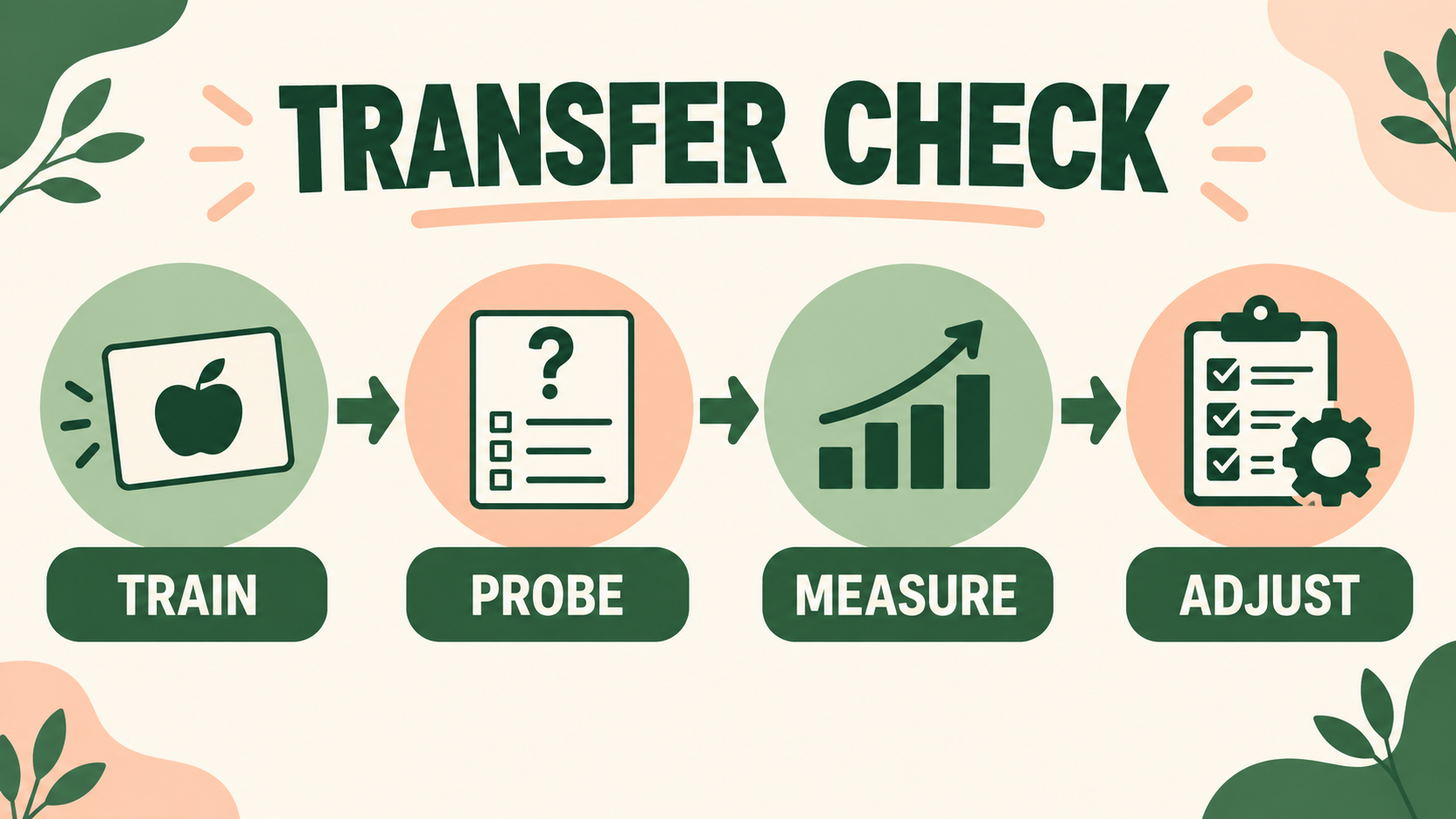
- Planned probes: test untrained conditions to see whether the skill transferred rather than assuming it did.
More variation is not always better. If every feature changes at once, the team may not know what supported or blocked the response. Introduce variations thoughtfully, keep safety procedures stable, and use data to decide when to adjust the plan.
How to measure generalization
Measure the conditions, not only the overall percentage. A generalization data sheet may include:
- person or communication partner;
- setting, activity, and time of day;
- material, instruction, or cue;
- independent, prompted, incorrect, or no response;
- response form, including approved AAC or alternative communication;
- latency, duration, or other program-defined measure; and
- natural or programmed outcome.
Use probes carefully. A probe is not a surprise test designed to catch the learner failing. The team should protect dignity, provide safety support, and ensure the person has access to needed communication. If a probe creates distress or risk, stop according to the plan and contact the supervisor.
Generalization and maintenance are different
Generalization asks whether the skill appears under new conditions. Maintenance asks whether the skill continues over time after intensive teaching or after the schedule of support changes. A learner can generalize to a new person today but lose the skill after several weeks, or maintain a skill with one therapist without using it at school.
Plan both when they matter. A maintenance check may occur after a defined interval, during a natural routine, or when the original teaching supports are reduced. The RBT records the actual condition and communicates a pattern instead of assuming that a skill is secure because it was once mastered.
Caregiver, teacher, and team coordination
Generalization often depends on what happens outside the therapy session. Caregivers and teachers should receive clear, realistic instructions and know which responses to accept, which prompts to use, and where to record concerns. They should not be asked to invent a new intervention or share confidential information through an unapproved channel.
Use common language for the target and outcome, but respect the routines of each setting. A school may not have the same materials as a clinic. A caregiver may prefer a different approved communication mode. The supervisor coordinates the program; the RBT reports what was observed and follows the authorized direction.
The RBT’s role and boundaries
The BACB RBT Ethics Code requires RBTs to provide services within a clearly defined role under close, ongoing supervision. An RBT may implement assigned generalization practice, collect data, support functional communication, and document changes. The RBT should not independently decide which settings count as a probe, rewrite mastery criteria, remove safety supports, or promise a family that generalization will occur.
Ask the supervisor for direction when the program does not identify the target setting, a caregiver uses a different response form, the learner needs a communication accommodation, a natural consequence is unavailable, or performance changes sharply. Document the question and the direction received. Good generalization work is collaborative, measurable, and connected to the learner’s actual life rather than to a score in one room.
Frequently asked questions
What is an example of generalization training ABA?
A learner taught to request help with one therapist and one item practices the same functional request with a caregiver, a different item, and another setting, while the team measures independence and the natural help that follows.
Why does a skill work in therapy but not at home?
The learner may be responding to narrow cues, a specific therapist, a particular material, or a programmed outcome that is missing at home. The team should examine conditions and data rather than assume that the learner cannot perform the skill.
Is generalization the same as maintenance?
No. Generalization is transfer across new conditions. Maintenance is continued performance over time. A complete plan may measure both.
Can an RBT decide to practice a skill in a new community setting?
Not independently. The RBT should follow the authorized plan and ask the supervisor about location, consent, privacy, safety, materials, and data requirements before changing the setting.
Where can I read more?
Review the PubMed record for Stokes and Baer’s review of generalization technology, the BACB RBT Ethics Code, and the current RBT Handbook. These sources provide research and role context; your supervisor determines how an individual program is designed.
Source note: This article was reviewed against peer-reviewed generalization research and current BACB RBT resources, retrieved September 28, 2026. It is educational information, not an individualized treatment protocol or clinical advice.
Ready to practice the RBT concepts you just reviewed?
Try an independent, original RBT practice resource with exam-style questions, scoring, and answer explanations.
References
- Behavior Analyst Certification Board. RBT Test Content Outline, 3rd edition.
- Behavior Analyst Certification Board. RBT Handbook.
- Behavior Analyst Certification Board. RBT Ethics Code.