
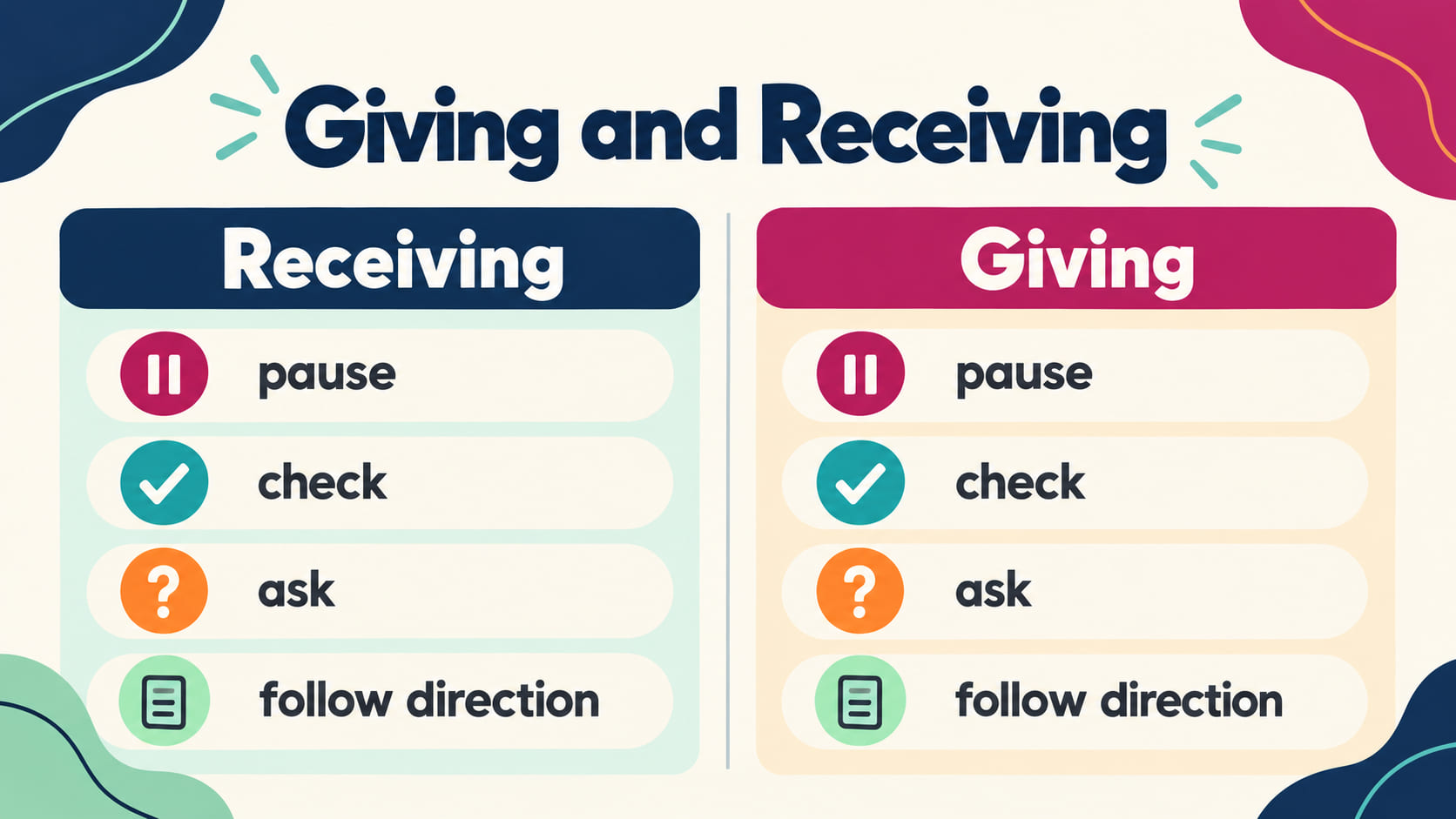
Gift giving receiving guidelines RBT professionals use should begin with the current BACB Ethics Code, employer policy, and supervision—not a personal rule about holidays or dollar amounts. Whether an RBT is offered a gift or is considering giving one, pause, describe the facts, check the applicable policy, ask the responsible supervisor, and follow the approved direction.
Table of Contents
- Gift giving receiving guidelines RBT: the short answer
- The four-part boundary checklist
- Use the checklist when receiving
- Use the checklist when giving
- Respectful language for a difficult moment
- Approved records and follow-through
- Mistakes that break the checklist
- Frequently asked questions
RBT gift boundaries, ethics checks, supervision, documentation, and respectful communication
Gift Giving Receiving Guidelines RBT: A Boundary Checklist
A reusable checklist for gifts in either direction: pause, check, ask, and follow the approved decision.
Gift giving receiving guidelines RBT professionals use should begin with the current BACB Ethics Code, employer policy, and supervision—not a personal rule about holidays or dollar amounts. Whether an RBT is offered a gift or is considering giving one, pause, describe the facts, check the applicable policy, ask the responsible supervisor, and follow the approved direction.
This checklist is useful because giving and receiving can create similar boundary concerns in opposite directions. A personal gift may create a relationship, a financial benefit, a promise, or an appearance of favoritism. The goal is not to shame appreciation; it is to keep the professional role clear and reviewable.
Gift giving receiving guidelines RBT: the short answer
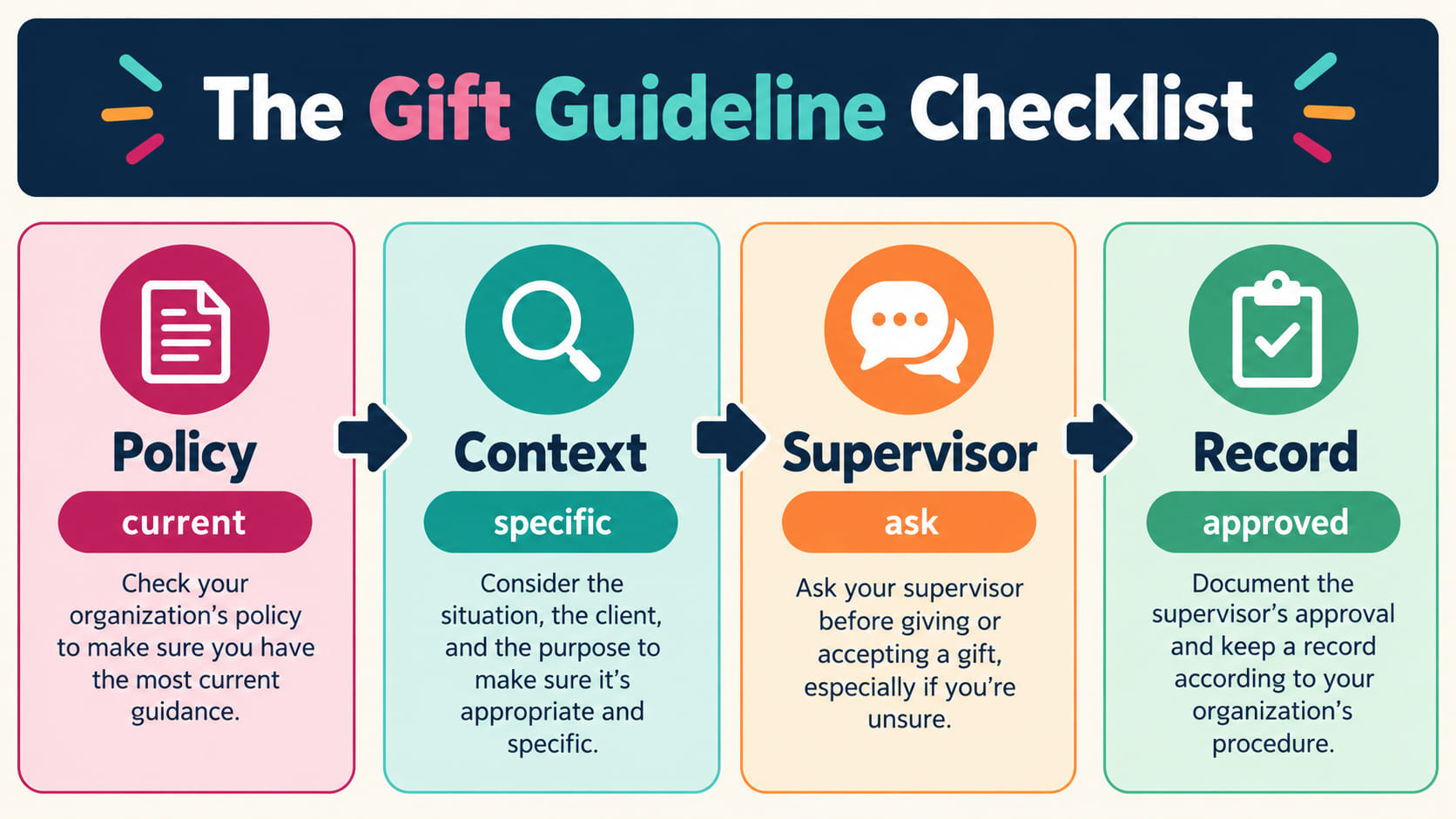
Use four words to remember the process: policy, context, supervisor, record.
- Policy: check the current BACB Ethics Code and employer or agency policy.
- Context: identify who, what, when, where, why, how often, and what could be affected.
- Supervisor: ask before accepting, giving, promising, or arranging a benefit when the answer is unclear.
- Record: use the approved channel for the direction and action, with only necessary information.
Do not turn the four steps into a private exception. “The policy says ask” does not mean “I can decide first and report later.” Early consultation is part of protecting the relationship.
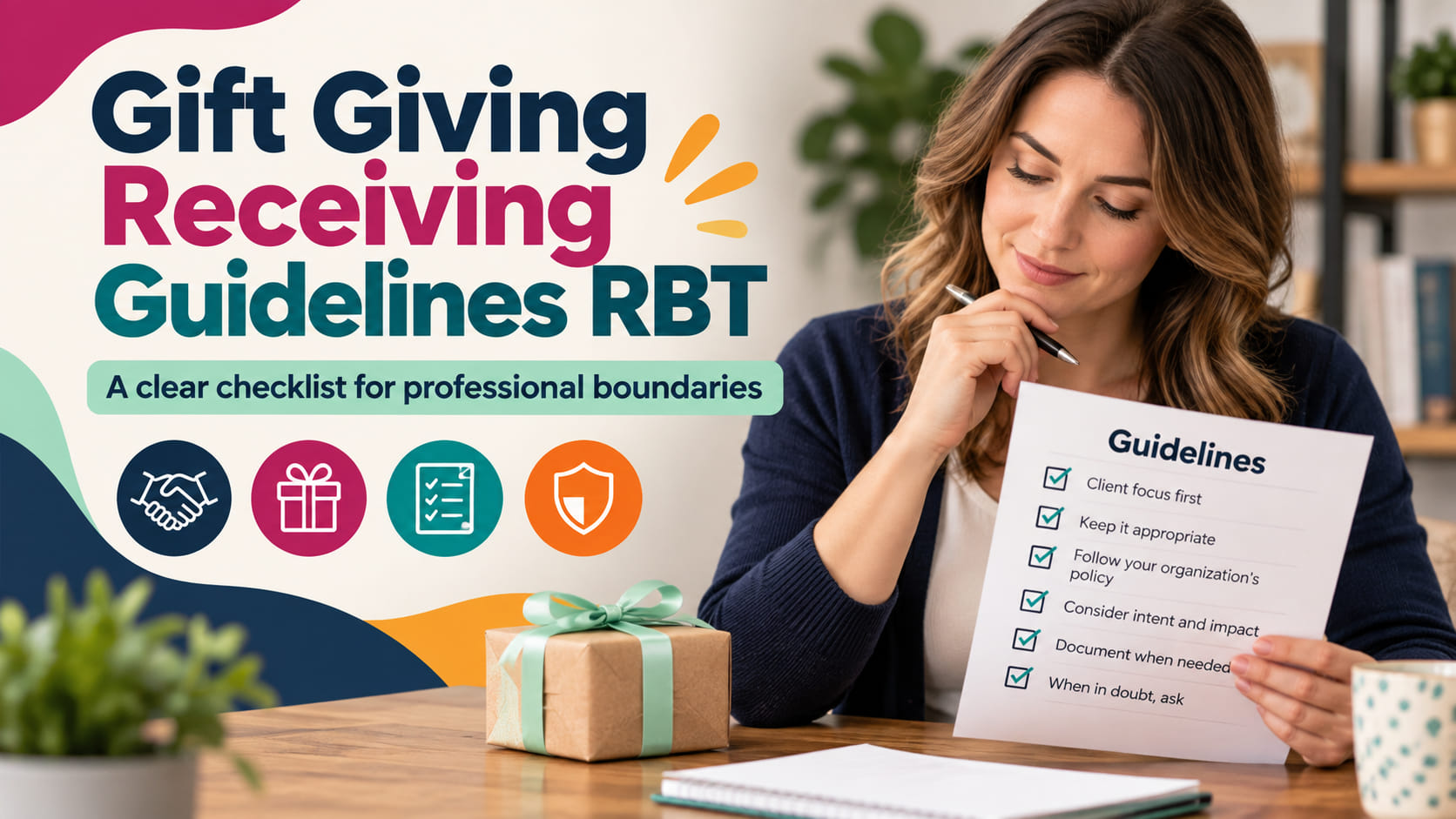
The four-part boundary checklist
Policy: Start with the source that controls your work today. Use the current BACB Ethics Code and the policy your employer or agency actually follows. A course summary, former workplace custom, or social-media comment is not a substitute.
Context: Name the benefit precisely: money, gift card, food, object, discount, free service, invitation, ride, or favor. Note the relationship, timing, setting, repetition, privacy, and whether anyone requested special access, treatment, scheduling, or secrecy.
Supervisor: Ask a specific question with enough facts to receive useful direction. “A caregiver offered a gift card after today’s session; they did not ask for a service change. What does our policy require?” is clearer than “Can I take it?”
Record: Use the approved supervision, incident, or workplace process. Record what occurred, who was consulted, what direction was given, and what action followed. Do not create an informal file that exposes private family information.
Use the checklist when receiving
When someone offers a gift, begin with a pause and appreciation: “Thank you for thinking of me. I need to check our professional policy and ask my supervisor before I can answer.” This acknowledges the gesture without accepting the item or promising an outcome.
Receiving money, valuable items, repeated benefits, personal services, or private invitations deserves especially careful review. These offers may create financial, social, or access expectations. Do not use, deposit, post, return, or exchange the item while waiting if doing so could conflict with the organization’s process.
If the direction is to decline, a brief explanation can preserve rapport: “I appreciate the kindness, but I cannot accept this under our professional policy. I need to keep the relationship focused on services.” Ask the supervisor for wording that fits the family and setting.
Use the checklist when giving
Giving a gift can create the same type of boundary question. Before bringing something for a client, caregiver, coworker, or supervisor, ask whether the benefit could create a personal tie, expectation, obligation, or appearance of unequal treatment.
Be careful with gifts that are personal, recurring, secret, expensive, or linked to performance, complaints, access, or schedule. A reward used in an assigned intervention is not automatically the same as a personal present. The RBT should follow the plan and supervision instead of turning a service procedure into a private exchange.
Never give something to obtain cooperation, soften documentation, influence a complaint, secure a shift, obtain private contact, or create a relationship outside the approved role. If the intention is appreciation or celebration, ask the supervisor for a role-consistent option.
Respectful language for a difficult moment
Keep the focus on the professional role, not the person’s motives. Try: “Your thought is appreciated. I need to follow our policy, so I cannot make that decision privately.” Avoid “You are trying to buy special treatment,” unless a supervisor directs a formal response based on documented facts.
If someone presses for an exception, repeat the boundary without arguing. “I understand this is meant kindly. I still need to follow the same professional process.” Ask the supervisor for support when the person becomes upset, offers the benefit again, or asks for secrecy.
Approved records and follow-through
Document through the channel the organization identifies. Keep the description factual and minimal: the offer or planned gift, relevant context, person consulted, direction received, and action taken. Do not include unnecessary private details, screenshots, family names, or financial information in an informal chat.
Follow through consistently. If the supervisor directs a decline, do not later accept the same benefit at home. If a policy allows a narrow category, do not expand that direction to a different item, person, setting, or repeated pattern. Ask again when the facts change.
Mistakes that break the checklist
- Starting with a dollar amount: the checklist starts with current policy and context.
- Assuming holidays create exceptions: a date does not replace a professional review.
- Using one approval forever: a changed item, person, setting, or pattern needs a new check.
- Keeping it secret: secrecy makes the boundary harder to review and protect.
- Shaming the giver: firm boundaries can still recognize sincere appreciation.
- Recording too much or too little: use the approved process and capture only decision-relevant facts.
Frequently asked questions
Are there simple gift giving receiving guidelines for every RBT?
Use current official ethics guidance, employer policy, and supervision. Do not rely on a universal dollar rule or assume that one workplace’s custom applies everywhere.
Should giving and receiving be treated exactly the same?
They use the same pause, policy, context, supervisor, and record process, but the risks and facts can differ. Review the actual direction of the benefit.
What if a supervisor approves a small gift?
Follow the exact direction and any conditions. Do not treat a narrow approval as permission for different gifts, repeated offers, or private exchanges.
What if there is no policy?
Ask the responsible supervisor or organization contact and use the current BACB Ethics Code as an official starting point. Do not create a hidden personal rule.
Role reminder: This is educational information, not credentialing, employment, legal, tax, or clinical advice. Verify the current BACB Ethics Code and your employer or agency policy, and ask a supervisor about a specific gift situation.
Official starting points: the BACB RBT Ethics Code, ethics codes page, RBT Handbook, and supervision and training resources.
Ready to practice the RBT concepts you just reviewed?
Try an independent, original RBT practice resource with exam-style questions, scoring, and answer explanations.
References
- Behavior Analyst Certification Board. RBT Test Content Outline, 3rd edition.
- Behavior Analyst Certification Board. RBT Handbook.
- Behavior Analyst Certification Board. RBT Ethics Code.