

This identify personal biases RBT guide provides a practical sequence for noticing triggers, checking evidence, and choosing a role-safe response.
Table of Contents
- What does identify personal biases RBT mean?
- Notice the trigger
- Name the assumption
- Check the evidence and language
- Ask for feedback and choose the next action
- Practice the five-step self-check
- Quick comparison
- Frequently Asked Questions
- Sources and further reading
RBT self-reflection and supervision guide
Identify Personal Biases RBT: A Practical Self-Check
Notice triggers, name assumptions, check evidence, ask for feedback, and choose the next role-safe action.
The phrase identify personal biases RBT describes a repeatable self-check, not a permanent label. An RBT may notice a strong reaction, a quick interpretation, or a pattern in how they describe different people. The useful question is what happens next: Can the RBT separate the trigger from the evidence, ask for feedback, and choose a respectful action that follows the current plan and role?
Identifying a possible bias does not require the RBT to diagnose themselves or solve every ethical concern alone. It means slowing down before an assumption becomes a note, a communication decision, or an unauthorized change. When the concern involves safety, discrimination, privacy, retaliation, or the treatment plan, use the appropriate supervision and reporting process.
What does identify personal biases RBT mean?
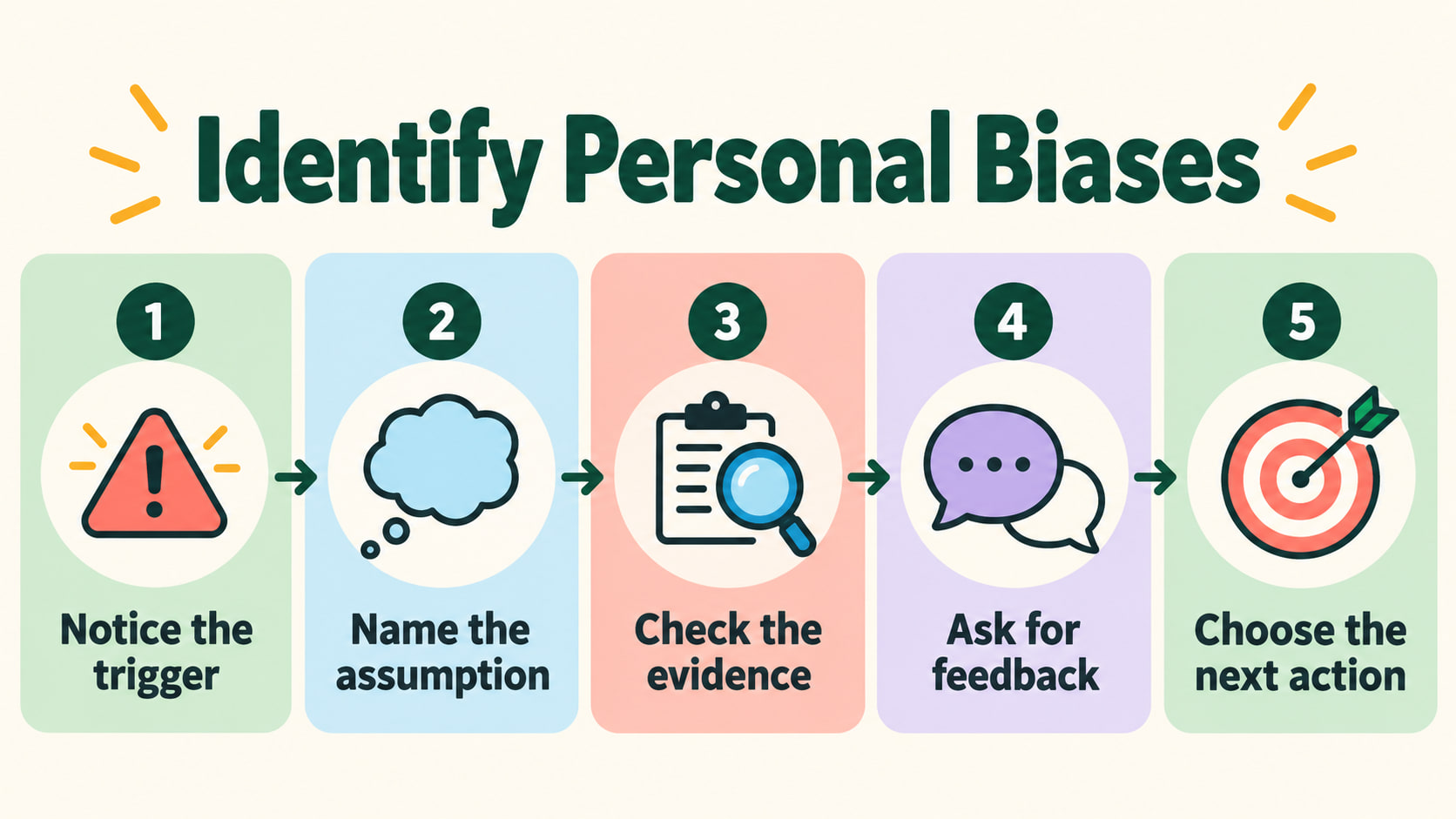
For practical RBT work, the phrase can be translated into five steps:
- Notice the trigger: identify the event, feeling, or interaction that produced a fast reaction.
- Name the assumption: state the meaning you added, without treating it as a verified fact.
- Check the evidence: review what was directly observed, measured, documented, or confirmed.
- Ask for feedback: bring a focused question to the supervisor or authorized channel.
- Choose the next action: use the current procedure, repair the communication, or route a decision that is outside your authority.
This sequence keeps self-reflection connected to professional behavior. It is not intended to make the RBT monitor every thought during a session or delay urgent safety action. It is a compact tool for moments when an assumption could affect accuracy, dignity, access, or decision-making.
| Step | Example question | Role-safe result |
|---|---|---|
| Trigger | What caused my immediate reaction? | Describe the event without a label |
| Assumption | What story did I add? | Keep the story separate from the record |
| Evidence | What can I observe or verify? | Use the definition, data, and plan |
| Feedback | Who can clarify the question? | Ask the appropriate person |
| Action | What can I do now? | Follow the current authorized step |
Notice the trigger
A trigger is the moment that makes an assumption more likely to appear. It might be a behavior that feels unexpected, a caregiver request that conflicts with the RBT’s preference, a correction from a supervisor, a communication difference, or a situation that resembles a difficult past experience.
Use neutral language to capture the trigger:
- “The caregiver requested a different format for the visual.”
- “The learner did not answer after the first instruction.”
- “The supervisor corrected the wording in my note.”
- “A team member gave guidance that did not match the written procedure.”
These statements identify what happened without claiming why it happened. If the trigger is an emotion, name it privately and return to the work: “I feel frustrated because the routine changed.” Emotion is information about the RBT’s reaction; it is not evidence about the other person’s motive or ability.
Noticing the trigger quickly can protect the next decision. A short pause may be appropriate when safety allows. If a safety process is urgent, follow it first and reflect afterward with the supervisor.
Name the assumption
An assumption is the interpretation that arrives before the evidence is complete. It can sound like “they do not care,” “the family is not cooperating,” “this person is manipulating the situation,” or “that communication style means….” Naming the assumption is not the same as accusing the RBT of bad intent. It gives the RBT something specific to check.
Try the sentence, “I am assuming ___, but I do not yet know ___.” For example: “I am assuming the learner is avoiding the task, but I do not yet know whether the instruction was understood or whether the communication system was available.” This wording keeps curiosity open without making the learner responsible for the RBT’s uncertainty.
Do not convert a group label into an individual rule. A person’s language, identity, family structure, disability, appearance, or community membership does not tell the RBT exactly what that person prefers or means. Use relevant person-specific information and ask through the approved process.
Check the evidence and language
After naming the assumption, check the strongest available evidence. Start with the current operational definition, measurement rule, written procedure, session record, and direct observation. Ask whether another trained observer could verify the words in the note.
Replace vague conclusions with observable detail:
- Instead of “refused,” record the defined response, latency, duration, or number of opportunities.
- Instead of “wanted attention,” record what the person did and what social event followed.
- Instead of “the caregiver was difficult,” record the request, question, or disagreement and how it was routed.
- Instead of “the learner was unmotivated,” record the materials, cue, response, and programmed consequence.
Evidence does not mean collecting every possible detail. Use the information needed for the professional purpose and protect privacy. If the current plan does not answer the question, that is a reason to seek supervision, not a reason to fill the gap with a confident interpretation.
Ask for feedback and choose the next action
A good feedback question is narrow and connected to the assumption. Examples include:
- “Can you review whether this note separates observation from interpretation?”
- “Which part of the current definition should I apply to this example?”
- “I notice I made a quick assumption about intent. What is the role-safe way to document the concern?”
- “This request may affect the written procedure. Who should review it before I change anything?”
Then choose the smallest authorized action. It might be revising wording through policy, using the current communication support, repeating a measurement correctly, documenting a question, or asking the supervisor for a plan review. The action should be observable enough that the team can tell whether it occurred.
Do not use a bias concern to justify a new assessment, a new consequence, or an independent plan change. A thoughtful question can improve the process without giving the RBT authority that the role does not include.
Practice the five-step self-check
Use a neutral role-play and complete this sequence:
- Notice: “The routine changed and I felt a strong reaction.”
- Name: “I am assuming the change means the person is unwilling.”
- Check: “The observable data show the instruction, materials, response, and timing; they do not prove that motive.”
- Ask: “Can we review whether the current communication or choice procedure applies here?”
- Act: “I will follow the current authorized procedure and document the question through the approved channel.”
After the role-play, ask a supervisor or training partner whether the wording was specific, respectful, and within scope. If a mistake affected another person, practice an apology that names the behavior and the repair: “I used an interpretation instead of an observable description. I will correct the record according to policy and use the definition next time.”
Self-checks are most useful when they become ordinary. One five-minute review after a difficult interaction may reveal a better question for supervision, a documentation phrase to replace, or a communication adjustment that protects dignity.
Quick comparison
| Internal moment | Helpful response | What to avoid |
|---|---|---|
| I felt surprised | Name the event and check context | Turn surprise into a group rule |
| I felt frustrated | Pause and describe the task or communication | Assign a motive |
| I found an error | Correct it through policy and seek feedback | Hide or silently erase it |
| I am unsure what to do | Ask the authorized person | Improvise a plan change |
Frequently Asked Questions
Can an RBT identify personal biases without judging themselves?
Yes. The goal is to identify a trigger, assumption, evidence gap, and next action. A neutral self-check is more useful than a permanent character judgment.
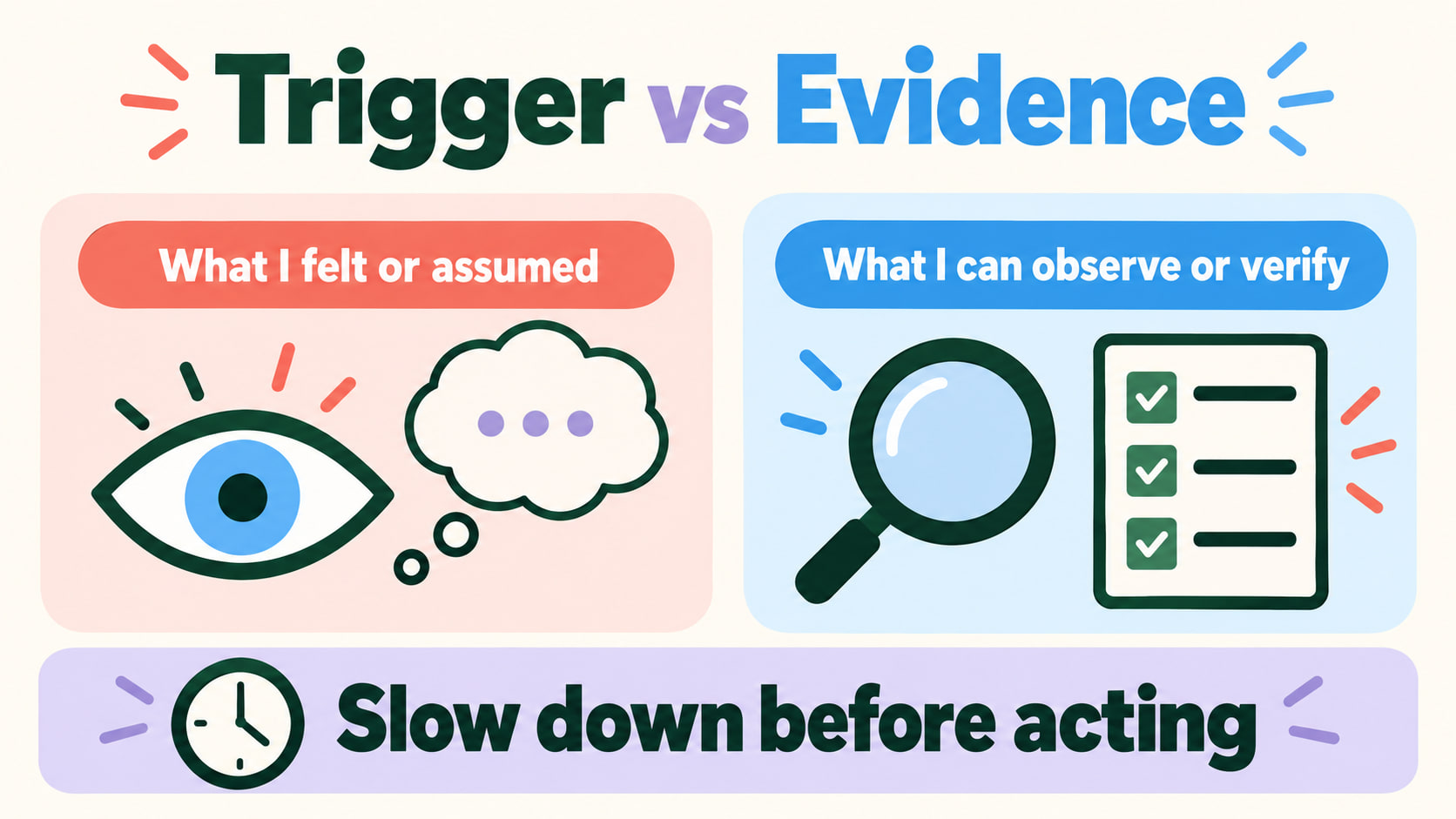
What is the difference between a trigger and evidence?
A trigger is the event or reaction that prompts reflection. Evidence is what can be observed, measured, documented, or confirmed. A strong decision does not treat the trigger as proof.
Should an RBT write personal bias reflections in a client record?
Follow the organization’s documentation policy. Client records should contain the objective, relevant information required for the professional purpose, not unnecessary private reflections or labels. Discuss the self-reflection in an approved supervision channel.
What if identifying a bias reveals an ethical concern?
Use the applicable supervisor, compliance, safety, or reporting process. A self-check can help you describe the concern, but it does not replace required escalation.
Sources and further reading
- BACB RBT Test Content Outline, 3rd edition
- BACB Supervision and Training resources
- BACB RBT Handbook
- BACB Ethics Codes and RBT Ethics Code resources
Explore RBT ethics, communication, supervision learning, and role-safe practice resources for your next self-check.
Ready to practice the RBT concepts you just reviewed?
Try an independent, original RBT practice resource with exam-style questions, scoring, and answer explanations.
References
- Behavior Analyst Certification Board. RBT Test Content Outline, 3rd edition.
- Behavior Analyst Certification Board. RBT Handbook.
- Behavior Analyst Certification Board. RBT Ethics Code.