
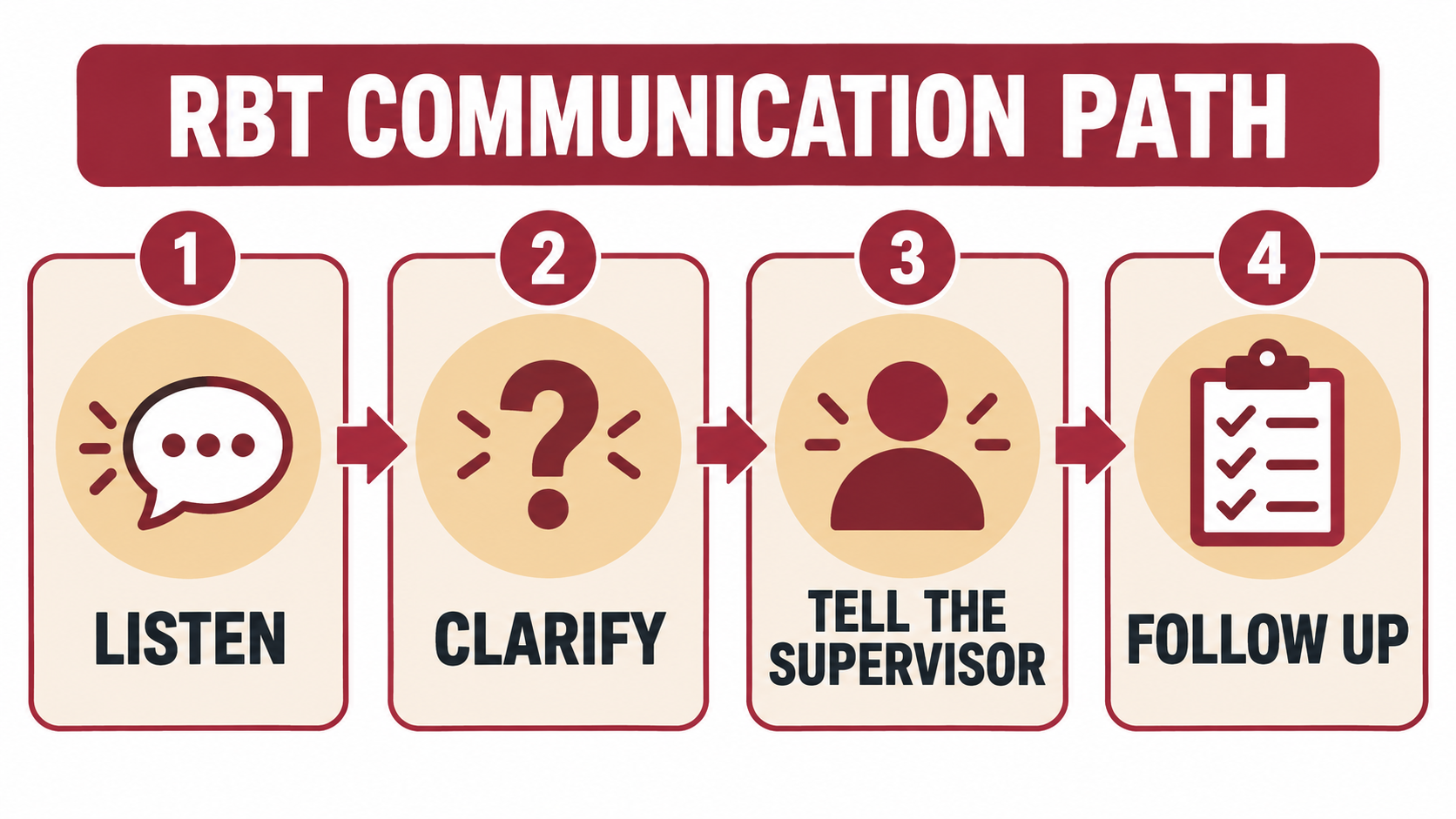
Intervention team communication is a core RBT skill: listen to concerns and suggestions, clarify the facts, tell the supervisor promptly, and follow up within role.
Table of Contents
- Intervention team communication for RBTs: quick answer
- What the RBT task requires
- Step 1: Listen without dismissing
- Step 2: Clarify the concern
- Step 3: Separate facts from conclusions
- Step 4: Tell the supervisor promptly
- Step 5: Follow up within role
- Choose the right communication channel
- Protect privacy and boundaries
- Examples of good team communication
- Common intervention-team communication mistakes
- Frequently asked questions
RBT communication, supervision, and teamwork
Intervention Team Communication for RBTs: Reporting Path
Intervention team communication is a core RBT skill because caregivers, teachers, and other service providers often notice changes that matter to a client’s progress. The RBT’s job is to listen respectfully, clarify what was observed, communicate the concern or suggestion to the supervisor in a timely manner, and follow the authorized next step without promising a clinical change or creating a private plan.
Intervention team communication for RBTs: quick answer
When a caregiver, teacher, or service provider shares a concern or suggestion, listen, clarify the observable issue, identify who raised it and when it matters, communicate it through the supervisor route, and document or follow up according to the team process. Do not dismiss the concern, promise a plan change, or make a clinical decision alone.
The BACB RBT Test Content Outline (3rd ed.) lists this as task E.1: communicate concerns and suggestions from the intervention team with a supervisor in a timely manner. The task is about professional communication and escalation, not about making every team member agree or turning every suggestion into a program change.
What the RBT task requires
Task E.1 names caregivers, teachers, and service providers as examples of an intervention team. These people may observe the client in different settings, notice schedule or health changes, report a new concern, or suggest a way to make a routine more workable. Their information can be clinically relevant even when the RBT cannot decide what it means.
The task includes a timing requirement. “Tell the supervisor eventually” is not enough when the concern affects safety, data, service delivery, or the client’s experience today. Use the team’s emergency or urgent route when required. Use the normal chain of command for nonurgent questions, and record the communication in the approved system.
Good communication is collaborative but not casual. The RBT should listen actively, avoid defensiveness, and protect the client’s confidentiality while making sure the supervisor receives information that could affect services.
Step 1: Listen without dismissing
Give the person enough attention to understand the concern. A caregiver may describe a change at home; a teacher may report a transition problem; another provider may notice that a routine is not generalizing. Do not respond with “that is not part of my program” before you understand the information.
Use a neutral acknowledgment: “I hear that the transition was more difficult this morning. I’ll make sure the supervisor receives that information.” You are not admitting that a clinical conclusion is true. You are showing that the concern has been heard and will enter the appropriate communication path.
If the conversation occurs during an active safety issue, prioritize safety and use the emergency procedure. A routine communication conversation should not delay urgent help.
Step 2: Clarify the concern
Ask short questions that make the information more useful:
- What did you observe?
- When and where did it happen?
- Who was present?
- How often has it happened or changed?
- What was happening immediately before and after?
- What support or suggestion are you asking the team to consider?
- Does the concern require action before the next routine supervision contact?
Do not interrogate the person or demand a behavior-analytic explanation. The purpose is to understand the report, not to make the caregiver or teacher prove a function. If the person does not know an answer, record that uncertainty.
Step 3: Separate facts from conclusions
Distinguish what someone observed from what they think caused it. “Teacher reported that the student left the group area three times after lunch” is a report of an event. “The student left because the task was too hard” is a hypothesis. Both may matter, but they should not be presented as the same type of information.
Use attributed language in notes and messages: “Caregiver reported…,” “Teacher asked whether…,” or “Service provider suggested….” Then add your own direct observation separately. This helps the supervisor weigh the information and avoids turning a casual conversation into a false clinical record.
Step 4: Tell the supervisor promptly
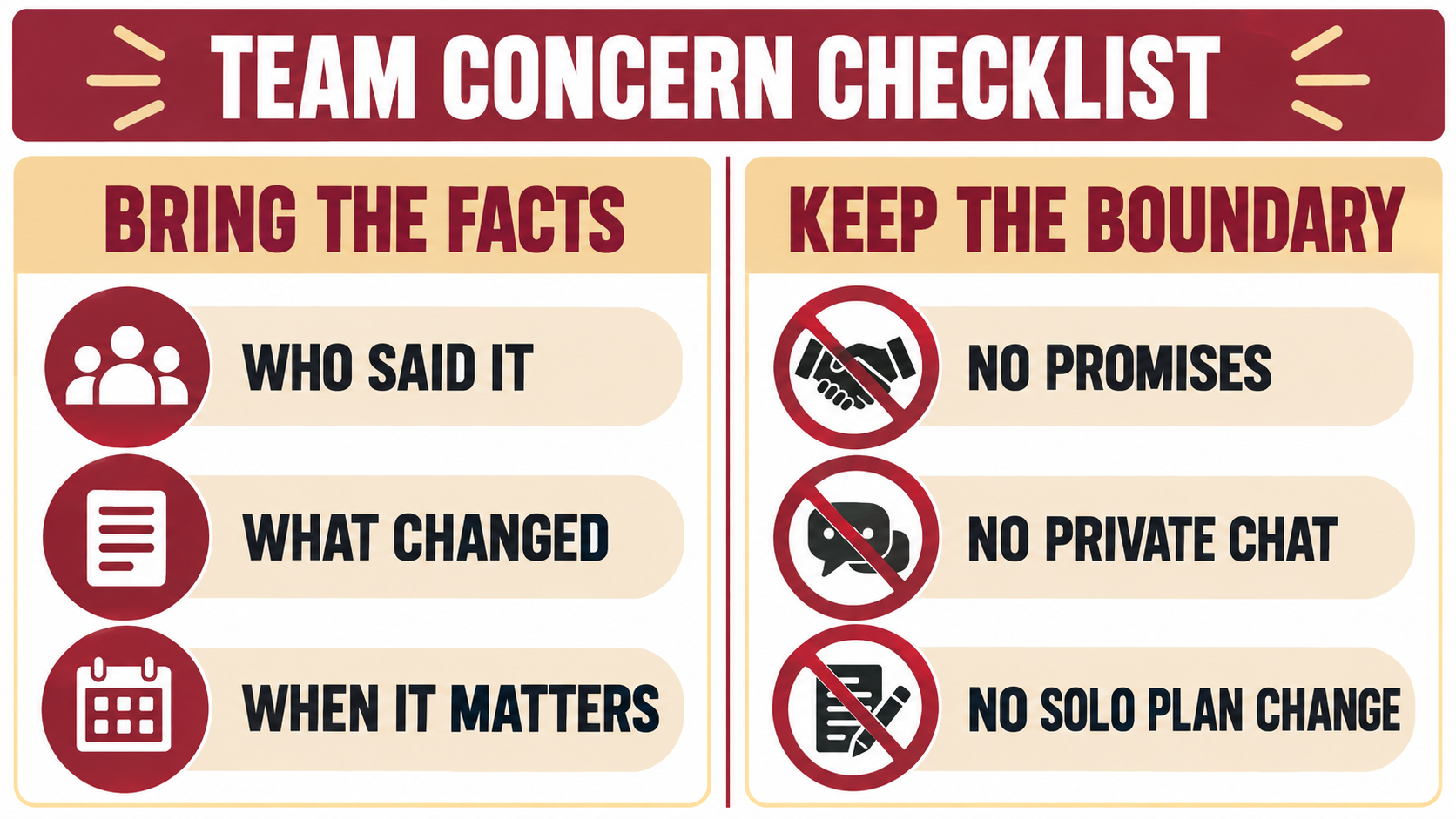
Use the supervisor’s approved channel and explain the concern in a compact format: who raised it, what changed, when it matters, what you observed, and what question needs a decision. If the supervisor is unavailable, follow the backup chain of command. Do not wait for a monthly meeting when the information affects safety, health, data integrity, or today’s service.
Ask for direction rather than asking for permission to do something you have already decided to change. For example: “The teacher reported that the transition routine changed after lunch. I observed two exits from the area today. Should we continue the current program and schedule an observation, or is there a current instruction I should follow?”
Record when the message was sent and the direction received. If a message remains unanswered and the matter is urgent, escalate according to policy instead of repeatedly sending it to an unmonitored inbox.
Step 5: Follow up within role
Once the supervisor provides direction, implement the authorized next step and communicate what you actually did. If the supervisor decides to change the program, use the updated version and confirm that the old instruction is no longer active. If the supervisor asks for more data, collect it according to the current definition.
Do not tell the caregiver or teacher that a suggestion was approved until the authorized team has made that decision. If you do not know the answer, say that you will route the question to the supervisor. Follow-up may also mean checking that a concern was received, not promising a specific outcome.
Choose the right communication channel
Use the channel that matches urgency, privacy, and policy. An emergency may require a phone call or emergency service. A same-day clinical question may use the supervisor’s secure messaging or direct call. A routine suggestion may be recorded in a team note or discussed at supervision. A public group chat or personal social-media message is not automatically an approved clinical channel.
Before sending information, check the recipient, the client identifier, and whether the channel is secure. Keep the message focused on the client and service need. Do not include unrelated family details or forward a private message to people who are not authorized.
Protect privacy and boundaries
Team communication requires sharing enough information with authorized people, not sharing everything with everyone. Follow the organization’s rules for records, consent, caregiver communication, and disclosure. Avoid discussing a client in a hallway, public group, or personal social-media account.
Professional boundaries also mean not becoming the unofficial decision-maker for the team. An RBT can be warm, helpful, and responsive while still referring clinical choices to the qualified supervisor. If a caregiver asks you to hide a concern or bypass the supervisor, explain that you must use the approved process.
Examples of good team communication
Caregiver concern: “Caregiver reported that the client woke several times and asked whether the morning schedule should change. I documented the report and sent it to the supervisor before today’s session.”
Teacher suggestion: “Teacher suggested using the same visual transition cue in class. I told the teacher I would share the suggestion with the supervisor and did not promise that the program would change.”
Service-provider observation: “Speech provider reported that the client used the new communication response twice during the session. I sent the observation to the supervisor for coordination with the current program.”
Each example identifies the source, preserves uncertainty, and routes the decision to the person responsible for clinical direction.
Common intervention-team communication mistakes
- Dismissing a report: Listen before deciding whether it matters.
- Turning a suggestion into an order: Route it to the supervisor.
- Removing the source: Say who observed or suggested the change.
- Waiting too long: Use a timely channel when services or safety may be affected.
- Sharing private messages widely: Use authorized, secure communication.
- Promising a plan change: Do not promise a clinical decision.
- Changing the program alone: Implement only the current authorized instruction.
Frequently asked questions
Who is part of the intervention team?
The BACB gives caregivers, teachers, and service providers as examples. The exact team depends on the client and service setting.
What should an RBT do with a caregiver suggestion?
Listen, clarify the suggestion, communicate it to the supervisor promptly, and follow the authorized direction. Do not promise that the program will change.
How quickly should an RBT report a concern?
Use the urgency and channel defined by the plan and workplace policy. Safety or same-day service concerns should not wait for a routine meeting.
Can an RBT change a program after a teacher reports a problem?
No. Report the information and seek clinical direction. Implement a change only after it is authorized and the current program is clear.
How should I protect confidentiality during communication?
Use approved secure channels, check recipients, share only necessary information, and follow the organization’s privacy and disclosure requirements.
Official sources: BACB RBT Test Content Outline (3rd ed.); BACB RBT 2026 Training Requirements; BACB RBT supervision resources; BACB RBT guidance on supervision concerns. Retrieved September 28, 2026. Follow the current workplace communication and privacy policy.
Ready to practice the RBT concepts you just reviewed?
Try an independent, original RBT practice resource with exam-style questions, scoring, and answer explanations.
References
- Behavior Analyst Certification Board. RBT Test Content Outline, 3rd edition.
- Behavior Analyst Certification Board. RBT Handbook.
- Behavior Analyst Certification Board. RBT Ethics Code.