

Least-to-most prompting in ABA is a planned teaching arrangement that begins with the least intrusive prompt likely to support a response and increases assistance only when authorized.
Table of Contents
- What least-to-most prompting in ABA means
- The prompt sequence
- Why the wait matters
- Data, fading, and independence
- Common errors
- RBT implementation boundaries
- A study example
- Frequently asked questions
- References
RBT KNOWLEDGE · PROMPTING
Least-to-Most Prompting in ABA: Steps and Examples
Learn how a planned prompt hierarchy starts with the least assistance, increases only as authorized, and supports independence through data and fading.
Least-to-most prompting in ABA is a planned teaching arrangement that begins with the least intrusive prompt likely to support a response and increases assistance only when the learner does not respond or needs more help, according to the current procedure. The hierarchy is not an improvisation and does not mean waiting indefinitely while a learner struggles.
The goal is to create opportunities for independent responding while providing enough support for successful practice. Follow the written plan, training, timing, prompt definitions, reinforcement procedure, and supervisor direction. A general definition does not authorize an RBT to invent a hierarchy or change fading criteria.
What least-to-most prompting in ABA means
Least-to-most prompting starts with a low level of assistance, gives the learner the planned opportunity to respond, and moves to a stronger prompt when the response does not occur within the specified interval or does not meet the defined criterion. The sequence ends when the learner responds or the procedure directs the next step.
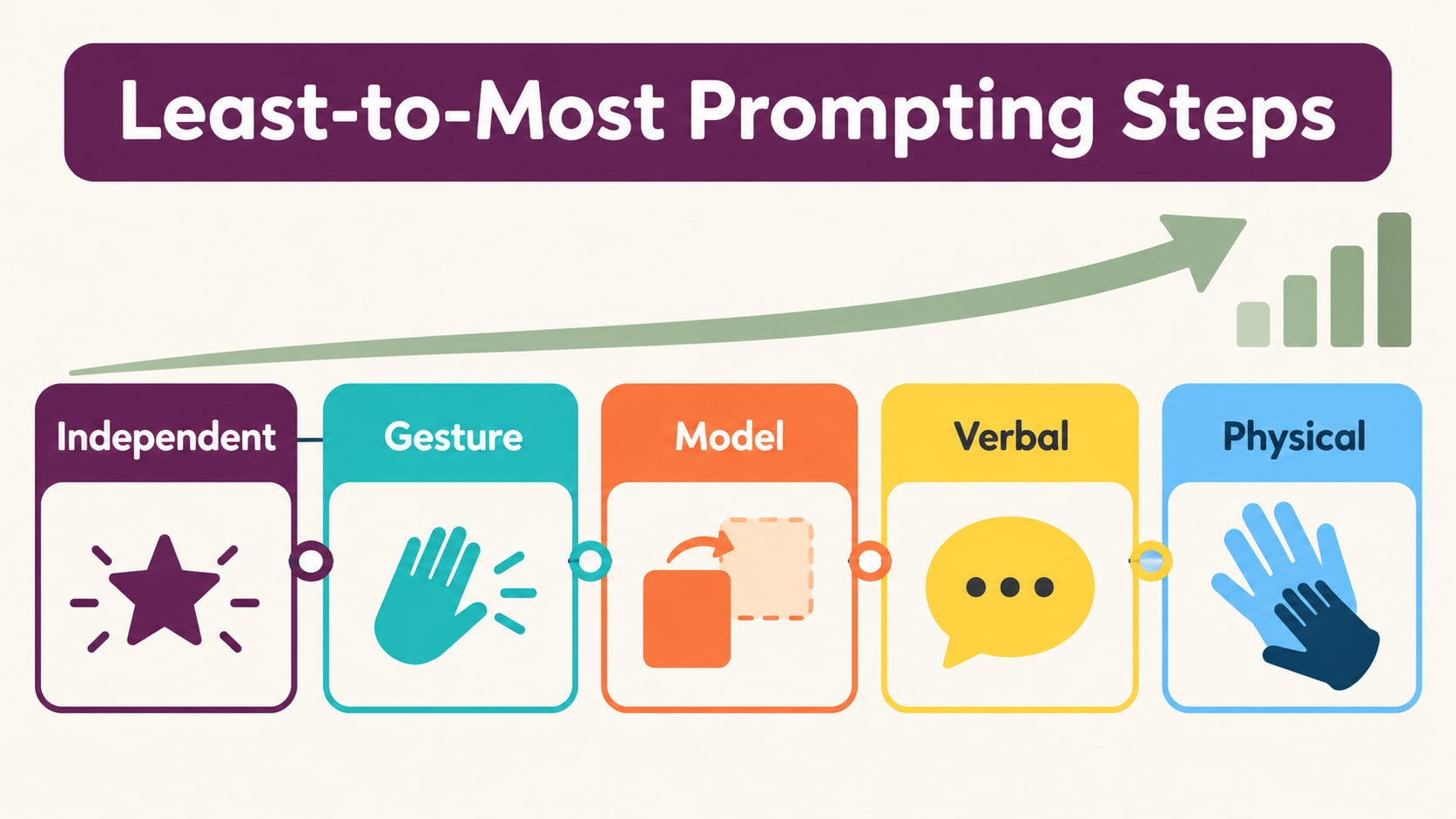
The exact levels vary by skill and plan. A hierarchy might move from an independent opportunity to a gesture, model, verbal prompt, and physical prompt. Another plan may define different levels or a different order. The labels in a study guide are not a substitute for the prompt definitions the team trained you to use.
The prompt sequence
Study the sequence as a chain of decisions:
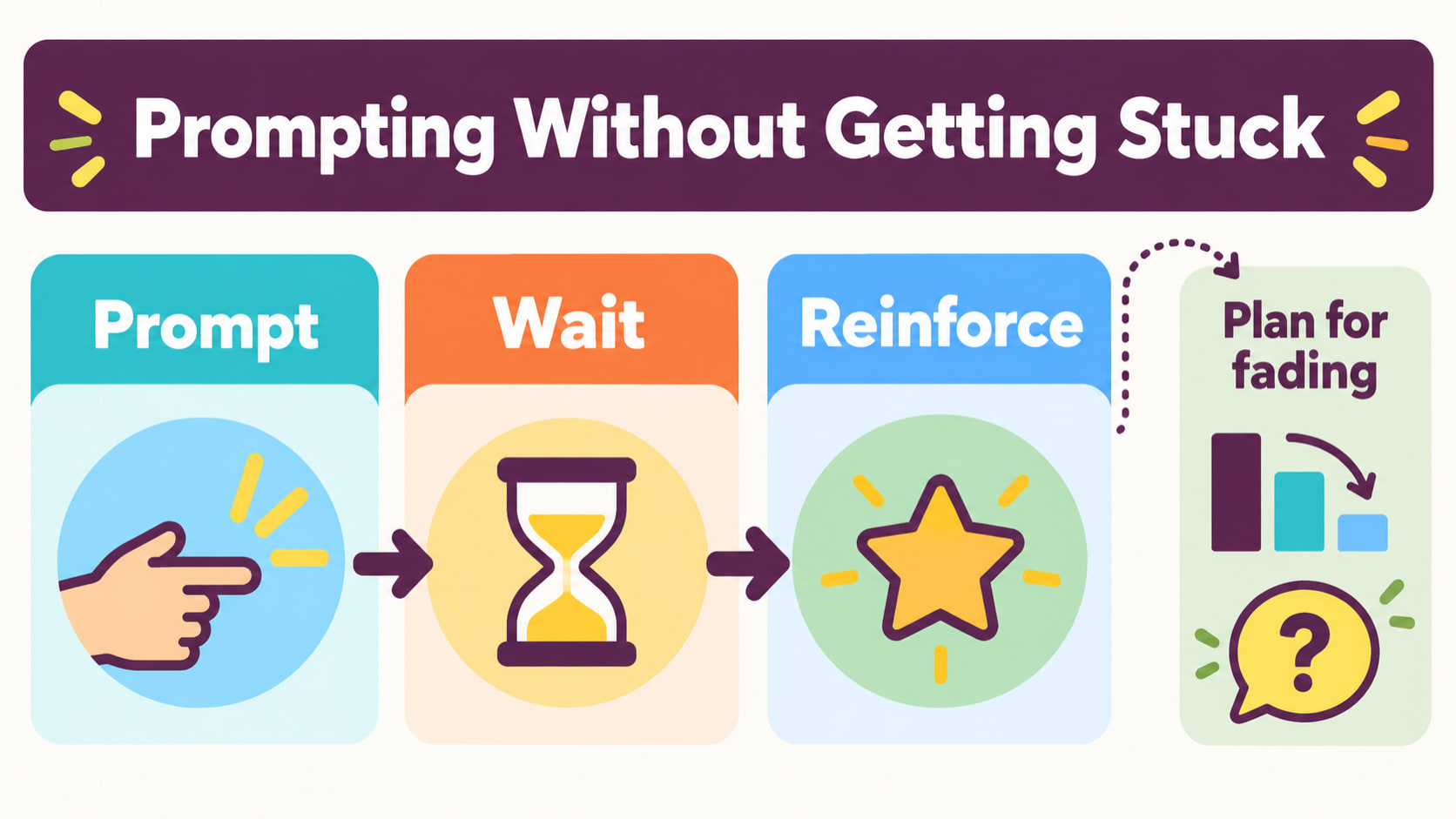
- Present the opportunity: deliver the instruction or cue as written.
- Allow the planned wait: give the learner the specified opportunity to respond.
- Observe: record whether the response was independent, prompted, incorrect, or absent according to the operational definition.
- Increase assistance: move to the next authorized prompt if the criterion for escalation is met.
- Reinforce and record: follow the programmed consequence and data procedure.
Prompting is not a race to the strongest level. Use the least assistance that is effective within the plan and avoid adding extra language, gestures, or physical contact because the next step feels obvious. If a safety or communication need changes the situation, follow the designated escalation route.
Why the wait matters
The wait interval gives the learner a chance to respond independently and makes the data interpretable. If the prompt is delivered immediately every time, the team may not know whether the learner can respond without that assistance. If the wait is much longer than the plan specifies, the opportunity may become inconsistent and the learner may experience unnecessary delay.
Confirm the timing method. The plan may specify a count, a timer, a natural pause, or another observable rule. Do not estimate silently or change the interval based on one trial. Ask the supervisor when the instruction, response definition, or timing rule is unclear.
The wait is also a communication opportunity. Watch for the learner’s response, orientation, attempt, or other behavior the plan defines as relevant. Do not interpret a pause as refusal or assume that a learner who needs more time has failed. Record the observable response and follow the procedure’s next step.
Data, fading, and independence
Data should show which prompt level was needed, whether the response occurred, and any other measure the plan specifies. A high percentage of correct responses does not necessarily mean independence if most responses required a prompt. Prompt-level data help the team decide when and how to fade assistance.
Review data across opportunities rather than relying on the most recent trial. A learner may respond independently with one material and need a prompt with another. Generalization, maintenance, response effort, and setting changes may all matter to the supervisor’s review.
Fading reduces prompt dependence gradually and according to an authorized plan. An RBT should not remove a prompt suddenly, skip levels, or create a new mastery rule. Report patterns such as repeated errors at one level, unusually long delays, refusal, or signs of distress. The supervisor can determine whether the teaching procedure needs review.
Common errors
- Skipping the independent opportunity: prompting before the learner has the planned chance to respond.
- Using an undefined prompt: adding words or gestures that are not part of the hierarchy.
- Changing the wait: using a different interval from the written procedure.
- Confusing correctness with independence: counting a prompted response as independent.
- Fading by guesswork: reducing assistance because the response looked better once.
- Ignoring context: overlooking materials, motivation, setting, or instruction changes.
Correct these errors by returning to the operational definitions, observing the exact sequence, and asking for feedback. Do not conceal a prompt or alter data to make independence appear higher.
RBT implementation boundaries
An RBT implements prompting procedures after training and under supervision. Follow the current plan for prompt levels, timing, reinforcement, correction, data, safety, and fading. Physical prompting requires special attention to authorization, training, dignity, assent-related signals as directed, and safety.
Do not use a stronger prompt to speed up a session, continue physical contact after the authorized step, or create a hierarchy from a general online example. If the plan conflicts with a verbal instruction or a learner’s response raises a concern, pause safely and use the designated supervisor route.
When a prompt is not working, describe the exact level, timing, materials, and learner response. Avoid writing that the learner “would not cooperate” when the record can state what happened. Objective detail gives the supervisor something actionable to review during the next supervision review.
A study example
Imagine a plan teaching a learner to place a card in a matching bin. The RBT presents the card and waits the specified interval. If no response occurs, the RBT uses the defined gesture prompt, waits again, and then follows the next authorized level if needed. The RBT records the prompt level and delivers the programmed consequence after the correct response.
To study this example, ask: What counted as the response? How long was the wait? What made escalation necessary? Which prompt level was used? What data show change? What would require supervisor clarification? These questions keep the example connected to measurement and role boundaries.
Frequently asked questions
Is least-to-most prompting always the same five levels?
No. The levels and order are procedure-specific. Use the current plan and training rather than importing a generic hierarchy.
Does least-to-most prompting mean never prompting quickly?
No. Follow the planned wait, safety instructions, and response criteria. The method provides an opportunity for independence while still delivering timely support.
Can an RBT decide when to fade prompts?
No. Implement the authorized fading procedure and record the data. Bring patterns and questions to the supervisor.
What should I record?
Record the response and prompt level using the measure and form specified by the current plan. Do not relabel prompted responses as independent.
Source note: Review the current BACB RBT content outline, RBT Handbook, client plan, training materials, and supervisor direction for your situation. This article is educational and does not provide individualized legal, clinical, employment, or credentialing advice.
Ready to practice the RBT concepts you just reviewed?
Try an independent, original RBT practice resource with exam-style questions, scoring, and answer explanations.
References
- Behavior Analyst Certification Board. RBT Test Content Outline, 3rd edition.
- Behavior Analyst Certification Board. RBT Handbook.
- Behavior Analyst Certification Board. RBT Ethics Code.