
Multiple relationship risks RBT work can create are easier to manage when an RBT notices overlapping roles early, pauses favors, protects boundaries, and consults a supervisor.
Table of Contents
- Multiple relationship risks RBT: what the risk means in work
- The four signals to notice
- Signal 1: Overlapping roles
- Signal 2: Pressure or special access
- Signal 3: Favors and favoritism
- How to respond safely
- Consultation and documentation
- Everyday examples
- Frequently asked questions
- References
RBT ETHICS · PROFESSIONAL BOUNDARIES
Multiple Relationship Risks RBT: A Practical Guide
Notice overlapping roles early, protect boundaries, and bring uncertainty to supervision.
Multiple relationship risks RBT work can create are easier to manage when an RBT notices overlapping roles early, pauses favors, protects boundaries, and consults a supervisor. The concern is not that every warm interaction is wrong. The concern is that a second relationship or special arrangement may affect objectivity, privacy, decision-making, or the client’s welfare.
This guide provides a recognition-and-response routine. It does not make a final ethics ruling for a particular person or situation. Use the current BACB Ethics Code, applicable law, employer policy, supervisor direction, and formal reporting process. When a situation feels confusing, the professional step is to raise it early rather than create a private workaround.
Multiple relationship risks RBT: what the risk means in work
A multiple relationship can arise when a professional role overlaps with another relationship or interest. Examples may include being a service provider and a family friend, accepting a personal business arrangement, joining a client’s private social group, or becoming involved in a situation where the technician has a financial, family, or romantic interest. The details matter, and the same fact can have different implications in different settings.
Risk is not measured only by intention. A person may intend to be helpful and still create pressure, favoritism, confusion about who decides, or access to information that should remain private. Ask what the arrangement could do to the professional role, the client’s choices, the family’s expectations, and the team’s ability to make objective decisions.
An RBT is not expected to privately investigate every relationship or announce a verdict. An RBT is expected to notice relevant facts, maintain professional boundaries, protect confidential information, and bring concerns to the authorized supervisor or organization.
The four signals to notice
Use these signals as prompts for consultation, not as an automatic label. They help turn a vague feeling into observable information that can be discussed.
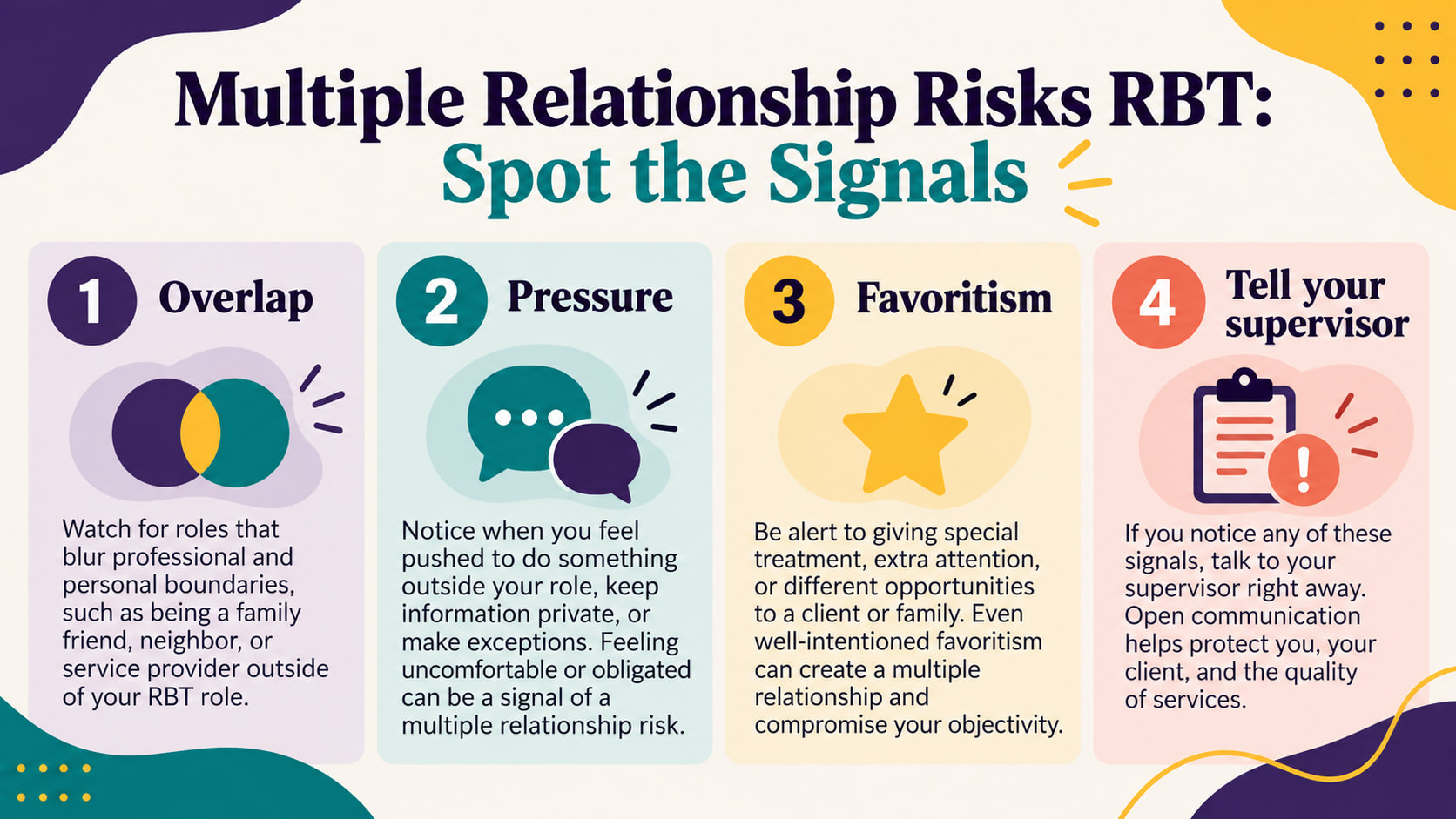
- Overlap: The professional role is combined with a family, friendship, business, social, or other personal role.
- Pressure: Someone asks for special access, secrecy, a private favor, or a decision outside the approved process.
- Favoritism: A gift, discount, invitation, exception, or personal benefit could change expectations or objectivity.
- Uncertainty: The situation is hard to explain clearly, or you feel you should hide it from the supervisor or team.
Signal 1: Overlapping roles
Role overlap can be obvious, such as providing services to a close friend’s child, or subtle, such as joining a family’s private business venture after a service relationship begins. It can also occur outside the client relationship, for example when a technician and supervisor have an undisclosed personal or financial arrangement that affects feedback or scheduling.
Do not decide that an overlap is safe because the people involved trust one another. Trust is valuable, but professional boundaries also protect the person receiving services, the family, the technician, the supervisor, and the organization. Tell the supervisor the relevant facts without adding gossip or unnecessary private history.
Describe what happened and what roles are involved. “The caregiver asked me to provide paid tutoring on weekends” is more useful than “This feels weird.” The supervisor can then identify the correct policy, conflict review, reassignment, or documentation step.
Signal 2: Pressure or special access
Pressure can sound like a request to keep a conversation secret, skip a normal approval, share a personal phone number, provide a service outside the plan, or give one person information that others do not receive. A request may be framed as a favor or emergency even when it changes the professional relationship.
Stay respectful and avoid making a promise while the issue is under review. A simple response can be: “I need to follow the approved process and check with my supervisor before I agree.” Do not debate the person’s motives. Protect the relationship by making the boundary about the process, not about a personal accusation.
If pressure includes threats, harassment, retaliation, or an immediate safety issue, follow the organization’s escalation and emergency procedures. Save accurate facts and contact the designated support route. Do not respond by creating a secret record on a personal device or by sharing confidential information with an unrelated person.
Signal 3: Favors and favoritism
Favors can create expectations even when they seem small. A gift, ride, discount, personal purchase, social invitation, childcare request, or special scheduling arrangement may affect how a person experiences the technician’s role. Organizational limits and ethics rules may apply, and a stricter local policy may apply as well.
Do not accept or reject a questionable offer in isolation if the answer could affect the client, family, team, or credentialed role. Thank the person for asking, explain that you need to check the policy, and bring the details to the supervisor. Avoid a private exchange that would be difficult to explain later.
Favoritism can also be unintentional. Giving one family extra informal access, repeatedly making exceptions, or sharing personal opinions with one client may create a pattern. Use the same approved process for everyone unless a documented plan or authorized accommodation says otherwise.
How to respond safely
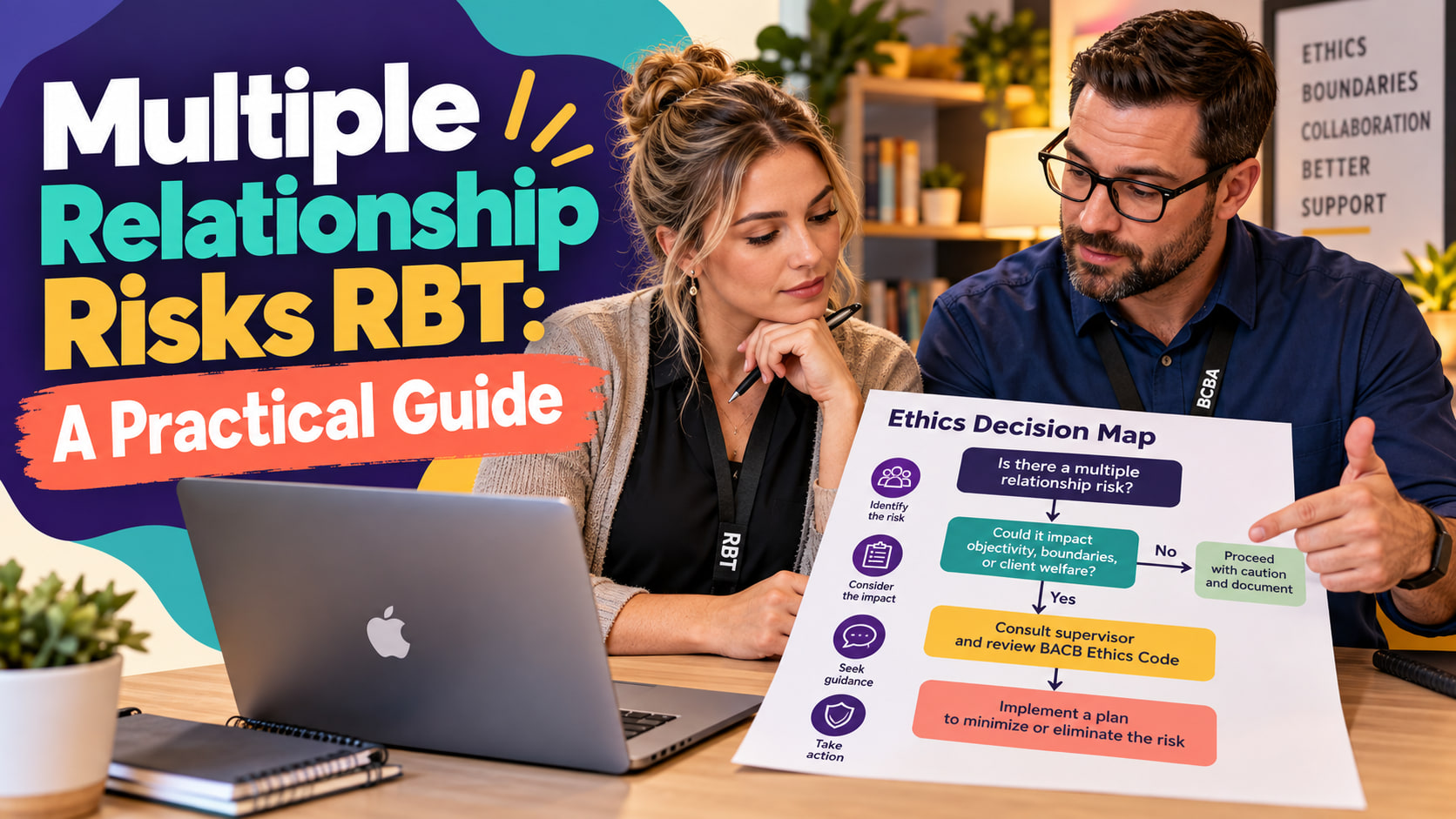
When a possible multiple relationship appears, use a short response sequence: notice the observable fact, pause the new arrangement, protect privacy, consult the supervisor, and follow the approved decision. Do not try to solve a complex boundary issue by yourself just because the answer feels obvious.
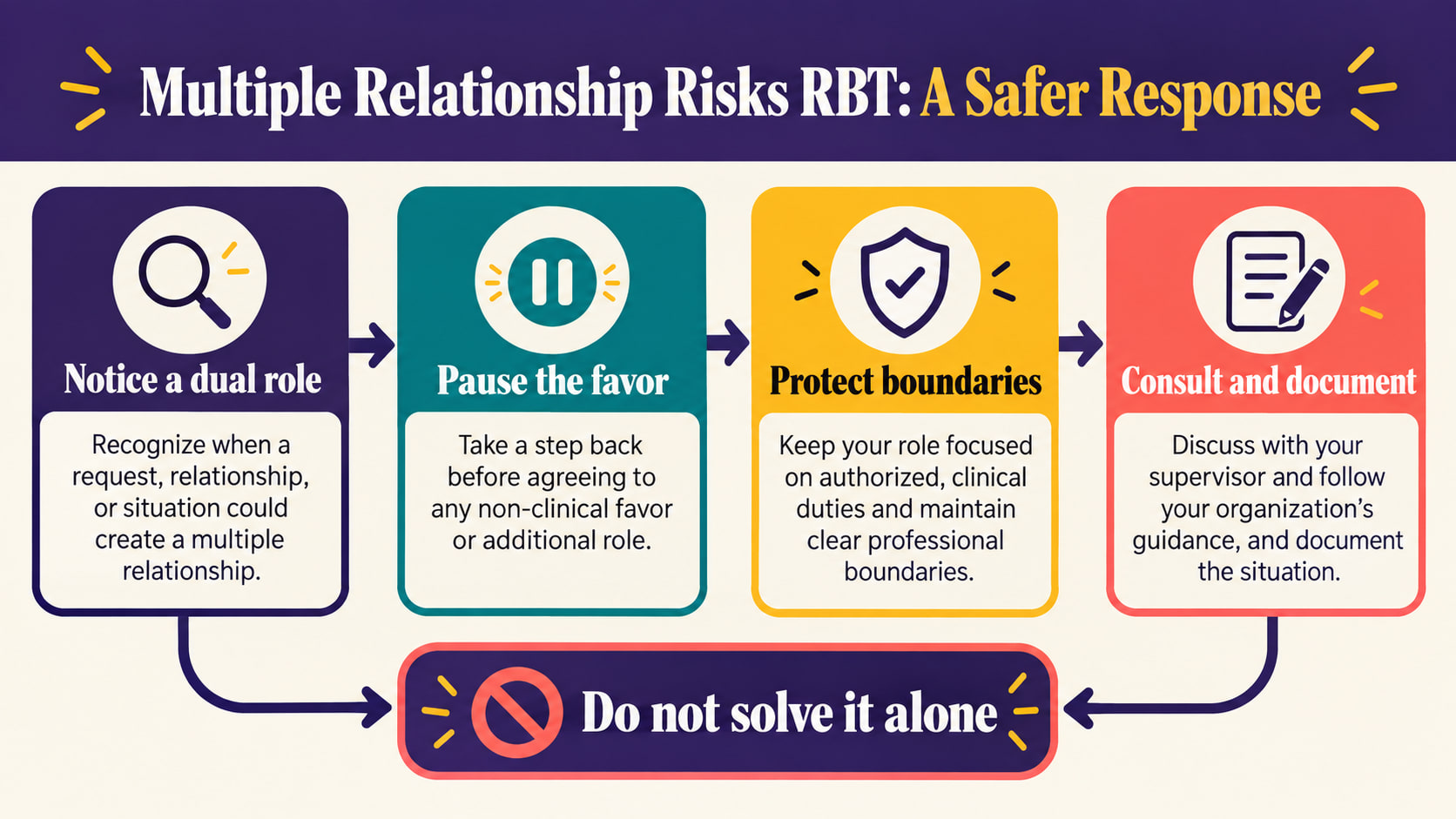
- Notice: Identify the roles, request, favor, or pressure without adding a diagnosis or motive.
- Pause: Do not accept, promise, disclose, or continue the new arrangement until direction is clear.
- Protect: Keep confidential information and personal boundaries intact while you seek help.
- Consult: Contact the supervisor or designated process and ask what should be documented or changed.
Consultation and documentation
Good documentation is factual, timely, and stored through the approved system. Record what was requested or observed, when it occurred, who was involved in the professional process, what immediate boundary you maintained, and what direction you received. Do not write a long private narrative full of speculation or identifying details that do not belong in the record.
If a concern is about a supervisor, use the organization’s alternate reporting route when available. If the usual person is involved in the conflict, do not abandon the concern; ask how to reach the next authorized contact. Keep the information limited to people who need it for the review.
Consultation does not mean spreading a story. Ask for guidance through the proper channel, use neutral language, and follow up on the action assigned. If the supervisor says to decline a gift, end a private arrangement, or transfer a task, complete that action consistently and document it as required.
Everyday examples
- Friendship: A close friend asks you to provide services to a family member. Disclose the overlap through supervision before accepting the assignment.
- Business request: A caregiver offers to hire you privately for another service. Do not agree on the spot; ask which policy and boundary review applies.
- Gift: A family offers an expensive present after a difficult month. Thank them without accepting or refusing privately until you check the current policy.
- Social media: A client’s relative asks to connect through a personal account. Protect privacy and follow the organization’s communication rules.
- Supervisor conflict: A supervisor asks you to conceal an arrangement. Preserve the facts and use the alternate reporting route or designated escalation process.
Frequently asked questions
Are all multiple relationships automatically prohibited?
Not every interaction has the same facts or risk. The correct response depends on current ethics requirements, law, policy, supervision, and the effect on the professional relationship. Consult rather than make an automatic ruling.
What should I say when someone asks for a favor?
Say that you need to follow the approved process and check with your supervisor before agreeing. Keep the response respectful and do not promise secrecy.
Should I document a concern even if nothing happened?
Follow the supervisor’s and organization’s documentation instructions. At minimum, preserve accurate facts for the consultation and avoid creating a private informal record outside the approved system.
What if I already accepted a gift or personal invitation?
Do not hide it or try to repair the situation alone. Tell the appropriate supervisor promptly, describe the facts accurately, and follow the direction for next steps.
Source note: Review the current BACB RBT Handbook, Ethics Code, applicable law, employer policy, and supervisor instructions. This article is educational and does not provide individualized legal, clinical, employment, or credentialing advice.
Ready to practice the RBT concepts you just reviewed?
Try an independent, original RBT practice resource with exam-style questions, scoring, and answer explanations.
References
- Behavior Analyst Certification Board. RBT Test Content Outline, 3rd edition.
- Behavior Analyst Certification Board. RBT Handbook.
- Behavior Analyst Certification Board. RBT Ethics Code.