

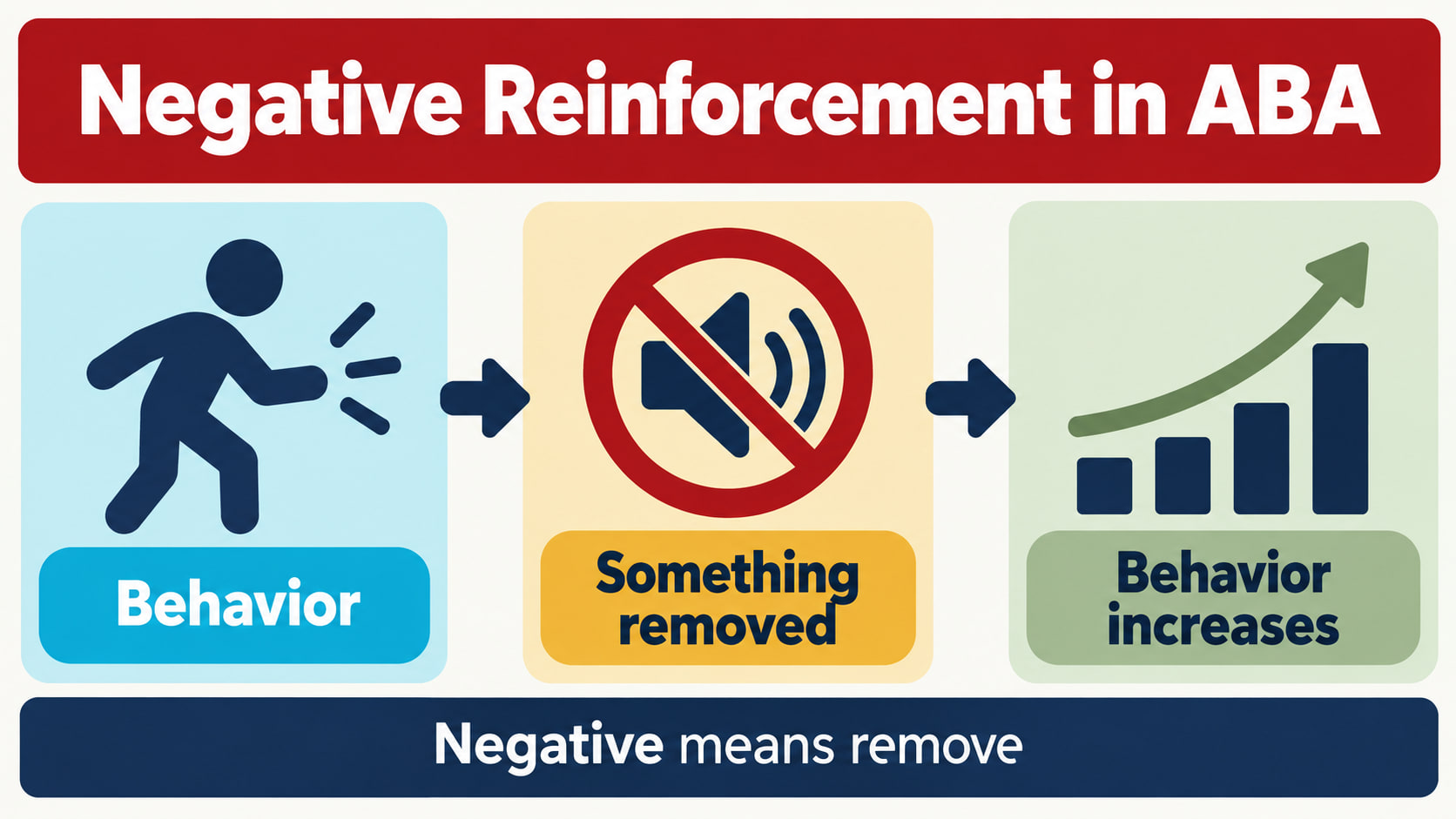
Negative reinforcement in ABA is a process in which a consequence removes or reduces a stimulus after a behavior and that behavior becomes more likely in the future.
Table of Contents
- What negative reinforcement in ABA means
- What is removed
- The future-behavior test
- Examples and nonexamples
- Negative reinforcement versus punishment
- Data and timing
- RBT role boundaries
- Study checklist
- Frequently asked questions
- References
ABA CONCEPTS · RBT STUDY GUIDE
Negative Reinforcement in ABA: Definition, Examples, and Boundaries
Understand remove versus add, the future-behavior test, examples, data, and RBT role limits.
Negative reinforcement in ABA is a process in which a consequence removes or reduces a stimulus after a behavior and that behavior becomes more likely in the future. Negative means something is subtracted; it does not mean bad, harmful, or punishment. The future increase is essential to the definition.
To analyze an example, separate the behavior, the immediate change, and what happens later. Ask what response occurred, what was removed or reduced, and whether the response increased under comparable conditions. An adult’s intention or the apparent pleasantness of the event is not enough to identify reinforcement.
What negative reinforcement in ABA means
In negative reinforcement, a behavior is followed by the removal, reduction, delay, or termination of a stimulus, and the behavior increases in the future. The stimulus may be an ongoing demand, sound, prompt, or another event defined by the authorized procedure. The label depends on the arrangement and its effect, not simply on whether the stimulus feels unpleasant.
For example, a learner appropriately requests a break and a task pause occurs according to the plan. If appropriate break requests become more frequent in similar situations, the task pause may function as negative reinforcement for requesting. The plan must specify the response, timing, duration, and conditions; a generic example does not authorize an RBT to create an escape procedure.
What is removed
“Removed” can mean that an event stops, becomes shorter, is delayed, or is reduced after the response. A seat-belt alert that stops after fastening is a familiar everyday example. In a teaching context, the exact event and response requirement must be defined by the program rather than inferred from a broad phrase such as “escape behavior.”
Do not confuse removal with the delivery of a preferred item. Adding a break card, token, praise statement, or activity is a positive change in stimulus presentation, even if the learner also experiences relief. Identify the immediate stimulus change and the future response pattern separately.
Do not assume that every demand removal is reinforcement. If the response does not increase, the event may have been ineffective, delivered inconsistently, or related to another process. Data are needed to evaluate the function of the arrangement.
The future-behavior test
Negative reinforcement is defined by an increase in future behavior. Look for more frequent responding, shorter latency, longer duration, greater independence, or generalization when the same conditions recur, depending on the measure in the plan. One successful trial is not enough to establish a pattern.
Intent is not the test. A teacher may remove a demand because they believe it will help, but if the target response does not increase, the event may not be functioning as reinforcement. Likewise, a stimulus that looks unpleasant may be irrelevant if it does not change future responding.
Compare similar opportunities and follow the plan’s data rules. Record the response, the consequence, the timing, the prompt level, and the outcome required by the measurement system. Never relabel a consequence to make a data pattern fit a definition.
Examples and nonexamples
Use a three-part sentence: “After behavior, stimulus was removed or reduced, and later the behavior did or did not increase.” This structure prevents the common error of choosing negative because something seems unpleasant.
- Possible negative reinforcement: a learner uses an authorized help request, a difficult task is briefly paused according to the plan, and appropriate help requests increase across later opportunities.
- Possible negative reinforcement: a person fastens a seat belt, an alert stops, and fastening becomes more likely in similar situations.
- Not enough information: a task ends after a response, but no comparable data show whether the response increased.
- Not necessarily negative reinforcement: an adult removes a demand once, but the response does not increase or the removal was unrelated to the response.
The same event can have different effects for different learners, responses, or contexts. Describe the arrangement precisely rather than labeling it from the item alone.
Negative reinforcement versus punishment
Reinforcement increases a behavior; punishment decreases a behavior. Negative describes removal or reduction of a stimulus, so negative reinforcement and negative punishment are not the same. In negative reinforcement, something is removed and the behavior becomes more likely. In negative punishment, something is removed and the behavior becomes less likely.
Positive and negative are direction words, not moral judgments. Positive reinforcement adds a consequence and increases behavior; positive punishment adds a consequence and decreases behavior. When studying, write both dimensions: what changed in the stimulus and what changed in future behavior.
Do not use a label to justify an intervention. A current plan, authorized procedure, supervision, consent, safety direction, and data system govern what an RBT may implement.
Data and timing
Timing matters. A consequence delivered immediately after a defined response may have a different relation to behavior than an event delivered several minutes later or after several responses. Follow the stated response window, schedule, duration, and measurement rules.
Document objective events. “The learner requested a break using the programmed response; the demand was paused for the stated interval” is more useful than “the learner escaped.” If a procedure is unclear or unsafe, record the issue through the approved process and ask for supervision rather than inventing a new removal contingency.
Data collection may include frequency, rate, latency, duration, percentage of opportunities, prompt level, or another measure. Use the system in the current plan. Do not estimate missing events, alter a response definition, or decide from one trial that a consequence is reinforcing.
RBT role boundaries
An RBT may implement trained procedures, collect accurate data, report objective observations, protect privacy, and receive feedback. An RBT should not independently select a new escape procedure, change a demand, alter a schedule, choose a consequence, diagnose function, or rewrite a behavior plan.
If a caregiver asks why a demand was removed, explain only what you are authorized to explain and route clinical questions to the supervisor. If a learner’s response or safety condition falls outside the written procedure, use the designated escalation route. Respectful implementation protects dignity and keeps data interpretable.
Study checklist
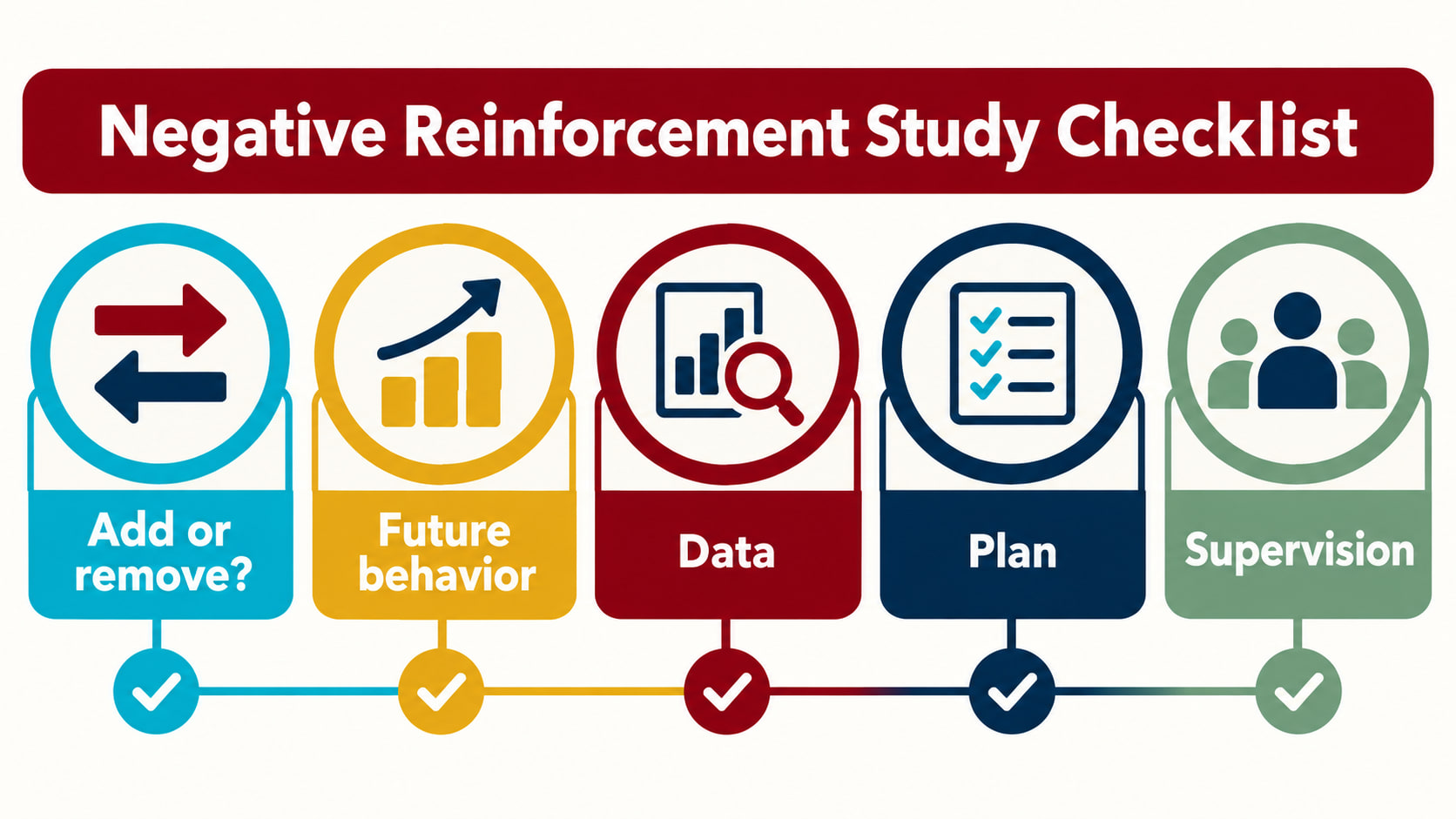
- What behavior occurred?
- What stimulus was removed, reduced, delayed, or ended?
- Did the behavior increase later under comparable conditions?
- What measurement and timing rules apply?
- Is the example reinforcement, punishment, or not enough information?
- What does the current plan authorize?
- Which question belongs with the supervisor?
Frequently asked questions
Is negative reinforcement punishment?
No. Negative reinforcement removes or reduces a stimulus and increases future behavior. Punishment decreases future behavior.
Does negative mean bad?
No. Negative describes a stimulus being removed or reduced. The word does not describe moral value or whether an event is harmful.
Is escape always negative reinforcement?
No. An event may be related to a response, but reinforcement requires evidence that the behavior increases in the future. Follow the authorized plan and data rules.
Can an RBT create an escape procedure?
No. An RBT implements the current trained procedure and asks the supervisor about ambiguity, safety, or proposed changes.
Source note: Review the current BACB Handbook, RBT materials, learner plan, employer policy, and supervisor direction for your situation. This article is educational and does not provide individualized legal, clinical, employment, or credentialing advice.
Ready to practice the RBT concepts you just reviewed?
Try an independent, original RBT practice resource with exam-style questions, scoring, and answer explanations.
References
- Behavior Analyst Certification Board. RBT Test Content Outline, 3rd edition.
- Behavior Analyst Certification Board. RBT Handbook.
- Behavior Analyst Certification Board. RBT Ethics Code.