
Observation of RBT service delivery should focus on what was planned, what occurred, what was recorded, and what needs timely follow-up.
Table of Contents
- What service-delivery observation is for
- Observation of RBT service delivery: the five-part sequence
- Notice the setting and materials
- Compare the procedure with the plan
- Record prompts and responses objectively
- Turn observations into follow-up
- Common observation mistakes
- Frequently asked questions
- Sources and further reading
RBT PRACTICE GUIDE · OBSERVATION AND DOCUMENTATION
Observation of RBT Service Delivery: What to Notice
Use observable details to connect the setting, written procedure, learner response, and follow-up direction.
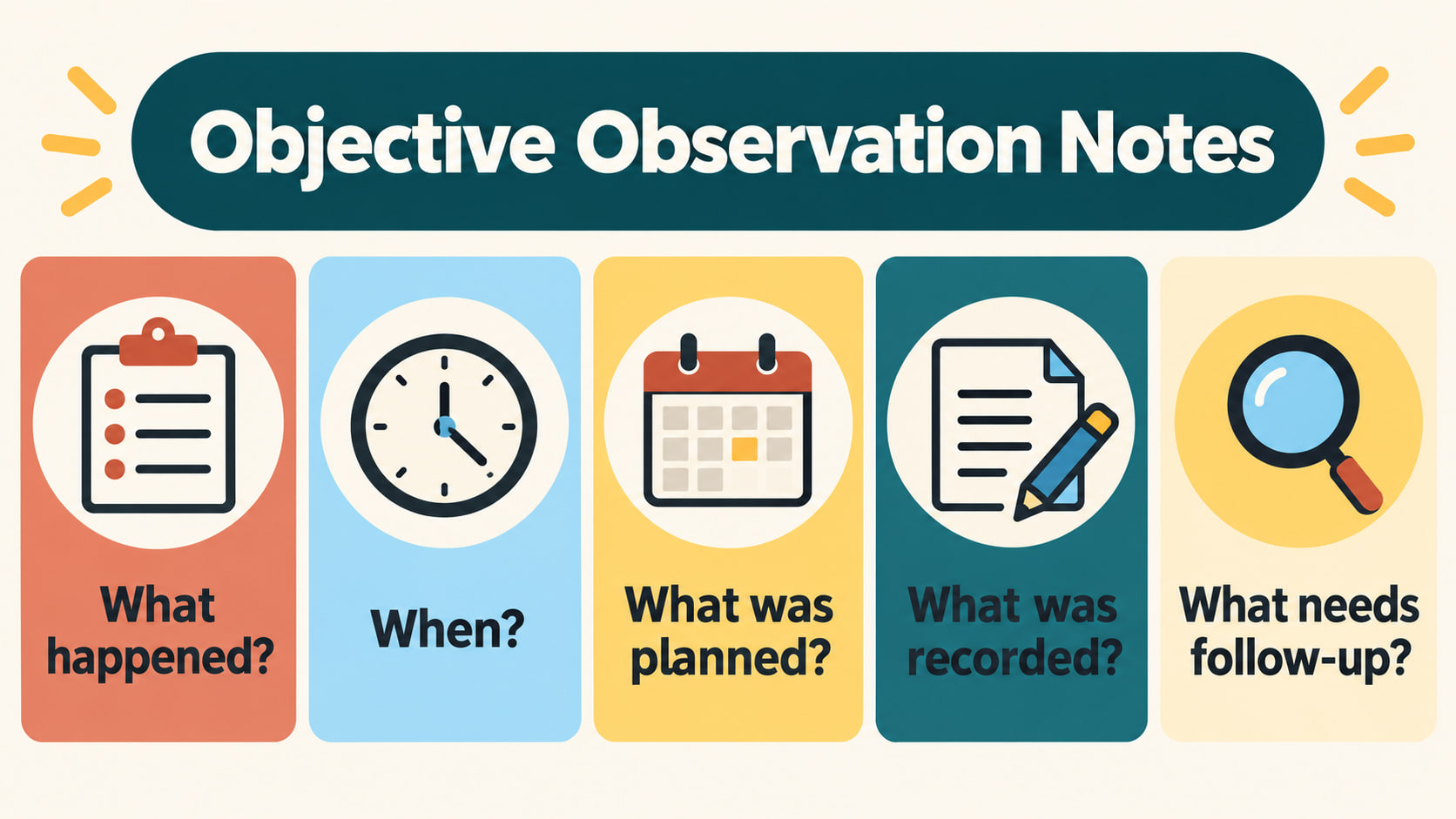
Observation of RBT service delivery should focus on what was planned, what occurred, what was recorded, and what needs timely follow-up. It is not a search for personality flaws or a reason to redesign a procedure in the moment. A useful observation helps an RBT, supervisor, or intervention team describe service delivery in observable terms and identify the next role-appropriate action.
In plain language, observation of rbt service delivery means watching the connection between the plan and the service actually delivered. It does not require guessing what a person intended. It asks what materials were present, what instruction or procedure occurred, how the response was measured, and whether the record supports a clear next question. That distinction makes the observation more useful for training, supervision, and respectful communication.
The current BACB RBT Test Content Outline connects effective supervision with observation of RBT service delivery, instruction, modeling, rehearsal, and feedback. It also expects objective communication, attention to procedural fidelity, and timely direction. This guide uses original educational examples. The current written plan, workplace process, supervisor direction, and BACB materials control a specific situation.
Observation is not surveillance for its own sake. It should have a defined purpose, a suitable observer, an approved record, and a respectful plan for discussing what was seen. If the purpose is unclear, ask the responsible supervisor or organization before collecting more detail.
What service-delivery observation is for
Observation can answer different questions, so define the purpose before taking notes. A supervisor may be checking whether an RBT can implement a trained procedure. An RBT may be reviewing a data question. A team may be checking whether a schedule change, material problem, or environmental variable affected progress. The observer should not pretend that one short observation answers every question.
Keep the observation proportional and respectful. Protect privacy, use approved recording systems, and describe the service rather than labeling the learner or technician. “The instruction was delivered, the response window elapsed, and no response was recorded” is more useful than “the learner was unmotivated.”
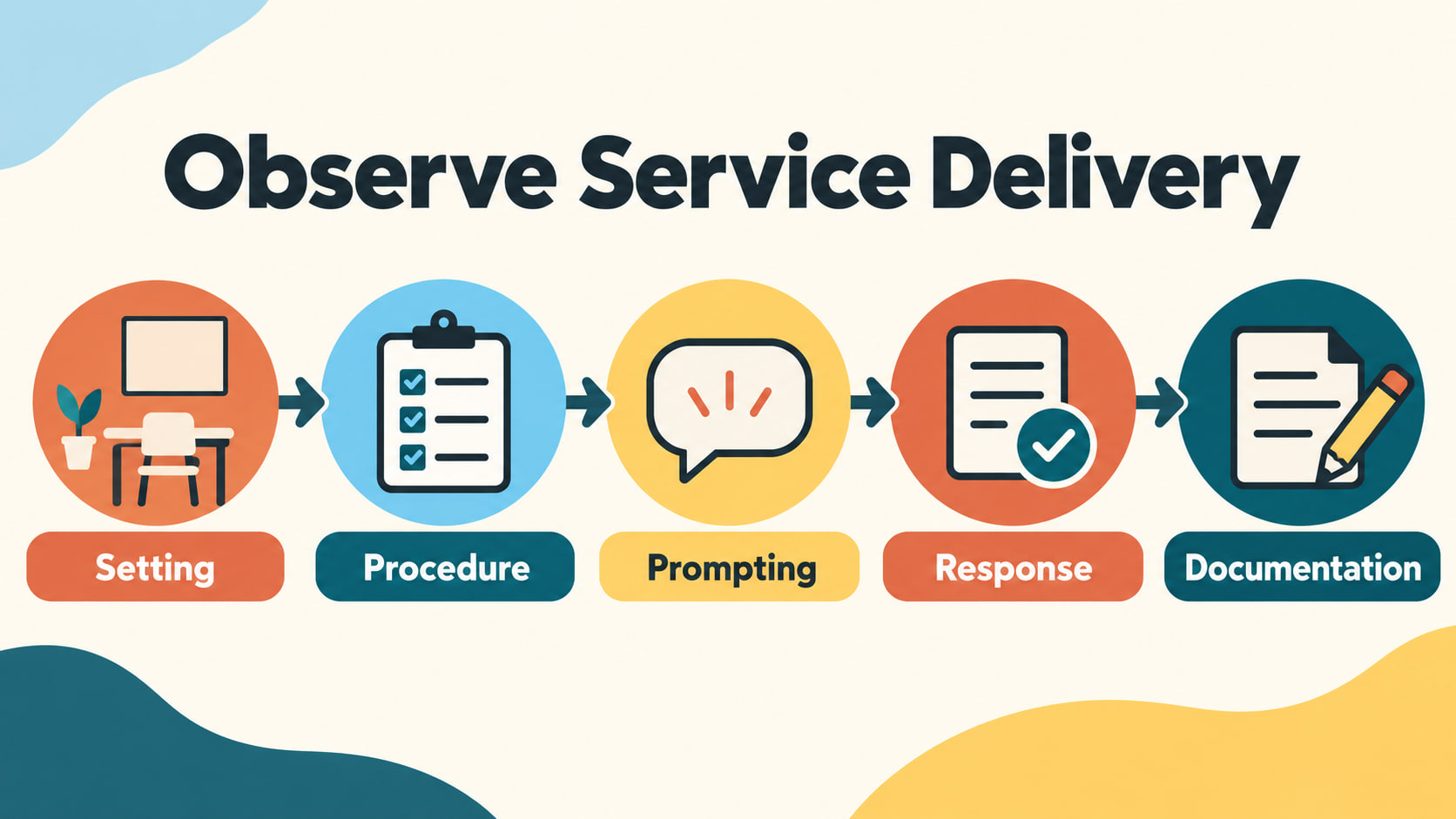
Observation of RBT service delivery: the five-part sequence
- Setting: note the location, materials, people involved, and relevant environmental changes.
- Procedure: identify the written or trained step that should be implemented.
- Prompting: note whether a prompt was planned, when it occurred, and how it was recorded.
- Response: describe the observable response using the operational definition or data rule.
- Documentation: record what happened and identify questions or follow-up needed.
Notice the setting and materials
Start with the context. Was the service delivered in the planned setting? Were the required materials available and arranged as trained? Did a new person, noise, illness, schedule change, or other variable appear? The observer should record only relevant details and avoid collecting unnecessary personal information.
For example, if a teaching activity normally uses a visual choice board but the board is missing, document that fact before interpreting the learner’s response. The missing material may affect the opportunity, but it does not prove why the learner responded differently. The correct next step may be to obtain the approved material, ask the supervisor for direction, or document a planned deviation according to workplace policy.
Compare the procedure with the plan
Observation is stronger when the observer knows which procedure or training step is being reviewed. Identify the instruction, prompt rule, reinforcement step, measurement system, or safety direction that applies. Then compare the observable implementation with that source without turning a single difference into a global judgment.
Suppose the written plan says to deliver an instruction, wait the defined interval, and then use the trained prompt if needed. An objective note can state whether the instruction was delivered, whether the interval elapsed, whether the prompt occurred, and whether the event was recorded. If the procedure is unclear, pause the uncertain decision and ask the responsible supervisor rather than inventing a correction.
Record prompts and responses objectively
Prompting and response notes should match the current data system. Use the defined categories, such as independent, prompted, incorrect, or no response, only when those categories are part of the plan. Record timing and sequence when they matter. Avoid replacing a defined response with an interpretation such as “cooperative,” “lazy,” or “confused.”
An observation may show that the RBT delivered a prompt before the response window ended. The next question is not whether the person is careless. It is whether the timing changed the opportunity, whether the data should be marked for review, and what direction or retraining is needed. Feedback should identify the observable step to keep or change and give the RBT a chance to rehearse it.
Turn observations into follow-up
A useful observation ends with a clear next action. That action might be continued implementation, a modeled practice trial, a request for clarification, a data correction, a safety escalation, or a scheduled re-observation. Write the direction in the approved record and identify who is responsible for the follow-up.
Use a simple conversation structure:
- State the observation: “The response window ended before the prompt was delivered.”
- Name the source: “The written procedure says to wait five seconds.”
- Ask the focused question: “Should this trial be marked for review?”
- Record the direction: capture the supervisor’s instruction in the required system.
- Follow up: apply the direction and report what happened next.
If an immediate safety concern is present, follow the trained emergency or safeguarding process first. Observation notes do not replace urgent care, emergency services, mandated reporting, or workplace escalation.
Common observation mistakes
- Watching without a defined purpose: decide whether the focus is fidelity, training, data, safety, or another approved question.
- Writing judgments: use observable actions and the applicable operational definition.
- Ignoring context: record relevant changes in materials, schedule, setting, or instructions.
- Fixing the plan independently: report uncertainty and seek authorized direction.
- Over-documenting private information: use approved systems and the minimum necessary detail.
- Assuming one observation proves competence: competence and supervision decisions require the applicable process and evidence.
Frequently asked questions
What should an RBT observe during service delivery?
Notice the setting, relevant materials, trained procedure, prompt sequence, observable response, data rule, and variables that may affect progress. Ask the supervisor when the plan or next step is unclear.
Can an RBT change a procedure after observing a problem?
No. Record the problem and seek direction. An RBT should not independently change targets, prompts, reinforcement rules, measurement systems, or safety procedures.
How should observation notes be written?
Use objective, dated, relevant language that separates what happened from an interpretation. Follow the organization’s approved documentation and privacy process.
Is this an official BACB observation checklist?
No. This is an independent educational guide with original examples. It is not an official BACB form, answer key, or guarantee of competence or certification.
Sources and further reading
Ready to practice the RBT concepts you just reviewed?
Try an independent, original RBT practice resource with exam-style questions, scoring, and answer explanations.
References
- Behavior Analyst Certification Board. RBT Test Content Outline, 3rd edition.
- Behavior Analyst Certification Board. RBT Handbook.
- Behavior Analyst Certification Board. RBT Ethics Code.