
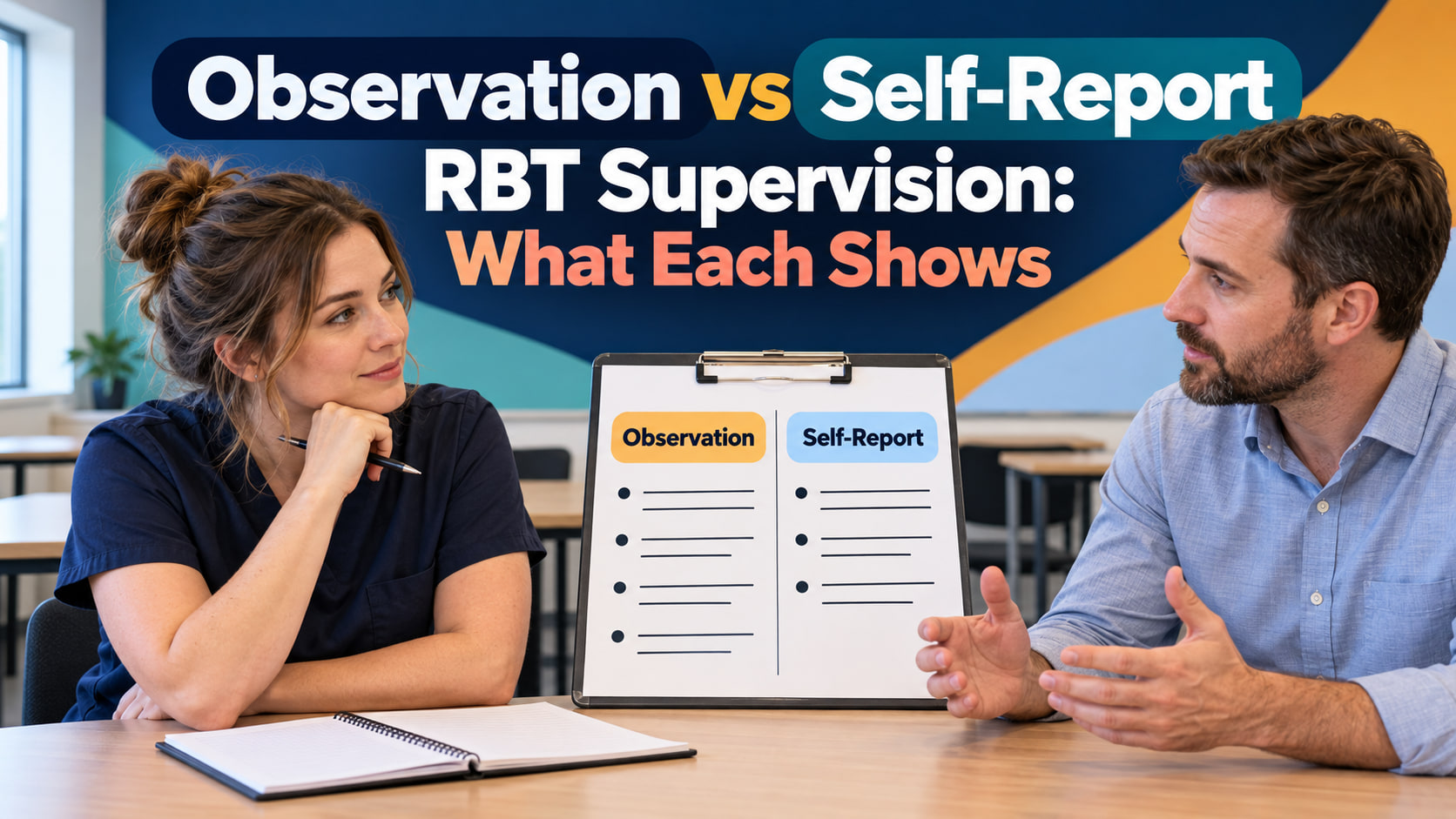
Observation vs self report RBT supervision is not an either-or choice: direct observation shows implementation, while self-report reveals the RBT’s experience, questions, and context.
Table of Contents
- The short answer
- Observation vs self report RBT supervision: the difference
- What direct observation can show
- What self-report can show
- How to combine both sources
- A practical supervision example
- Document the source and follow-up
- Common interpretation mistakes
- Stay within the RBT role
- Frequently asked questions
- References
RBT SUPERVISION GUIDE · EVIDENCE IN PRACTICE
Observation vs Self-Report RBT Supervision: What Each Shows
Compare direct observation with the RBT’s own report, then use follow-up to understand the full picture.
Observation vs self report RBT supervision is not an either-or choice. Direct observation shows what happened during the observed opportunity. Self-report reveals what the RBT noticed, understood, questioned, or experienced outside that observation. Each source has value and limits.
The current BACB RBT Test Content Outline connects supervision with observation of service delivery, communication, documentation, feedback, and timely direction. The exact method and record depend on the current requirements, written arrangement, organization, and supervisor. This article is an educational comparison, not a substitute for those sources.
The short answer
Use direct observation when the question is about an action, sequence, timing, or implementation that can be seen. Use self-report when the question is about a concern, barrier, uncertainty, context, or event that may not be visible during the supervisor’s visit. When the question matters, combine the sources and seek the appropriate follow-up instead of treating either one as a complete record by itself.
Observation vs self report RBT supervision: the difference
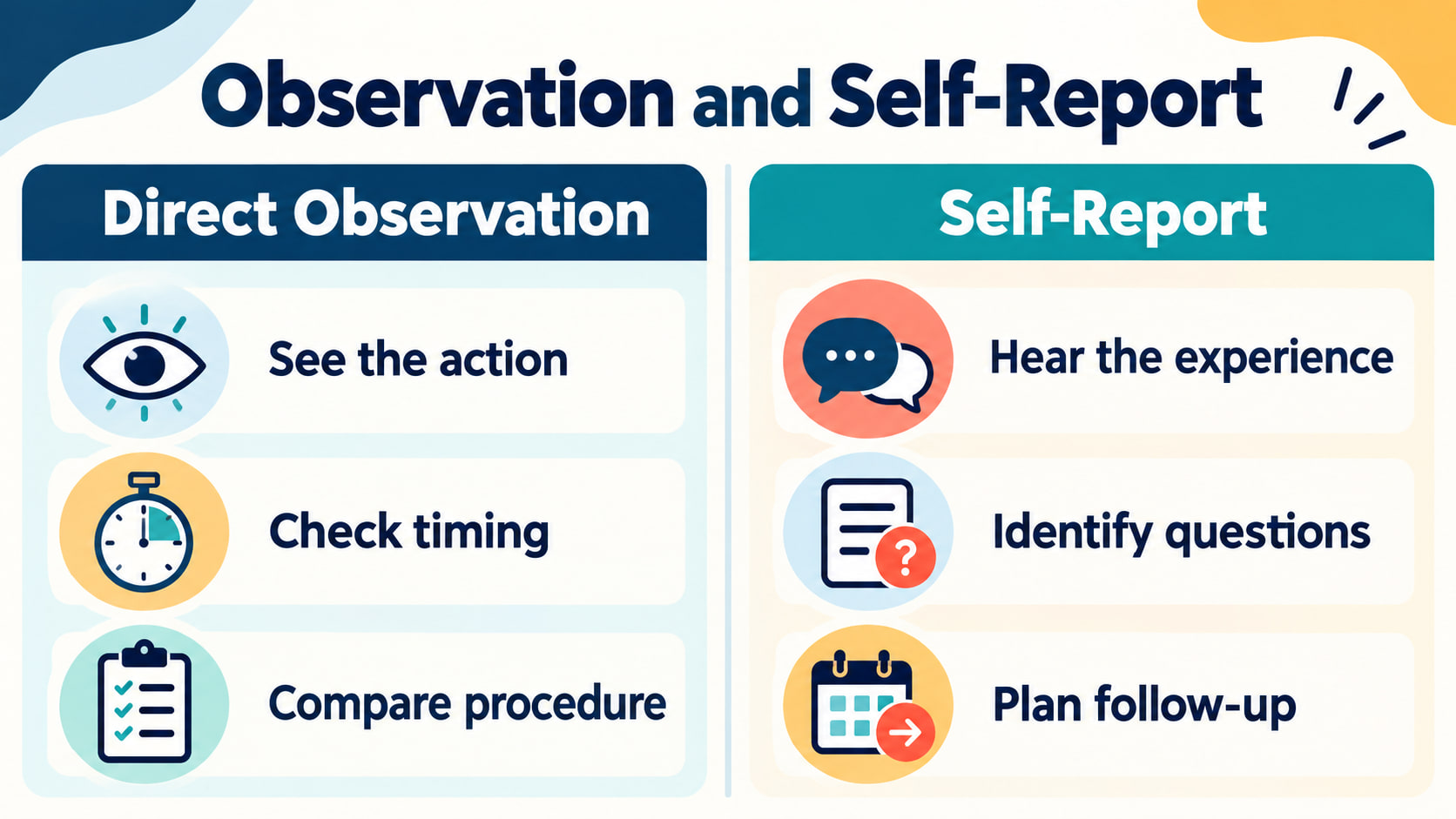
Direct observation answers, “What did the supervisor see in this setting and opportunity?” Self-report answers, “What does the RBT say happened, what was unclear, and what support is needed?” The sources may agree, add different details, or appear to conflict because they cover different moments or perspectives.
A difference is not automatically dishonesty or poor performance. The supervisor may have observed only a small sample. The RBT may remember a different opportunity. Materials, timing, client context, or instructions may have changed. The next step is to clarify the question and gather the information needed through the approved process.
What direct observation can show
Direct observation can show whether the RBT follows a sequence, uses the defined prompt, waits the required interval, records a response at the correct time, communicates with the team, or responds according to an assigned safety procedure. It gives the supervisor access to an actual sample of implementation rather than only a description of it.
Observation is still a sample. One session may not show every condition, target, or challenge. The supervisor should describe what was observed, when it occurred, and what procedure or expectation was used for comparison. Avoid turning a single sample into a broad label about the person.
What self-report can show
Self-report can reveal that an instruction was unclear, a material was unavailable, a data system was difficult to access, a safety concern occurred outside the observation window, or the RBT is unsure about a step. It can also identify a training question before a visible error occurs.
Self-report is information to explore, not a reason to dismiss the RBT or accept every conclusion without clarification. Ask for the date, situation, procedure, observable example, and immediate action when those details are needed. A respectful question can turn a vague concern into a useful supervision target.
How to combine both sources
- Observe: review the relevant implementation or approved record.
- Ask: invite the RBT to describe the context, uncertainty, and question.
- Triangulate: compare the sources with the written procedure and decide what follow-up is appropriate.
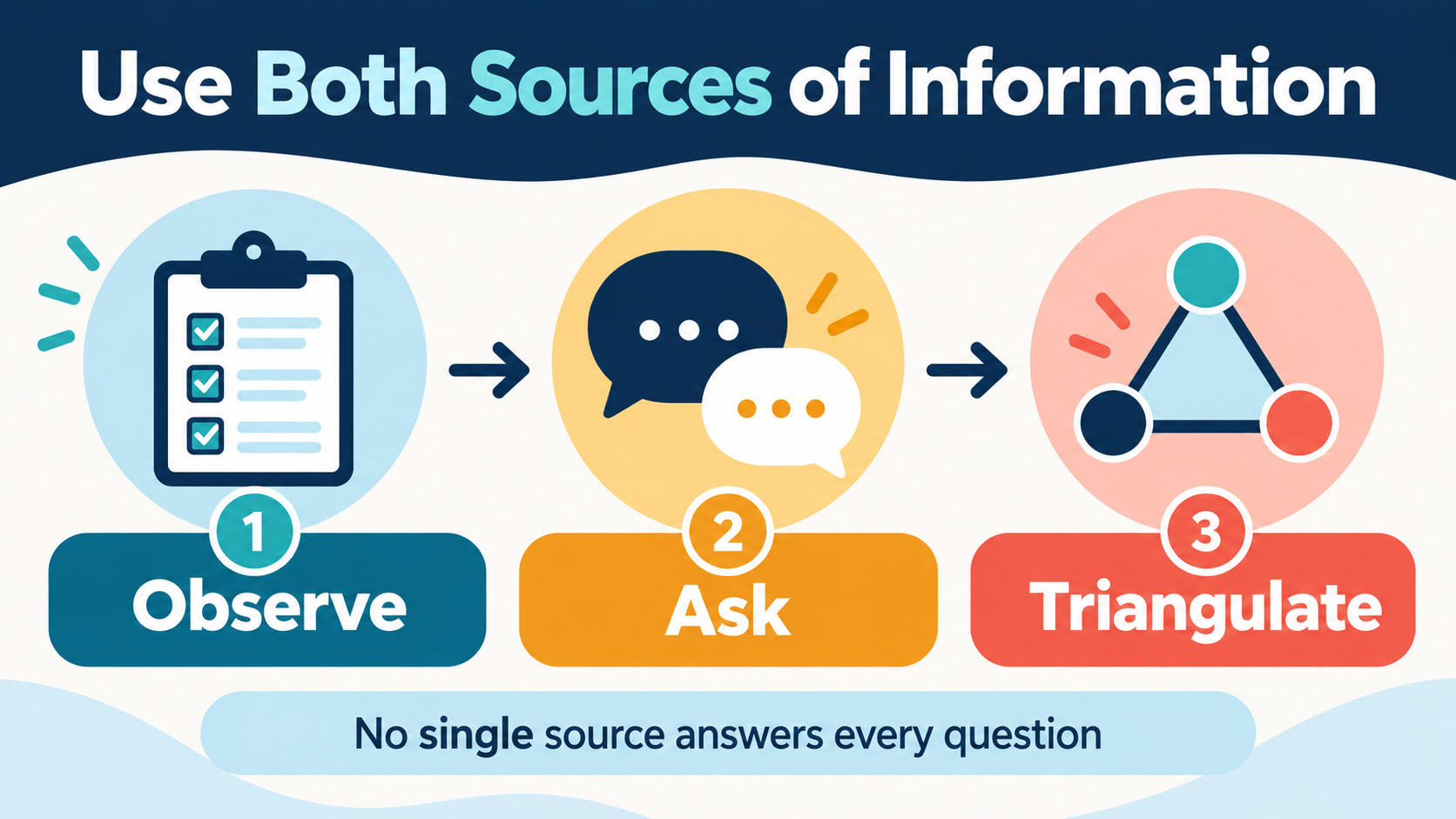
Triangulation does not mean forcing the sources to match. It means using the difference to decide whether the next step is clarification, training, another observation, documentation review, or escalation. The supervisor should explain the next action in terms the RBT can implement.
A practical supervision example
Question: an RBT reports that data entries are being delayed because the approved device is slow during a busy part of the session.
Self-report: the supervisor asks when the delay occurs, which field is affected, and whether the RBT has used the approved backup procedure.
Observation: during a permitted observation, the supervisor sees accurate recording during a quiet interval and delayed entry during a transition. The observation supports part of the report but also shows that the timing condition matters.
Follow-up: the supervisor reviews the current procedure, resolves the device or workflow question through the organization, and schedules another focused check. The RBT does not create a personal workaround or change the measurement rule.
Document the source and follow-up
Document whether information came from direct observation, the RBT’s report, an approved record review, or a combination. State the objective facts, the procedure or question discussed, the direction provided, and the next check. Use the approved system and avoid unnecessary client identifiers.
Good documentation preserves uncertainty when uncertainty remains. “The RBT reported a delay during transitions; direct observation confirmed delayed entry in one transition; supervisor reviewed the approved workflow and scheduled another check” is stronger than “the RBT has a data problem.”
Common interpretation mistakes
- Overgeneralizing: one observation is treated as the whole pattern.
- Dismissing self-report: a concern is ignored because it was not visible during the meeting.
- Assuming conflict means dishonesty: context and timing are not explored.
- Skipping the procedure: opinions replace the current written instruction.
- No follow-up: the team collects information but never decides what happens next.
The goal is not to select a winner between observation and self-report. The goal is to make the next correct action easier to identify while protecting accuracy, dignity, and role clarity.
It also helps to say what each source cannot establish. An observation does not explain every reason for an action, and a report does not show every detail of implementation. Careful supervision keeps those limits visible while still taking both kinds of information seriously.
Stay within the RBT role
An RBT reports objective observations and concerns, implements assigned services after demonstrating competence, and works under ongoing supervision. An RBT should not independently change a treatment plan, reinterpret a consent decision, alter a measurement rule, or resolve a clinical conflict based only on personal observation or self-report.
If there is immediate danger, a medical need, a safeguarding concern, a privacy issue, or conflicting direction, use the designated urgent or organizational escalation route. Supervision evidence supports the response but does not replace emergency procedures.
Frequently asked questions
Which is more reliable, observation or self-report?
Reliability depends on the question and context. Observation is useful for visible implementation; self-report is useful for events, barriers, and experiences outside the observation window. Use both when appropriate.
Can self-report replace direct observation?
It may answer some questions, but it does not automatically replace an observation requirement or a competence check. Follow the written arrangement and supervisor direction.
What if the two sources disagree?
Clarify the date, situation, procedure, and sample. Treat the difference as a reason for careful follow-up, not an automatic conclusion about intent.
How should I prepare for supervision?
Bring one objective example, the relevant procedure or data question, and a clear statement of what you need to understand or practice.
Source note: Review current BACB materials, the written arrangement, organizational policy, and supervisor direction for your setting. This article is educational and does not provide individualized legal, clinical, employment, or credentialing advice.
Ready to practice the RBT concepts you just reviewed?
Try an independent, original RBT practice resource with exam-style questions, scoring, and answer explanations.
References
- Behavior Analyst Certification Board. RBT Test Content Outline, 3rd edition.
- Behavior Analyst Certification Board. RBT Handbook.
- Behavior Analyst Certification Board. RBT Ethics Code.