
An operational definition RBT learners study is an objective, observable, and measurable description that tells observers what counts as the behavior and what does not. It is more precise than a label such as “tantrum,” “aggressive,” or “uncooperative.” This guide explains the parts of a strong definition, shows weak-versus-strong examples, and keeps the RBT role boundary clear: an RBT follows the current written program and seeks supervisor direction when a definition is unclear or needs to change.
Table of Contents
- Operational definition RBT: the quick meaning
- Operational definition RBT: four quality tests
- How to separate behavior from interpretation
- Operational definition RBT: weak versus strong examples
- Start, stop, context, and nonexample rules
- How an RBT handles an unclear definition
- Frequently asked questions
- Official sources and scope
RBT measurement and data collection knowledge point
Operational Definition RBT: How to Write Observable, Measurable Behavior Descriptions
Learn how to recognize a strong behavior description, separate observation from interpretation, and use start, stop, example, and nonexample rules.
If you are studying operational definition RBT concepts, the central idea is simple: describe what an observer can detect and measure, not what you assume a person feels or intends. The definition should give two trained observers enough information to decide whether the same response occurred.
Operational definitions support data collection, communication, and consistency. They do not explain the cause of behavior, diagnose a person, or replace a written behavior plan. An RBT uses the definition that is part of the current program and asks the supervisor when the wording, target, or measurement rule is unclear.
Operational definition RBT: the quick meaning
An operational definition is a precise description of a target response or event. It states the observable form of the behavior and the conditions that determine when it starts, stops, or counts. Depending on the program, the behavior may be measured by frequency, duration, latency, rate, interval recording, or another defined system.
Compare these labels:
- “Tantrum” is a broad label. Different observers may include crying, dropping, yelling, refusal, or several responses.
- “Aggressive” can be interpreted differently unless the plan says exactly what contact, movement, or event counts.
- “Uncooperative” may describe an interpretation rather than an observable response.
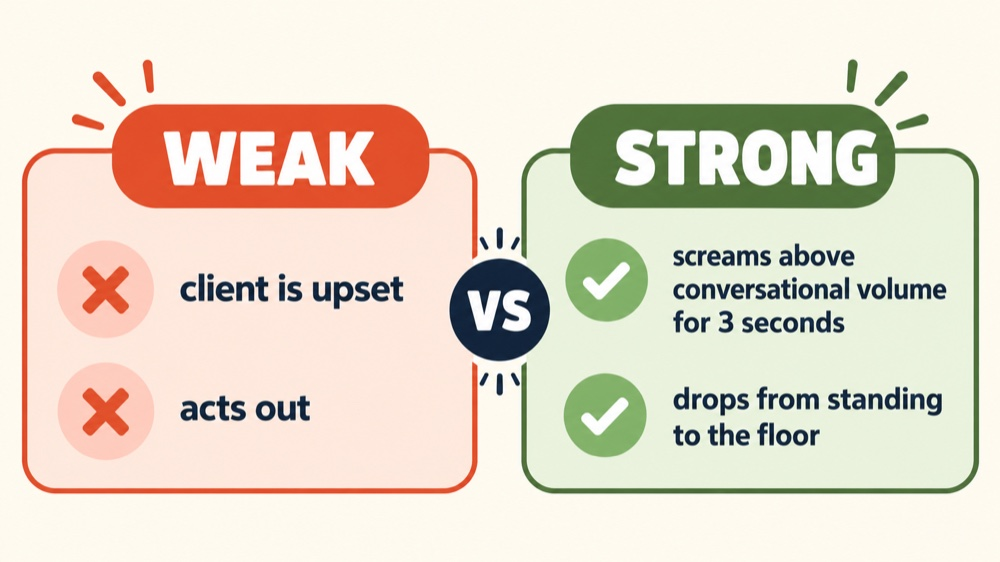
A definition turns the label into a scoring rule. For example, a program might define a target as “screaming above conversational volume for at least 3 seconds.” That sentence is still only an educational example; the actual definition must come from the learner’s current program and supervisor.
Operational definition RBT: four quality tests
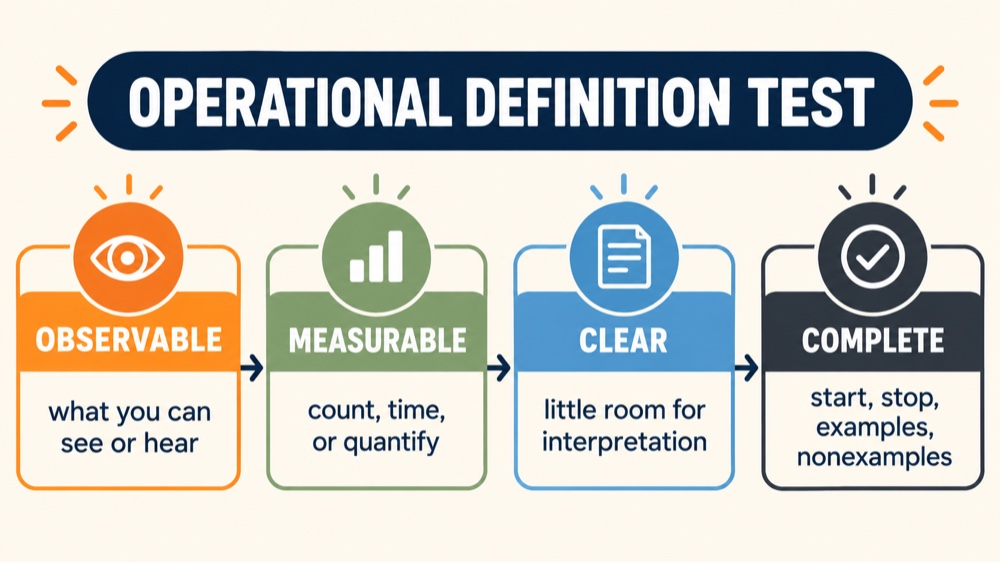
Use four questions when reviewing a definition for study purposes or checking whether you understand the current program:
- Observable: Can you see or hear the response? The wording should describe movement, sound, contact, location, or another detectable event.
- Measurable: Can the response be counted, timed, or scored with the specified measurement system? A definition should connect to how the data will be recorded.
- Clear: Would a trained observer understand the wording without guessing what the writer meant? Avoid vague adjectives, assumed motives, and undefined thresholds.
- Complete: Does it explain relevant start and stop rules, examples, nonexamples, context, exclusions, or episode boundaries when those details are needed?
These tests are related but not identical. A definition can be observable but still too vague to measure consistently. It can be measurable in theory but incomplete because it does not say when one episode ends and another begins. Quality comes from the combination.
How to separate behavior from interpretation
Interpretation adds a conclusion that may not be directly visible. Words such as “angry,” “anxious,” “lazy,” “attention-seeking,” “manipulative,” or “did not care” may be meaningful in everyday conversation, but they do not tell an observer exactly what to record.
Replace the label with the observable response and, when relevant, the context:
- Instead of “was frustrated,” describe the vocalization, movement, or task response that was observed.
- Instead of “refused work,” state what the learner did after the instruction, how long the response lasted, and what counts as the end if the program defines those details.
- Instead of “was aggressive,” identify the specified contact or attempted contact, body part, object, force rule, and exclusions if those are part of the written definition.
Objective description does not mean ignoring context or the learner’s communication. It means separating what was observed from what someone thinks it means. A note can report that a learner said “no,” pushed materials away, or left the area without claiming why the learner did it.
Operational definition RBT: weak versus strong examples
The following comparison is for learning the structure, not for copying into a client program:
| Weak wording | Why it is weak | More observable example |
|---|---|---|
| Client is upset | It names an inferred internal state | Client cries with audible vocalizations for at least 10 seconds |
| Acts out | It does not identify a response | Client throws an item more than 3 feet from the current location |
| Does not pay attention | It does not say what attending looks like or how it is measured | Client’s eyes and head are oriented away from the instructional materials for 5 consecutive seconds |
| Refuses to transition | It assumes refusal and omits the transition boundary | After the transition instruction, client remains seated and does not move toward the stated area within 30 seconds |
Notice that a stronger example uses observable action plus a threshold. It still may not be appropriate for every learner or setting. The correct definition is the one selected and documented by the responsible clinical team, not the one that sounds most detailed in a general article.
Start, stop, context, and nonexample rules
Some behaviors are easy to count as single events. Others occur in episodes or have brief gaps that make scoring ambiguous. A complete definition may need:
- Start rule: the first observable action that begins the response.
- Stop rule: the condition or amount of time that ends the response.
- Episode rule: how much time must pass before a new episode is counted.
- Examples: responses that clearly meet the definition.
- Nonexamples: similar responses that should not be counted.
- Context and exclusions: setting events, safety conditions, accidental contact, or other boundaries stated in the program.
These details should be added because the program needs them, not because every definition must be long. Overly complicated wording can create a different problem if observers cannot use it during a real session. The goal is reliable, practical scoring that matches the measurement system.
How an RBT handles an unclear definition
An RBT should not silently rewrite a target definition when the wording does not match what is happening in the session. Pause and prioritize the appropriate supervisory direction according to the workplace and program. Describe the specific ambiguity objectively: which words are unclear, which event does not fit, what data are affected, and what happened.
Useful questions include:
- What observable response should I count?
- What starts and ends an episode?
- Which similar response is a nonexample?
- Which measurement method and recording form should I use?
- What should I do if the definition does not fit the current situation?
Keep the report objective and protect confidential information. The RBT role is to implement within demonstrated competence, collect data as directed, report irregularities, and seek clarification—not to make an independent clinical change.
Frequently asked questions
What is an operational definition for an RBT?
It is an observable, measurable, clear description of a response or event that helps observers apply the same scoring rule. The definition should match the current written program.
Why is “the client is upset” a weak definition?
“Upset” is an interpretation that can include many different responses. A stronger definition identifies what the observer can see or hear and any relevant duration, frequency, or episode rule.
Can an RBT write a new operational definition?
An RBT may practice identifying the features of a good definition for study, but should follow the workplace and supervision process for client-specific targets. Do not independently change the written program or measurement rules.
Do examples and nonexamples always have to be included?
Not always. They are useful when similar responses could be scored differently. The appropriate level of detail depends on the behavior, measurement system, setting, and current program.
How does an operational definition support data collection?
It gives observers a shared rule for what counts, which makes the resulting data easier to compare and discuss. It does not by itself guarantee agreement; observers still need training, practice, and a suitable recording system.
Official sources and scope
This guide was checked against the RBT Test Content Outline (3rd ed.), BACB’s test-content-outline page, the RBT resource page, and the supervision and training page. The examples are original educational examples, not official BACB examination questions or client-specific instructions.
Ready to practice the RBT concepts you just reviewed?
Try an independent, original RBT practice resource with exam-style questions, scoring, and answer explanations.
References
- Behavior Analyst Certification Board. RBT Test Content Outline, 3rd edition.
- Behavior Analyst Certification Board. RBT Handbook.
- Behavior Analyst Certification Board. RBT Ethics Code.