
This personal bias RBT guide turns self-reflection into observable checks that protect accurate notes, dignity, and role boundaries.
Table of Contents
- What is personal bias RBT?
- Notice assumptions before they control action
- Check observation, evidence, and language
- Repair a mistake and seek feedback
- Keep self-reflection within role boundaries
- Practice the personal-bias self-check
- Quick comparison
- Frequently Asked Questions
- Sources and further reading
RBT ethics and self-reflection guide
Personal Bias RBT: Notice It, Check It, Improve
Use a practical self-check to separate observation from interpretation and choose a respectful, role-safe action.
The phrase personal bias RBT points to a practical ethics and communication question: how might an RBT’s assumptions influence what they notice, write, say, or do? The purpose is not to assign a permanent label. It is to create a repeatable pause that separates direct observation from interpretation, checks the evidence, and brings uncertainty to supervision.
Everyone can make a fast assumption. A professional response is to notice it, avoid letting it become an unsupported fact, and use the appropriate corrective process. Self-reflection does not replace safety reporting, privacy requirements, training, or the written plan. It supports more accurate implementation and more respectful teamwork.
What is personal bias RBT?
In this guide, personal bias means a possible preference, expectation, or interpretation that may influence how an RBT understands a person or situation. It can affect which details seem important, whether a behavior is described neutrally, how a caregiver’s request is interpreted, or whether the RBT assumes a learner is capable or unwilling before checking the data.
Notice the difference between an internal reaction and an external action. Feeling surprised by a routine is not the same as writing a stereotype in a note. Feeling frustrated is not the same as changing a consequence without authorization. The professional task is to examine the reaction before it directs communication or implementation.
| Self-check question | More useful wording | Risk to avoid |
|---|---|---|
| What did I see or hear? | “The learner pushed the card away twice.” | “The learner was being difficult.” |
| What am I inferring? | “I wonder whether the task or cue changed.” | “The learner does not care.” |
| What should I check? | Review the definition, data, and current procedure | Search for evidence that confirms the first story |
| Who owns the decision? | Ask the supervisor about a plan-level question | Change the program independently |
Notice assumptions before they control action
A useful pause is short and concrete. When a reaction feels immediate, ask:
- What exactly happened that another observer could verify?
- What meaning did I add to the event?
- What information could change my interpretation?
- Am I applying a group label, a past experience, or a personal preference to this individual?
- Could my wording affect dignity, choice, privacy, or access to support?
For example, an RBT might think, “The caregiver is not following through.” That thought may hide several possibilities: the instruction was unclear, the materials were unavailable, the routine changed, the caregiver had a safety concern, or the current plan was difficult to implement. A more useful communication is: “The home practice was not completed on two reported days. I need to understand what happened and ask the supervisor what support or clarification is appropriate.”
Do not use self-reflection to avoid accountability. If an error occurred, state it accurately and follow the correction process. The goal is to replace a broad judgment with a specific, reviewable question.
Check observation, evidence, and language
Bias can enter documentation through labels that sound efficient but hide the actual event. “Noncompliant,” “attention-seeking,” “lazy,” “manipulative,” and “unmotivated” do not explain what another observer should count, see, or hear. If the written plan defines a target term, use that definition. Otherwise, describe the topography and relevant context.
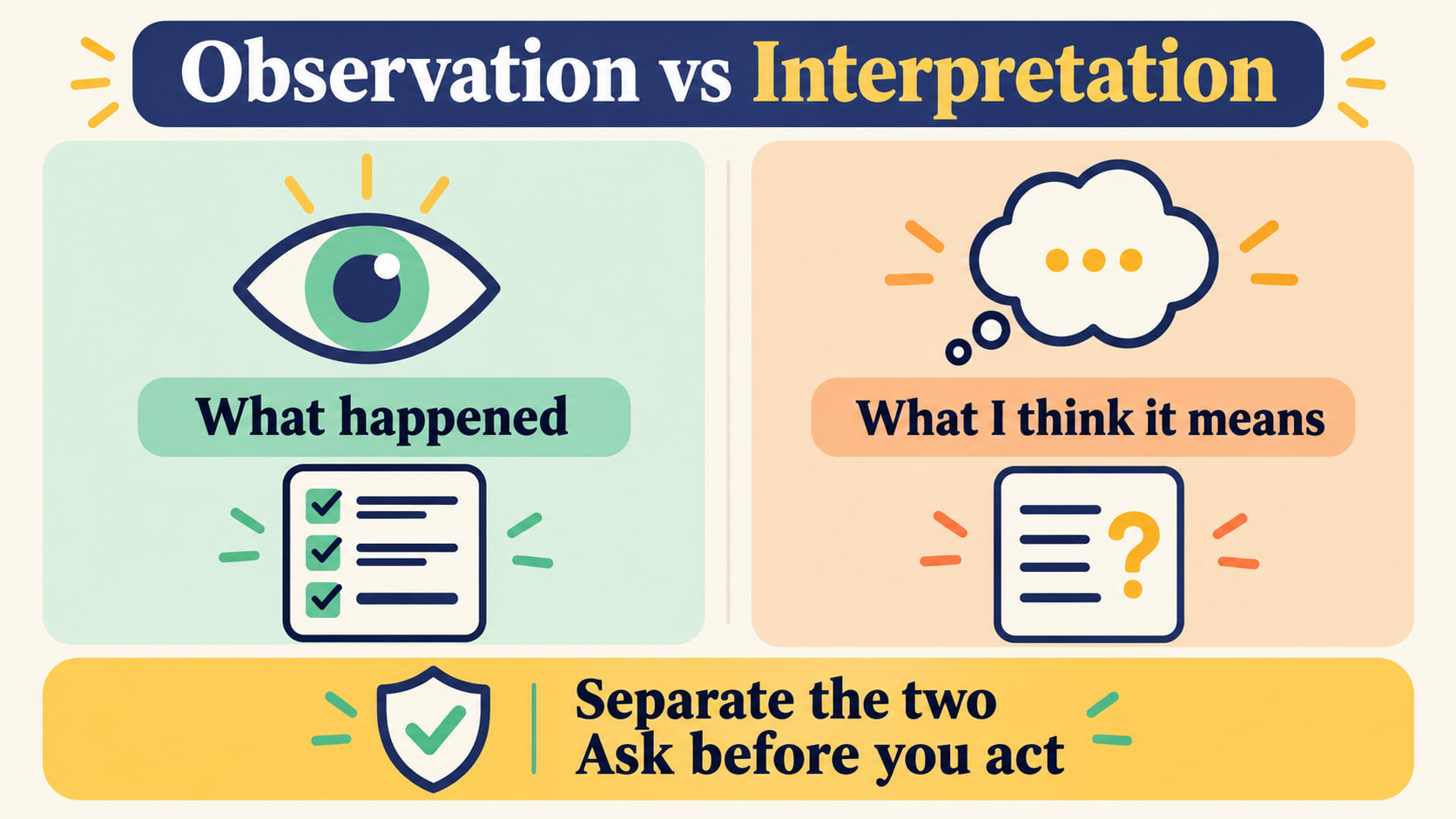
Use a three-column check:
- Observation: What happened, when, where, and after which cue?
- Interpretation: What do I think it means, and what evidence is still missing?
- Action: What current authorized step can I take, and what question belongs in supervision?
Suppose a learner does not answer a question. The observation might be, “The RBT asked the defined question, waited five seconds, and the learner looked toward the window without speaking.” The interpretation might be, “I do not yet know whether the learner did not understand, needed a different communication mode, or chose not to answer.” The action could be to follow the written response procedure and ask the supervisor whether the communication support should be reviewed.
Evidence does not mean collecting private information without purpose. Use the data system, current definition, and approved team communication. Ask only what is needed for accurate support.
Repair a mistake and seek feedback
When an RBT notices that bias may have affected wording or action, the repair should be observable. A simple process is:
- Acknowledge: state what was inaccurate or unfair without making the other person manage your feelings.
- Correct: amend the communication or record through the approved policy; do not silently erase the original error.
- Ask: seek feedback from the responsible supervisor about the next role-safe step.
- Practice: use a neutral description or updated communication method in the next opportunity.
A repair might sound like: “I described the family’s request as a lack of cooperation, which was an interpretation rather than an observation. I will correct the note according to policy and ask the supervisor how to document the actual request.” This is more useful than saying only, “I am sorry if I offended you,” because it names the work that must change.
Feedback can feel uncomfortable. A focused question is not a failure. Ask, “Which words should I replace with observable language?” or “Can we review one example so I apply the definition consistently?”
Keep self-reflection within role boundaries
An RBT may identify a bias concern without having authority to resolve every part of it. Do not diagnose a client, evaluate a colleague’s motives, conduct an independent assessment, or change a behavior plan because a personal assumption was noticed. Bring the relevant observation and request to the responsible professional or required reporting channel.
Self-reflection also does not mean tolerating discrimination, harassment, retaliation, abuse, unsafe instructions, or privacy violations. If the concern is urgent or serious, follow the applicable safety and reporting process. Do not reframe a reportable event as a private “bias lesson” that the RBT must solve alone.
Protect confidentiality while seeking feedback. Use approved systems, remove unnecessary identifying details from practice examples, and share information only with people who need it for the professional purpose.
Practice the personal-bias self-check
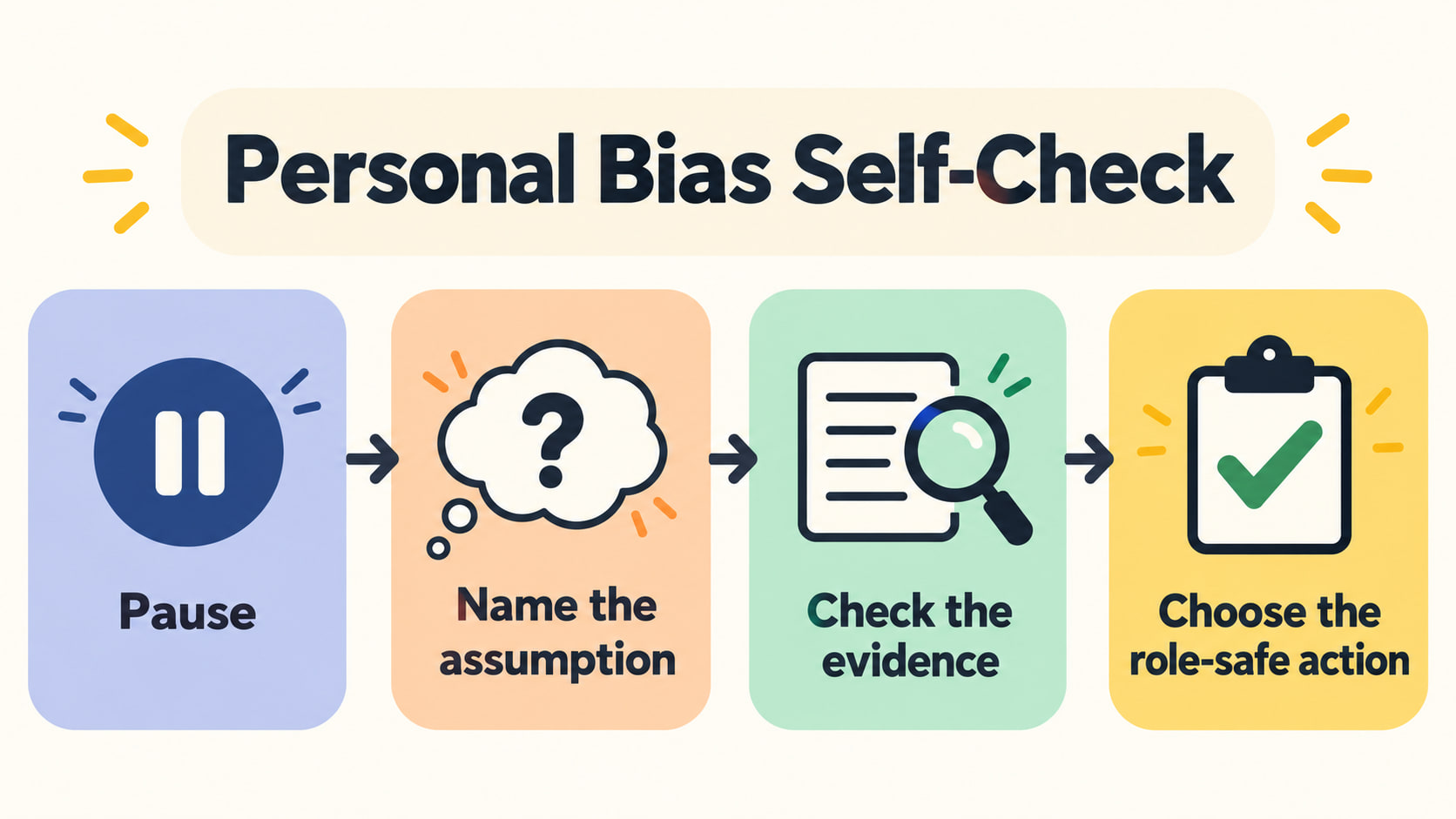
Use this four-step prompt during supervision or private preparation:
Pause. Name the assumption. Check the evidence. Choose the role-safe action.
Apply it to a general scenario:
- Pause: “I notice I am frustrated that the routine did not go as expected.”
- Name: “I am assuming the person is refusing, but that is not yet an observation.”
- Check: “What did the person do, what cue was given, and what does the current definition say?”
- Act: “I will follow the current procedure, write the observable event, and ask the supervisor about the unanswered question.”
After practicing, ask whether the new wording is more specific, respectful, and useful to the team. Improvement means the next action is better supported, not that the RBT has proven a bias-free identity.
Quick comparison
| Step | Helpful check | What to avoid |
|---|---|---|
| Notice | Identify the observable event | Assign a motive immediately |
| Check | Review the definition, data, and procedure | Choose only evidence that supports the first story |
| Repair | Correct wording or action through policy | Hide or erase an error |
| Follow through | Ask supervision and practice the next step | Change the plan independently |
Frequently Asked Questions
Does having personal bias mean an RBT is unethical?
A quick assumption or mistake does not by itself define a person. The professional question is how the RBT notices, corrects, documents, seeks feedback, and prevents the assumption from controlling support.
How can an RBT identify bias in documentation?
Look for labels, motives, group-based explanations, and conclusions that cannot be directly observed. Replace them with the event, context, measurement, and unanswered question required by the current plan.
Should an RBT confront a coworker about bias?
Use respectful, role-appropriate communication and the organization’s reporting or supervision process. Describe the observable concern, protect privacy, and escalate when safety, discrimination, retaliation, or ethics requirements apply.
Can a self-check replace supervision?
No. A self-check can prepare a clear question, but supervision and the current plan remain necessary for clinical, procedural, safety, and role-level decisions.
Sources and further reading
- BACB RBT Test Content Outline, 3rd edition
- BACB Supervision and Training resources
- BACB RBT Handbook
- BACB Ethics Codes and RBT Ethics Code resources
Explore RBT ethics, communication, supervision learning, and role-safe practice resources for your next self-check.
Ready to practice the RBT concepts you just reviewed?
Try an independent, original RBT practice resource with exam-style questions, scoring, and answer explanations.
References
- Behavior Analyst Certification Board. RBT Test Content Outline, 3rd edition.
- Behavior Analyst Certification Board. RBT Handbook.
- Behavior Analyst Certification Board. RBT Ethics Code.