

Positive reinforcement in ABA means that a consequence follows a behavior and the behavior becomes more likely in relevant future conditions.
Table of Contents
- What positive reinforcement in ABA means
- The behavior–consequence sequence
- What it is not
- Build an accurate example
- Connect reinforcement to data
- Implement only the authorized procedure
- Study questions and common errors
- Frequently asked questions
- References
RBT KNOWLEDGE · CORE CONCEPTS
Positive Reinforcement in ABA: Definition and Examples
Understand the functional definition, separate it from praise or preference, and connect examples to data and the authorized plan.
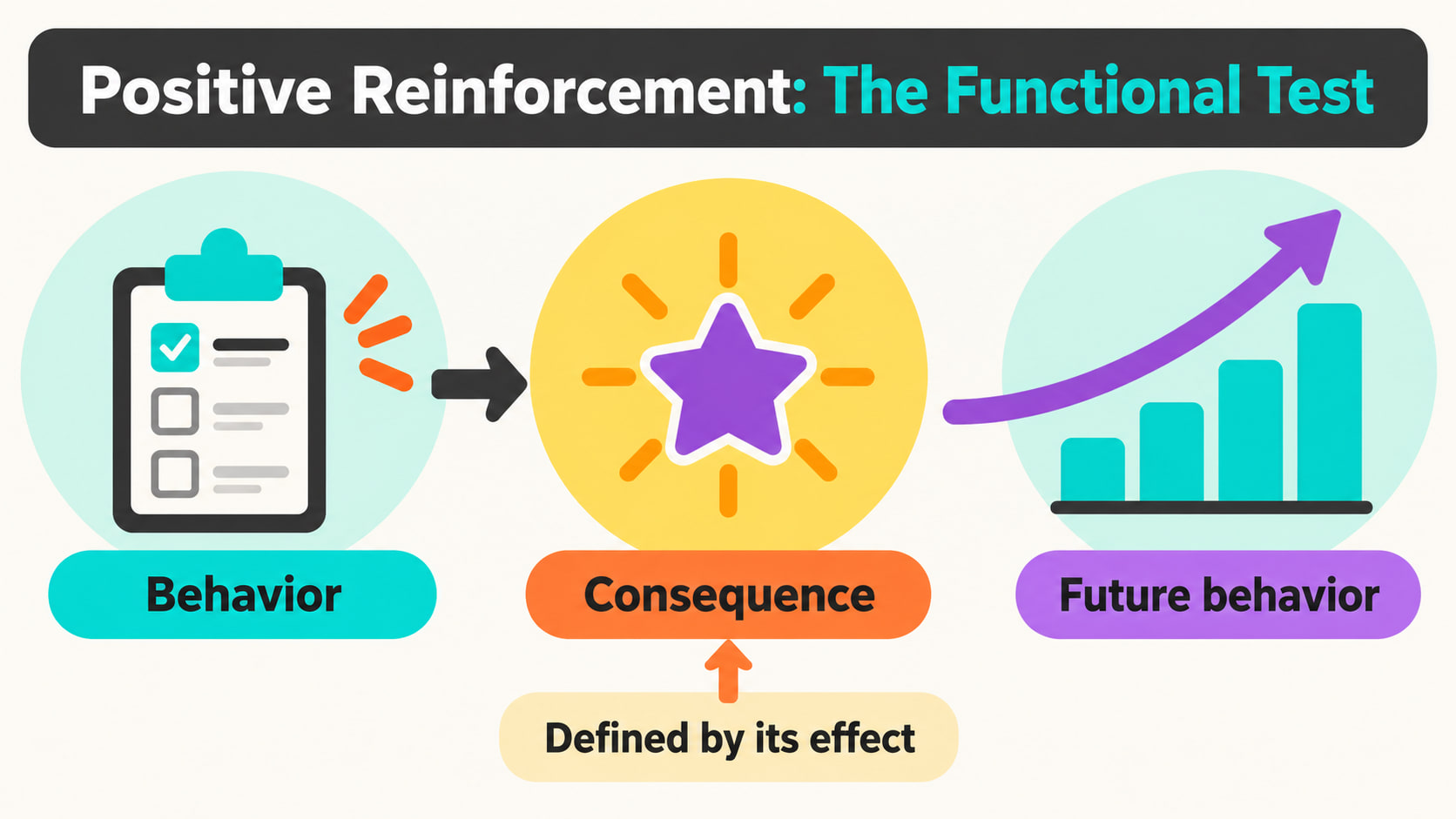
Positive reinforcement in ABA means that a consequence follows a behavior and the behavior becomes more likely in relevant future conditions. The word “positive” describes adding or presenting a consequence; it does not mean that the consequence is morally good or that the learner appears happy. “Reinforcement” is defined by the effect on future behavior.
This distinction matters for RBT study and service delivery. An item can be preferred without reinforcing a particular response, and praise can be delivered without increasing the behavior that preceded it. Use the current written plan, measurement rule, and supervisor direction when applying the concept.
What positive reinforcement in ABA means
A complete definition has three parts: a defined behavior occurs, a consequence is presented after that behavior, and the future frequency, duration, rate, or probability of that behavior increases under comparable conditions. If the future behavior does not increase, the consequence may have been preferred or rewarding in the moment, but the technical definition of reinforcement has not been demonstrated.
Do not infer the effect from appearance alone. A sticker, break, token, edible, activity, or verbal statement is not automatically a reinforcer. Its function depends on what happens to future responding and on the conditions in which it is delivered.
The behavior–consequence sequence
When studying an example, write the sequence in order:
- Behavior: describe the observable response, such as placing a card in a bin within the defined opportunity.
- Consequence: identify what was presented immediately or according to the programmed schedule.
- Future responding: compare later responding using the specified data and conditions.
For example, a learner completes a programmed communication response, receives access to the planned activity, and later uses the response more often during similar opportunities. The example supports the functional definition if the data show an increase and the procedure was implemented as authorized.
Do not skip the timing or data step. “The learner liked the toy” does not tell you whether the target response increased. “The learner received a toy” does not tell you whether the toy was delivered contingently or whether the plan specified that consequence.
What it is not
Positive reinforcement is not the same as bribery, praise, preference, reward, permissiveness, or making every task pleasant. Everyday language often uses these words loosely, while ABA uses a functional definition. A preferred item may be offered before a response as an establishing operation or may be available noncontingently; that does not by itself demonstrate positive reinforcement.
It is also not a guarantee that a behavior will increase every time. Motivation, schedule, competing consequences, response effort, context, and implementation fidelity can affect results. If a programmed consequence appears ineffective or creates a concern, record the objective observation and contact the supervisor rather than changing the procedure independently.
Build an accurate example
Use examples that are specific enough to observe and measure. A strong study example names the target response, the consequence, the relevant condition, and the data pattern. A weak example uses mental-state language such as “the learner wanted to cooperate” or “the reward made the learner happy.”
Try a nonexample too. If a learner receives praise after a response but the response does not increase, the event may be praise delivered after the response, but the available evidence does not establish reinforcement. If the consequence is presented before the response, the sequence may be relevant to motivation or instruction but is not an example of a consequence following the behavior.
Connect reinforcement to data
Data make the functional claim testable. Depending on the plan, the team may monitor frequency, rate, duration, latency, percentage of opportunities, or another defined measure. The RBT should use the specified operational definition and recording procedure, not choose a new measure because it makes the effect look clearer.
Check the baseline or comparison, the observation window, the response definition, and the programmed consequence. Ask whether the same conditions were present and whether other changes occurred. One successful trial is not enough to establish a durable increase, and one unsuccessful trial does not authorize an independent change.
A simple study table can make the logic visible: list the opportunity, the defined response, the consequence delivered, and the later response measure. Keep the table fictional or de-identified when studying. If the consequence was delivered late, delivered for a different response, or delivered inconsistently, note that as an implementation question rather than claiming that reinforcement was demonstrated.
Implement only the authorized procedure
An RBT may implement a reinforcement procedure after appropriate training and under supervision. Follow the current plan for the target response, consequence, schedule, prompt, timing, and data. Protect dignity, assent-related signals as directed, privacy, and safety.
Do not add a consequence, withhold a programmed consequence, change a schedule, or decide that a new item is a reinforcer without authorization. If the plan conflicts with an instruction, a safety issue appears, or the learner’s response does not match the definition, use the designated escalation route and document objectively.
Implementation fidelity also matters. If the written procedure specifies a prompt, timing window, exchange rule, or data form, follow those details as trained. Bring changes in motivation, access, safety, or response patterns to the supervisor so the team can decide whether the plan needs review.
Study questions and common errors
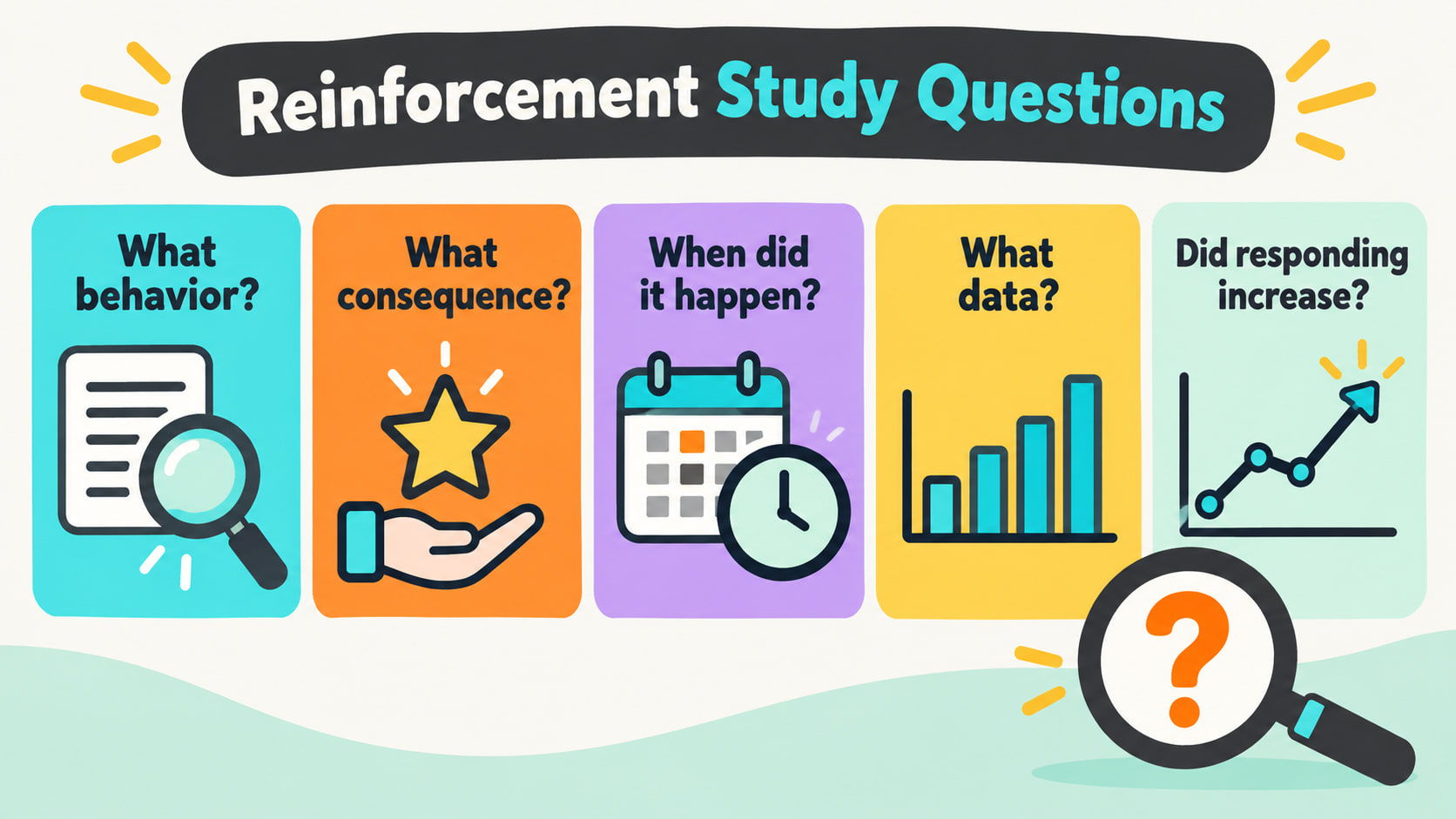
Use these questions to test your understanding:
- What exact response occurred?
- What was presented after it, and when?
- What data would show an increase?
- Were the conditions comparable?
- Which part of the plan authorizes the procedure?
Common errors include treating “positive” as “good,” calling every preferred item a reinforcer, ignoring future behavior, confusing a consequence with an antecedent, and recommending a procedure from a definition alone. Correct the error by returning to the sequence and the data.
The most reliable explanation is modest: describe what was observed, identify what the data show, and state what still needs supervisor review. Precision is more useful than promising that one consequence will work for every learner or setting.
Frequently asked questions
Does positive reinforcement mean giving something nice?
Not necessarily. It means presenting a consequence after a defined behavior and observing an increase in future behavior under relevant conditions.
Is praise always positive reinforcement?
No. Praise may be a programmed consequence, but it is reinforcement only when the relevant behavior increases as a result.
Can an RBT choose a new reinforcer?
Follow the current plan and supervisor direction. An RBT should not independently add, remove, or redesign consequences.
How should I explain this concept on a study card?
Write the definition, one observable example, one nonexample, the data that would show an increase, and the role boundary requiring the plan or supervisor.
Source note: Review the current BACB RBT content outline, RBT Handbook, ethics materials, client plan, and supervisor direction for your situation. This article is educational and does not provide individualized legal, clinical, employment, or credentialing advice.
Ready to practice the RBT concepts you just reviewed?
Try an independent, original RBT practice resource with exam-style questions, scoring, and answer explanations.
References
- Behavior Analyst Certification Board. RBT Test Content Outline, 3rd edition.
- Behavior Analyst Certification Board. RBT Handbook.
- Behavior Analyst Certification Board. RBT Ethics Code.