
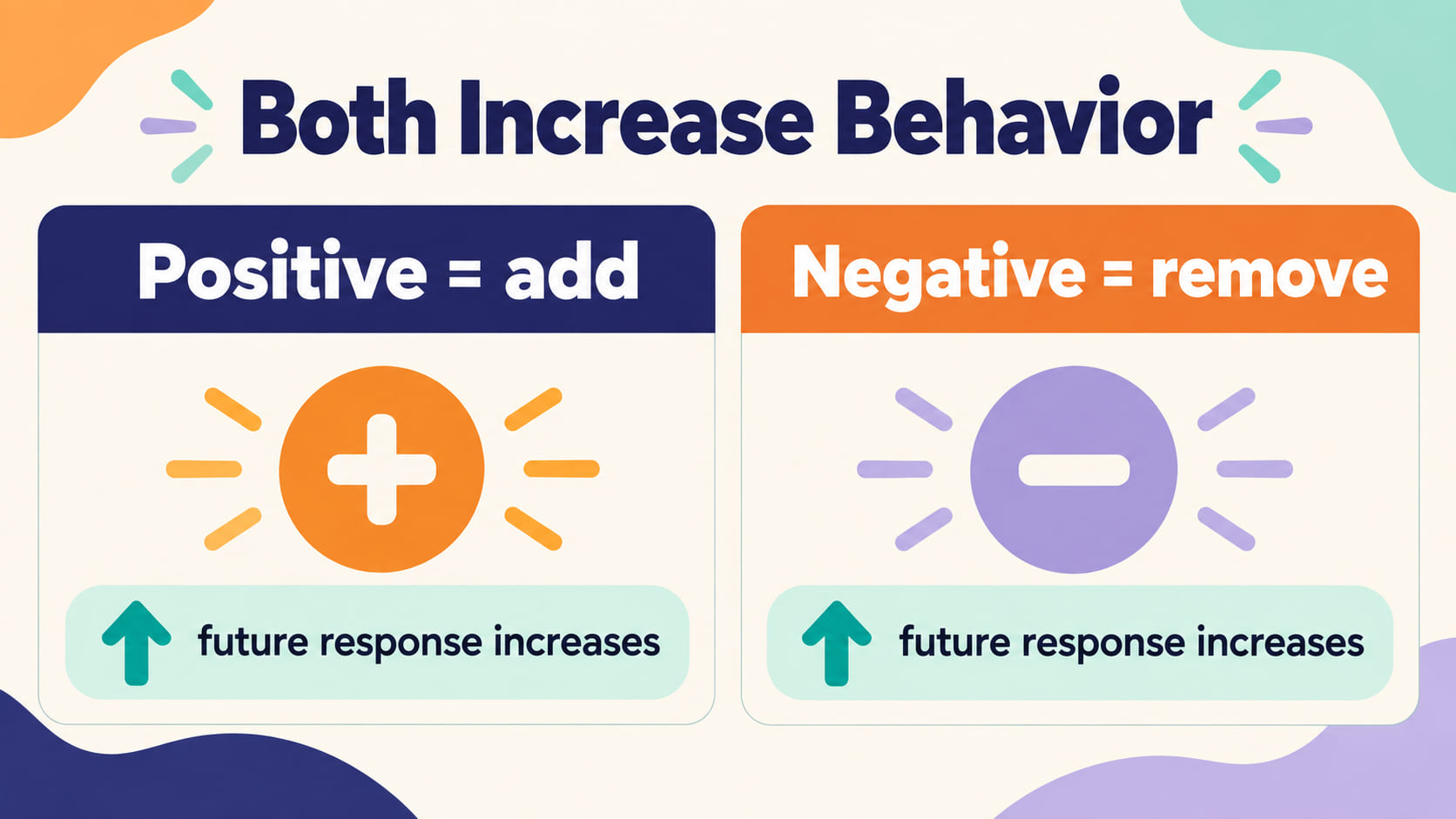
Positive vs negative reinforcement ABA is not a comparison between good and bad reinforcement. Both terms describe consequences that increase future behavior. Positive means something is added after the response; negative means something is removed or avoided after the response. The future increase is what makes either consequence reinforcement.
Table of Contents
- Positive vs negative reinforcement ABA: the short answer
- What positive reinforcement means
- What negative reinforcement means
- A side-by-side comparison
- Why reinforcement is not punishment
- The RBT’s role in using the terms
- Common comparison mistakes
- Frequently asked questions
ABA reinforcement definitions, comparison, contingencies, data, and RBT implementation
Positive vs Negative Reinforcement ABA: Compare What Changes
Positive means add, negative means remove, and reinforcement means the future response increases.
Positive vs negative reinforcement ABA is not a comparison between good and bad reinforcement. Both terms describe consequences that increase future behavior. Positive means something is added after the response; negative means something is removed or avoided after the response. The future increase is what makes either consequence reinforcement.
The quickest memory aid is: positive = add, negative = remove, reinforcement = increase. That shortcut is useful only when paired with a real contingency and data. An adult’s intention, a learner’s smile, or the fact that an event seems pleasant does not prove that reinforcement occurred.
Positive vs negative reinforcement ABA: the short answer
| Term | What changes after the response? | What happens to future behavior? |
|---|---|---|
| Positive reinforcement | Something is added. | The defined response increases. |
| Negative reinforcement | Something is removed or avoided. | The defined response increases. |
| Positive punishment | Something is added. | The defined response decreases. |
| Negative punishment | Something is removed. | The defined response decreases. |
The table describes the dimensions of the terms, not a treatment recommendation. The exact consequence, timing, schedule, and measurement must come from the assigned plan and qualified supervision.
What positive reinforcement means
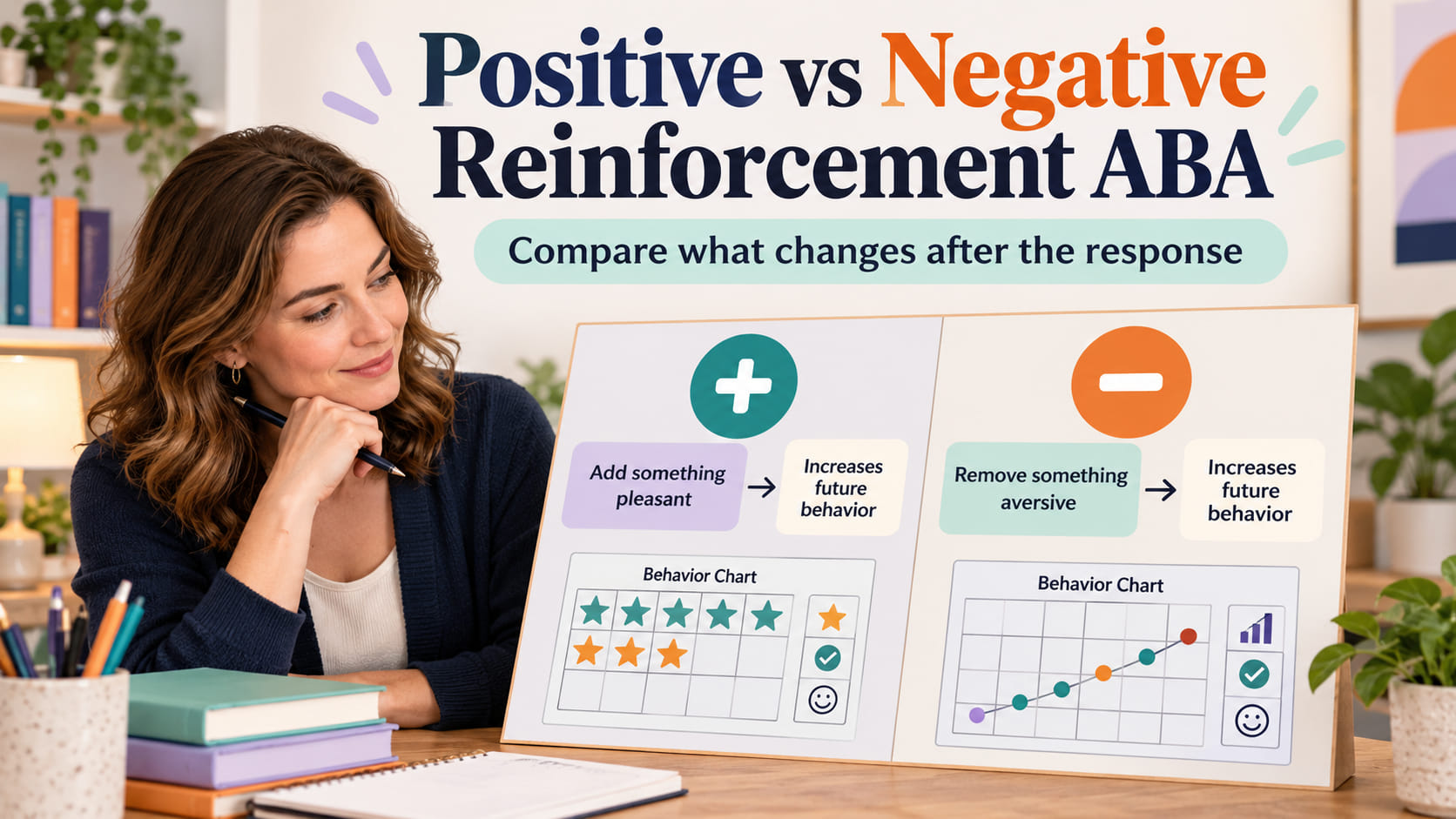
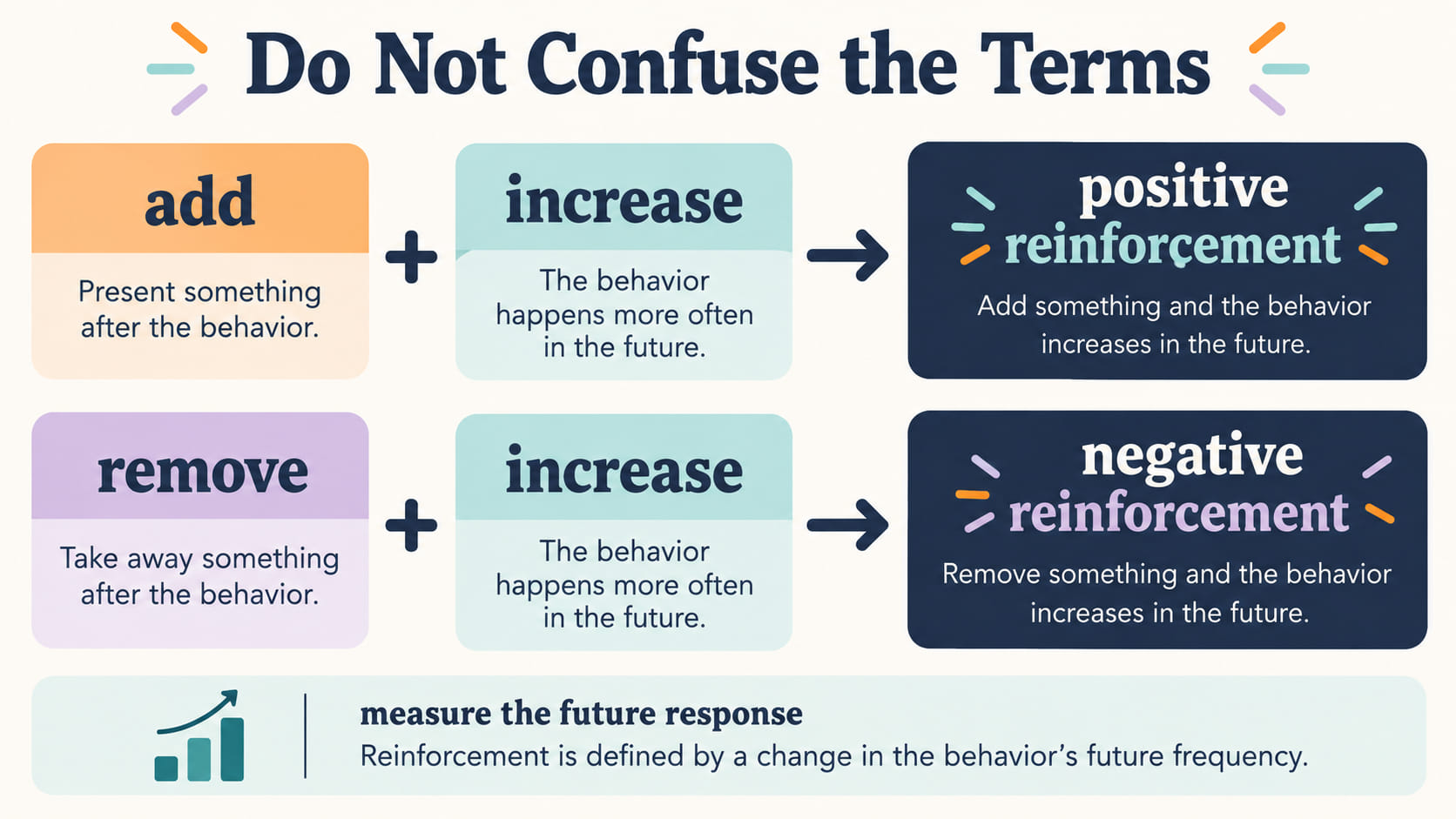
Positive reinforcement occurs when a consequence is added after a response and the response becomes more likely in a relevant future situation. The added event could be praise, access to an activity, a token, information, attention, or another programmed consequence.
Consider a de-identified example: after a learner independently requests a break using the taught response, the plan provides a brief break. If the request occurs more often under comparable opportunities, access to the break may be functioning as positive reinforcement. It is not enough to say the break was “nice”; the future response matters.
Positive also does not mean “the adult likes the consequence.” A token may be added without being valuable to the learner. Praise may be added without strengthening the response. The label depends on the observed effect and the measurement rule.
What negative reinforcement means
Negative reinforcement occurs when a consequence is removed, reduced, or avoided after a response and the response becomes more likely in a relevant future situation. The word negative describes removal; it does not mean harmful, wrong, or emotionally negative.
For a simple illustration, imagine that a learner uses an assigned communication response and a recurring nonpreferred demand is paused according to the plan. If that communication response increases under comparable conditions, the removal or avoidance may be functioning as negative reinforcement. The example is only a definition illustration; the actual procedure must be assigned, ethical, safe, and supervised.
Negative reinforcement is often confused with “making someone do something.” The important question is not whether an adult intended to remove pressure. It is whether the defined response increased after a programmed removal or avoidance. If the behavior decreases, the label may be different.
A side-by-side comparison
Use the same questions for both terms:
- What was the response? Define it in observable terms.
- What changed after it? Identify the event that was added, removed, reduced, or avoided.
- Was the change contingent? Did it follow the response according to the assigned arrangement?
- What happened later? Did the response increase in the relevant conditions?
- What does the data show? Use the program’s definitions rather than an impression from one trial.
This process prevents a common error: labeling a consequence from what it looks like instead of what it does. Removing a demand is not automatically negative reinforcement. Adding praise is not automatically positive reinforcement. The behavioral effect completes the definition.
Why reinforcement is not punishment
Reinforcement and punishment describe opposite effects on future behavior. Reinforcement increases the future response; punishment decreases it. Positive and negative then describe whether something is added or removed. That creates four combinations, but the words do not describe whether an intervention is kind, harsh, good, or bad.
Do not infer the effect from a single moment. A consequence that decreases one response may increase another. A learner may stop one behavior and start a different response. The team needs clear definitions, appropriate data, and supervision before drawing conclusions.
Ethical implementation also requires attention to dignity, safety, consent where applicable, least-restrictive practice, and the assigned plan. This comparison explains vocabulary; it does not authorize an RBT to select a consequence or design an intervention.
The RBT’s role in using the terms
An RBT may implement a programmed consequence, follow the timing and schedule, collect the defined data, and report what occurred. Accurate reporting includes whether the response happened, what was added or removed, whether the procedure was delivered as written, and what happened afterward.
Do not independently switch positive reinforcement to negative reinforcement, introduce an escape contingency, remove a planned consequence, or change the measurement definition. If the learner’s response changes, the consequence is unavailable, or the plan seems unclear, report the facts and ask the supervisor for direction.
When teaching teams discuss these terms, ask them to name the response and the consequence instead of relying on shorthand. “The learner earned a break” does not tell you whether the break was added, whether it followed a defined response, or whether that response increased later. Clear language helps the team compare observations and prevents a label from becoming a substitute for data.
It is also possible for the same event to have different effects across people, responses, or settings. A consequence that strengthens one response in one context may have little effect elsewhere. That is why the plan should identify the target, opportunity, timing, and measurement, and why changes should be reviewed through supervision.
Common comparison mistakes
- Positive means good: positive refers to adding, not moral value.
- Negative means bad: negative refers to removing or avoiding, not harm or disapproval.
- Negative reinforcement decreases behavior: reinforcement is defined by an increase.
- Any consequence is reinforcement: the future response must be measured.
- One trial proves the label: look for a relevant pattern and follow the data definition.
- The vocabulary permits treatment changes: an RBT still needs an assigned plan and supervision.
Frequently asked questions
What is the main difference between positive and negative reinforcement?
Positive reinforcement adds a consequence after the response; negative reinforcement removes or avoids a consequence after the response. Both increase future behavior.
Is negative reinforcement punishment?
No. Negative reinforcement increases future behavior. Punishment decreases future behavior. The words positive and negative describe adding or removing, not whether the effect is good or bad.
Can praise be negative reinforcement?
Praise is usually described as something added, but the label still depends on the observed effect. If a response increases after praise is added, it may function as positive reinforcement.
Can an RBT choose which type to use?
Follow the assigned plan and supervision. An RBT should not independently select or change a reinforcement contingency; report observations and ask for direction.
Role reminder: This is educational information, not individualized clinical, credentialing, or treatment advice. RBTs should follow the assigned plan and ask a supervisor before changing consequence, reinforcement, or measurement procedures.
Official starting points: the BACB RBT Test Content Outline, RBT Handbook, supervision and training resources, and RBT Ethics Code.
Ready to practice the RBT concepts you just reviewed?
Try an independent, original RBT practice resource with exam-style questions, scoring, and answer explanations.
References
- Behavior Analyst Certification Board. RBT Test Content Outline, 3rd edition.
- Behavior Analyst Certification Board. RBT Handbook.
- Behavior Analyst Certification Board. RBT Ethics Code.