

A preference assessment in ABA is a structured way to learn which items, activities, or interactions a learner selects or engages with under defined conditions. A strong preference assessment ABA study guide must also explain what the result does not prove: a selected stimulus is a candidate for reinforcement, not a guarantee that it will strengthen a future response.
Table of Contents
- What preference assessment ABA means
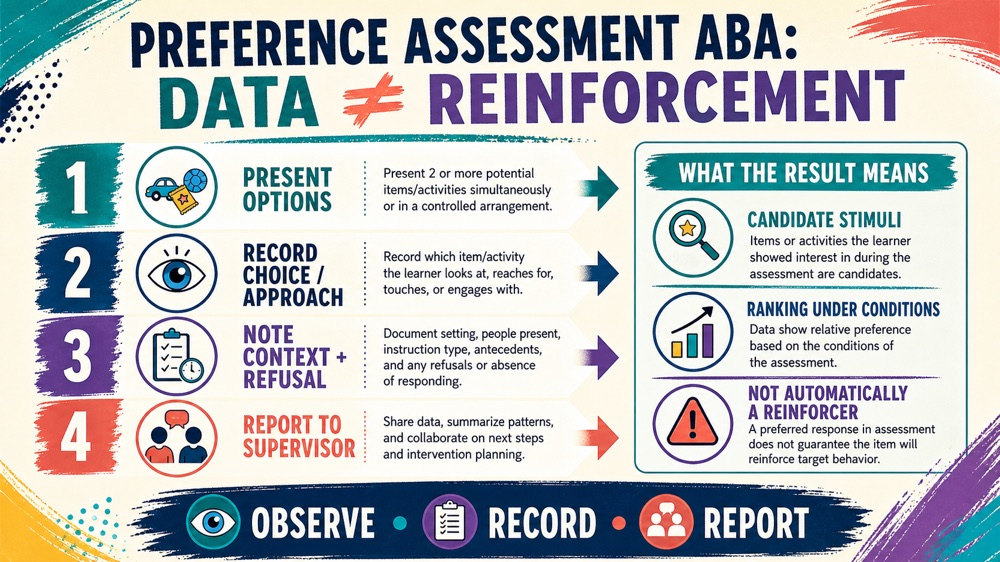
- Separate preference from reinforcement
- Compare preference-assessment formats
- Follow the written procedure
- Record and interpret the result
- Handle change, choice, and assent
- Practice preference assessment ABA decisions
- Avoid these preference-assessment mistakes
- Frequently Asked Questions
- References
This guide reviews common formats, selection and recording rules, the difference between preference and reinforcement, and the role-safe steps an RBT follows under a written procedure. It aligns the topic with the current RBT Test Content Outline (3rd ed.), including the Behavior Assessment domain.
RBT Training is not affiliated with, operated by, or endorsed by the Behavior Analyst Certification Board (BACB). The examples below are newly written for independent study. They are not official, recalled, leaked, or BACB-endorsed questions. No preference checklist, practice score, or study guide can guarantee a passing result or a clinical outcome.
What preference assessment ABA means
A preference assessment arranges choices or observations so the behavior-analytic team can identify relative preference under specified conditions. The assessment may record approach, selection, engagement duration, or another response defined by the procedure. The output is often a rank order or a set of high-, medium-, and low-preference candidates.
The current RBT TCO includes 43 tasks across six domains, and the examination includes 75 scored questions plus 10 unscored pilot questions. Preference assessment is part of the Behavior Assessment content area. Those numbers describe the current examination framework; they do not turn an independent quiz into an official BACB assessment.
| Assessment element | What to specify | Example |
|---|---|---|
| Stimuli | Which items, activities, people, or sensory options are available? | Four activities selected according to the written plan. |
| Choice rule | How does the learner select, approach, reject, or engage? | Touches one picture or reaches toward one item. |
| Recording rule | What response, order, duration, or refusal is recorded? | Order of selection and engagement time. |
| Use of result | How will the team treat the result? | Candidate stimuli for a programmed reinforcement check. |
The word “preference” should not be used to justify removing a learner’s meaningful choices or assuming that an item must be delivered. The assessment is a way to gather information under a defined arrangement while respecting the learner’s communication, refusal, dignity, and the supervisor’s direction.
Separate preference from reinforcement
Preference and reinforcement answer different questions:
- Preference: which option is selected, approached, or engaged with more under the assessment conditions?
- Reinforcement: does a consequence delivered after a response increase the future likelihood of that response under the relevant conditions?
A learner may choose a tablet during a brief choice assessment because it is novel, but the tablet may not strengthen a target response when it is delivered after a long task. Another learner may select a familiar activity less often but work steadily for it when it is made contingent. The assessment narrows the candidates; teaching data help the team evaluate whether a programmed consequence functions as reinforcement.
| Question | Evidence | What not to conclude |
|---|---|---|
| What does the learner select now? | Choice, approach, or engagement data from the assessment. | “This will always be a reinforcer.” |
| What happened after the target response? | Contingency and future response data in the teaching program. | “The learner liked it, so the behavior increased because of it.” |
| Did conditions change? | Time, access, deprivation or satiation variables, task difficulty, and item availability. | “The ranking is a permanent personality trait.” |
This distinction is one of the most important preference assessment ABA study points. If a question asks what a preference assessment identifies, choose relative preference or potential reinforcing stimuli. If it asks whether a consequence strengthened behavior, look for future behavior data and the contingency.
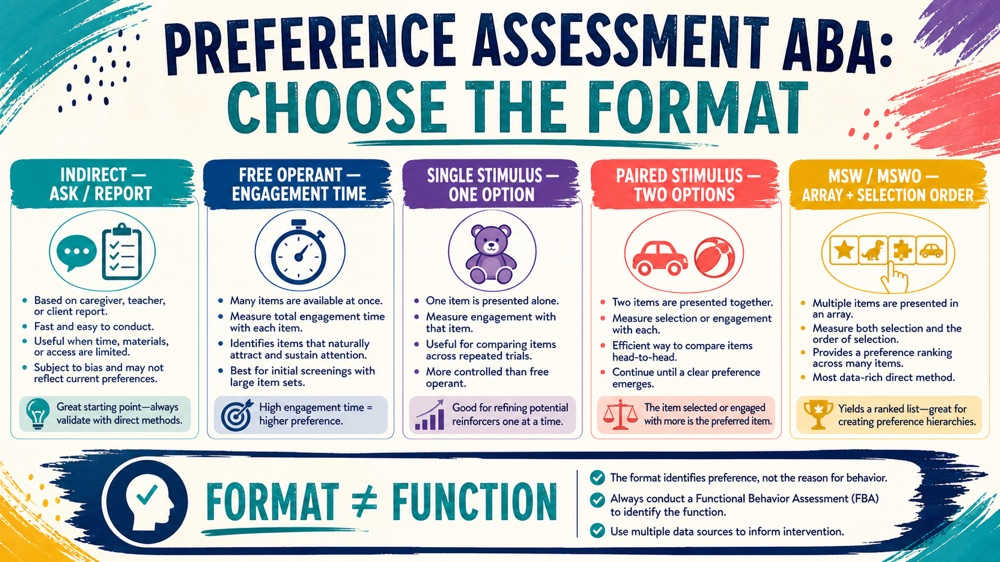
Compare preference-assessment formats
The format should match the learner, setting, available stimuli, communication method, and written procedure. The following descriptions are study explanations, not permission to select a procedure independently.
| Format | Arrangement | Typical recorded outcome | Study distinction |
|---|---|---|---|
| Indirect interview or questionnaire | Ask a learner, caregiver, or knowledgeable person about likely preferences. | Reported ranking or list of candidates. | Report is not the same as direct choice data. |
| Free operant | Make several options available and observe movement or engagement without requiring one choice per trial. | Duration or allocation of engagement. | Access and competing stimuli shape the observation. |
| Single stimulus | Present one option at a time under the defined trial rule. | Approach, acceptance, rejection, or engagement. | One item is not a forced comparison with another. |
| Paired stimulus | Present two options and record the selected option across pairings. | Choice percentage or selection order. | Each comparison is between the available pair. |
| Multiple stimulus with replacement | Present an array, record the choice, and return items according to the procedure. | Selections across repeated arrays. | The chosen item remains available if the protocol says replacement. |
| Multiple stimulus without replacement | Present an array, record the choice, remove the selected option, and continue as written. | Rank order across the array. | Removal changes the next choice set. |
Do not memorize the names without the arrangement. “Without replacement” means the selected stimulus is removed for the next selection according to the procedure; it does not mean the learner can never access it again. “Paired” means two options are arranged for a comparison; it does not mean the learner must choose if the procedure includes a valid no-choice or refusal response.
Follow the written procedure
Before conducting or assisting with an assessment, use a preparation check:
- Read the plan: confirm the format, stimuli, trial sequence, access rule, recording form, and safety direction.
- Prepare the array: check that items are available, safe, clean, and presented as directed.
- Confirm communication: identify how the learner can choose, decline, pause, or request something else.
- Deliver the instruction: use the wording, prompt, and time allowance specified by the protocol.
- Record observable data: mark the choice, approach, duration, refusal, or no-response exactly as defined.
- Report uncertainty: pause and seek clinical direction if the procedure, item, or response is unclear.
For example, if the plan specifies a paired-choice assessment and one item is missing, do not substitute a new item because it seems similar. Record the problem and follow the established route. If a learner refuses the presented options, record the refusal according to the procedure and protect the learner’s dignity; do not repeatedly prompt until a preferred item is selected.
RBTs implement assigned procedures under supervision. A study guide can describe common formats, but the supervisor and written plan determine which format is appropriate for a particular client and session.
Record and interpret the result
A preference result is only as interpretable as the conditions and recording. Keep the observation record specific:
| Record | Why it matters | Example |
|---|---|---|
| Order of presentation | Position can influence selection. | Item A, B, C, and D were placed in the defined order. |
| Order of selection | Shows which options were selected first. | C, A, D, B. |
| Access or engagement | Choice alone may not describe sustained engagement. | Selected C and engaged for 45 seconds. |
| Refusal or no choice | Nonselection is data, not a reason to force a response. | Turned away and no option selected within the time rule. |
| Context variables | Novelty, prior access, illness, schedule, or competing events may affect the result. | Item was available earlier in the session. |
Use cautious language: “Item C was selected most often under this arrangement.” Avoid “Item C is the learner’s favorite” or “Item C will work as a reinforcer.” The first statement describes the data; the second turns a temporary result into a broad trait; the third makes a functional claim that needs additional evidence.
If rankings change across sessions, that does not automatically mean the assessment failed. Preference can shift with access, novelty, context, communication, effort, and time. Report the pattern and let the responsible team decide whether to repeat or modify the assessment.
Handle change, choice, and assent
Ethical and role-safe preference assessment includes meaningful choice and attention to refusal. A learner’s communication may be spoken, signed, gestural, aided, or expressed through approach and withdrawal. The exact response definition belongs in the plan, but the RBT should not ignore clear signs of distress or refusal.
- Offer the defined options: do not hide a choice because you expect a different answer.
- Allow the defined response time: do not turn a brief assessment into repeated pressure.
- Respect refusal: record it and follow safety and supervision direction.
- Protect privacy and dignity: avoid public commentary about a learner’s choices.
- Report meaningful changes: communicate illness, medication, schedule, access, or environmental variables that may affect preference data.
Choice does not mean that every request can be granted immediately. It does mean that the assessment arrangement should be transparent, the learner’s response should be interpreted according to the plan, and concerns should be addressed through the responsible team rather than through coercive improvisation.
Practice preference assessment ABA decisions
Use these original study prompts. For each one, name the arrangement, the observable data, and the role-safe next action:
- A learner chooses the same item in three paired trials. What does that show, and what does it not prove about future reinforcement?
- An MSWO procedure removes the chosen item after each trial. What changes about the next choice set?
- A learner turns away from every item in the array. What should be recorded before anyone concludes that the items are not preferred?
- A caregiver reports that a toy is highly preferred, but direct observation shows no approach today. How should the two sources be labeled?
- An item was available freely for an hour immediately before the assessment. Which context variable should be documented?
- The plan does not state whether selected items are returned. What should the RBT do before proceeding?
The strongest answer is usually the one that separates observable data from interpretation and stays inside the written procedure. That is the central study habit for preference assessment ABA: identify, record, report, and avoid turning a ranking into an unsupported conclusion.
Avoid these preference-assessment mistakes
- Calling preference reinforcement: a selection identifies a candidate; future response data test reinforcement.
- Mixing formats: name the arrangement, replacement rule, and recorded response.
- Forcing a choice: respect refusal and follow the plan and safety direction.
- Ignoring context: record prior access, novelty, illness, schedule, and competing events when relevant.
- Changing the array independently: seek clinical direction when a stimulus or step is unavailable.
- Overstating the result: report what happened under the conditions, not a permanent trait.
- Calling independent examples official: keep study content newly written and source-labeled.
Bottom line: preference assessment ABA procedures gather structured information about relative selection or engagement. Use the assigned format, record observable data, respect choice and refusal, and keep preference separate from the functional test of reinforcement.
Ready to practice assessment decisions?
Use independent RBT questions to compare preference formats, observable choice data, and role-safe next actions.
Try Free RBT Practice Questions →
Frequently Asked Questions
What does a preference assessment in ABA identify?
It identifies relative selection, approach, or engagement under defined conditions and produces candidates for possible reinforcement.
Is a preferred item automatically a reinforcer?
No. Reinforcement is a functional claim about future behavior after a consequence. Teaching data are needed to evaluate it.
Which preference-assessment format should an RBT use?
Use the format and recording rules in the written plan. Do not choose or change a procedure independently.
What if the learner refuses the options?
Record the observable refusal according to the procedure, protect dignity, and follow the established safety and supervision route.
References
- Behavior Analyst Certification Board. RBT Test Content Outline, 3rd edition.
- Behavior Analyst Certification Board. RBT Handbook, updated June 2026.
- Behavior Analyst Certification Board. RBT Ethics Code.