
The phrase professional communication RBT describes the practical habits that help an RBT share accurate information, listen to questions, protect privacy, and move work forward within the assigned role.
Table of Contents
- What does professional communication RBT mean?
- Build a clear professional message
- Listen and clarify before responding
- Use the approved channel and protect privacy
- Repair a difficult exchange
- Use a practical communication checklist
- Frequently Asked Questions
- Sources and further reading
RBT communication and role-boundary guide
Professional Communication RBT: Clear, Respectful, and Role-Safe
Use accurate role language, observable facts, approved channels, and specific follow-up to make communication easier to act on.
The phrase professional communication RBT describes the practical habits that help an RBT share accurate information, listen to questions, protect privacy, and move work forward within the assigned role. These habits include using precise role language, separating observations from interpretations, asking focused questions, and naming the next approved action.
Professional communication is not the same as agreeing with everyone or avoiding difficult conversations. It also does not give an RBT authority to diagnose, design treatment, change a plan, or provide clinical advice. Clear communication and clear boundaries should appear together.
What does professional communication RBT mean?
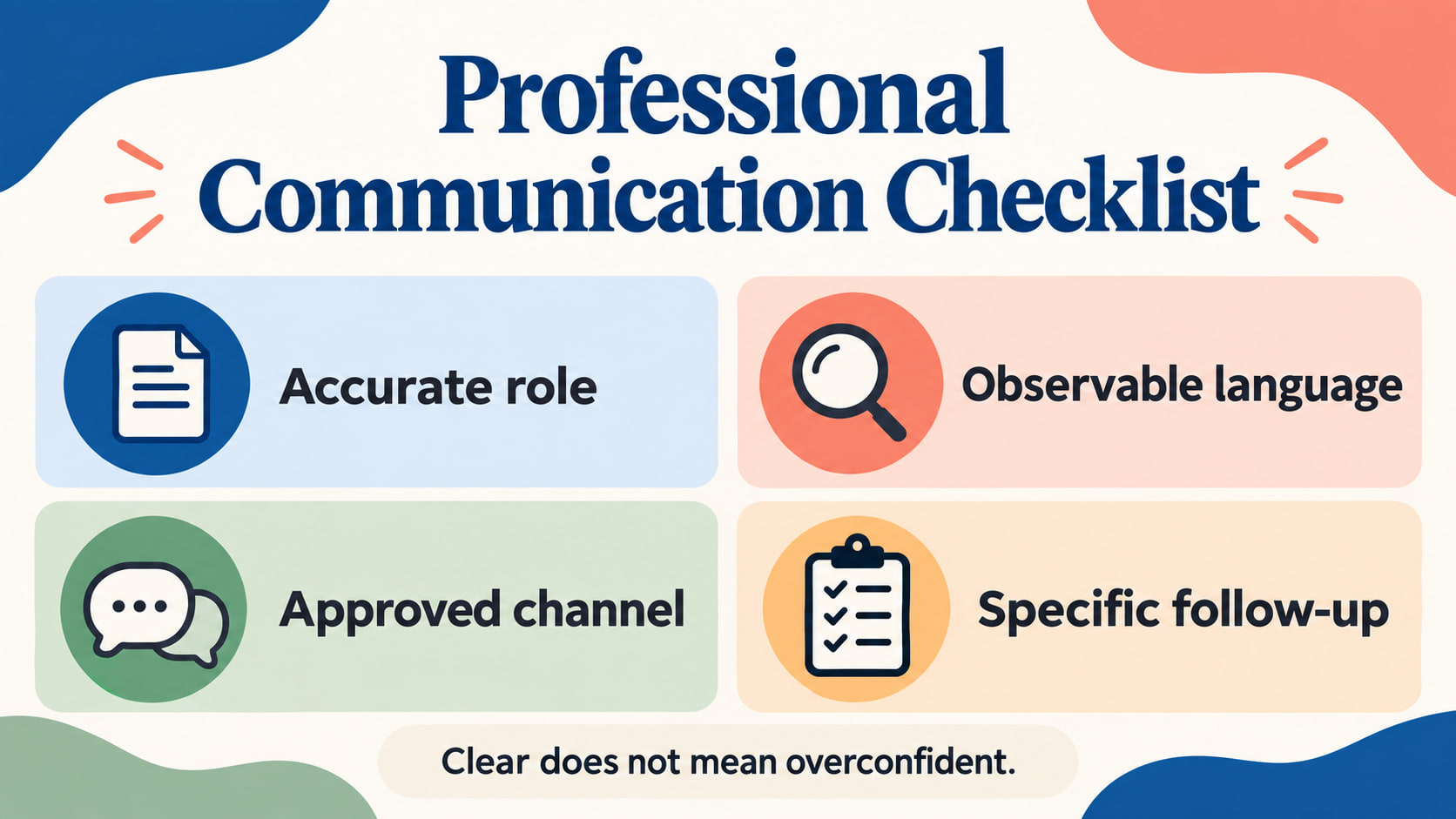
For an RBT, professional communication can be checked through four observable features:
- Accurate role: describe what you are assigned and supervised to do without overstating authority.
- Observable language: report what happened, what was measured, or what document was checked.
- Approved channel: share information only with authorized people through the required route.
- Specific follow-up: state who will review the question and what you will do while waiting.
A message does not need to be long to be professional. It needs to be accurate enough for the next person to understand and act on.
Build a clear professional message
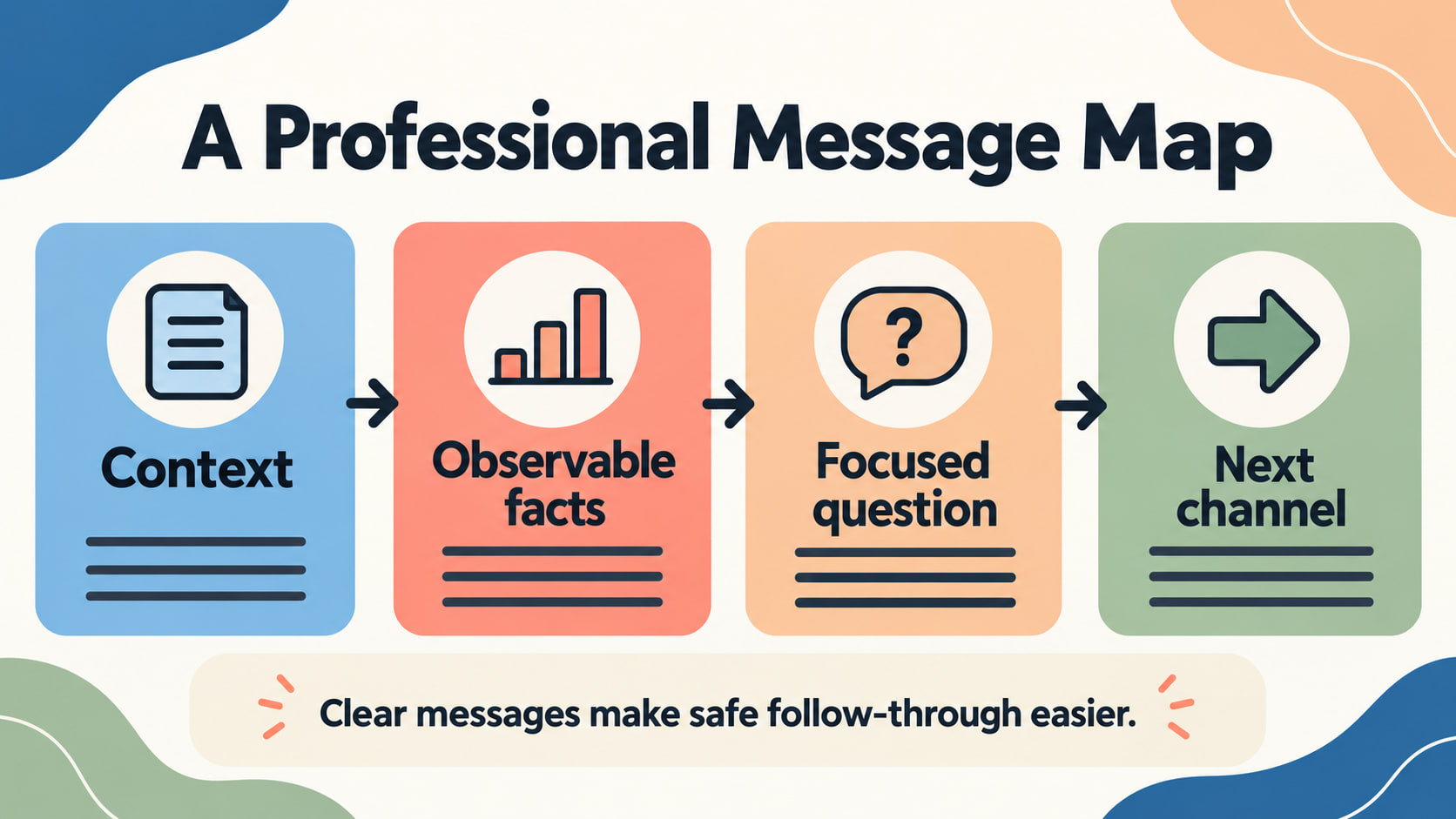
A useful message usually starts with context, then gives observable facts, asks one focused question, and names the next channel. For example: “During the final transition, the learner left the table twice after the instruction. I recorded the events according to the current procedure. Should this be reviewed as a possible deviation, and should I send the question through the supervision channel?”
This structure prevents two common problems. First, it avoids making a conclusion sound like a fact. Second, it tells the recipient what kind of response is needed. A supervisor can answer a plan question more efficiently when the message identifies the event and the requested decision.
Keep the message respectful and specific. Replace “Everything went badly” with the relevant observation. Replace “You need to fix the plan” with “Could you clarify whether the current plan applies to this situation?” Professional tone is not decorative; it reduces ambiguity.
Listen and clarify before responding
Communication is two-way. When a caregiver, supervisor, or coworker raises a concern, listen for the question underneath the words. Is the person asking for data, describing a safety concern, requesting a plan decision, or sharing a preference?
Reflect the concern without confirming an unverified interpretation. “I hear that the transition felt difficult” acknowledges the experience. It does not automatically confirm why the transition occurred. Then ask a focused question such as “Which part of the routine are you asking us to review?”
If you do not know the answer, say so and route the question. A short pause to check the plan is more professional than an immediate guess. If the message involves safety, privacy, suspected harm, or a medical concern, follow the urgent escalation process rather than waiting for a routine reply.
Use the approved channel and protect privacy
Professional communication includes choosing where a message belongs. A session note, supervision meeting, approved team message, employer coordinator, or official credentialing source may each serve a different purpose. If you are unsure, ask the supervisor or organization which route is approved.
Share the minimum necessary information. Do not put client-identifying details in a public group, send them from a personal account, or invite unauthorized people into a case conversation. Privacy is part of professional skill, not a separate courtesy.
Do not assume that a coworker’s informal suggestion is an authorized plan change. Continue the current procedure and request clarification through the proper channel. If the information conflicts with written instructions, make that conflict visible instead of quietly choosing one version.
Repair a difficult exchange
Even a careful message can be misunderstood. A repair conversation can keep the work moving:
- Pause: slow down and avoid adding a new assumption.
- Name the facts: describe the words, instruction, observation, or record that created confusion.
- Ask the role-safe question: identify what needs clarification and who owns the decision.
- Agree on the next channel: state what will be documented, reviewed, or followed up.
Repair does not require accepting blame for something you did not do or agreeing with a false interpretation. It means making the communication problem specific enough to address. If the exchange includes harassment, discrimination, retaliation, unsafe directions, or a privacy concern, use the organization’s reporting or escalation process.
Use a practical communication checklist
Before sending a message or ending a conversation, check:
- Did I describe my role accurately?
- Did I separate facts from assumptions?
- Did I ask one clear question?
- Did I use the approved channel and protect privacy?
- Did I state the next action without promising an outcome?
Ask a supervisor for feedback on one real sentence or handoff rather than asking whether you are generally “good at communication.” Specific feedback produces a specific practice target. You might rehearse how to report a data discrepancy, how to ask for input, or how to explain that a plan decision belongs to the supervisor.
Document corrections through the approved process. If a message was unclear or information was sent to the wrong channel, report the issue and ask how to repair it. Hiding a communication problem usually creates more risk than acknowledging it early.
A useful test is whether another authorized team member could understand the situation without guessing what you meant. If not, shorten the message, add the missing fact, or identify the person who should answer.
Frequently Asked Questions
What makes communication professional for an RBT?
Professional communication is accurate, respectful, observable, role-appropriate, privacy-aware, and specific about the next step. It does not need to sound formal to be clear.
Can an RBT disagree professionally?
Yes. A professional disagreement identifies the observation, source, or role difference and routes a plan-level question to the responsible person. Agreement is not required for respectful collaboration.
What should an RBT do when a message asks for clinical advice?
Acknowledge the question, state that the clinical decision belongs to the responsible professional, and route it through the approved supervision or team channel. Do not guess or change the plan independently.
How can an RBT improve professional communication?
Practice short message maps, listen for the actual question, use observable language, and request feedback on specific examples. Review whether the next action was clear and within scope.
Does a professional tone require tolerating disrespect?
No. Professional communication includes boundaries and escalation. Use the organization’s process for unsafe, abusive, discriminatory, retaliatory, or unethical conduct.
Sources and further reading
- BACB RBT Test Content Outline, 3rd edition
- BACB Supervision and Training resources
- BACB RBT Handbook
- BACB Ethics Codes and RBT Ethics Code resources
Explore RBT communication training, supervision learning, and role-safe practice resources for your next message.
Ready to practice the RBT concepts you just reviewed?
Try an independent, original RBT practice resource with exam-style questions, scoring, and answer explanations.
References
- Behavior Analyst Certification Board. RBT Test Content Outline, 3rd edition.
- Behavior Analyst Certification Board. RBT Handbook.
- Behavior Analyst Certification Board. RBT Ethics Code.