
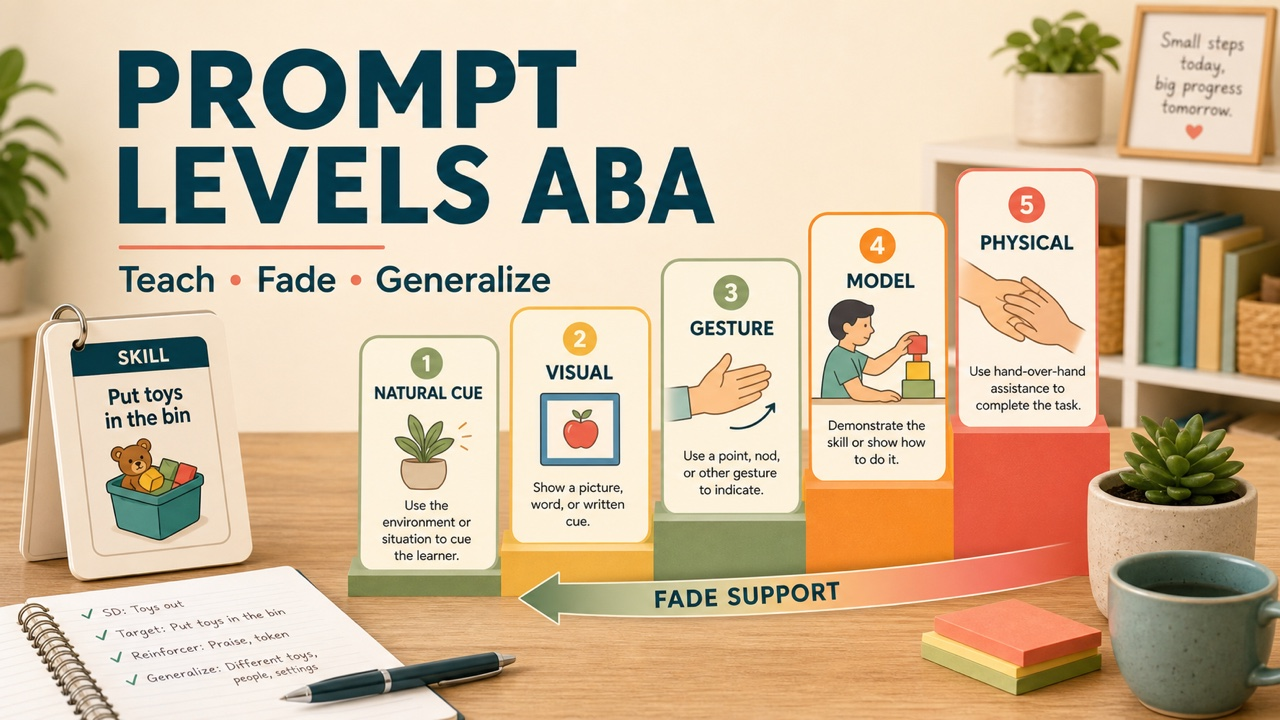
If you are reviewing prompt levels aba, remember that a prompt is support added to increase the chance of a correct response. The goal is not to make the learner dependent on the adult’s help. The goal is to arrange teaching so the relevant instruction or natural cue controls the response, then fade unnecessary assistance according to the written program and supervisor direction.
Table of Contents
- prompt levels aba: the core idea
- Why the prompt is not the teaching goal
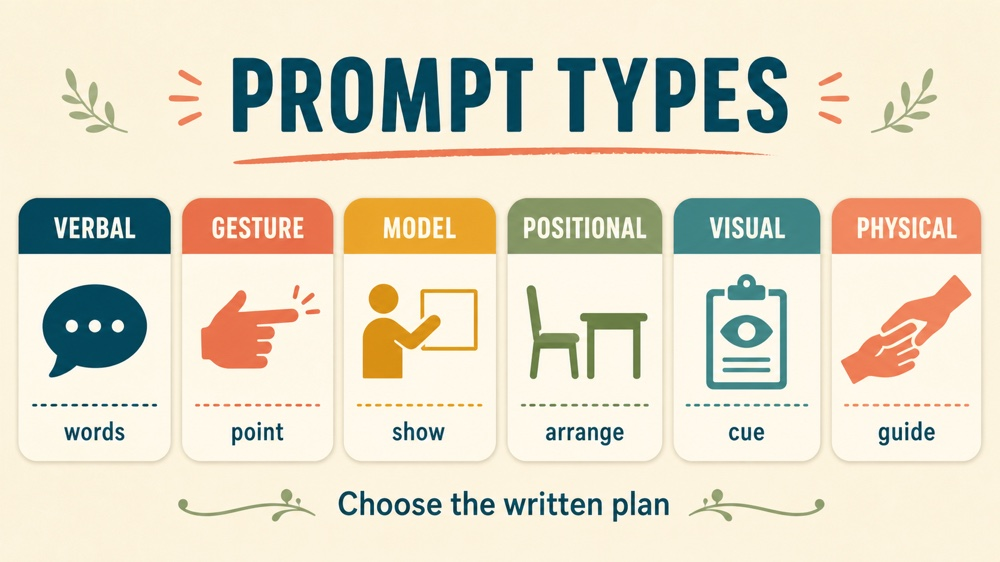
- Common prompt types and how to describe them
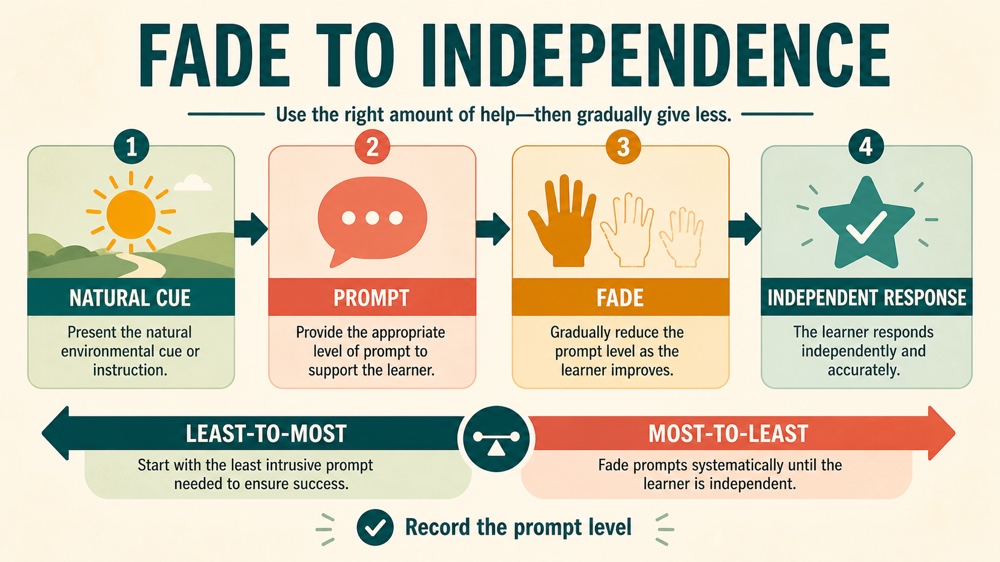
- Least-to-most and most-to-least prompting
- Prompt fading and transfer of stimulus control
- Error correction, reinforcement, and data
- RBT role, dignity, and practical boundaries
- Frequently Asked Questions
- References
Quick answer: Prompt levels can be organized from less intrusive to more intrusive or from more intrusive to less intrusive, depending on the skill, risk, learner, and teaching plan. Common prompt types include verbal, gestural, model, positional, visual, and physical prompts. The correct choice is the one specified by the program, paired with objective data and a plan for fading.
Study boundary: This is independent exam-preparation content, not an official BACB handbook, application determination, or answer key. The examples in this article are newly written for study. They are not official, recalled, leaked, or BACB-endorsed exam questions. Requirements and policies can change, so use the current BACB handbook and your supervisor or requirements coordinator for decisions about an individual application or client program.
prompt levels aba: the core idea
A prompt is an antecedent added to help evoke a skill that the learner has not yet performed independently in the presence of the natural stimulus. “Prompt level” refers to the type or amount of assistance, not a universal ranking that applies to every program. A verbal prompt may be less intrusive for one communication goal but more intrusive than a visual cue for another. Always use the definitions and hierarchy written by the supervising professional.
For example, in a handwashing program, the natural cue might be “hands are dirty” or the bathroom routine. A picture sequence, a point toward the soap, a model of rubbing hands, and physical guidance are different supports. The learner’s independent response is the behavior completed after the natural cue without an added prompt. Recording that distinction helps the team evaluate progress.
Why the prompt is not the teaching goal
When a learner responds only after an adult says the answer, the adult’s words may become the controlling cue. That can produce a correct response during teaching but fail to generalize to a classroom, home, or community setting. Prompting should therefore be paired with stimulus control transfer, reinforcement for independent responding, and a clear fading plan.
A useful study question is: “What should be present when the learner eventually performs the skill independently?” If the answer is a picture, a teacher instruction, a sign, or a naturally occurring event, the prompt should not permanently replace that stimulus.
Common prompt types and how to describe them
| Prompt type | Study description | What to record |
|---|---|---|
| Verbal | An added spoken word, phrase, or question that helps evoke the response. | Exact prompt, timing, and whether the learner needed a full or partial verbal cue. |
| Gestural | A point, head movement, or other gesture that directs attention without giving the response. | The gesture and whether it occurred before or after an error. |
| Model | The adult demonstrates the response for the learner to imitate. | Which part was modeled and whether the learner completed the same step. |
| Positional | The materials or cue are arranged closer, more visible, or in a helpful location. | How the arrangement changed and whether it altered the learner’s opportunity. |
| Visual | A picture, written cue, icon, schedule, or other visual support defined by the plan. | Which visual was available and whether it remained part of the natural routine. |
| Physical | Contact or guided movement used only as defined, authorized, and ethically appropriate. | Level, duration, safety context, and supervisor-required documentation. |
Least-to-most and most-to-least prompting
In a least-to-most hierarchy, the implementer begins with the least intrusive planned prompt and increases assistance only when the learner does not respond within the defined wait time or makes an error. This arrangement can create opportunities for independent responses, but it requires consistent timing and an appropriate error procedure.
In a most-to-least hierarchy, the implementer starts with a prompt likely to produce a correct response and systematically reduces assistance across trials or sessions. This can reduce errors when the skill is new or safety is important, but it can also create prompt dependency if fading is delayed or inconsistent.
Neither label is automatically “better.” The question is whether the hierarchy is written, feasible, respectful, safe, and supported by data. An RBT should not switch from one hierarchy to another because a session feels difficult; ask the supervisor for a program update.
Prompt fading and transfer of stimulus control
Prompt fading means systematically reducing the added assistance. Fading can change prompt intensity, delay the prompt, reduce part of a verbal cue, increase distance from a model, or alter another dimension described in the plan. A prompt should not disappear randomly; the team should define the decision rule and measure independent responding.
Transfer of stimulus control is the process of arranging for the natural stimulus to evoke the response rather than the prompt. Suppose a learner is taught to select “juice” after a verbal model. The team may gradually delay or reduce the model while keeping the opportunity and reinforcement consistent. The data should show whether the learner responds to the relevant cue with less assistance, not merely whether the learner can copy an adult.
Error correction, reinforcement, and data
- Define an opportunity: Identify the instruction or natural cue, the response window, and what counts as independent, prompted, incorrect, or no response.
- Use the written correction procedure: Some programs repeat the cue, model the response, use a prompt, or insert an easier trial. Do not invent a correction step.
- Reinforce the planned response: Deliver the programmed consequence with the timing and magnitude specified, while respecting assent, dignity, and safety.
- Track prompt level: Record the least or most intrusive prompt used, depending on the data system, and do not mark a prompted response as independent.
- Review trends: Share repeated errors, prompt dependence, or rapid improvement with the supervisor so the program can be evaluated.
RBT role, dignity, and practical boundaries
An RBT is a paraprofessional who provides behavior-analytic services under the direction and close supervision of the responsible supervisor or requirements coordinator. A strong answer therefore separates what an RBT can implement as written from what requires assessment, clinical interpretation, plan changes, or supervisor direction.
Physical prompting deserves special care. Use it only when the program authorizes it, the implementer is trained, the least intrusive safe procedure is clear, and the learner’s dignity and assent-related signals are respected. If a learner resists, a safety concern appears, or the prompt is not working, follow the escalation procedure instead of adding force or improvising a hierarchy.
Current exam frame: The current RBT Test Content Outline (3rd ed.) applies beginning January 1, 2026. It describes 43 tasks across six content domains. The current examination format is 75 scored questions plus 10 unscored pilot questions, four answer choices per item, and a 90-minute testing period. These facts explain the study frame; they do not turn an independent guide into an official BACB resource.
For review, build a small prompt map for one skill: natural cue, independent response, prompt type, wait time, correction, reinforcement, and fading rule. Then compare the map with the current training materials. This process tests conceptual understanding without treating third-party examples as official exam content.
Practice prompt and teaching concepts
Review original RBT-style scenarios and explanations after you have checked the current official outline and your supervisor-directed procedures.
Review the RBT resource →
Frequently Asked Questions
What are prompt levels in ABA?
Prompt levels describe the type or amount of added assistance used to evoke a response. The hierarchy is program-specific; common types include verbal, gestural, model, positional, visual, and physical prompts.
What is the difference between least-to-most and most-to-least prompting?
Least-to-most begins with less intrusive planned help and increases it when needed. Most-to-least begins with stronger help and systematically fades it. The supervising professional selects the approach.
Why is prompt fading important?
Fading reduces dependence on the prompt and helps transfer control to the natural instruction or cue. It should be systematic and measured rather than improvised.
Should a prompted response be scored as independent?
No. Use the definitions in the data system. If an added prompt was required, record the programmed prompt level rather than marking the response independent.
Are these official BACB questions?
No. The examples are newly written independent study content and are not official, recalled, leaked, or BACB-endorsed examination questions.
References
- Behavior Analyst Certification Board: Registered Behavior Technician Handbook, updated June 2026.
- Behavior Analyst Certification Board: RBT Test Content Outline (3rd ed.).
- Behavior Analyst Certification Board: RBT resources.
- Behavior Analyst Certification Board: RBT Ethics Code.
- RBT Training: independent practice resource.