
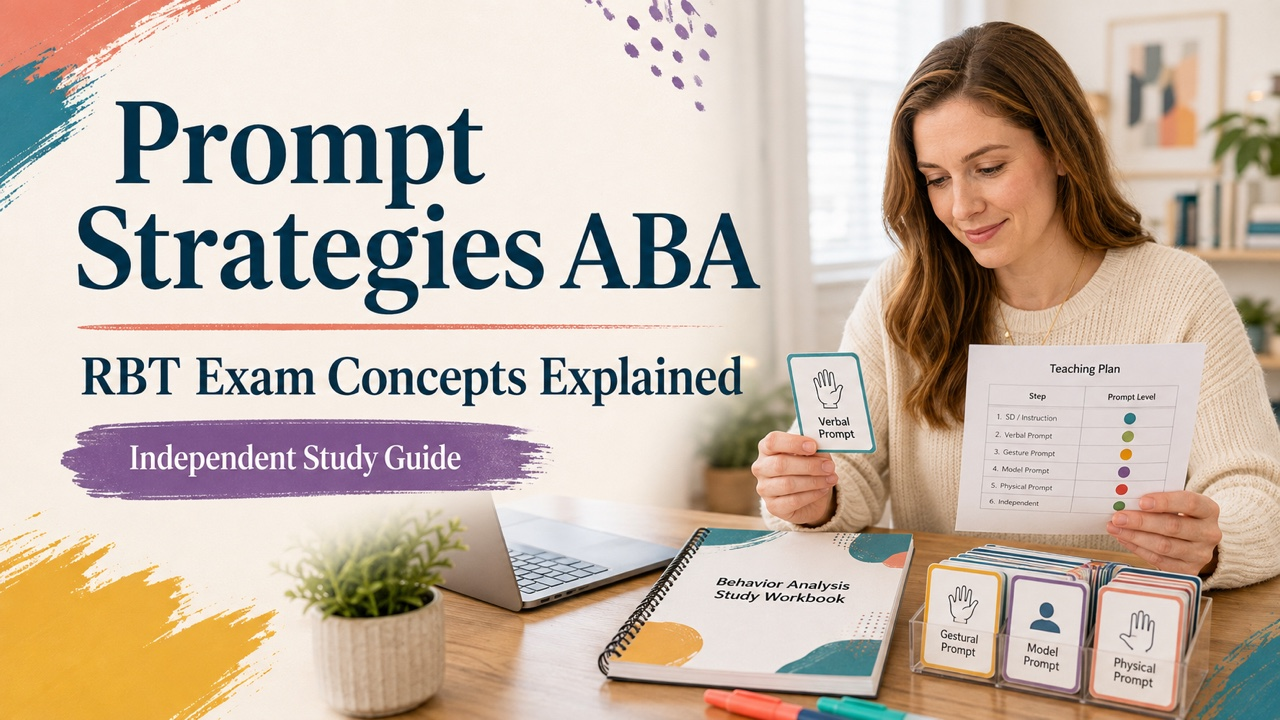
Prompt strategies ABA are teaching supports that help a learner contact the correct response while a skill is being acquired. For an RBT, the important question is not which prompt looks most helpful in the moment. It is which prompt, delay, fading step, reinforcement rule, and error-correction procedure are written in the learner’s program and trained by the supervising team.
Table of Contents
- What prompt strategies ABA means in practice
- Prompt hierarchies and least-to-most support
- Most-to-least prompting and stimulus control
- Time delay, prompt delay, and error prevention
- A prompt-strategy scenario for an RBT
- Prompt fading, generalization, and maintenance
- Reinforcement and prompting are not interchangeable
- Mistakes to avoid with prompt strategies ABA
- How to study prompt strategies ABA
- Prompt strategies ABA review checklist
- Frequently Asked Questions
- References
Quick answer: Treat prompt strategies aba as a current-source study topic. Define the term, follow the written procedure, practice an original scenario, and keep the RBT’s supervision boundary visible.
Study boundary: This independent guide is educational content. It is not a BACB policy, certification decision, legal opinion, answer key, or guarantee of examination success. Examples are original and are not official, recalled, leaked, or BACB-endorsed questions.
Current exam context: The current BACB RBT Test Content Outline describes 43 tasks across six domains; the examination includes 75 scored questions and 10 unscored pilot questions in a 90-minute testing period. Verify the current handbook and outline before relying on a time-sensitive detail.
What prompt strategies ABA means in practice
A prompt is an added cue or assistance that increases the likelihood of a correct response. In applied behavior analysis, prompts can be verbal, gestural, modeled, visual, positional, or physical, depending on the skill and the written plan. A prompt is not the same thing as praise, reinforcement, or a replacement for a clear instruction. It is part of an arranged teaching sequence.
For exam study, describe a prompt by its observable effect and level of assistance. Avoid labeling a learner as unmotivated when the observable issue is that the instruction, materials, prompt, or consequence is unclear. The RBT’s job is to implement the programmed strategy accurately, collect the specified data, and communicate patterns or barriers to the supervisor.
Prompt hierarchies and least-to-most support
A least-to-most hierarchy begins with the least intrusive prompt likely to help and increases assistance only when the learner does not respond or responds incorrectly within the programmed interval. A common teaching sequence might move from an independent opportunity to a gesture, model, verbal cue, and then a more intensive prompt. The exact order is not universal; the learner’s program controls it.
The advantage of least-to-most support is that it can preserve opportunities for independent responding. The risk is that an RBT may wait too long, add an unapproved prompt, or deliver reinforcement for a response that does not meet the plan’s criterion. During study, write the hierarchy as a decision tree: condition, permitted prompt, response, consequence, and data entry. That makes the plan easier to follow under pressure.
Most-to-least prompting and stimulus control
Most-to-least prompting starts with a high level of assistance so the learner can contact the correct response, then systematically reduces assistance across trials or sessions. This can be useful for new or difficult skills, but fading must be planned. If the same full prompt is delivered forever, the learner may respond only when the prompt is present. The teaching goal is not merely a correct response; it is transfer of control to the relevant instruction, object, or natural cue.
A scenario may show a learner completing a task only after a model. The correct RBT response is usually to follow the programmed fading procedure and record the prompt level, not to remove all help abruptly or invent a new schedule. Ask the supervisor when the prompt is not producing the planned change, because prompt design and fading criteria are clinical decisions.
Time delay, prompt delay, and error prevention
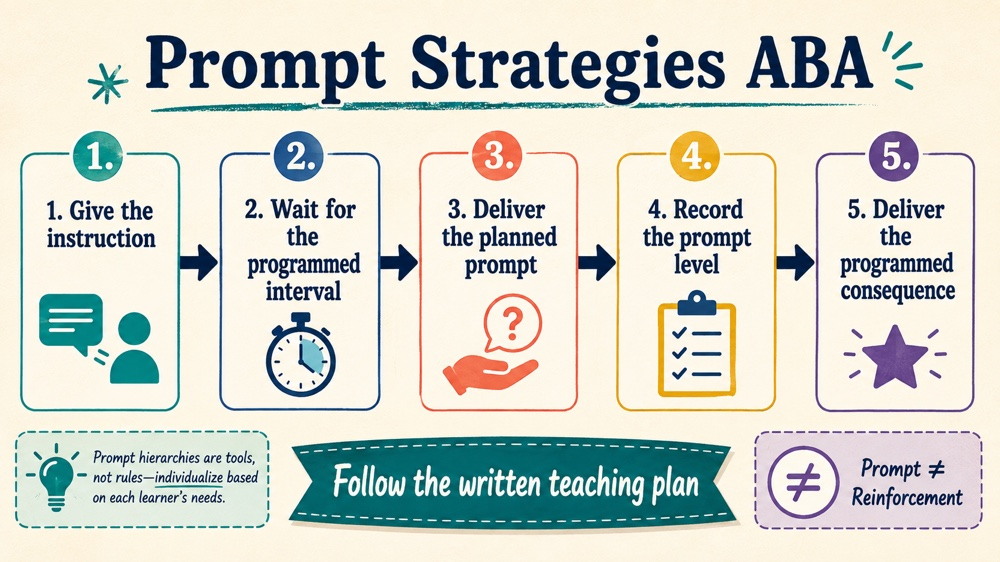
Time-delay procedures arrange a pause between the instruction and the prompt. With a constant delay, the same interval may be used across teaching opportunities. With a progressive delay, the interval gradually increases according to the plan. The purpose is to give the learner an opportunity to respond independently before the prompt is delivered. The RBT must use a timer or trained timing rule when one is specified and must record the response and prompt level accurately.
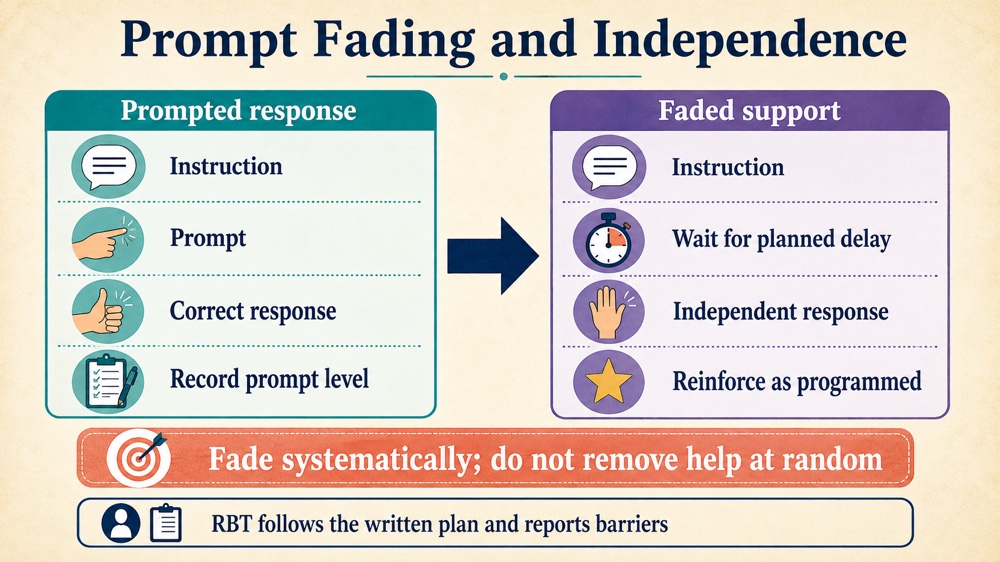
Errorless teaching may arrange an immediate prompt so that errors are unlikely, then fade the prompt systematically. It is not permission to skip data collection or to assume that a correct prompted response is independent. A high-quality study answer names the controlling variable: the delay, the prompt, the programmed consequence, and the criterion for changing the next opportunity.
A prompt-strategy scenario for an RBT
A learner is practicing selecting a picture when asked, ‘Show me the cup.’ The program says to wait three seconds, give a gesture toward the correct picture if there is no response, and record independent, prompted, incorrect, or no response. The learner touches the correct picture after one second. The RBT should mark the response as independent, deliver the programmed consequence, and avoid adding a verbal prompt that was not needed.
If the learner touches the wrong picture after the instruction, the RBT should follow the written error-correction sequence. The RBT should not scold the learner, repeat the instruction until the answer changes, or change the target card. This example tests discrimination between an observable response and an interpretation about why the learner made an error.
Prompt fading, generalization, and maintenance
Prompt fading reduces assistance while preserving the target response. A useful plan specifies what changes, when it changes, and what counts as success. Fading might reduce physical guidance, increase a time delay, move a visual cue, or transfer control from a model to a natural instruction. The RBT records the level and outcome so the supervisor can evaluate whether the fading step is working.
Generalization means the skill occurs with relevant changes in people, materials, settings, or instructions. Maintenance means the skill continues over time after intensive teaching is reduced. Neither should be assumed because a learner succeeds in one room with one technician. The RBT implements programmed generalization opportunities, protects the integrity of materials, and reports when performance changes across conditions.
Reinforcement and prompting are not interchangeable
A prompt helps evoke a response; reinforcement changes the future likelihood of behavior after a response. A learner may receive both during one teaching trial, but they serve different functions. If an RBT gives a preferred item before the learner responds, that may not be the programmed consequence for the target skill. If the RBT gives a prompt after every correct response, the learner may experience the prompt as part of the routine rather than as assistance that can be faded.
When a question asks which strategy to use, identify the condition first. Is the learner missing the response, failing to contact the consequence, or encountering an unclear instruction? Then select only the action authorized by the written procedure. This prevents the common error of changing reinforcement when the actual issue is a prompt hierarchy or measurement rule.
Mistakes to avoid with prompt strategies ABA
- Adding a prompt that is not in the program because it feels efficient.
- Calling a prompted response independent or failing to record the prompt level.
- Fading assistance without a criterion, supervisor direction, or data review.
- Using a physical prompt without required training, consent safeguards, or the written procedure.
- Repeating an instruction in a way that changes the programmed teaching trial.
- Treating the learner’s error as evidence of a motive instead of describing what was observed.
- Continuing a strategy that is ineffective or unsafe without reporting the pattern.
How to study prompt strategies ABA
Create one card for each prompt type and write four lines: what the prompt looks like, when it is delivered, how it is recorded, and how it is faded. Then create mixed scenarios where the same skill is taught with a different hierarchy, delay, or generalization condition. Explain why the correct answer changes when the program changes, even if the learner’s target response stays the same.
Use your missed questions to separate vocabulary errors from implementation errors. If you confuse a model and a gesture, draw the topography. If you confuse prompting with reinforcement, label the event before and after the response. If you choose an independent clinical change, underline the words that require supervisor direction. This makes practice more transferable than memorizing a list of prompt names.
Prompt strategies ABA review checklist
- Can I define a prompt as added assistance that increases the chance of a correct response?
- Can I follow a least-to-most or most-to-least hierarchy exactly as written?
- Can I distinguish independent, prompted, incorrect, and no-response data?
- Can I explain why time delay and fading protect opportunities for independence?
- Can I identify when generalization and maintenance require programmed opportunities?
- Can I report a barrier or safety concern rather than redesigning the teaching plan?
- Can I explain the difference between a prompt and a reinforcer in an original scenario?
A strong RBT answer is usually precise and modest: follow the trained procedure, record the observable event, deliver the programmed consequence, and ask the responsible supervisor when the plan is unclear. That sequence protects both learning and professional boundaries.
Practice the concept
Review prompt strategies aba with original RBT scenarios, current-source reminders, and clear role boundaries.
Review the RBT study resource →
Frequently Asked Questions
What are prompt strategies in ABA?
Prompt strategies are planned forms of assistance that increase the likelihood of a correct response while a skill is being taught. The written program determines the prompt, timing, fading, and data rule.
Is a prompt the same as reinforcement?
No. A prompt assists the response; reinforcement follows a response and is arranged to affect future behavior. One teaching trial may include both.
Can an RBT create a new prompt hierarchy?
An RBT should implement the trained plan and report barriers. Prompt design, fading criteria, and changes to a procedure should come from the responsible supervising team.
Are these official BACB exam questions?
No. The examples are original study scenarios and are not official, recalled, leaked, or BACB-endorsed questions.
References
- Behavior Analyst Certification Board: Registered Behavior Technician Handbook, updated June 2026.
- Behavior Analyst Certification Board: RBT Test Content Outline (3rd ed.).
- Behavior Analyst Certification Board: RBT resources.
- Behavior Analyst Certification Board: ethics resources.
- Behavior Analyst Certification Board: RBT Ethics Code (2.0).