
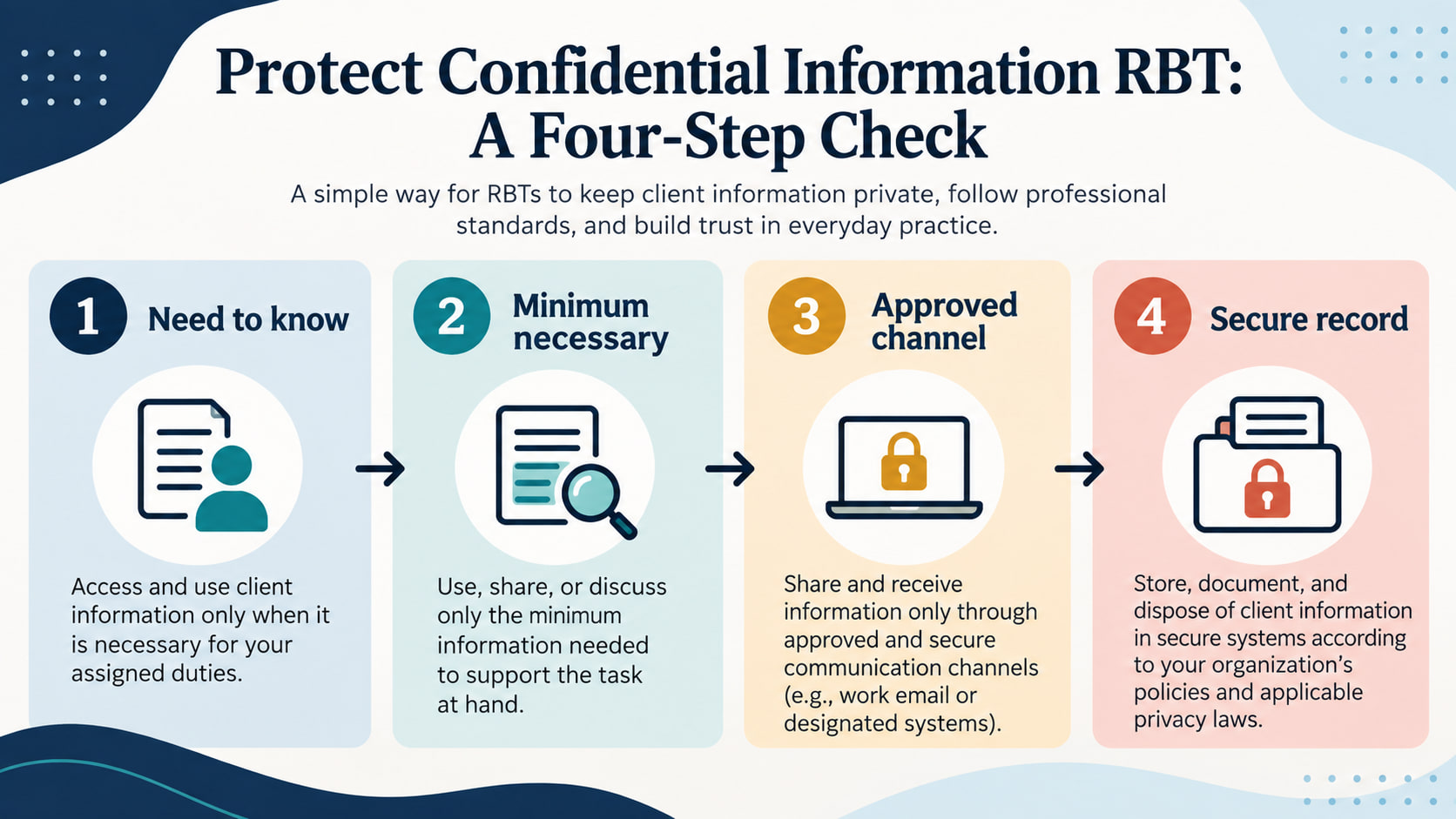
Protect confidential information RBT by checking authorization, sharing the minimum necessary, using an approved channel, and securing the record.
Table of Contents
- Protect confidential information RBT: why it is an everyday skill
- The four-step protection check
- Step 1: Check the need to know
- Step 2: Share the minimum necessary
- Step 3: Use an approved channel
- Step 4: Secure the record
- What to do when a request is unclear
- Common everyday examples
- Frequently asked questions
- References
RBT ETHICS · PRIVACY IN PRACTICE
Protect Confidential Information RBT: A Practical Guide
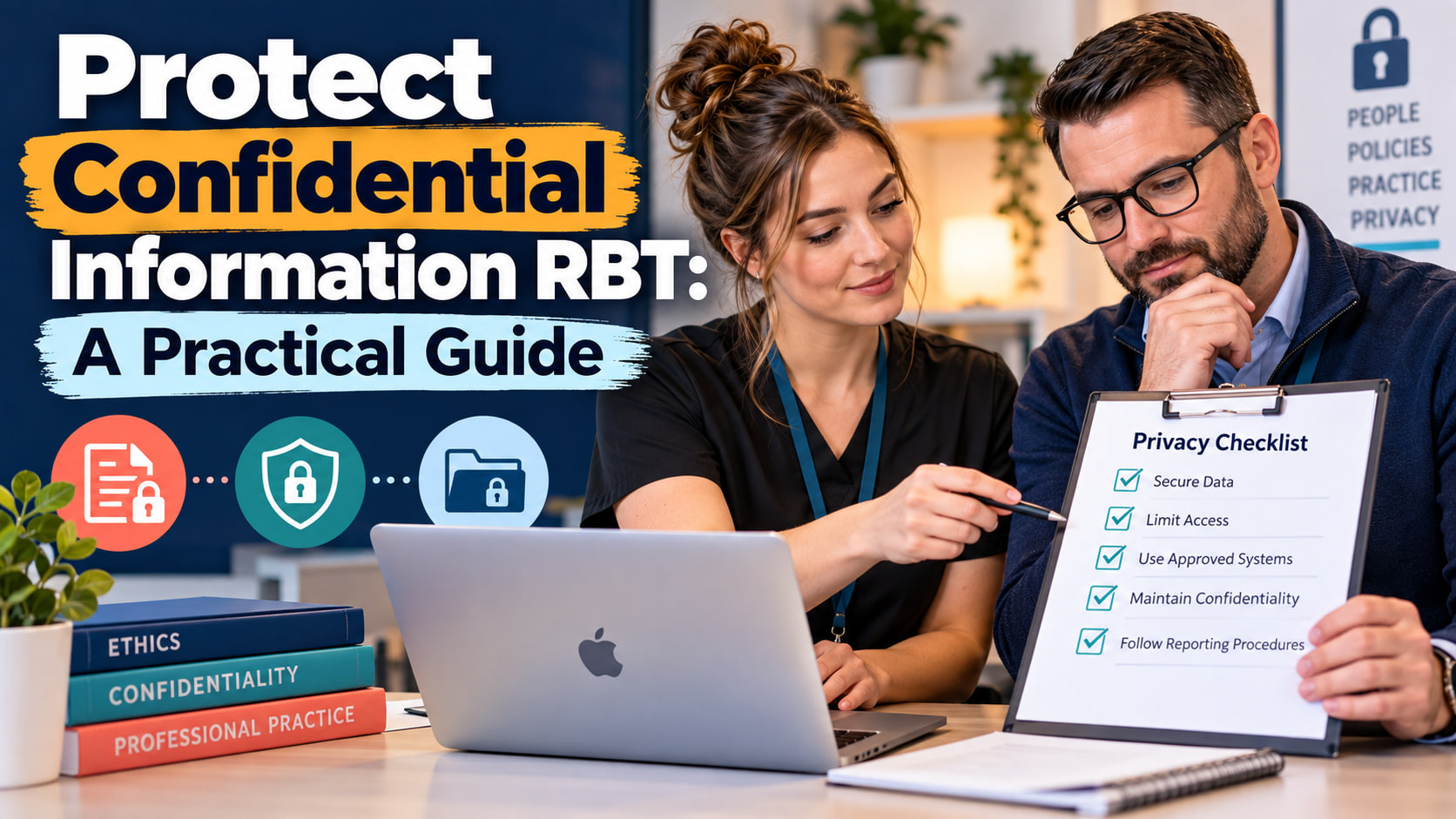
Protect confidential information RBT with a repeatable check before collecting, using, storing, or disclosing client information.
Protect confidential information RBT by treating every request as a decision about purpose, authorization, amount, channel, and record—not as a test of good intentions. Before collecting, using, storing, or disclosing information, pause to check those details. A small privacy decision can happen during a handoff, a data session, a phone call, a team message, or a discussion in a public hallway.
This guide offers a practical decision routine. It does not replace the current BACB Ethics Code, the RBT Handbook, applicable law, supervisor direction, or your organization’s privacy and security process. When rules conflict or a request is unusual, use the official support or supervision route and share no more information than is necessary to ask the question.
Protect confidential information RBT: why it is an everyday skill
Confidentiality is not limited to a formal report. A client name, schedule, photograph, diagnosis, service location, behavior record, family message, billing detail, or combination of ordinary facts may identify a person when placed in context. Even a statement that seems harmless can become sensitive if it reveals who received services, where a session occurred, or what a family is managing.
Protective practice has two parts. First, use information only for an approved work purpose. Second, reduce the chance that the information will be seen, copied, stored, or sent by someone who is not authorized. The right question is not only “Can I access this?” but also “Why do I need it, who needs it, and what is the safest approved way to handle it?”
Privacy is also part of dignity. A person should not have to become a topic of casual conversation because a team member is curious, a visitor asks a question, or a technician wants to share an interesting story. Keep the conversation focused on the work and bring uncertainties to the appropriate supervisor.
The four-step protection check
Use the following sequence before sharing or creating a record. The steps are simple enough to remember, but the answer still depends on the current policy and the specific situation.
- Need to know: Is there an approved work purpose, and does this person need the information for that purpose?
- Minimum necessary: What is the smallest amount of accurate information that will accomplish the task?
- Approved channel: Which system, device, location, or communication method does policy allow?
- Secure record: Where should the information be stored, and how should access, correction, and retention be handled?
Step 1: Check the need to know
A work relationship does not automatically create a right to every client detail. A supervisor, assigned team member, administrator, or service partner may have a defined reason to receive particular information. A visitor, friend, unrelated coworker, or curious acquaintance may not. When the purpose is unclear, do not use the person’s curiosity as the authorization.
Ask yourself what action the information supports. If you are preparing for an assigned session, you may need the current plan and relevant instructions through the approved system. You may not need unrelated family history, a full record, or details from another case. If you are reporting a safety event, use the designated process and include the facts required by that process rather than forwarding an entire conversation.
Need-to-know is not the same as “I might find this interesting.” Keep professional discussions tied to the assigned task. Do not discuss client information in a break room, elevator, classroom, social gathering, or online group where people can overhear or forward the message.
Step 2: Share the minimum necessary
Once a work purpose is established, narrow the information. Check names, dates, times, and descriptions for accuracy. Remove details that do not help the recipient take the approved next step. A concise message can be both more respectful and more useful than a large attachment containing unrelated material.
For example, if a supervisor asks whether a data sheet was completed, the answer may be the status and the specific barrier—not a screenshot of an entire client record. If an authorized team member needs to know that a session time changed, send the scheduling detail through the approved channel rather than adding diagnoses, family comments, or other private history.
Minimum necessary does not mean leaving out a fact that safety or accurate documentation requires. It means using judgment within the approved process. If you are unsure whether a detail is required, ask the supervisor or policy owner before sending it.
Step 3: Use an approved channel
A correct recipient can still receive information through the wrong channel. Personal email, text messages, social media, a public cloud folder, a shared family tablet, or an unapproved AI tool may not be permitted for client information. Use the platform, device, account, and location identified by the organization’s current policy.
Check the recipient before pressing send. Confirm the address, group, attachment, and visible preview. Lock your screen when stepping away, sign out of shared devices when required, and avoid leaving printed notes where visitors can see them. Do not photograph a screen or record a conversation simply because it seems convenient.
If a caregiver or coworker asks for information through an informal channel, respond respectfully without disclosing details until you can verify the approved process. You can say that you need to follow the organization’s communication procedure and will route the request to the appropriate person.
Step 4: Secure the record
Information protection continues after a message is sent. Store notes, data, forms, and messages only where policy allows. Use the required naming, access, retention, correction, and disposal process. Do not keep a private duplicate on a personal phone or laptop because it feels easier to find later.
Write objective records. Separate what you observed from what you inferred, and correct mistakes through the approved method rather than deleting history or silently changing a record. If a document was sent to the wrong person, a device was lost, or access may have been exposed, report the event promptly through the designated incident process. Do not hide the problem while trying to fix it alone.
Security habits should fit the setting. In a home, protect paper and screens from visitors. In a school or center, follow room, badge, cabinet, and device rules. During remote work, check the background, headphones, screen sharing, recording controls, and participant list before discussing anything sensitive.
What to do when a request is unclear
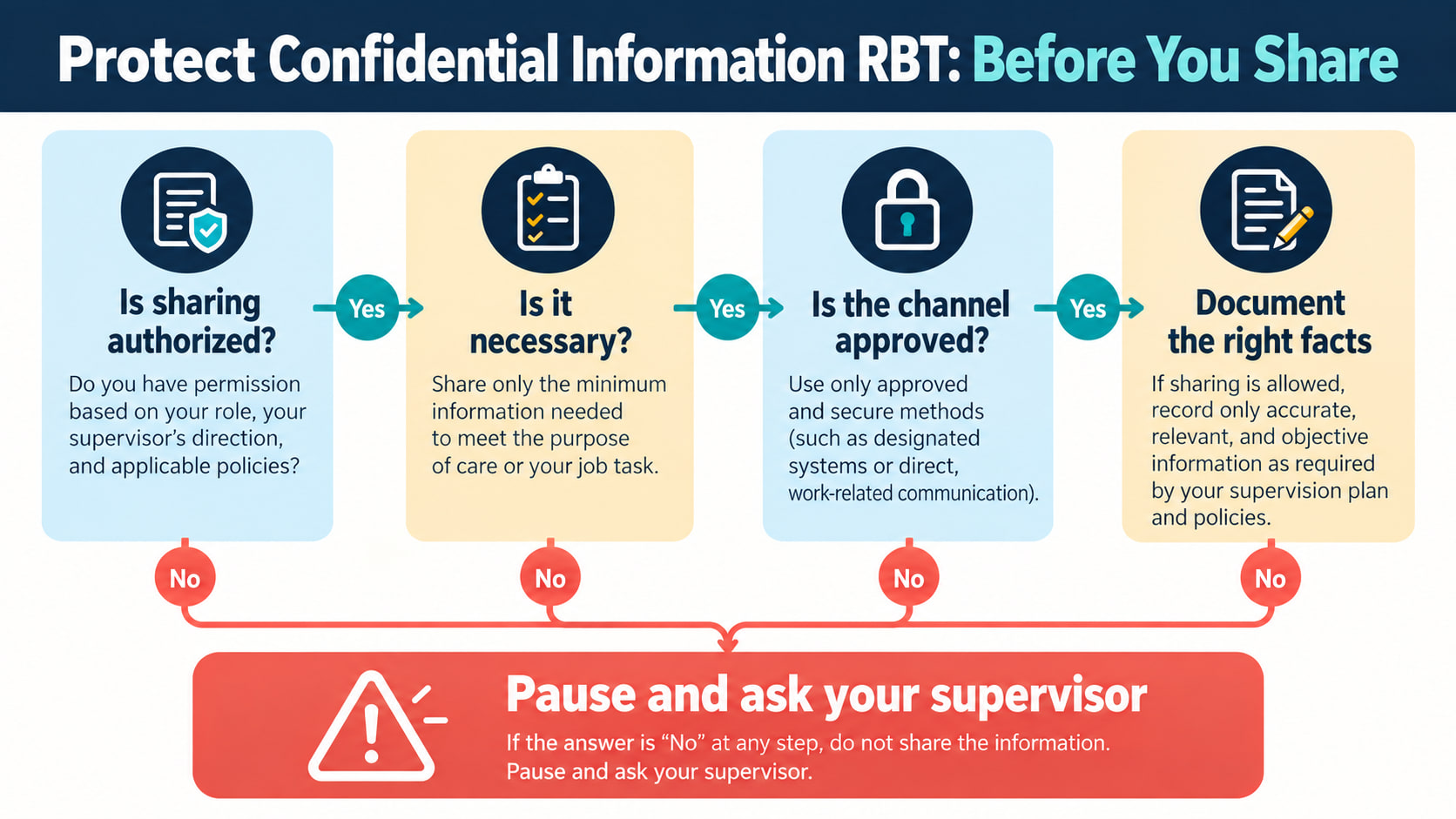
Uncertainty is a signal to pause, not an invitation to guess. Use the decision questions shown in the infographic and contact the authorized supervisor or policy owner when the answer is not clear.
First ask whether the request has an approved purpose. Next ask whether the recipient is authorized for that purpose. Then ask what minimum detail is needed and which channel is approved. If any answer is unknown, do not send the information yet. Describe the situation in general terms and ask for direction without including identifying details in an unapproved message.
Do not rely on urgency alone. A request that says “send it now” can still require verification. Do not rely on authority signals such as a job title, a forwarded signature, or a familiar phone number. Verify through the organization’s current contact method when the request involves sensitive information, unusual access, or a new recipient.
Common everyday examples
- Public conversation: A person asks whether a named child receives services. Do not confirm or deny the relationship. Move the question to the approved contact route.
- Team message: A teammate asks for “everything from last week.” Clarify the work purpose and send only the necessary approved record through the approved system.
- Caregiver request: A caregiver asks for a copy through personal text. Do not improvise a transfer. Follow the organization’s identity verification and release process.
- Accidental exposure: A screen is visible to an unauthorized person. Protect it immediately, preserve the facts, and report according to the incident procedure.
- Study note: You want an example for training. Use a fictional or properly de-identified example and follow the policy for educational materials.
These examples share the same pattern: connect the action to an approved purpose, reduce the information, use the correct channel, and document or escalate through the right process. A technician does not need to solve every privacy question alone.
Frequently asked questions
What is the fastest way to protect confidential information?
Pause before sharing and run the four checks: need to know, minimum necessary, approved channel, and secure record. If one answer is uncertain, ask the authorized supervisor or policy owner.
Can I share information with any coworker?
No. A coworker’s job title does not automatically establish a need to know. Share only for an approved work purpose and through the current approved process.
Is de-identifying a note always enough?
Not necessarily. A combination of dates, location, unusual events, images, or other details can identify a person. Follow the applicable policy and ask before using a real situation for training.
What if I sent information to the wrong person?
Follow the organization’s incident or privacy-breach procedure promptly. Preserve accurate facts, notify the designated contact, and do not conceal or independently rewrite the record.
Source note: Review the current BACB RBT Handbook, Ethics Code, applicable law, organizational privacy policy, and supervisor instructions. This article is educational and does not provide individualized legal, clinical, employment, or credentialing advice.
Ready to practice the RBT concepts you just reviewed?
Try an independent, original RBT practice resource with exam-style questions, scoring, and answer explanations.
References
- Behavior Analyst Certification Board. RBT Test Content Outline, 3rd edition.
- Behavior Analyst Certification Board. RBT Handbook.
- Behavior Analyst Certification Board. RBT Ethics Code.