
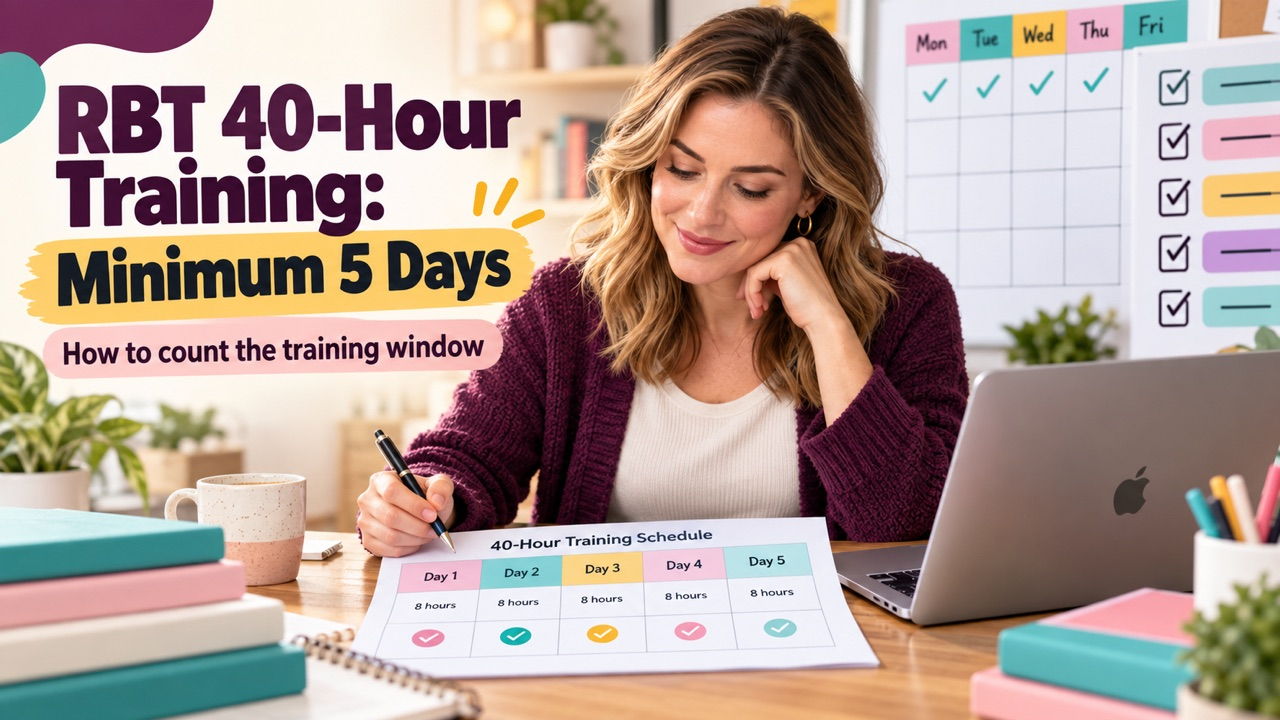
rbt 40 hour training attendance records: this guide explains the planning and recordkeeping question behind the topic, while the current BACB Handbook, forms, and portal instructions control the final requirement.
rbt 40 hour training attendance records: Why RBT 40-hour training attendance records matter
RBT 40 hour training attendance records answer a different question from the five-day rule. The five-day article explains how the calendar minimum works; this guide explains how an applicant can show what happened during the training. A certificate is useful, but a well-organized file also preserves the provider, course version, dates, hours, curriculum information, and completion evidence that support the certificate.
The current BACB materials control the exact requirements and can change. No private checklist can replace the current Handbook, curriculum outline, or application instructions. Treat the record set as an organized evidence file: it should let you and the training provider explain when the course occurred, what it covered, and how the completion document was issued.
The core record set to request
Start with the provider’s completion certificate or equivalent completion document. Check that the learner name is spelled consistently, the provider is identifiable, the total hours are stated, and the completion date is clear. Keep the original download and a backup copy. If the provider uses a portal, save the confirmation page or completion email as well as the certificate.
Next, keep the course description or curriculum map that shows how the training was designed to cover the current RBT 40-hour requirements. The document does not need to promise an outcome. It should simply make the course identity and coverage understandable. If the provider changes a lesson or issues a revised certificate, retain the final version and note why the earlier version was replaced.
How to document dates and hours
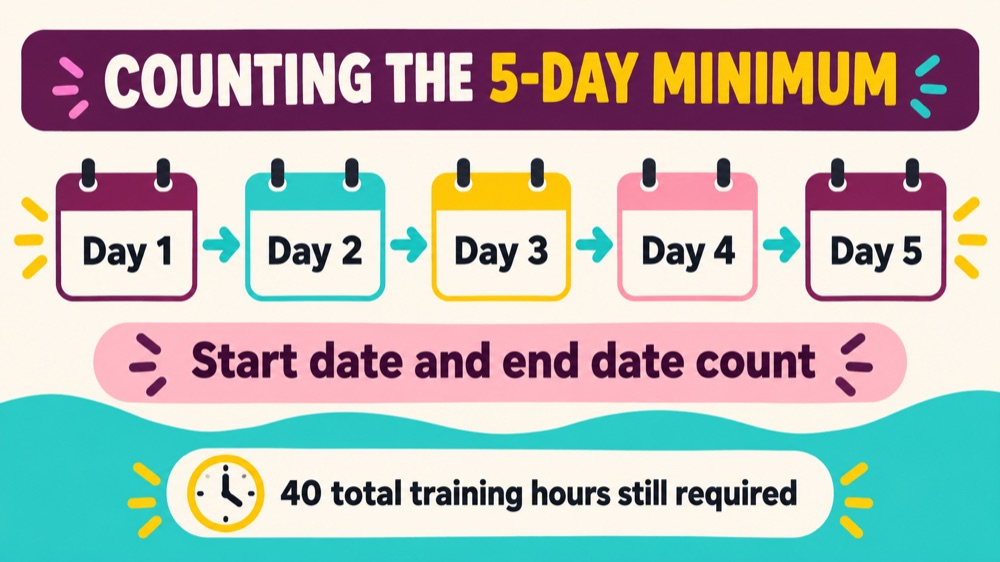
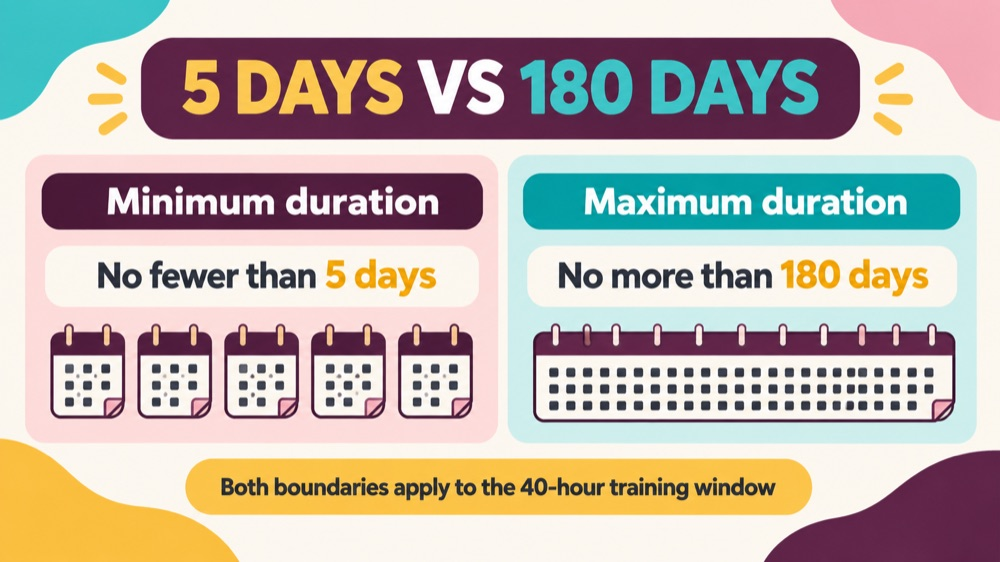
Create a simple timeline with the first training date, last training date, each session date, and the hours completed. The start and end dates still matter because the current rule includes both the minimum five-day and maximum 180-day boundaries. A recordkeeping sheet does not change those rules; it makes it easier to spot a gap before the application is submitted.
Avoid rounding a partial session into a full day without a provider record. If a course is self-paced, save the platform’s completion history and the provider’s statement about how the hours were calculated. If a course is live, keep attendance confirmations or session receipts when available. These records are for clarity, not a substitute for the provider’s responsibility to issue an accurate completion document.
What to check against the current curriculum
Compare the course name and version with the current BACB curriculum document. Look for the required topic coverage, the total at least 40 hours, and the provider’s explanation of how completion was assessed. If the course page only says ‘RBT training’ and does not identify its curriculum or completion process, ask the provider for clarification before relying on it.
Do not assume a certificate automatically proves every eligibility requirement. Training, the initial competency assessment, the attestation, background checks, and the application each have separate roles. A record file is strongest when it keeps those categories separate instead of placing every document under one vague label.
A folder structure that reduces mistakes
Use four folders: provider information, attendance and hours, completion documents, and application preparation. Name files with the date and document type, such as 2026-06-15-session-log or 2026-07-20-completion-certificate. Keep an untouched original and work from a copy when you need to add notes. This is especially useful if a portal asks for a replacement document later.
Review the file once before scheduling the next step. Confirm that names, dates, and hours agree across the certificate, attendance record, and course summary. If they do not agree, ask the provider which document is authoritative and request a corrected version in writing. Do not silently edit a certificate yourself.
Common recordkeeping errors
The most common problem is a file that proves only that someone paid for a course. Payment is not the same as completion. Another problem is keeping a certificate without the course dates or provider identity. A third is mixing two versions of a course after a provider updates its curriculum. Label each version and keep only the final completion document in the application-ready folder.
A record can also become confusing when the training window is mixed with the application window. Training has its own start and end dates; the application, attestation, and assessment have their own instructions. Write the name of the rule beside each date so a later review does not treat every deadline as one 90-day or 180-day period.
Before you use the file for an application
Open every PDF, confirm that the pages are readable, and verify that the applicant name matches the application account. Check that the completion document is final rather than a draft or attendance-only receipt. If the provider uses an electronic signature, preserve the original file and any verification page instead of printing and rescanning it.
Finally, compare the file with the current BACB Handbook and application portal instructions. If the official instructions ask for a different document or a current version, follow those instructions. The safest record is not the largest record; it is a consistent, current, and explainable one.
Frequently asked questions
Can an attendance spreadsheet replace a completion certificate? Usually it should be treated as supporting evidence, not as an automatic replacement. The provider’s current completion document and the application instructions control.
Should old training files be deleted? Keep them if they explain a correction or version change, but clearly mark which document is final. Never submit two conflicting completion documents without an explanation.
Does keeping records guarantee application approval? No. It improves readiness and auditability, but BACB eligibility and approval depend on the current official requirements and the complete application.
How to keep the decision clear
Before you close the file, write one sentence stating what the record proves and one sentence stating what it does not prove. For example, a training record can show completion, but it cannot by itself show that an application was approved. A signed form can show that an attestor made a confirmation, but it cannot replace a missing eligibility document. A calendar can show the dates you planned, but it cannot change an official deadline. This small distinction keeps a useful checklist from becoming an unsupported promise.
Save the current official source with the review date, then set a reminder to recheck it if your application or recertification cycle continues. Forms, handbook language, fees, portal instructions, and processing information can change. When a source changes, update the plan and preserve the earlier record rather than silently rewriting history. That approach makes the file easier for the applicant, provider, attestor, or assessor to understand later.
When the review is complete, record the next action, the person responsible for it, and the date you intend to revisit it. If the next action depends on an official response, label it as waiting rather than complete. If the next action is a document correction, keep the correction request with the file. This turns the article’s advice into a small workflow that can be checked by someone else without reinterpreting the whole history.
Keep the review brief enough to repeat. A dated checklist, a source link, and a clearly named next action are more useful than a long note with no owner. If another person takes over the file, they should be able to understand the status without changing any original record.
If the record is shared with a provider, attestor, assessor, or organization administrator, share only the portion needed for that person’s task. Keep a private note of what was sent, when it was sent, and whether a correction was requested. This is a practical privacy measure as well as a quality check: it reduces the chance that an old draft, a duplicate file, or an unrelated personal document is used by mistake.
Use the same review method whenever a date, form version, or portal instruction changes. First identify the official source, then compare the source with the saved record, then document the decision and next action. If the source is unclear, mark the item as needing confirmation. A transparent “waiting for confirmation” note is safer than filling in an uncertain answer and treating it as a completed requirement.
When possible, have a second person perform a visual check without changing the substance. A fresh review often catches a missing page, a mismatched name, an unreadable scan, or a date entered in the wrong field. Keep the reviewer’s note separate from the official form so the original record remains intact.
Source and scope: This is an educational summary of public BACB guidance, not individualized certification, legal, immigration, employment, or financial advice. Check the current BACB Handbook, forms, portal instructions, and organization records before acting.