
The RBT attesting certificant requirements are a three-part test: an accepted active credential, a qualifying relationship with the organization that employs the applicant, and the ability to verify and support the attestation. This checklist expands the qualification details behind the shorter who-can-sign answer and helps an organization prepare the right signer without treating a job title as automatic authority.
Table of Contents
- RBT attesting certificant requirements: the three gates
- Accepted credential and active status
- Employment or contract relationship
- Verification and organizational knowledge
- Fields and records to prepare
- Final pre-signing checklist
- Frequently asked questions
- Official references and final reminder
RBT attesting certificant qualification and application records
RBT Attesting Certificant Requirements: Complete Checklist
Confirm the credential, organization relationship, verification path, and records before the attestation is signed.
The RBT attesting certificant requirements are a three-part test: an accepted active credential, a qualifying relationship with the organization that employs the applicant, and the ability to verify and support the attestation. This checklist expands the qualification details behind the shorter “who can sign?” answer. It is designed for applicants and organizations preparing the right signer, not for treating a job title as automatic authority.
Use the current BACB RBT Certification Application Attestation form as the controlling document. The BACB application-processing page currently lists the RBT Certification Attestation Form as version 3/2025. If an old PDF or internal checklist says something different, stop and compare it with the current form and portal instructions.
RBT attesting certificant requirements: the three gates
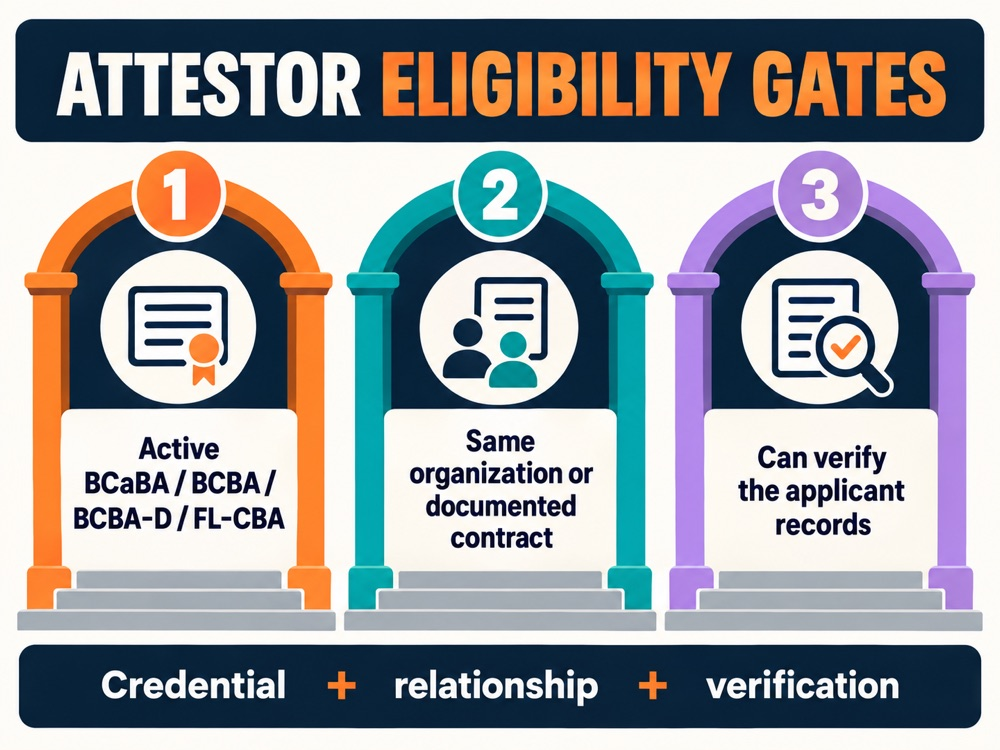
A person should pass all three gates before signing:
- Credential gate: The person holds an active BCaBA, BCBA, BCBA-D, or FL-CBA.
- Relationship gate: The person is employed by the same organization as the applicant or has a contractual relationship with the organization that employs the applicant.
- Verification gate: The person can confirm the applicant’s required information and support the attestation with organizational records if BACB requests an audit response.
These gates work together. A qualified credential without a relationship is not enough. A close employment relationship without the accepted credential is not enough. And a person who meets both formal gates should still pause if they cannot understand the organization’s screening process or locate the records behind the statements.
Accepted credential and active status
The current form identifies four credential categories: BCaBA, BCBA, BCBA-D, and FL-CBA. It also asks the attestor to provide the certification type and BACB certification number or BACB ID. That information ties the signature to an identifiable certificant record.
Check the credential status before preparing the form, not after the signature. A former credential, expired credential, pending application, or unrelated license should not be treated as an accepted active credential without confirmation from the current BACB instructions. The signer’s legal name and credential information should also be entered exactly and consistently across the form and the signer’s BACB account.
The credential gate is about the person who is attesting. It is separate from the applicant’s RBT training, competency assessment, age, education, or screening results. The signer does not become eligible because the applicant has completed those items; the signer must independently meet the current attestor criteria.
Employment or contract relationship
The current form requires the attesting certificant to be employed at the same organization as the applicant or to have a contractual relationship with the organization that employs the applicant. The relationship should be current, genuine, and documentable.
| Relationship route | What to document | What can go wrong |
|---|---|---|
| Same-organization employee | Organization name and the signer’s employment connection. | The organization name differs across the application and attestation, or the signer is no longer employed there. |
| Contracted certificant | Organization name and a current contract or equivalent relationship record. | The arrangement is informal, expired, or cannot be produced if BACB requests it. |
| Unrelated professional | No qualifying route unless a real contract with the employing organization exists. | An active credential is mistaken for a universal right to sign. |
The organization field matters because the attestor’s confirmation depends on access to the employer’s verification process. A signer who knows the applicant socially or professionally but has no qualifying organization relationship should not be selected merely for convenience.
Verification and organizational knowledge
The current form allows the attestor to confirm the relevant requirements by reviewing documentation directly or by confirming the information with the organization employing the applicant. Either route requires a reasonable basis for the signature.
The attestor must be familiar with the organization’s policies, procedures, and processes when vetting RBT applicants. This matters when human resources staff handled the background and abuse registry checks. HR can perform the operational screening, but the attesting certificant remains responsible for understanding the organization’s process well enough to confirm the information and provide documentation if audited.
The information being confirmed includes:
- The applicant is at least 18 years old.
- The applicant completed at least a high-school-level education or equivalent.
- The applicant passed a criminal background check comparable to the checks required in the community where services will be provided.
- The applicant cleared an abuse registry check under the current form instructions.
This is why “I know the applicant” is not a sufficient verification method. The signer should know which records were checked, who maintained them, what date or process applies, and how the organization would produce supporting evidence. The attestation is not a promise that the application will be approved; it is a formal confirmation that can be audited.
Fields and records to prepare
Prepare the signer’s information before opening the final signature step. The form asks for the attesting certificant’s legal name, certification type, BACB certification number or BACB ID, organization name, and relationship to that organization as employed or contracted.
A practical record set includes:
- The signer’s current credential category and BACB identifier.
- The applicant’s legal name and BACB ID as shown in the applicant’s account.
- The exact organization name used by the employer and on the application.
- Employment evidence or the contract supporting the signer’s relationship.
- The organization’s screening policy, procedure, or responsible-records contact.
- The background-check and abuse-registry records or the organization’s permitted confirmation path.
- A secure copy of the completed form and supporting documentation for the current retention period.
Do not fill uncertain fields from memory. An inconsistent organization name, incorrect BACB ID, missing relationship selection, or unsupported check result can make the form incomplete even when the signer is otherwise qualified.
Final pre-signing checklist
Use this final review before the attestor signs:
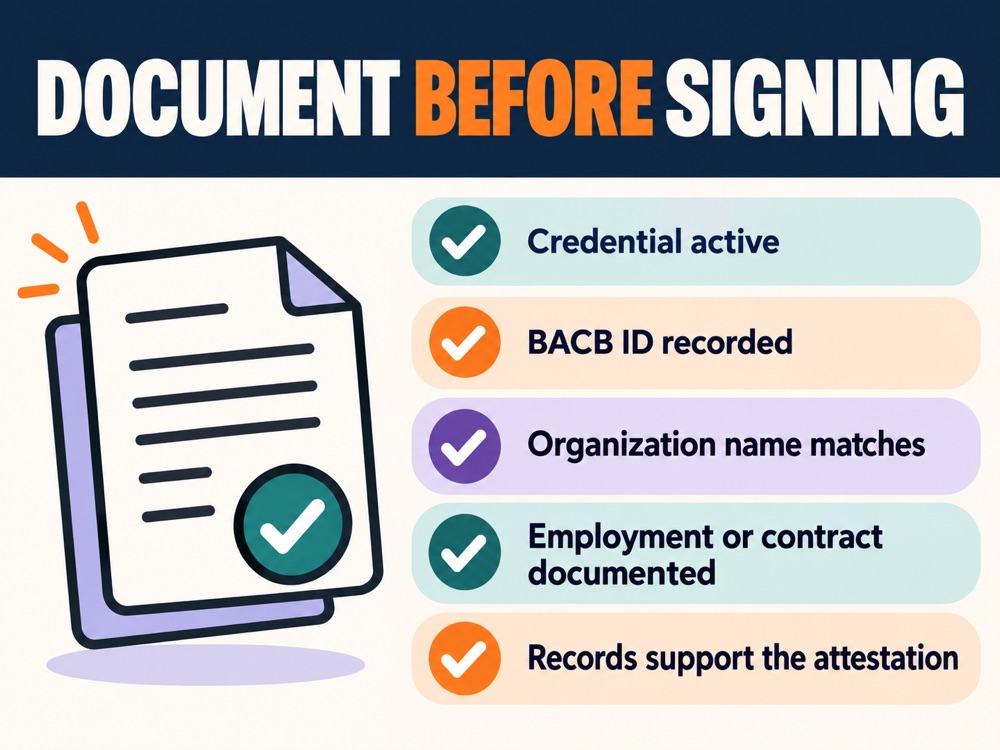
- Confirm active status: Check the accepted credential and record the correct BACB number or ID.
- Confirm the organization: Match the organization name across the applicant’s application and the attestation.
- Confirm the relationship: Select employed or contracted and retain evidence for the selected route.
- Confirm the verification path: Know whether the records were reviewed directly or confirmed through the employer.
- Confirm process knowledge: Understand how the organization’s HR or compliance team conducted and stored the checks.
- Complete every field: Review legal names, credential type, identifiers, relationship selection, signature, and date.
- Keep audit support: Save the completed form and supporting documents securely under the current BACB instructions and organization policy.
Frequently asked questions
Does the attesting certificant have to be a BCBA?
No. The current form lists active BCaBA, BCBA, BCBA-D, and FL-CBA categories. The accepted credential is only one part of the test; the signer also needs the required organization relationship and verification ability.
Can a contracted certificant complete the attestation?
A contractual relationship with the organization that employs the applicant may satisfy the relationship route when it is genuine and documentable. Keep the contract available in case BACB requests it during an audit, and confirm the wording on the current form.
Can HR complete the attestation?
HR may provide or confirm screening records. However, HR staff must also meet the current attesting-certificant credential requirements to sign as the attestor. HR responsibility alone does not replace an accepted active credential.
Is the RBT Supervisor automatically the attestor?
No. The RBT Supervisor or RBT Requirements Coordinator may be the attestor if the current requirements are met, but the role title itself does not create signing authority. The 2025 application update specifically explains that the attestor does not have to hold those roles.
Does passing the checklist guarantee approval?
No. The checklist helps prepare a complete, supportable attestation. The BACB controls review, action items, exam authorization, and certification decisions under the current requirements and portal process.
Official references and final reminder
For controlling details, review the current RBT Certification Application Attestation form, the BACB application-processing updates, the 2025 RBT application update, and the RBT Handbook. If a credential category, relationship rule, field, timing instruction, or retention instruction changes, the current BACB source controls.
This article is an educational summary of public BACB guidance, not individualized certification, legal, employment, immigration, or financial advice. If the signer’s credential, organization relationship, contract, or verification records are unclear, resolve that issue with the organization and current BACB instructions before submitting the application.
Ready to practice the RBT concepts you just reviewed?
Try an independent, original RBT practice resource with exam-style questions, scoring, and answer explanations.
References
- Behavior Analyst Certification Board. RBT Test Content Outline, 3rd edition.
- Behavior Analyst Certification Board. RBT Handbook.
- Behavior Analyst Certification Board. RBT Ethics Code.