
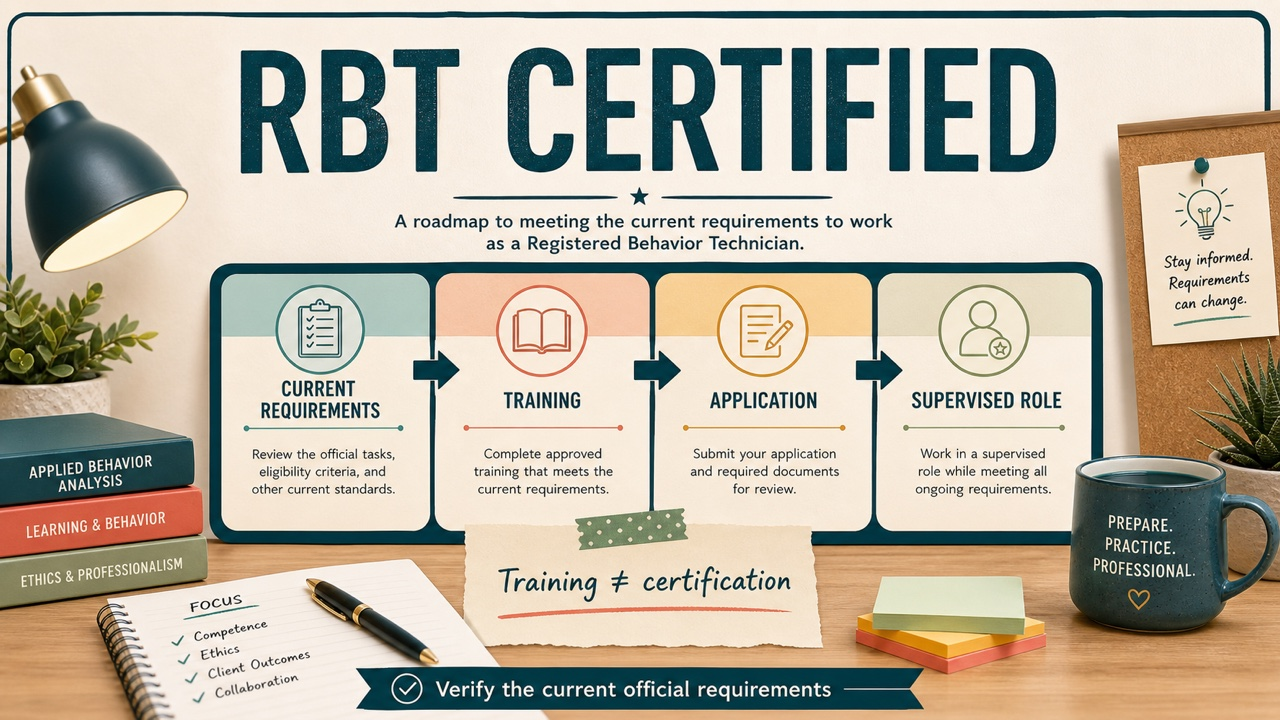
If you search for rbt certified, first separate the BACB credential from a training provider, a job title, or a study website. The Registered Behavior Technician credential is issued through the Behavior Analyst Certification Board (BACB) when an applicant meets the current requirements. RBT Training is not a BACB certification program and is not affiliated with or endorsed by BACB. This guide explains the terminology and study workflow without making an individual certification decision.
Table of Contents
- rbt certified: what the phrase means
- The current RBT pathway at a high level
- Training completion is not the same as BACB certification
- What a certified RBT does under supervision
- Study checklist for people seeking the credential
- Frequently Asked Questions
- References
Quick answer: “RBT certified” should mean that a person has met the current BACB requirements and holds the credential. A course, certificate of completion, mock exam, or employer orientation may support preparation, but none of those items alone changes a person’s BACB credential status. Always use the current Handbook for the exact application, assessment, examination, supervision, and renewal rules.
Study boundary: This is independent exam-preparation content, not an official BACB handbook, certification decision, task answer key, or application determination. The examples in this article are newly written for study. They are not official, recalled, leaked, or BACB-endorsed exam questions. Requirements and policies can change, so use the current BACB handbook and your supervisor or requirements coordinator for decisions about an individual application or client program.
rbt certified: what the phrase means
The phrase is often used loosely. It can describe a certified Registered Behavior Technician, but it can also be used in a job advertisement or a search query by someone who is still preparing. The safe reading is credential-first: ask which organization issued the credential, whether the credential is current, and whether the person is working within the required supervision and role boundaries.
BACB requirements are time-sensitive. An older checklist, social post, or course landing page may omit a step or describe an earlier edition. A study article can explain concepts; it cannot approve an application, verify a background check, or replace the current BACB account and Handbook.
The current RBT pathway at a high level
- Read current requirements: Start with the BACB Handbook and RBT resource page in effect for your application.
- Complete required preparation: Use an accepted training route and retain the documentation the current process asks for.
- Complete competency steps: Follow the current instructions for the responsible assessor or requirements coordinator.
- Submit the application: Use the BACB process and provide accurate information rather than relying on an unofficial checklist.
- Schedule and take the examination: Follow the authorization, testing, identification, and scheduling instructions shown in the current Handbook.
- Maintain the role: Continue required supervision, competence, ethical conduct, and renewal activities after certification.
This is a study map, not a substitute for the current application instructions. If a requirement affects your eligibility, ask BACB or the designated requirements coordinator instead of treating a general article as a ruling.
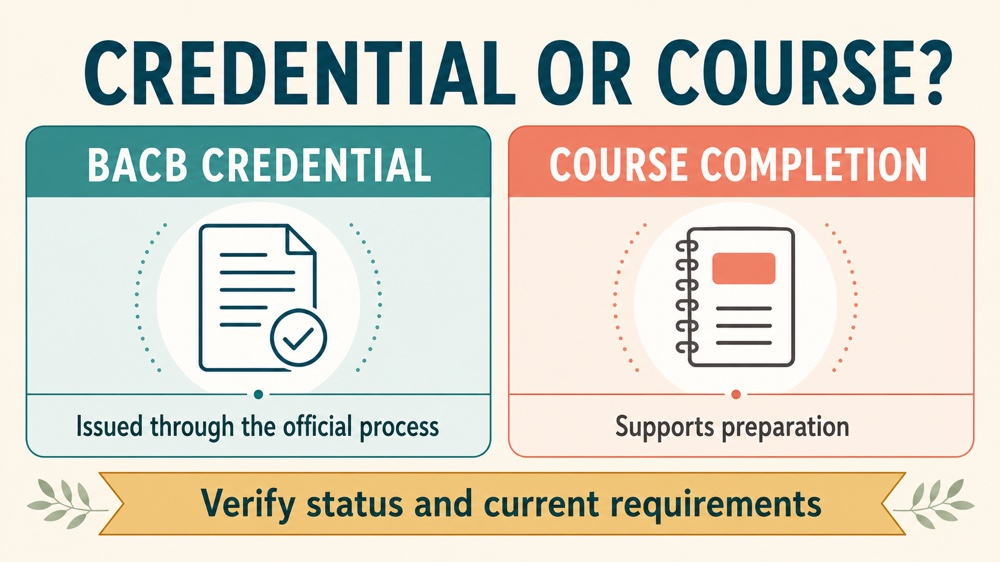
Training completion is not the same as BACB certification
A training provider can teach measurement, prompting, reinforcement, documentation, and ethical role boundaries. It can issue its own completion record under its own policies. The BACB, however, controls its certification process. The two records should not be described as interchangeable.
For example: A learner finishes an online RBT preparation course and receives a completion email. The accurate description is “completed the course,” not “BACB-certified RBT,” unless the learner has separately met the current BACB requirements and holds the credential. The learner should next check the official application steps and ask the responsible coordinator which documents are still needed.
What a certified RBT does under supervision
Certification does not make an RBT an independent diagnostician or plan designer. An RBT is a paraprofessional who provides behavior-analytic services under the direction and close supervision of the responsible supervisor or requirements coordinator. The role commonly includes implementing written procedures, collecting and recording data, supporting skill acquisition, following behavior-reduction and safety procedures, documenting objectively, and communicating concerns.
Assessment interpretation, diagnosis, treatment-plan changes, independent function claims, and decisions outside training require appropriate professional direction. If a procedure is unclear or a client-safety issue occurs, pause at the boundary described by the plan and contact the designated supervisor.
Study checklist for people seeking the credential
- Make a two-column note: “current official requirement” and “independent study aid.”
- For each measurement term, write the unit, observation window, onset, offset, and error rule.
- Practice recognizing the difference between an RBT implementation decision and a supervisor-level clinical decision.
- Use objective language in documentation examples and protect confidential information.
- Recheck the official Handbook before submitting an application or relying on an older course outline.
For example: If a practice item asks whether a technician can change a consequence because the written procedure seems inconvenient, the role-safe answer is to follow the approved plan and seek direction. If the question asks whether a learner is “certified” after a course, look for separate BACB status rather than a provider’s completion label.
Current exam frame: The current RBT Test Content Outline (3rd ed.) applies beginning January 1, 2026. It describes 43 tasks across six content domains. The current examination format is 75 scored questions plus 10 unscored pilot questions, four answer choices per item, and a 90-minute testing period. These facts explain the study frame; they do not turn an independent guide into an official BACB resource.
The outline provides a content framework for study. It does not certify a person, determine eligibility, or promise an examination outcome. Use the official Handbook for changing requirements and use your supervisor for client-program decisions.
Build an RBT study plan
Use independent RBT study materials for retrieval practice, then verify certification requirements against the current official BACB sources.
Review the RBT resource →
Frequently Asked Questions
What does rbt certified mean?
It should refer to a person who holds the current BACB Registered Behavior Technician credential after meeting the applicable requirements.
Can a course make me BACB-certified?
No. A course may provide training or a completion record, but BACB controls its own certification process.
Is RBT Training a BACB certification program?
No. RBT Training is an independent study resource and is not affiliated with or endorsed by BACB.
Can an RBT work independently after certification?
RBT services remain within the required direction and supervision structure. Certification does not authorize independent diagnosis or plan changes.
Are these official BACB questions?
No. The examples here are newly written independent study content and are not official, recalled, leaked, or BACB-endorsed examination questions.
References
- Behavior Analyst Certification Board: Registered Behavior Technician Handbook, updated June 2026.
- Behavior Analyst Certification Board: RBT Test Content Outline (3rd ed.).
- Behavior Analyst Certification Board: RBT resources.
- Behavior Analyst Certification Board: RBT Ethics Code.
- RBT Training: independent exam study materials.