

RBT competence requirements are not just a certificate or a completed course. Readiness means the RBT has appropriate training, has demonstrated the relevant skill, receives supervision, and can perform the task accurately and safely within role.
Table of Contents
- RBT competence requirements: what competence means
- Certification is not the same as task readiness
- The competence pathway
- Start with relevant training
- Demonstrate the skill under supervision
- Use feedback and reassessment
- Stay within scope when a task is unfamiliar
- Document competence-related communication
- Frequently asked questions
- Sources and scope note
RBT TRAINING GUIDE · COMPETENCE, FEEDBACK, AND SCOPE
RBT Competence Requirements: How to Know You Are Ready
Separate certification milestones from task-specific readiness, then use training and supervision to confirm safe performance.
RBT competence requirements are not just a certificate or a completed course. Readiness means the RBT has appropriate training, has demonstrated the relevant skill, receives supervision, and can perform the task accurately and safely within role.
The BACB Handbook describes certification requirements and maintenance, while the RBT Ethics Code addresses competence in practice. The current Ethics Code says an RBT provides services only after the supervisor confirms demonstrated competence and should immediately inform the supervisor or another appropriate workplace person when asked to work beyond certification or competence. This article is educational and does not replace an individualized supervisor assessment.
RBT competence requirements: what competence means
Competence is task-specific performance. It is the ability to carry out an assigned activity accurately, consistently enough for the setting, and safely under the required level of supervision. It is not the same as being confident, having a helpful personality, or memorizing a definition.
A competence question should name the task. “I am an RBT, so I can do anything in ABA” is too broad to be useful. Better questions are:
- Can I implement this written teaching procedure as trained?
- Can I collect and record the assigned measurement accurately?
- Can I recognize when the procedure is not working as expected or creates a concern?
- Can I ask for help and pause at the boundary before guessing?
Certification is not the same as task readiness
Certification shows that specified eligibility, examination, and maintenance requirements were met. It does not mean an RBT is automatically competent with every intervention, client population, setting, communication system, or safety procedure. The current Handbook expressly distinguishes certification from a guarantee of competence to provide professional services.
The distinction matters when the workplace changes. A certified RBT who moves from a familiar clinic routine to a school, home, community, or telehealth setting may need setting-specific orientation and observation. A new client may communicate differently or require procedures the RBT has not practiced. A new data system may require separate training even if the underlying concept is familiar.
Do not use this distinction to undermine certification. It protects the meaning of the credential by recognizing that good service requires continuing training, supervision, and honest limits.
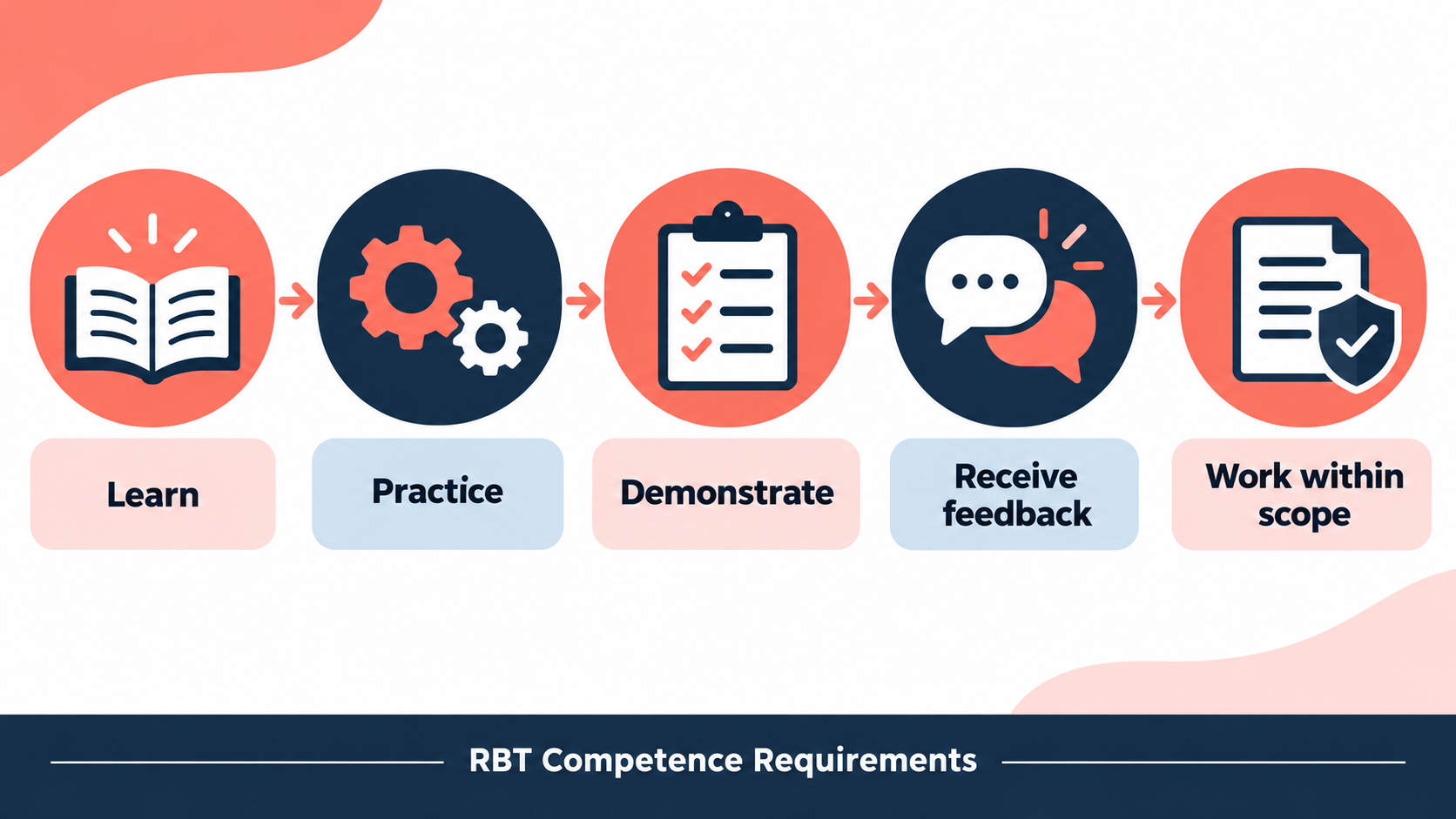
The competence pathway
A practical pathway has five connected stages:
- Learn: Receive instruction on the procedure, definition, materials, safety considerations, and documentation requirements.
- Practice: Rehearse the skill with feedback before relying on it during a live service when possible.
- Demonstrate: Show the supervisor that you can perform the task as required.
- Receive feedback: Correct errors, clarify questions, and practice again when the supervisor identifies a gap.
- Work within scope: Use the skill only in the authorized context and continue seeking supervision as conditions change.
The pathway is not always a single linear event. An RBT may return to practice after a long break, after a plan changes, after a safety event, or when data show that implementation is inconsistent. Reassessment is a quality safeguard, not a personal failure.
Start with relevant training
Training should match the task. Ask what the procedure is designed to do, which steps are essential, what counts as a correct implementation, which errors matter, and what to do if the learner responds unexpectedly. Training may include written instructions, modeling, role-play, video examples, rehearsal, or live coaching according to the supervisor’s plan.
Do not assume that watching another person is enough. Observation can introduce the task, but the RBT may need to practice the response and demonstrate it. Ask how competence will be checked and how questions should be handled between observations.
The RBT’s responsibility is not to design a replacement training program independently. It is to identify what is unclear, participate actively, and be honest about what has and has not been demonstrated.
Demonstrate the skill under supervision
Demonstration gives the supervisor evidence of performance rather than relying on a promise. The supervisor may observe the RBT directly, use a competency assessment, review data and notes, or combine methods appropriate to the task and setting.
Before the observation, confirm which version of the plan or procedure is current, which materials are needed, what measurement will be collected, and what safety steps apply. During the task, follow the written direction and communicate if a step is impossible or unclear. Afterward, review what occurred instead of assuming that a quiet session was a successful one.
If the supervisor has not confirmed competence, do not present yourself as ready for independent performance. Ask what interim action is authorized, such as shadowing, additional rehearsal, or a different assigned task.
Use feedback and reassessment
Feedback converts an observation into improvement. Listen for the exact behavior that needs to change: timing, prompt delivery, data definition, materials, communication, or safety response. Ask for an example if the feedback is too general to implement.
After practicing the correction, request another check when appropriate. A single successful trial may not establish stable performance, and one difficult session may not prove that an RBT lacks the skill. The supervisor can determine the relevant evidence and plan for continued support.
Document competence-related direction according to workplace procedure. Record what training or feedback was provided, what the RBT was asked to do next, and any unresolved question. Never change a data record to make performance look better.
Stay within scope when a task is unfamiliar
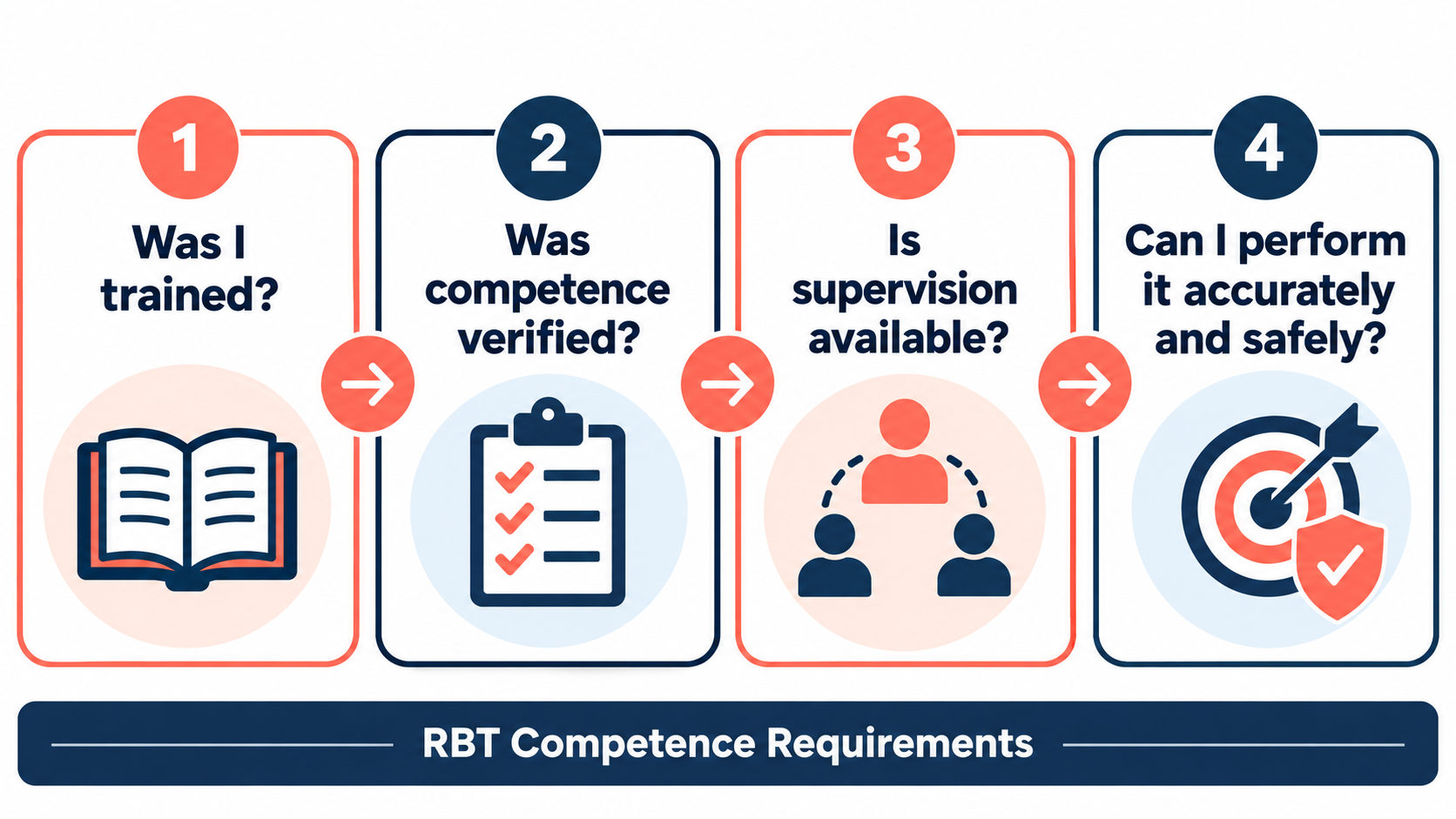
Use a readiness check before starting an unfamiliar task:
- Was I trained on this specific procedure or tool?
- Has the supervisor verified my competence for this context?
- Is the required supervision available now?
- Can I perform it accurately and safely rather than improvising?
If the answer is no or unclear, tell the supervisor. This is especially important for unfamiliar interventions, restrictive or punishment-based procedures, new client populations, new communication systems, or tasks with significant safety implications. The RBT can protect the client and remain helpful by asking for a defined next step.
Do not quietly substitute a familiar technique, change the sequence, or omit a difficult step because the written procedure feels inconvenient. If the plan appears impractical or creates a concern, report the observation and seek authorized review.
Document competence-related communication
Competence records should be factual and relevant. Note the task, the instruction or observation, the feedback, the direction for next steps, and any communication about limits or safety. Separate direct observation from information reported by someone else.
Keep records in the approved system and protect confidentiality. Do not send a client-identifying training video through a personal account or store a supervision note in a public document. Follow the employer, school, payer, and applicable privacy requirements.
If an RBT realizes that a task was performed before competence was confirmed, do not hide the event. Protect immediate safety, tell the supervisor, describe what occurred accurately, and follow the organization’s correction or incident process. The exact response depends on the facts and local requirements.
Frequently asked questions
Does the RBT exam prove that I am competent?
The exam is one certification requirement. It does not demonstrate competence with every task, intervention, client, or setting. Supervisors still confirm readiness for assigned services.
Can I provide a task if I watched someone else do it?
Watching may be part of training, but it does not automatically verify your performance. Ask the supervisor whether you need rehearsal, direct observation, or another competency check before providing the task.
What should I do when I am not competent yet?
Say so promptly, protect the client, and ask the supervisor for training or an authorized alternative. Do not guess, conceal the limitation, or independently rewrite the procedure.
Can competence change after it has been demonstrated?
Yes. New procedures, settings, client needs, long gaps in practice, feedback, or performance data may show that more support is needed. Reassessment is part of responsible supervision.
Sources and scope note
This guide is based on the BACB Registered Behavior Technician Handbook, the RBT Test Content Outline (3rd ed.), and the RBT Ethics Code (2.0). Requirements can change, and employer, payer, school, state, and legal rules may add obligations. Check the current sources and ask the appropriate supervisor about your situation.
Ready to practice the RBT concepts you just reviewed?
Try an independent, original RBT practice resource with exam-style questions, scoring, and answer explanations.
References
- Behavior Analyst Certification Board. RBT Test Content Outline, 3rd edition.
- Behavior Analyst Certification Board. RBT Handbook.
- Behavior Analyst Certification Board. RBT Ethics Code.