
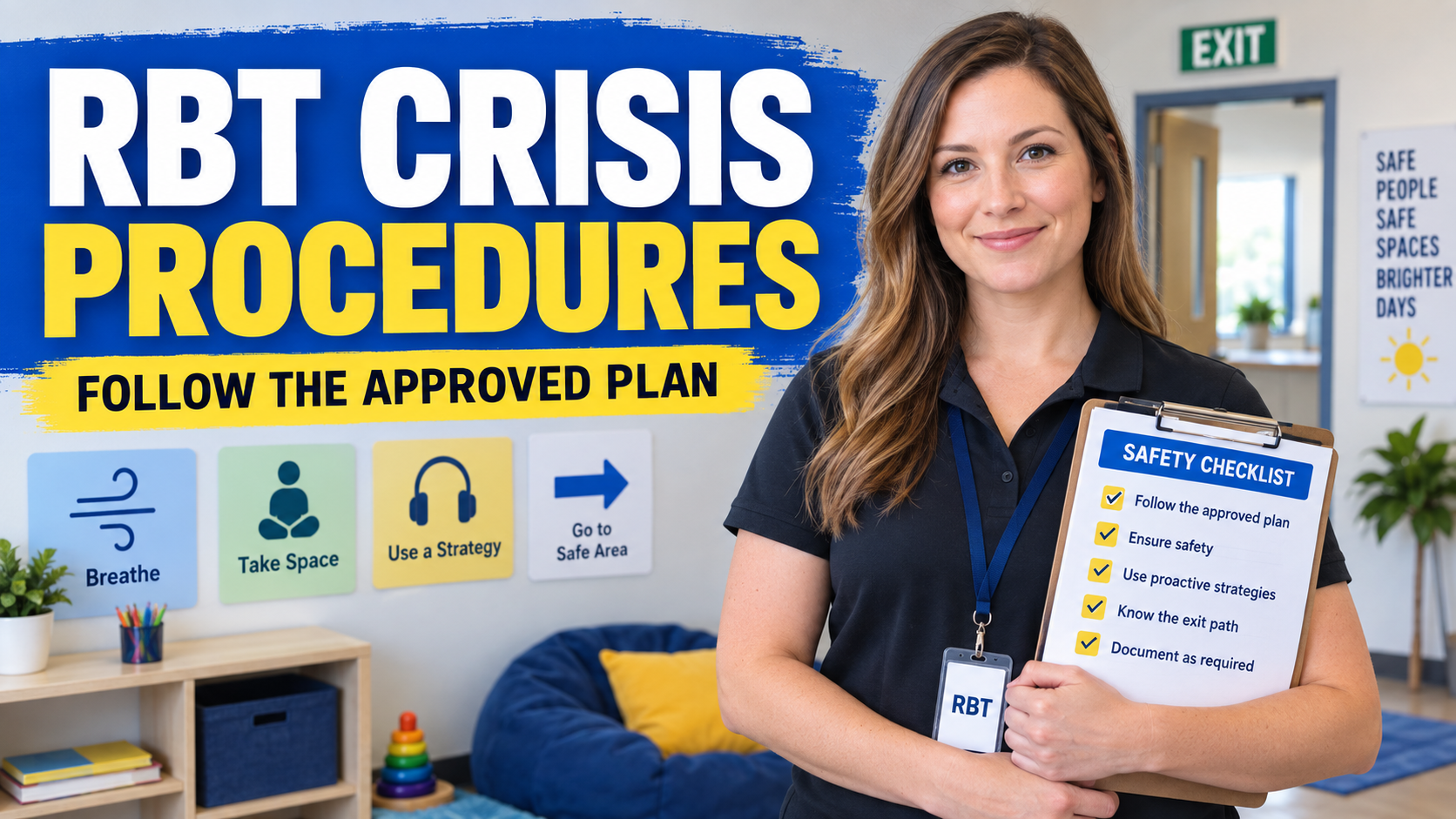
RBT crisis procedures are not a license to invent a response in the moment; they are approved steps implemented within training, supervision, and scope.
Table of Contents
- RBT crisis procedures: quick answer
- What “crisis procedures” means on the RBT outline
- What to know before a crisis happens
- When the approved plan is activated
- Protecting immediate safety
- Contacting the supervisor and chain of command
- What an RBT should not improvise
- Objective documentation after the event
- How to study and rehearse crisis procedures safely
- Common RBT crisis-procedure mistakes
- Frequently asked questions
RBT task-list and safety guidance
RBT Crisis Procedures: How to Follow an Approved Plan
RBT crisis procedures are not a license to invent a response in the moment. The BACB’s current RBT Test Content Outline includes implementing crisis/emergency procedures as a behavior-reduction task. For an RBT, that means learning the approved plan, following the written protocol within your training and scope, protecting safety, contacting the right supervisor or emergency resource, and documenting what actually happened.
RBT crisis procedures: quick answer
The RBT Test Content Outline (3rd ed.) places “implement crisis/emergency procedures” in Domain D, Behavior Reduction. The outline names the task, but it does not create one universal crisis protocol for every client or workplace. The actual response comes from the client’s approved plan, the supervisor’s clinical direction, the employer’s policy, and applicable law.
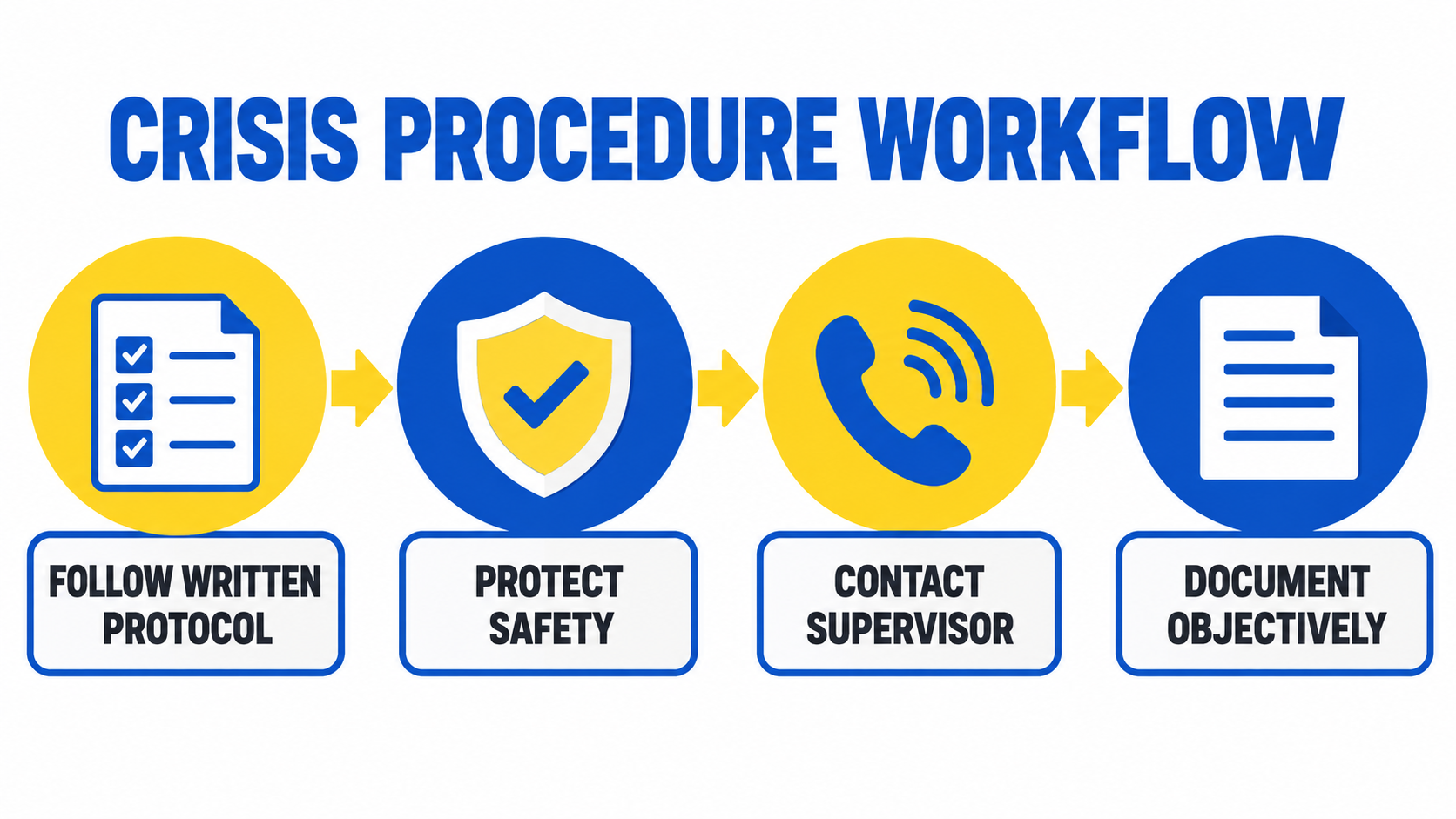
A safe RBT response has four parts: follow the written protocol, protect the client and other people from immediate danger, contact the supervisor or emergency resource required by the plan, and document the facts objectively. The response should be least disruptive and most protective within the approved plan—not an improvised punishment or a personal experiment.
What “crisis procedures” means on the RBT outline
The current BACB RBT Test Content Outline (3rd ed.) is the examination content beginning in 2026. Within behavior reduction, task D.7 is to implement crisis/emergency procedures. The task is intentionally broad because crisis plans differ by client, setting, risk, and authorization. It does not tell an RBT to choose a restraint, create a consequence, or diagnose the reason for the behavior.
The RBT’s responsibility is implementation. A supervisor or other authorized clinical leader designs, approves, teaches, and updates the intervention plan. The RBT should be able to locate the current protocol, identify the steps that apply, recognize when the plan says to call for help, and ask for clarification before a crisis occurs.
What to know before a crisis happens
Preparation is part of safe implementation. Before working with a client who has a crisis or emergency plan, ask the supervisor to review the following:
- What behaviors or situations activate the plan?
- What early signs should staff notice and report?
- Which prevention and de-escalation steps are approved?
- Who is the first supervisor or backup contact?
- What setting-specific emergency rules apply?
- What actions are prohibited or outside the RBT’s training?
- What documentation and incident-report forms are required?
Read the version date and confirm that the plan is current. A plan left in an old binder can be as dangerous as no plan. Practice locating exits, phones, call buttons, protective equipment, and the communication chain without rehearsing an unsafe procedure on a client.
When the approved plan is activated
Use the plan’s definitions and sequence. If the plan says to provide space, reduce demands, remove hazards, offer an approved choice, or call a supervisor, follow those steps in the order taught. Use neutral language and a calm tone. Avoid arguing about intent or trying to win compliance while a person is in danger or highly escalated.
Follow only procedures you have been trained and authorized to implement. If a step is unclear, the environment has changed, or the situation exceeds the protocol, request help rather than guessing. When immediate danger exists, follow the plan’s emergency instructions and contact emergency services when required. An RBT should not delay an emergency call in order to finish a data sheet or wait for a routine supervision meeting.
Protect dignity while protecting safety. Move bystanders away when the plan or workplace policy calls for it, preserve privacy, and use the least intrusive approved response. Do not record or share a crisis video unless the organization’s policy and the client’s permissions specifically authorize it.
Protecting immediate safety
Safety comes before perfect data collection. Scan the environment for hazards that can be safely removed, keep a clear path for help, and follow the plan for positioning and communication. Never block an exit, corner a person, or introduce a new physical interaction simply because the situation feels urgent.
If someone has a medical emergency or serious injury, use the emergency response required by the workplace and local rules. An RBT is not a substitute for a medical professional. Provide only the first-aid or emergency action for which you are trained and authorized, and hand off to emergency responders when they arrive.
After the immediate danger has ended, continue to monitor according to the plan and supervisor direction. A calm moment does not automatically mean the event is over. The supervisor may need to assess injuries, contact caregivers, change the session, or determine whether additional reporting is required.
Contacting the supervisor and chain of command
The current RBT outline separately expects RBTs to seek and prioritize clinical direction from a supervisor in a timely manner and to report variables that might affect client progress. Crisis communication should be timely, concise, and factual. State who is involved, what occurred, what safety steps were taken, whether anyone is injured, and what help is needed.
If the primary supervisor does not respond, use the backup chain of command in the plan. Do not keep calling one person while a known emergency remains unaddressed. After the event, ask what follow-up is required, whether the plan needs review, and whether you should pause service delivery until you receive direction.
What an RBT should not improvise
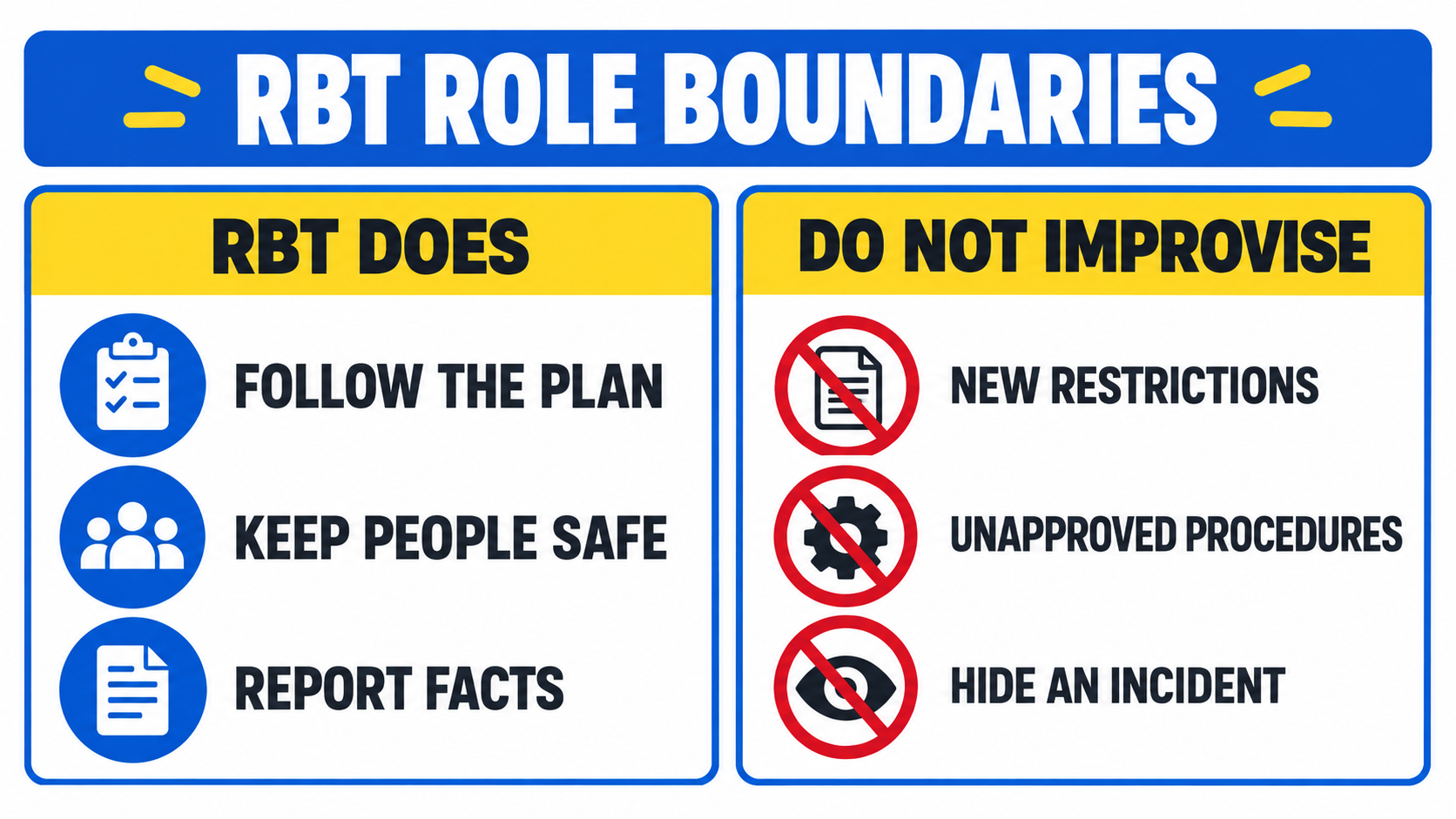
Do not invent a new restriction, add a punishment, change a reinforcement plan, or create a physical intervention because a familiar strategy did not work. Do not copy a technique from a video, another client’s plan, or an online discussion. A procedure that is appropriate in one setting can be unsafe, unauthorized, or clinically wrong in another.
Do not conceal a crisis to protect a session note, a performance metric, or a relationship with a caregiver. Do not make promises about what the supervisor or organization will decide. Your role is to implement the current plan, report the event, and preserve an accurate record.
Objective documentation after the event
Write what an observer could verify. Include the date, time, setting, people present, observable events before the response, the approved steps implemented, who was contacted and when, injuries or property damage if known, and what happened afterward. Use direct descriptions such as “hit the table with an open hand three times” rather than labels such as “was aggressive.”
Separate facts from interpretation. If you do not know why an event happened, say what you observed and ask the supervisor to analyze it. Complete the required incident report in addition to the routine session note when policy requires both. Store and disclose the information according to confidentiality rules and workplace requirements.
Documentation is not a place to defend yourself or blame a caregiver. It is a record that helps the team evaluate safety, treatment fidelity, supervision, and whether the plan needs revision.
How to study and rehearse crisis procedures safely
For an RBT exam or competency review, learn the principle: implement crisis/emergency procedures according to the approved protocol and seek direction when the situation is outside your scope. Then connect that principle to your workplace training. Ask the supervisor to model the plan, let you rehearse communication and documentation, and provide feedback.
Do not practice a restrictive or physical procedure on a client as a study shortcut. Use only the formal training method approved by your organization and applicable law. A good readiness check is whether you can explain where the plan is, when it activates, who to call, what you are authorized to do, what you must not do, and how you will record the event.
Common RBT crisis-procedure mistakes
- Using a generic internet protocol: Follow the client-specific approved plan.
- Waiting too long to call for help: Use the chain of command and emergency instructions.
- Improvising a restriction: Do not add an unapproved physical or punitive step.
- Prioritizing data over safety: Protect people first and document afterward.
- Writing labels instead of observations: Record objective, observable events.
- Hiding an incident: Report required events honestly and promptly.
- Practicing on a client: Rehearse only through approved training.
Frequently asked questions
Does the BACB publish one universal crisis procedure?
No. The RBT outline identifies the competency to implement crisis/emergency procedures, while the client-specific plan, supervisor, employer policy, and applicable rules determine the actual response.
Can an RBT create a new crisis intervention?
No. Follow approved procedures and seek clinical direction when the plan does not fit the situation. Do not improvise a new restriction or punishment.
What should an RBT document?
Document observable events, the approved steps implemented, contacts made, injuries or damage if known, and the outcome. Complete any additional incident report required by policy.
When should emergency services be contacted?
Follow the written emergency plan and local workplace requirements. If there is immediate danger or a medical emergency, use the appropriate emergency route without waiting for a routine supervision response.
Is “crisis procedures” on the 2026 RBT exam?
The current RBT Test Content Outline (3rd ed.) lists “implement crisis/emergency procedures” under Domain D, Behavior Reduction. The outline is not a substitute for hands-on training.
Official sources: BACB RBT Test Content Outline (3rd ed.); RBT Test Content Outline source document; BACB Supervision, Assessment, Training, and Oversight; BACB RBT examination resources. Retrieved September 28, 2026. Always follow the current client-specific plan and workplace emergency policy.
Ready to practice the RBT concepts you just reviewed?
Try an independent, original RBT practice resource with exam-style questions, scoring, and answer explanations.
References
- Behavior Analyst Certification Board. RBT Test Content Outline, 3rd edition.
- Behavior Analyst Certification Board. RBT Handbook.
- Behavior Analyst Certification Board. RBT Ethics Code.