

RBT data documentation is the process of turning direct observations and required measurements into an accurate, reviewable record. The RBT follows the written plan, uses the trained measurement system, records what was observed, checks for gaps, and communicates concerns without independently changing treatment.
Table of Contents
- RBT data documentation: the short answer
- Match the measure to the written plan
- Record and enter data accurately
- Run a data-quality check
- Summarize data without over-interpreting it
- Communicate gaps and concerns
- Final RBT data documentation checklist
- Frequently asked questions
RBT measurement, data entry, quality checks, and communication
RBT Data Documentation: Record, Check, and Communicate
Connect direct observation to the right measure, accurate entry, and useful supervisor communication.
RBT data documentation is the process of turning direct observation and required measurements into an accurate, reviewable record. It has several connected parts: understand the operational definition, use the measurement system taught for the program, enter the data in the approved location, check for gaps or obvious errors, and communicate relevant concerns to the supervisor. Documentation is not a replacement for observation, and a graph is not permission to redesign treatment.
The current RBT Test Content Outline places data collection and graphing alongside documentation and reporting as separate but related knowledge areas. In practice, the written program, supervisor direction, employer process, payer requirements, privacy rules, and approved data system control what an RBT must record. This article uses original educational examples rather than an official BACB form.
RBT data documentation: the short answer
A reliable workflow can be remembered as five questions:
- What is defined? Identify the target response, skill, opportunity, or product using the current program definition.
- What is measured? Use the assigned system, such as frequency, duration, latency, interval, percentage, or permanent product.
- Where is it entered? Use the approved data sheet, electronic platform, graph, or session field.
- What quality issue is visible? Check for missed opportunities, impossible values, duplicate entries, or a mismatch between the observation and the field.
- Who needs to know? Report meaningful gaps, barriers, safety concerns, or unclear instructions through the approved supervision route.
The purpose is traceability. An authorized reviewer should be able to see what was observed, how it was measured, and what happened when the data were incomplete or confusing.
Match the measure to the written plan
An RBT should not choose a more convenient measurement simply because it is easier to record. Frequency counts events. Duration measures how long a response lasts. Latency measures the time between a direction or event and the response. Percentage often describes correct or independent responses across opportunities. Interval systems divide time into defined observation periods. Permanent-product recording uses a lasting product or outcome specified by the program.
Different measures answer different questions. If the supervisor asks how long a response lasted, a count is not an equivalent substitute. If a skill plan requires independent responses across ten opportunities, a general statement such as “did well” does not replace the opportunity data. Use the definition, unit, and recording rule that were trained and written for that program.
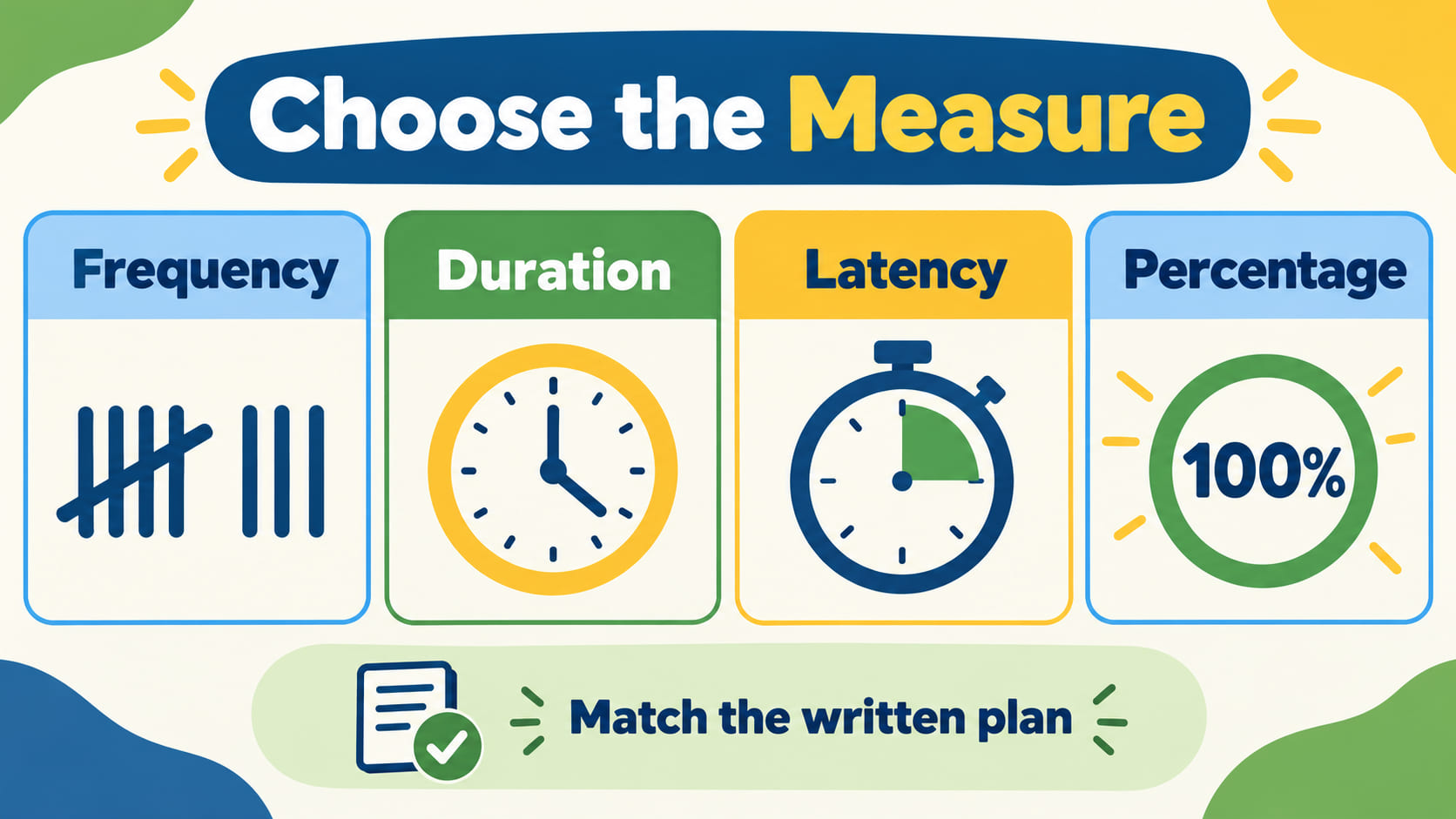
Before a session, check the version of the program or data sheet and confirm what counts as an opportunity, response, trial, interval, or completed product. If the definition appears inconsistent with the instructions you received, ask for clarification before making a personal change.
Record and enter data accurately
Record as close to the observation as the system and session allow. Use the required symbols, timing rules, prompt codes, and response categories. If the system uses a mobile device, verify that the correct client, program, date, and session are selected before entering information. A correct number in the wrong record is still a documentation error.
Data entry should preserve what was observed, not what you hoped would happen. Do not round a duration to a preferred number, convert a missed opportunity into a zero without following the rule, or fill an empty field from memory simply because the graph looks incomplete. If a correction is required, use the approved amendment or edit history.
Permanent products also require care. A completed worksheet, finished task, or other product may be evidence only when the program defines how it is scored and stored. Do not assume that a product proves every step of a behavior or skill. Record the feature that the written procedure asks you to score.
Run a data-quality check
A quality check is a review of the record, not a license to change the data. Look for entries that do not fit the session: a duration longer than the observation period, a percentage with the wrong denominator, a prompt code that was not used, duplicate trials, impossible dates, or a data field that does not match the program.
Compare the data with your session timeline. Were there opportunities that never appeared in the sheet? Did a material change, room move, illness report, or technology problem affect collection? Was a safety event handled before the measurement could be completed? Note the relevant barrier according to policy and tell the supervisor when it may affect interpretation or service quality.
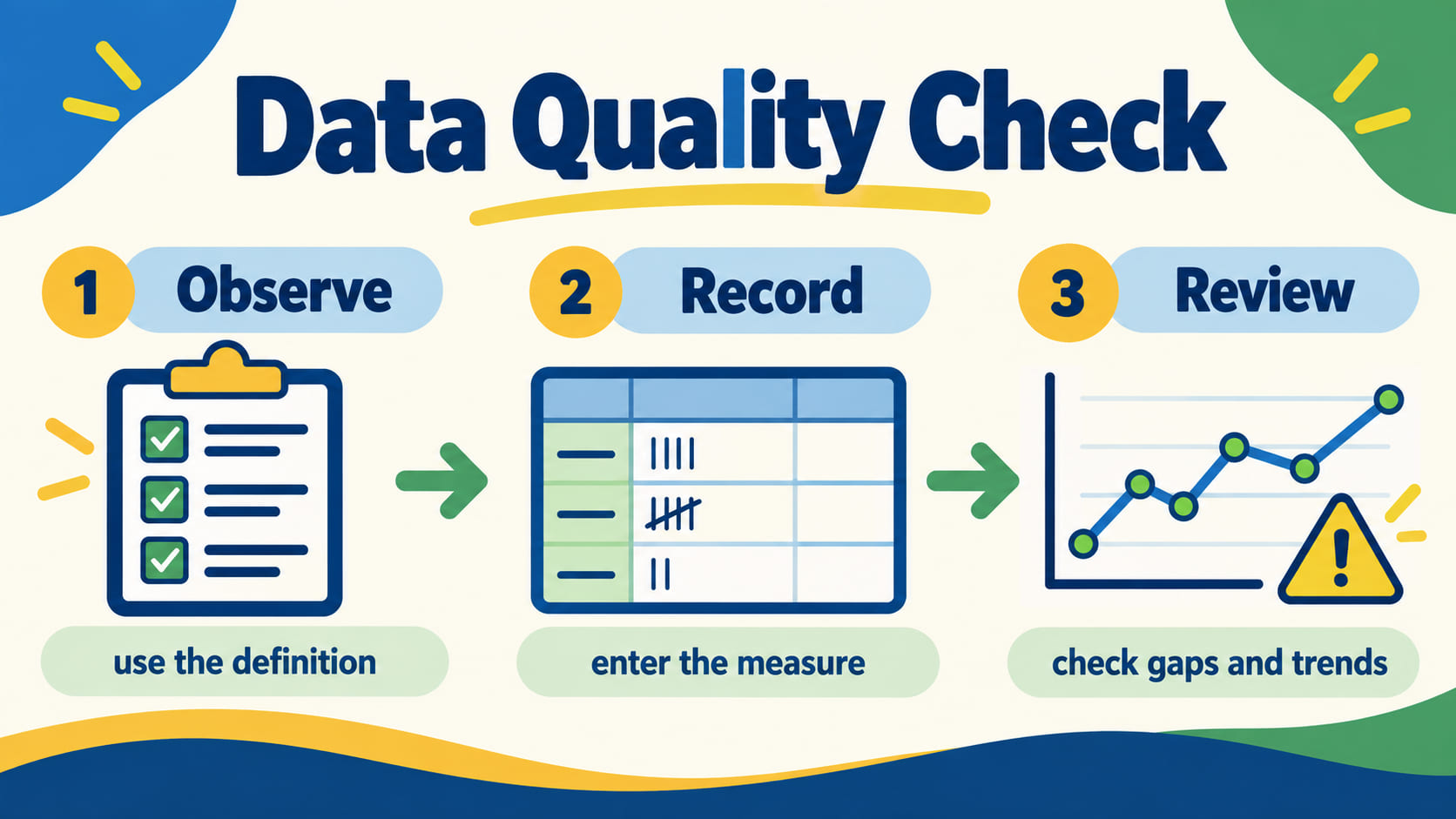
Reliable data depend on procedural fidelity as well as arithmetic. If the response definition was unclear, the timer was not started, or the recording rule was applied inconsistently, report the limitation. A transparent limitation helps the supervisor decide what review or retraining is needed.
Summarize data without over-interpreting it
An RBT may be asked to calculate or summarize data in a way already specified by the program or supervisor. Examples include a rate, mean duration, percentage of independent responses, or a simple trend description. Show the denominator and time period when they matter. “Seven responses” is less informative than “7 responses during a 60-minute observation period” when the system calls for a rate.
Describe what the graph shows without claiming more than the data support. “The last three recorded sessions show fewer prompted responses than the prior three” is a descriptive statement. “The intervention caused improvement” is a causal conclusion that may require a broader analysis and supervisor interpretation. Stay with the role assigned to you.
Do not smooth, remove, or rearrange inconvenient points to create a nicer visual trend. If a point is wrong, correct it through the approved process and preserve the reason for the correction. If a point is valid but unusual, keep it and explain the relevant context if the record requires one.
Communicate gaps and concerns
Good RBT data documentation includes communication when the record cannot be understood without context. Tell the supervisor when data were missed, the program was unclear, a new behavior or skill appeared outside the current definition, a safety issue interrupted collection, or the system produced an error.
A useful message is brief and factual: “The timer was not started for the second duration event because the activity ended for safety. I recorded the event as incomplete according to the system instruction and need direction on the next session.” This is more useful than silently entering an estimate or writing “data bad” without explanation.
Use the authorized communication route and protect client information. Do not send screenshots to a personal account or post a graph publicly as a teaching example. If the recipient or route is unclear, pause and ask the supervisor or designated contact.
Final RBT data documentation checklist
- The current written definition and data sheet were checked before recording.
- The measure matches the program: count, duration, latency, interval, percentage, rate, or permanent product as assigned.
- The correct date, session, learner record, program, and unit were selected.
- Entries were made from observation rather than memory, preference, or an expected outcome.
- Missed opportunities, interruptions, device errors, and barriers are marked according to policy.
- Arithmetic, denominators, timing, prompt codes, and duplicate entries were checked.
- Valid unusual data remain in the record; inaccurate data are corrected through an approved process.
- Trends are described cautiously without independent causal claims or program changes.
- Relevant concerns were communicated through the authorized supervision route.
- Data and screenshots remain in the approved system and do not expose identifying information.
Frequently asked questions
What does an RBT document?
An RBT documents the observations, measures, assigned services, barriers, and communication required by the written program, supervisor, employer, payer, and approved system. The exact fields vary by setting.
Can an RBT choose a different measure if it is easier?
Do not make that change independently. Use the assigned measurement system and ask the supervisor when the definition, unit, or recording rule is unclear.
What should an RBT do when data are missing?
Do not invent a value. Mark or explain the gap according to policy, preserve the facts about what interrupted collection, and notify the supervisor when the gap affects the record or service decision.
Can an RBT change a program after seeing a trend?
An RBT can report the observed pattern and follow the current written plan. Program changes, new criteria, and clinical conclusions belong to the authorized supervisor or treatment team.
Role reminder: This article is educational information, not an official BACB form, legal advice, or individualized supervision direction. Follow the current written program, supervisor, employer, payer, privacy policy, and approved data system.
Official starting points: RBT Test Content Outline (3rd ed.), the RBT Handbook, and the BACB ethics codes page.
Ready to practice the RBT concepts you just reviewed?
Try an independent, original RBT practice resource with exam-style questions, scoring, and answer explanations.
References
- Behavior Analyst Certification Board. RBT Test Content Outline, 3rd edition.
- Behavior Analyst Certification Board. RBT Handbook.
- Behavior Analyst Certification Board. RBT Ethics Code.